A back that aches upon waking, a persistent chemical smell in the room, or simply the desire to know exactly what you are putting under your sheets: the reasons to switch to an organic mattress are concrete and varied. This comparison selects five truly natural models, certified, available in France in 2026, with verified prices and useful information to choose without being misled by vague “eco” marketing.
Why a dedicated comparison of organic mattresses?
The natural bedding market has exploded in recent years — and with it, misleading labels. “Natural,” “eco-friendly,” “healthy”: none of these terms are regulated. A manufacturer can label a mattress that contains 80% polyurethane foam with these terms. This ranking distinguishes the references that rely on verifiable third-party certifications, transparent composition, and an honest sustainability/price ratio.
Selection Methodology
- Layer-by-layer composition analysis (nature and proportion of materials)
- Verifiable third-party certifications (GOLS, GOTS, OEKO-TEX, Greenfirst, Eurolatex)
- Verified customer reviews and feedback on long-term durability
- Traceability and CSR commitment of brands
- Value for money and trial conditions
Why choose an organic mattress?
The main reason is health-related: a conventional mattress can contain flame retardants, biocides, solvent-based adhesives, and polyurethane foams that emit VOCs (volatile organic compounds) for years. A certified GOLS natural latex mattress paired with a GOTS cover eliminates these risks at the source.
The other advantages are real, provided that “natural” is not taken for granted:
- Breathability: the honeycomb structure of natural latex ventilates much better than conventional foam
- Durability: 12 to 15 years for dense latex, compared to 7 to 8 years for entry-level foam
- Resilience: natural latex returns to its original shape after compression, without sagging prematurely
For whom?
This type of bedding is particularly suitable for people allergic to dust mites or sensitive to chemical odors, hot sleepers (latex ventilates, unlike memory foam), and those who want to invest once for 15 years rather than change mattresses every 7 years.
Ranking of the Best Organic Mattresses 2026
1. Kipli Organic Latex
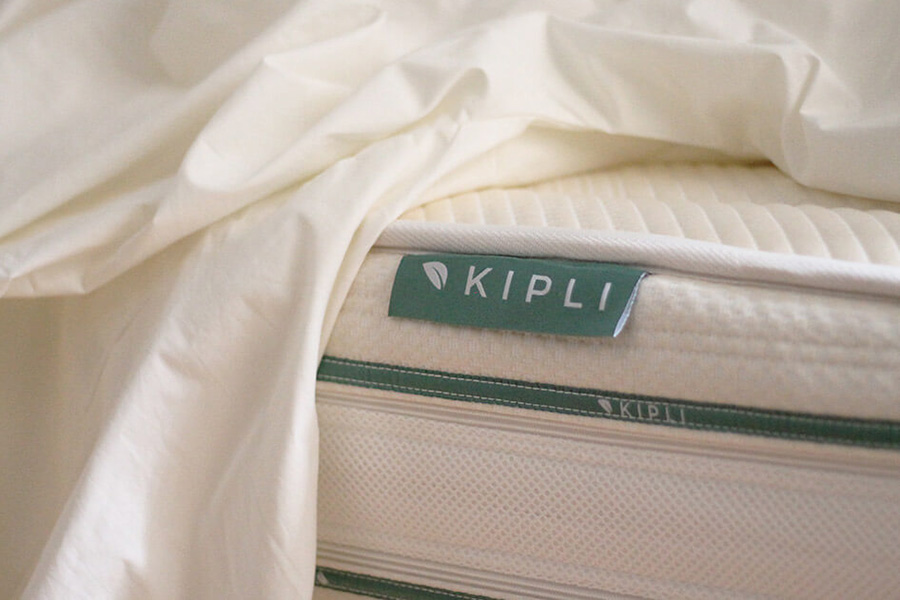
Technology: 100% natural latex certified GOLS, organic cotton cover certified GOTS. Made in Italy, sold directly online.
Main advantages:
- Natural latex certified GOLS, no synthetic foam or chemical glue
- GOTS certified organic cotton cover, removable and washable
- Reversible: one soft side, one firm side
- No intermediaries, direct delivery from the brand
- 100-night trial, 10-year warranty
Indicative price: starting from ~€600 (depending on size and firmness chosen)
See Kipli organic mattresses — natural latex certified GOLSKipli is now one of the most accessible brands for entering certified natural bedding without compromising on composition. The reversibility is a real plus for couples with different firmness preferences.
2. Cosme Natural Latex Prestige
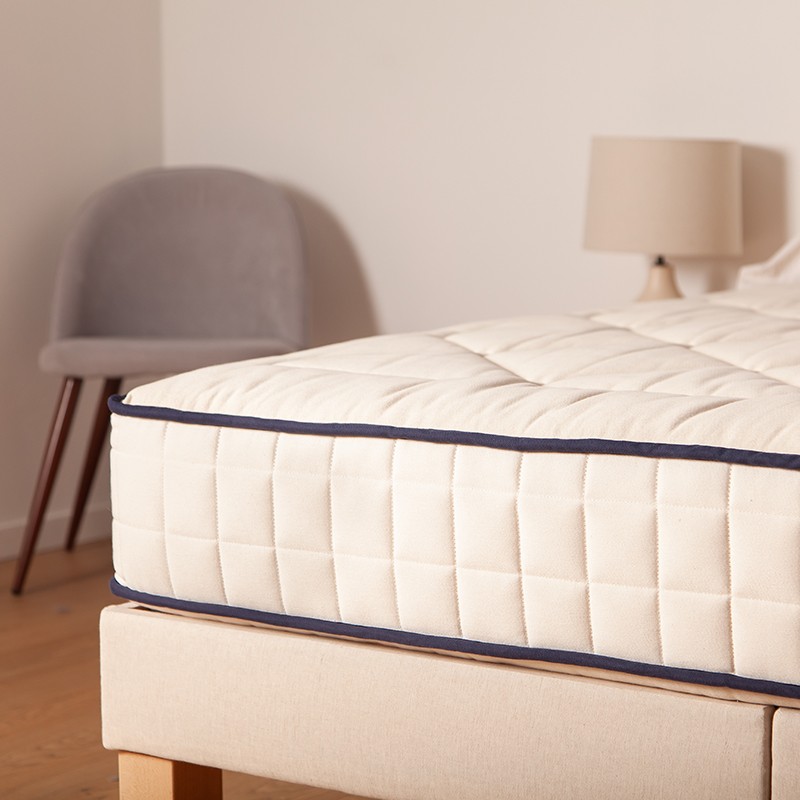
Technology: natural latex combined with selected noble materials according to the chosen finish (merino wool, French linen, silk, cashmere). Handmade in France, made to order.
Main advantages:
- Complete customization: size, firmness, filling materials
- GOTS and OEKO-TEX labels on the entire composition
- Made in France, custom-made, including for non-standard sizes
- Personalized advisory service, physical store in Paris
- 100-night trial
Indicative price: starting from ~€1,600 depending on materials and dimensions
See 100% natural mattresses from Cosme Literie — handmade in FranceCosme caters to those who do not want to compromise on the naturalness of materials and need a custom size, common in large rooms or for trundle beds. It is also one of the few brands to offer human support from start to finish.
3. Natural Organic Latex Mattress — No Stress Mattress
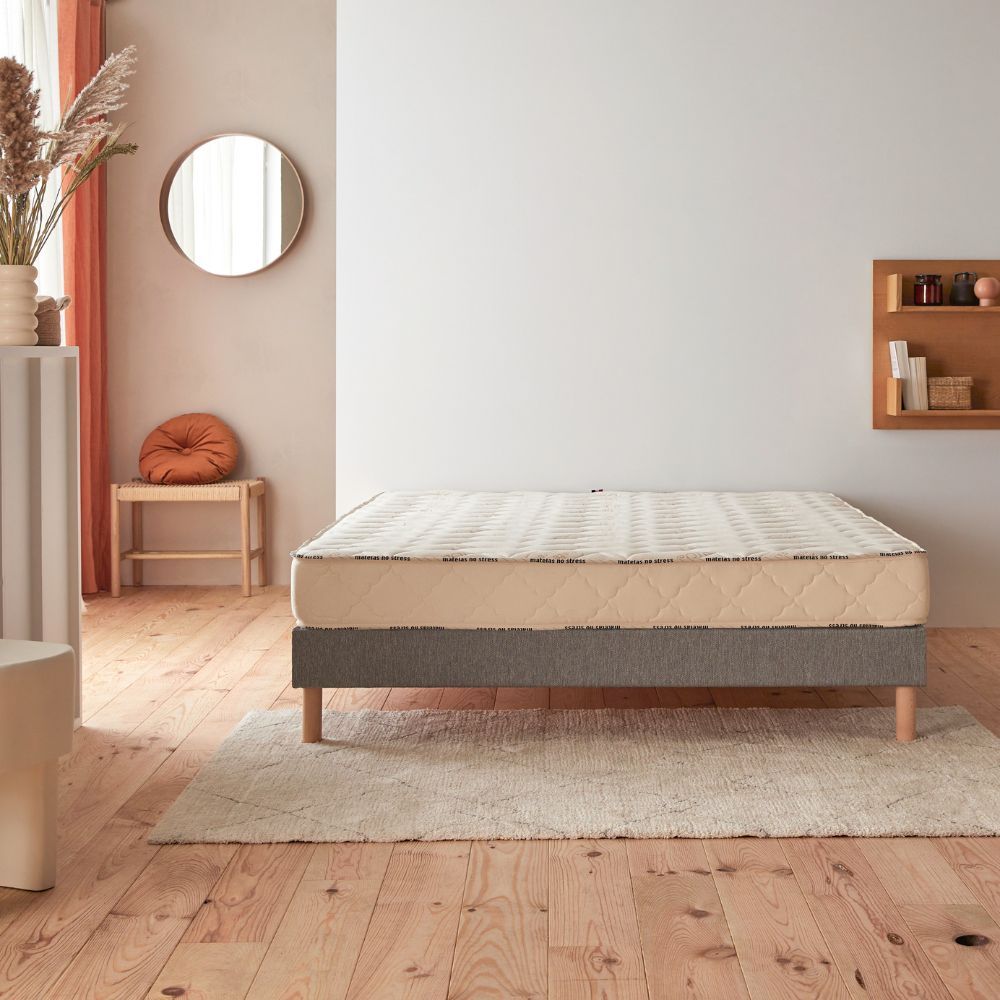
Technology: natural perforated latex combined with untreated organic cotton. A good entry point into certified natural bedding, without paying for premium finishes.
Main advantages:
- Perforated latex structure for effective breathability
- Cover made of untreated organic cotton
- OEKO-TEX Standard 100 certification
- Good balance between support and softness
- Competitive pricing
Indicative price: starting from ~€700 in 160×200 cm
Trial period: 30 nights
See the range of 100% natural latex mattresses from No StressThis is the most accessible option in this comparison for certified natural latex. The 30-night trial period is shorter than with premium competitors: plan it during a period without travel, to have time to test in real conditions.
4. LatexB.io — Natural Latex Mattress (Soft or Firm)
Technology: 100% natural block latex, removable and machine washable organic cotton cover. Two clearly segmented firmness levels.
Main advantages:
- Binary but well-defined firmness choice: soft or firm for adults
- Machine washable organic cotton cover
- Physical showroom in Paris (3rd arrondissement): possibility to test before buying
- Brand specialized exclusively in natural latex
- Delivery in mainland France
Indicative price: starting from ~€699 for entry-level models; thicker variants starting from ~€900
Trial period: variable depending on the model, to be checked at the time of order
What distinguishes LatexB.io is the Paris showroom: rare in a sector largely dominated by online sales. For buyers who hesitate between two firmness levels, being able to lie down on both models before ordering avoids many mistakes.
5. Biosense Wool & Natural Latex
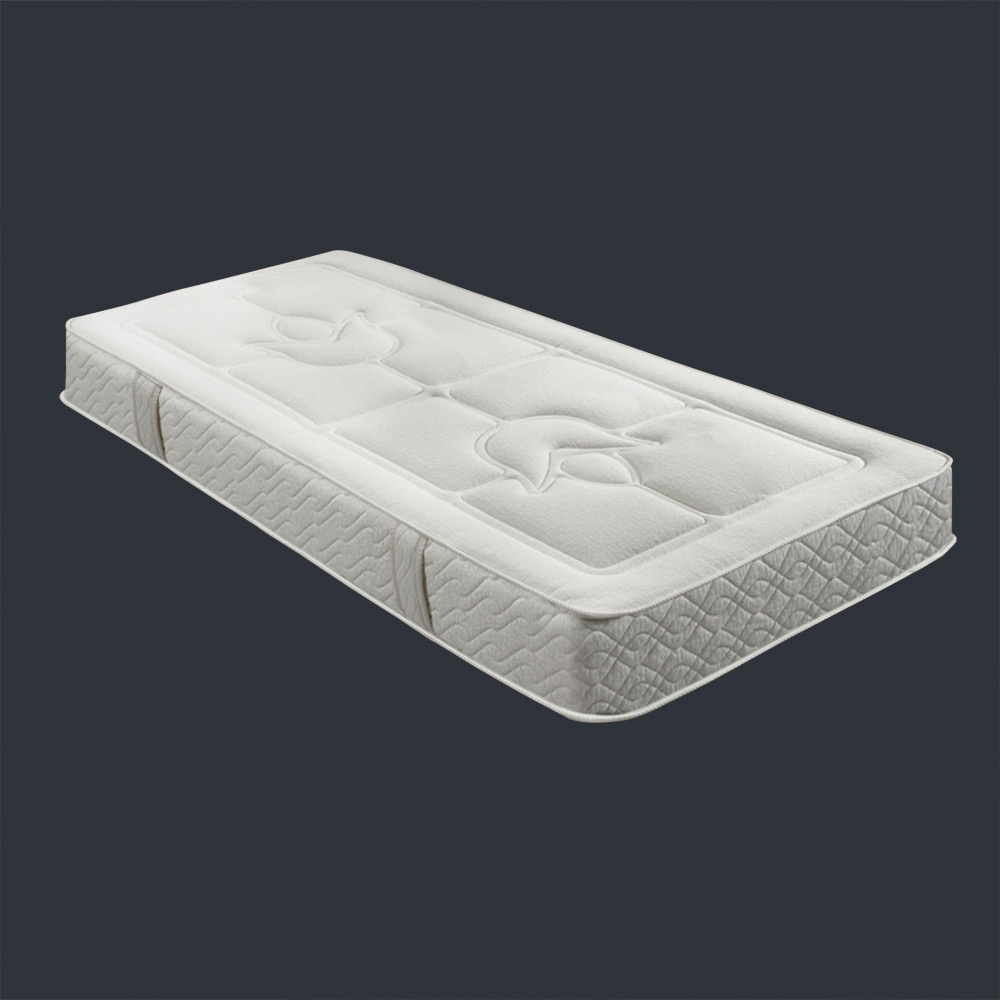
Technology: natural latex certified GOLS combined with wool and organic cotton. Assembly and finishing done in France by artisans specialized in high-end natural bedding.
Main advantages:
- Triple certification: GOLS, Greenfirst, and Eurolatex
- Natural wool for effective thermoregulation in summer and winter
- Excellent sleeping independence, firm and enveloping support
- Responsible manufacturing, traceable materials
- 100-night trial
Indicative price: starting from ~€1,500 depending on size and finish
The combination of wool + GOLS certified natural latex offers one of the best thermoregulations on the market. Wool absorbs moisture in summer and retains heat in winter: a particularly relevant choice for people who suffer from nighttime temperature variations or who share their bed with a partner with opposing thermal habits.
See the Biosense mattress in wool and GOLS certified natural latexComparison Table
| Model | Comfort | Main Composition | Indicative Price | Trial |
|---|---|---|---|---|
| Kipli Bio Latex | Balanced / reversible | GOLS latex + GOTS cotton | starting from ~€600 | 100 nights |
| Cosme Prestige | Custom-made | Latex + wool / silk / organic cotton | starting from ~€1,600 | 100 nights |
| No Stress Bio Mattress | Soft | Natural latex + organic cotton | starting from ~€700 | 30 nights |
| LatexB.io Natural Latex | Soft or firm | Natural latex + organic cotton | starting from ~€699 | Variable |
| Biosense Wool & Latex | Firm and enveloping | GOLS latex + wool + cotton | starting from ~€1,500 | 100 nights |
Understanding Organic Certifications: GOLS, GOTS, OEKO-TEX
Before relying on a “bio” label, it’s better to understand what each certification actually guarantees, as not all have the same level of requirements.
GOLS (Global Organic Latex Standard): this is the reference label for natural latex. It guarantees that the rubber comes from organic farming (without pesticides or synthetic fertilizers) and that the raw latex makes up at least 95% of the finished product. The certification is issued by an accredited third-party organization and covers the entire chain, from the plantation to the finished product.
GOTS (Global Organic Textile Standard): the equivalent of GOLS for textiles — it certifies that the fibers (cotton, wool, linen) come from organic farming and that the processing methods meet strict social and environmental criteria. A GOTS-certified cover guarantees the absence of toxic dyes, formaldehyde, and chemical finishes.
OEKO-TEX Standard 100: unlike the two previous labels, it does not certify the organic origin of the materials but the absence of harmful substances in the finished product. A mattress can be OEKO-TEX certified without being organic: it is a health guarantee, not an ecological guarantee.
Greenfirst and Eurolatex: specific labels for the latex sector, they certify the absence of allergenic substances and compliance with production criteria specific to the European latex industry.
The combination of GOLS + GOTS represents the highest level of guarantee for a complete organic mattress. If a manufacturer can only produce one of these certificates, ask to see the original document: certification numbers are public and verifiable in the Control Union or Ecocert registers.
Expert Tips
What to Check Before Buying
Certifications, supporting documents: a GOLS or GOTS label is associated with a certificate number that can be verified online. Any serious brand will provide this information willingly. Be wary of vague phrases like “made from natural latex” or “eco-friendly” without independent certification.
The actual composition, layer by layer: some mattresses claim to have a core made of natural latex while incorporating polyurethane foam comfort layers that are not prominently mentioned. Demand a detailed technical sheet before ordering.
The firmness suited to your body type and sleeping position: a side sleeper will benefit from a softer mattress (low firmness rating), while a stomach sleeper or a heavier person will prefer firmer support to maintain spinal alignment.
The Most Common Mistakes
Being swayed by marketing arguments alone is the most common mistake: terms like “natural,” “healthy,” or “eco-responsible” are not protected and can be used without any real guarantee. Buying without a trial period is another common mistake, especially risky since it can take two to three weeks for the body to adjust to natural latex and find its nighttime posture. As for density, it is often underestimated: latex below 60 kg/m³ will sag prematurely, negating much of the expected benefits.
What Budget According to Your Profile?
- Less than €800: choose certified OEKO-TEX natural latex without premium finishes. Good support, decent lifespan, a good entry point into certified natural bedding.
- Between €800 and €1,200: access to reversible or customizable models, with GOTS certified cover and GOLS latex. The best quality/durability ratio.
- Above €1,500: high-end artisanal bedding with noble materials (wool, silk, cashmere), custom-made or with exceptional finishes. A justified investment over 15 years and more.
If you are a senior or have specific support needs, consult our mattress guide for seniors .
To deepen your research, find all our comparisons and guides on our mattress tests and reviews page .
FAQ
Is an organic mattress always more expensive than a traditional mattress?
The starting price is generally higher than that of an entry-level foam mattress, but the gap narrows over time. A certified GOLS natural latex of good density lasts 12 to 15 years, which is two to three times longer than a low-end foam: over this period, the cost per night becomes very competitive. Certified OEKO-TEX models can be found around €700-800 in 160×200 cm, without premium finishes. Beyond €1,200, we enter the custom segment or noble materials (merino wool, silk, cashmere), where prices can exceed €2,000. For a first organic purchase, the range of €750-1,000 with GOLS or GOTS certification represents the best balance of quality/durability. At an equivalent budget, a certified GOLS latex of good density (≥ 65 kg/m³) is better than a memory foam mattress with unverified “natural” marketing.
What is the lifespan of a natural latex mattress?
On average, 12 to 15 years, which is 3 to 5 years longer than a traditional polyurethane foam mattress. Natural latex resists sagging well due to its elastic honeycomb structure that returns to its shape after each night — this is called resilience. Density plays a crucial role: below 60 kg/m³, latex noticeably sags after 7 to 8 years; above 70 kg/m³, maximum longevity is achievable. To optimize lifespan, three conditions must be met: use a well-ventilated flexible slatted base (slat spacing of 3 to 5 cm), rotate head-to-foot every 3 to 6 months, and always protect the mattress with a breathable organic cotton mattress protector. Absolutely to be avoided: airtight box springs, which block ventilation and promote internal condensation, accelerating the degradation of latex over the long term.
Does natural latex get hot at night?
No, it is actually one of the most breathable bedding materials available on the market. The honeycomb structure of latex incorporates thousands of micro-channels that allow air to circulate freely through the core of the mattress, naturally dissipating body heat and moisture. When combined with a cover made of organic cotton or linen, it offers significantly better thermoregulation than memory foam, which is known for retaining heat. However, an important nuance: synthetic latex, denser and less porous than natural latex, retains more heat. This is one of the concrete reasons why GOLS certification, which guarantees at least 95% natural latex in the core, is a useful indicator not only from an ecological standpoint but also in terms of thermal comfort. For those who sweat a lot at night, combining a GOLS natural latex mattress with a Greenfirst wool or linen cover offers the best thermoregulating performance.
Is an organic mattress compatible with all types of bases?
A natural latex mattress works very well with a flexible slatted base, with a spacing of 3 to 5 cm: this is the ideal combination. It is also compatible with most well-ventilated box springs. However, it is not recommended to pair it with a metal spring base, as its roughness can, over time, locally deform the latex and alter its support properties. Airtight box springs (solid slats or tufting without ventilation) should also be avoided: they prevent the air circulation essential for latex. For bed frames with center legs, check that the central slats properly support the lumbar area: unsupported latex in the center will sag prematurely and cause back pain. Note: using a base not recommended by the manufacturer may void the mattress warranty.
How to properly maintain a natural latex mattress?
Maintenance is simple, but a few rules preserve its properties over time. Air out your room every morning by folding the bedding for at least 15 minutes: this allows the nighttime moisture to evaporate naturally. Use a breathable mattress protector made of organic cotton or bamboo to protect it from stains and sweat (a waterproof but non-breathable protector is counterproductive). Rotate the mattress head-to-foot every 2 to 3 months to even out wear. In case of a stain, gently dab with a damp cloth and Marseille soap without scrubbing, then let it air dry. Avoid chemical cleaners, solvents, and steam cleaning, which are incompatible with natural latex. Do not expose it to direct sunlight for extended periods: UV rays degrade the molecular chains of rubber. With these precautions, the 15-year lifespan promised by the best manufacturers is entirely achievable.
What is the difference between a "natural latex" mattress and a "GOLS certified" mattress?
The difference is fundamental. The term “natural latex” is not regulated: a manufacturer can use it even if latex only represents 20% of the core of the mattress, the rest being made of polyurethane foam or synthetic latex. The GOLS certification (Global Organic Latex Standard), on the other hand, requires that organic natural latex constitutes at least 95% of the core of the finished product, and that the entire production chain, from rubber tree planting to the manufactured product, meets verified organic and social criteria by an accredited third-party organization. Each GOLS certificate is associated with a unique number, which can be checked on the public registry of Control Union or Ecocert. Before purchasing, ask the seller for this number: if they cannot provide it, the certification is questionable. Therefore, GOLS certification is the only solid guarantee that a mattress actually contains significant proportions of organic natural latex.
Which organic mattress should I choose for a side sleeper suffering from shoulder pain?
For a side sleeper, pressure on the shoulder and hip is the main issue to address. A mattress that is too firm creates painful pressure points; a mattress that is too soft allows the spine to drift laterally, causing cervical and lumbar tension. In organic natural latex, a soft to medium firmness index is recommended, with a density of at least 65 kg/m³ to avoid sagging at the shoulder. The reversible Kipli model is well suited in this case: the soft side provides the necessary relief for the shoulder, while the firm side remains available if your sleeping position changes. If you have established and diagnosed pain, pair the mattress with an ergonomic memory foam pillow that keeps the neck aligned with the spine. A 100-night trial, available at Kipli, Cosme, and Biosense, is particularly valuable in this case.