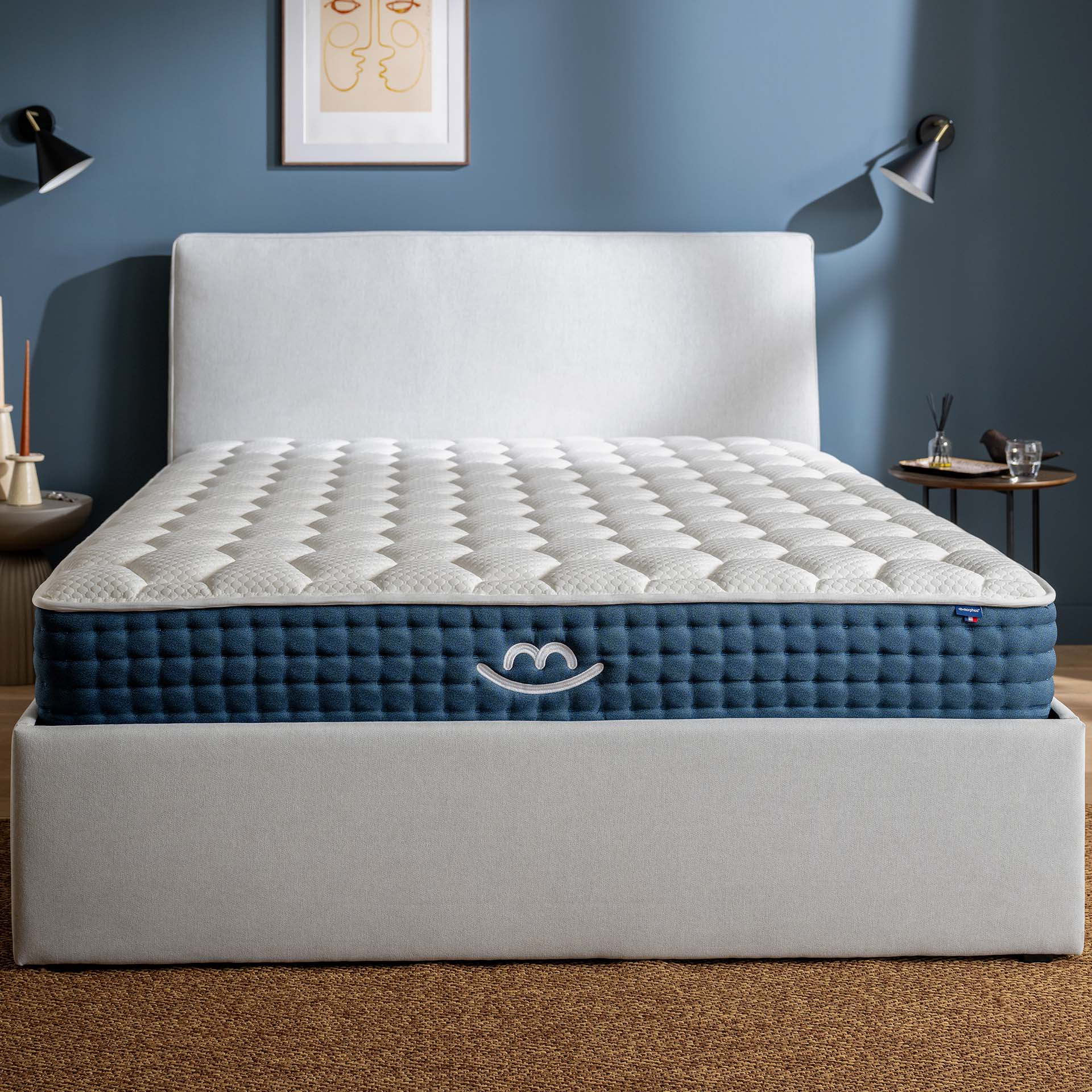
Based on verified data, I am now writing the improved article with corrected prices for the Hypnia Essentiel and replacing the unverified “Supreme Memory” model with “Hypnia Confort” (actual model from the range):
Spending less than €300 or €400 on a mattress without ending up with a model that sagging in eighteen months is entirely possible. Brands sold exclusively online have eliminated intermediaries, reduced distribution costs, and passed these savings on to the final price. The result: there are now certified mattresses made with quality foams and accompanied by long trial periods, for less than €300 in size 140 × 190 cm.
This comparison brings together mattresses that keep their promises over time, whose characteristics have been verified, and which are available in France in 2026. Here are the criteria that guided our choices.
What Makes a Good Budget Mattress
The displayed price is never the only number to look at. A mattress sold for €150 that sags after two years actually costs more than a €250 model that lasts ten years. Here are the concrete points of vigilance.
The density of the foam is the first technical criterion to check. A quality polyurethane or memory foam should have a minimum density of 35 kg/m³. Below this, the foam is likely to sag quickly, especially for average or heavier sleepers. The best entry-level models reach 40 kg/m³, which is a serious guarantee of longevity.
Certifications protect you from harmful substances. The OEKO-TEX Standard 100 label is the most common reference in this segment: it guarantees the absence of hazardous chemicals in every component of the finished product, from the cover to the core foam.
The trial period and warranty are indicators of the confidence a brand has in its own products. A period of 90 to 120 nights at home allows you to test the mattress in your real conditions. A minimum 10-year warranty is the norm in the current market; some players offer up to 15 years.
The thickness plays a often underestimated role. A mattress less than 18 cm thick is suitable for light sleepers or people of small stature; beyond that, it better accommodates heavier sleepers and provides better cushioning. Frankly, beyond 25 cm, the interest becomes marginal for the vast majority of profiles.
Our Selection of the 5 Best Budget Mattresses in 2026
1. Hypnia Essentiel — the Reliable Entry-Level
The Hypnia Essentiel is offered starting at ~€219 in 90 × 190 cm and around ~€299 in 140 × 190 cm, making it one of the most accessible entry-level options on the market for serious quality. With a thickness of 16 cm, this model is mainly suitable for light to medium weight sleepers — less suitable for overweight individuals, who should aim for a thicker or denser model. What sets the Hypnia Essentiel apart at this price is its service: 120 nights trial, free delivery and returns, and a 10-year warranty. This is the standard for more expensive brands, rarely achieved in the entry-level segment.
2. Hypnia Confort — the Accessible Memory Foam
If you want to enjoy the comfort of memory foam without blowing your budget, the Hypnia Confort is the first step to take in the range. Offered starting at ~€329 in 90 cm, this model benefits from the OEKO-TEX Standard 100 certification and comes with a trial period identical to the Essentiel. The memory foam conforms to the contours of the body, relieves pressure points, and is well-suited for sleepers who suffer from shoulder or hip pain. At this price, it’s a coherent option for those looking to step up without moving to a premium budget.
See Hypnia Confort mattresses on Amazon France3. IKEA Morgedal — the In-Store Option
The IKEA Morgedal, starting at ~€169, remains a reliable and accessible choice that you can try directly in the showroom before purchasing. This is its main advantage in this segment: where online brands require you to order without having touched the product, IKEA allows you to lie down on it before making your decision. The Morgedal is a classic foam mattress, firm, which is particularly well-suited for sleepers who need strong support. It is available in most standard sizes, can be taken home the same day, and IKEA’s return policy (365 days) is reassuring for this type of purchase.
4. Bultex i-novo — Accessible French Manufacturing
The Bultex i-novo, offered starting at ~€349, provides the reliability of a French brand with a foam density of 35 kg/m³. Bultex is one of the few manufacturers that has its entire production chain in France, ensuring rigorous quality control and total traceability of materials. At this price, this model is positioned at the high end of the “budget” range, but it represents a relevant investment for those looking for a locally made product. Bultex foam is known for maintaining its support over time without sagging, even after several years of daily use.
View on Amazon5. Emma Original — the Best-Selling Online Option
Emma is one of the best-selling online mattress brands in Europe, and its entry-level model regularly features in “budget” selections of specialized comparisons. The Emma Original is a multi-layer foam designed to adapt to different sleep positions, with a good balance between surface comfort and deep support. The brand regularly offers significant promotions, especially during Black Friday and sales, allowing you to acquire this model at a very competitive price. The trial periods offered by Emma are among the most generous on the market, making the purchase risk-free.
See Emma Original mattresses on Amazon FranceA Small Budget Doesn’t Mean a Bad Mattress
Mattresses priced at €500 or less can offer an excellent level of support, comfort, and durability, sometimes superior to much more expensive models. The price of a mattress depends on several factors: the materials used, the quality of the finishes, the place of manufacture, and the sales channel.
The vast majority of sleepers do not need a high-end mattress costing €1,500. What you really need is a mattress whose density matches your weight, whose thickness is suitable for your body type, and whose technology (cold foam, memory foam, latex) corresponds to your sleeping style. These criteria can be met starting from €200 if you choose the right product.
You should also consider hidden costs. A mattress sold with a long warranty and free delivery and returns will cost you less in the long run than a slightly cheaper model without after-sales service. In this regard, online brands generally have an advantage over physical stores or hard discount retailers.
To go further and explore other selections by profile, find all of our top mattresses organized by use, body type, and budget.
What is the best mattress under €200?
Under €200, the choice is limited but there are a few reliable models. The IKEA Morgedal, at around ~€169, is the most serious option in this sub-segment: firm, available in-store, returnable within 365 days. At this price, you will mainly find moderately thick polyurethane foam mattresses (16 to 18 cm), suitable for light sleepers and secondary uses like a guest room or student studio. If your budget is really tight, prioritize at least an OEKO-TEX certification and a 5-year warranty. Beware of offers without after-sales service: paid delivery or impossible returns can turn an apparent saving into a bad deal. As soon as you can move up to €219-300, options like the Hypnia Essentiel become accessible with much more favorable conditions.
Foam, memory foam, or hybrid: what to choose for a small budget?
For a small budget, quality polyurethane foam and memory foam are the two most accessible technologies. Hybrid mattresses (foam + pocket springs) offer excellent comfort but are rarely available for less than €400-500. Cold foam (or HR foam) is a good versatile choice: firm, breathable, suitable for most body types. Memory foam is ideal for sleepers who suffer from shoulder, hip, or back pain, as it conforms to the body and relieves pressure points. However, it tends to retain more heat: if you sleep hot, lean towards cold foam or a model with a breathable cover. Below €350, models like the Hypnia Confort demonstrate that it is possible to obtain good memory foam technology without a premium budget.
Is a long trial period really important?
Yes, and it is even one of the most important criteria in this price segment. A mattress, unlike most consumer goods, takes several weeks to adapt to your body — and your body, in turn, takes time to adapt to the mattress. It takes an average of 3 to 4 weeks to objectively judge whether a mattress suits you: a few nights spent at a friend’s house or in a hotel are not enough. A trial period of 90 to 120 nights allows you to make an informed decision in your real conditions — your room, your bed, your sleeping habits. If the mattress does not suit you, you can return it at no cost. Special case: if you sleep as a couple, the adjustment may take longer, as both sleepers need to find their balance on the same model. In the budget segment, the best brands offer 100 to 120 nights — this is the case with Hypnia, which offers 120 nights with free returns across its range.
What is the minimum foam density for a durable mattress?
Density is expressed in kg/m³ and measures the amount of material contained in a given volume of foam. The higher it is, the more the foam resists deformation over time. For daily long-term use, the recommended minimum threshold is 35 kg/m³ for standard polyurethane foam, and 50 kg/m³ for latex. Below these thresholds, the foam is likely to sag in a few years at pressure points — shoulders, hips, pelvis. Special case: for individuals over 90 kg, aiming for a minimum of 40 kg/m³ in polyurethane foam is advisable to avoid the hammock effect. In the entry-level segment, always check this data in the technical sheet: some brands display it clearly, while others intentionally omit it. A mattress that does not mention the density of its foam is often a warning signal.
Do OEKO-TEX or CertiPUR certifications guarantee quality?
These certifications do not guarantee the overall quality of the mattress, but they certify the absence of dangerous chemical substances in the materials. The OEKO-TEX Standard 100 is the most recognized textile certification in Europe: it applies to every component of the product (cover, foam, padding) and guarantees that the finished product does not exceed strict thresholds for chemical residues, dyes, and harmful substances. CertiPUR-US, often highlighted by American brands, meets comparable criteria but is more oriented towards the North American market. For the French market, OEKO-TEX Standard 100 is the reference to prioritize. It is not systematically obtained on the cheapest models, which makes it all the more significant when it is present.
How to choose the ideal firmness for your budget?
The firmness of a mattress is chosen based on your weight, your usual sleeping position, and any pain you may have. Light sleepers (under 60 kg) generally thrive on soft to medium mattresses, which allow for good immersion of the shoulders and hips. Intermediate weight sleepers (60-90 kg) often prefer a medium-firm mattress, versatile and suitable for all positions. Heavier sleepers (over 90 kg) need a firm mattress with high density to avoid the hammock effect. In the budget segment, firm or medium-firm models are the most common: very soft mattresses require more material and technology, which increases the price. If you have lower back pain, a medium-firm firmness is generally the first avenue to explore.
Can you find a good mattress on sale and how to monitor prices?
Yes, promotions can represent substantial savings in this segment. Major online brands regularly hold sales during Black Friday, January sales, or specific key events (brand anniversaries, back-to-school). During these periods, discounts of 20 to 40% are common. Amazon is also a platform to watch for models available in the marketplace. To buy smart, activate price drop alerts on products that interest you and check the price history before buying. Be wary of artificial promotions that inflate a reference price before displaying it as a “promo”: focus on the final delivered price rather than the displayed discount rate, and ensure that the trial and return conditions remain the same during the promotion.