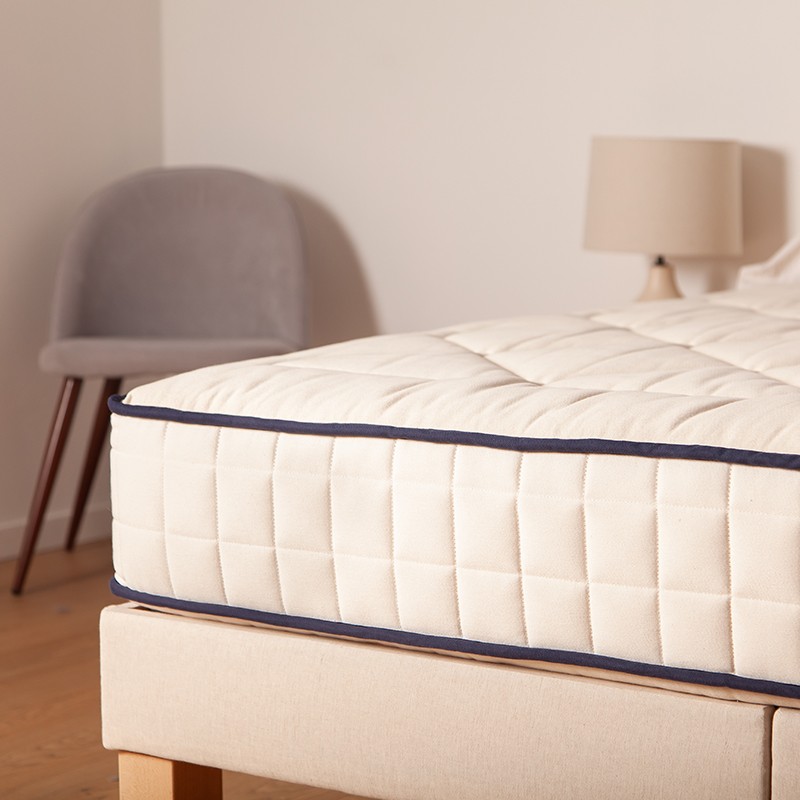
A back that aches upon waking, worsening dust mite allergies, or simply the desire for a mattress that lasts more than ten years without sagging: these are the three reasons that drive most sleepers to turn to natural latex. Derived from rubber tree sap, this material offers firm and progressive support, appreciated natural ventilation, and longevity rarely achieved by conventional foams.
We have selected the 5 best natural latex mattresses available in France in 2026. This comparison details their characteristics, prices, certifications, and strengths to help you choose the model that best suits your body type and priorities.
Why Choose a Natural Latex Mattress in 2026?
Natural latex has several decisive advantages over other materials:
- Exceptional Durability: 12 to 15 years on average, compared to 8 to 10 years for a foam mattress
- Optimal Ventilation: honeycomb structure that dissipates moisture and regulates temperature
- Progressive Support: uniform firmness that adapts to the body’s curves without memory foam effect
- Resilience: latex instantly returns to its shape, making nighttime position changes easier
- Naturally Hypoallergenic: antibacterial and dust mite resistant without chemical treatment
- Eco-Friendly: renewable, biodegradable material with strict environmental certifications (GOLS, FSC, GOTS for covers)
100% natural latex mattresses are particularly recommended for allergy-sensitive sleepers, those who want a firm mattress without sacrificing comfort, and individuals concerned about the environmental impact of their bedding.
Our top 5 best natural latex mattresses 2026
1. Kipli — The best-selling French natural latex
Price: Starting at ~€1,650 in 140×190 cm (stable price all year round, check the exact price on the official website)
The Kipli mattress has become the reference for natural latex in France since its launch in 2017. Made in Italy with 100% natural GOLS certified latex, it offers a bi-density design (firm side + medium side) reversible according to your preferences, a rare flexibility at this level of quality.
Composition:
- 20 cm total thickness
- Firm side: high-density natural latex (85 kg/m³)
- Medium side: intermediate density natural latex (65 kg/m³)
- Cover in GOTS certified organic cotton, removable and washable at 40 °C
- Certifications: GOLS (organic latex ≥ 95% natural), EUROLATEX, OEKO-TEX Standard 100
Strengths:
- Reversible two firmness levels in one mattress
- European manufacturing (Italy)
- 100-night trial
- 10-year warranty
- Excellent durability reported by users (5+ years without sagging)
Who is it for? Sleepers looking for a reference latex mattress with adjustable firmness, weight from 50 to 110 kg, all sleeping positions.
See the Kipli mattress on the brand's official website2. Latexbio — 100% local French latex
Price: Premium entry-level (starting at around €1,100 in 140×190 cm — check the updated price on latexbio.fr )
Latexbio stands out for its 100% French manufacturing in Hauts-de-France. The brand offers a natural latex mattress certified GOLS (Global Organic Latex Standard), the most demanding certification for organic latex.
Composition:
- 22 cm thickness
- Core: 18 cm of 100% natural latex (certified GOLS) in differentiated zones (7 comfort zones)
- Cover in organic cotton and French hemp, removable
- Certifications: GOLS, GOTS (cover), OEKO-TEX Standard 100
Strengths:
- French production from A to Z (latex transformed in France)
- GOLS certified organic latex
- 7 differentiated support zones
- Cover made from French materials (hemp + organic cotton)
- 120-night trial
- 15-year warranty
Who is it for? Committed sleepers prioritizing fully made in France, seeking precise zonal support, premium budget.
3. Cosme Natural Latex — The best quality-price ratio
Price: Accessible range for 100% certified natural latex (check on cosme-literie.com )
Cosme, a French brand launched in 2019, offers a natural latex mattress at a particularly attractive price without compromising on quality. The Natural Latex model provides balanced firmness and a transparent composition.
Composition:
- 20 cm thickness
- Core: 18 cm of 100% natural latex (origin Sri Lanka) 75 kg/m³
- Cover in organic cotton, removable and washable
- Certifications: EUROLATEX, OEKO-TEX Standard 100
Strengths:
- Excellent quality-price ratio for 100% natural latex
- Versatile medium-firm firmness (6.5/10)
- 100-night trial with free return
- 10-year warranty
- Fast delivery (3 to 5 days)
Who is it for? Sleepers looking for a first quality natural latex mattress at an accessible price, weight up to 90 kg, back and side sleepers.
4. Someo Aube 700 — The quintessential French natural latex
Someo is one of the last French manufacturers to produce its natural latex mattresses in its own workshops in Vendée. The Aube 700 is the flagship model of the brand’s natural latex range: true 100% natural certified latex, made in France with decades of expertise.
Composition:
- 21 cm thickness
- Core made of 100% certified natural latex
- 7 differentiated comfort zones for support tailored to each part of the body
- Removable cover made from natural materials
- Certification OEKO-TEX Standard 100
- Manufacturing in Vendée, France
Strengths:
- 100% French manufacturing (Vendée)
- Certified natural latex — no synthetic latex
- Zoned support with 7 zones for the back and joints
- Historic French brand with a network of stores
- 7-year warranty
- Available at the specialist lematelas.fr
Who is it for? Sleepers looking for a natural latex mattress made in France, all body types, side and back sleepers. Ideal for those who want to combine made in France and certified natural latex.
5. Morphea Natural Latex — High-density latex
Price: High-end range (starting at around €1,200 in 140×190 cm — check on morpheabed.com )
Morphea offers a high-end natural latex mattress with a density of 95 kg/m³, among the highest on the market. This exceptional density guarantees maximum longevity and very firm support.
Composition:
- 24 cm thickness
- Core: 20 cm of 100% high-density natural latex (95 kg/m³)
- 7 differentiated comfort zones with perforations for optimal ventilation
- Cover in linen and organic cotton, removable
- Certifications: EUROLATEX, GOTS (cover), OEKO-TEX Standard 100
Strengths:
- Exceptional latex density (95 kg/m³)
- High firmness (7.5/10) for maximum support
- Generous thickness (24 cm)
- Optimized ventilation through multiple perforations
- 120-night trial
- 15-year warranty
Who is it for? Sleepers looking for very firm support, heavier body types (80 to 120 kg), back and stomach sleepers, long-term investment.
Also note: Dunlopillo Hortense — The historical expertise of latex
Dunlopillo is literally the inventor of the natural latex mattress (1929). The British brand embodies technical excellence in this field for nearly a century. The Hortense model is its purest expression: 100% natural latex, firm, 7 comfort zones, 22 cm thickness.
Composition:
- 22 cm total thickness
- Core: 100% natural latex, firm profile
- 7 differentiated support zones (shoulders, lumbar, hips…)
- EUROLATEX certification
- Available at the specialist lematelas.fr
Who is it for? Back or stomach sleepers, medium to heavy body types, people sensitive to back pain seeking firm and proven support. Ideal also for those who prioritize a brand with a recognized technical heritage.
View on AmazonComparative table of the 5 best natural latex mattresses 2026
| Model | Price 140×190 | Thickness | Latex density | Firmness | Trial | Warranty | Manufacturing |
|---|---|---|---|---|---|---|---|
| Kipli | ~€1,650 | 20 cm | 85/65 kg/m³ | Reversible | 100 nights | 10 years | Italy |
| Latexbio | ~€1,100 | 22 cm | ~80 kg/m³ | 7/10 | 120 nights | 15 years | France |
| Cosme Latex | entry-level | 20 cm | 75 kg/m³ | 6.5/10 | 100 nights | 10 years | Europe |
| Someo Aube 700 | see lematelas.fr | 21 cm | 100% natural | 7 zones | — | 7 years | France |
| Morphea | ~€1,200 | 24 cm | 95 kg/m³ | 7.5/10 | 120 nights | 15 years | Europe |
How to choose your natural latex mattress?
Check the percentage of natural latex
Be cautious of the term “natural latex”: some mattresses contain only 20% natural latex mixed with synthetic latex. The models in our selection contain at least 85% natural latex, with EUROLATEX or GOLS certification.
To check before any purchase:
- EUROLATEX certification (minimum 85% natural latex)
- GOLS certification (minimum 95% natural latex, the most demanding)
- Detailed composition published by the brand
Choose the density suitable for your body type
The density of latex (expressed in kg/m³) determines firmness and durability:
- 65–75 kg/m³: medium comfort, light to medium body types (50–80 kg)
- 75–85 kg/m³: balanced comfort, medium body types (70–95 kg)
- 85–95 kg/m³: firm to very firm, strong body types (90–120 kg)
Reversible mattresses like the Kipli allow you to adjust according to your preferences without having to buy a new mattress.
Prioritize environmental certifications
A true ecological mattress made of natural latex should have several certifications:
- GOLS (Global Organic Latex Standard): certified organic latex
- GOTS (Global Organic Textile Standard): cover made from organic textile
- FSC: latex sourced from sustainably managed rubber tree plantations
- OEKO-TEX Standard 100: absence of harmful substances
- Made in Green by OEKO-TEX: complete traceability of production
Consider the trial period and warranty
A natural latex mattress represents a long-term investment. Prefer brands that offer at least 100 nights of trial with free returns, a minimum warranty of 10 years (15 years for high-end models), and a clearly stated return policy. These criteria reflect the manufacturer’s confidence in the durability of their product. By comparison, the 7-year warranty offered by Someo on the Aube 700 is shorter than what direct online brands typically offer, even though the quality of French manufacturing partly compensates for this gap.
Alternatives to 100% Natural Latex Mattresses
If your budget is more limited or if you are looking for different comfort, several alternatives deserve attention. You can also check out our comparison of the best mattresses for an overview across all categories.
Hybrid Latex-Spring Mattresses
Combining natural latex for comfort and pocket springs for support, these models offer maximum ventilation, optimal motion isolation, and firm support paired with a plush feel. They are a good entry point for sleepers curious about latex who want to soften the characteristic firmness of the material.
Eco-Friendly Foam Mattresses
Next-generation foams (bio-sourced) are a credible alternative for tight budgets. Less durable than latex (8 to 10 years compared to 12 to 15 years), they often provide a more pronounced hugging sensation, appreciated by side sleepers looking for a soft welcome.
High-End Spring Mattresses
For sleepers prioritizing firmness and motion isolation above all, pocket spring mattresses with natural filling represent a solid alternative. Their ventilation is excellent, and their very firm support is particularly suitable for heavier body types or stomach sleepers.
Natural Latex Brands to Avoid in 2026
The “Fake” Natural Latex Mattresses
Beware of misleading mentions:
- “Latex mattress” without specification = often 100% synthetic latex
- “Natural latex filling” = only a thin layer of latex on polyurethane foam
- Lack of certification EUROLATEX, GOLS, or equivalent
Brands Without a Trial Period
A quality natural latex mattress requires a few weeks of adjustment, as the body gets used to firmer and more progressive support than traditional foam. Serious brands know this and consistently offer a minimum of 100 nights trial. Avoid those that do not offer a trial period, charge for returns, or impose complex return conditions that are difficult to meet in practice.
Frequently Asked Questions about Natural Latex Mattresses
Is a natural latex mattress really more durable than a foam mattress?
Yes, the difference is significant and measurable over time. A quality natural latex mattress (density 80+ kg/m³) retains its properties for 12 to 15 years, compared to 8 to 10 years for a high-resilience polyurethane foam mattress. The reason lies in the molecular structure of natural rubber: its polymer chains are particularly resistant to repeated compression, meaning that latex returns to its original shape night after night without permanent sagging. In comparison, a polyurethane foam starts to lose 15 to 20% of its thickness after 5 to 7 years of intensive use. Customer feedback on mattresses like Kipli or Latexbio confirms excellent durability after 5+ years of daily use, which, when related to the total lifespan, makes it a more economical investment than its purchase price might suggest.Is natural latex suitable for allergic individuals?
Natural latex is naturally hypoallergenic, antibacterial, and dust mite resistant without chemical treatment. Contrary to a widely held belief, latex allergy primarily concerns direct skin contact, such as with medical gloves, and not the latex contained in a mattress covered with a cover: the allergenic proteins responsible for skin reactions are largely eliminated during the industrial vulcanization process, and the textile cover provides an additional barrier. However, in the case of a proven and diagnosed latex allergy, caution is advised: prefer a pocket spring mattress or a bio-sourced foam mattress, and consult your doctor before any purchase. For simple sensitivities to dust mites or respiratory allergies, natural latex is, on the contrary, one of the most recommended materials.What is the difference between natural latex and synthetic latex?
Natural latex comes from the sap of the rubber tree (Hevea), a renewable and biodegradable material derived from a plant resource. Synthetic latex, on the other hand, is made from petrochemical derivatives (styrene-butadiene), making it cheaper to produce but much less virtuous from an ecological and health standpoint. Their differences in terms of use are equally marked: natural latex is more durable (12 to 15 years compared to 6 to 8 years), more resilient, better ventilated, and biodegradable at the end of its life. Synthetic latex sags more quickly and may release volatile organic compounds (VOCs) during the degassing phase. The mattresses in our selection contain a minimum of 85% certified natural latex (EUROLATEX or GOLS), ensuring a serious and traceable composition.Is a latex mattress firm or soft?
Natural latex offers firm and progressive support without being hard in the strict sense. The sensation is fundamentally different from memory foam: latex "supports" the body with immediate resilience, pushing back as soon as you lie down, while memory foam "envelops" gradually by conforming to shapes. This resilience is valuable for nighttime position changes, as it does not create the "quicksand" effect sometimes attributed to viscoelastic foam. The final firmness depends on the density of the latex (65 to 95 kg/m³): for balanced comfort suitable for the majority of sleepers, a density between 75 and 85 kg/m³ is recommended. Reversible mattresses like the Kipli allow you to choose between two firmness levels without having to buy a new mattress.How much does a quality natural latex mattress cost?
For a 140×190 cm mattress made of 100% certified natural latex, prices vary significantly depending on brands and models. Serious entry-level options (certified natural latex EUROLATEX, correct density) range from €700 to €900. Mid-range options, with more demanding certifications like GOLS and long warranties, range from €1,000 to €1,400, while high-end models (density 90+ kg/m³, French manufacturing, complete certifications) often exceed €1,500, such as the Kipli around €1,650. Prices below €600 generally concern synthetic latex or non-certified blends. When related to the lifespan of 12 to 15 years, the annual cost of a quality natural latex mattress remains very competitive compared to a low-end foam mattress that needs to be replaced every 5 or 6 years.Can a latex mattress be used on a slatted base?
Yes, and this is even the configuration most recommended by nearly all manufacturers. Natural latex requires excellent air circulation underneath to dissipate the body moisture accumulated each night: up to 0.5 liters of sweat per sleeper. A slatted base with visible slats (spacing of 3 to 4 cm maximum between each slat) or a box spring with covered slats is perfectly suited to this requirement. Avoid solid bases (continuous particle board), non-ventilated bed frames, or closed bed platforms: they retain moisture, accelerate the aging of latex, and promote mold growth. Most reputable brands, such as Kipli, Latexbio, and Cosme, explicitly mention the recommended type of base in their documentation, and this information should be verified before purchase.Our verdict: which natural latex mattress to choose in 2026?
For most sleepers looking for an excellent compromise between quality, certifications, and versatility, Kipli remains our top choice. Its reversible design with two firmness levels, GOLS certification, European manufacturing, and consistent value for money make it the benchmark for natural latex in France since its founding in 2017.
For maximum ecological commitment with 100% French production, Latexbio stands out despite its premium price. Its GOLS certification and French-sourced materials, including hemp, justify the investment for the most demanding sleepers regarding traceability.
If the budget is tight without compromising on quality, Cosme Latex Naturel offers the best entry point into 100% certified natural latex, with a versatile firmness suitable for the majority of profiles.
Sleepers looking for an established French brand with a network of physical stores will appreciate the Someo Aube 700, made in Vendée with historical craftsmanship. Finally, strong body types and sleepers seeking very firm and durable support will find in the Morphea Latex Naturel, with its 95 kg/m³ density, the most solid investment on the market.
Whatever your priority, keep in mind the essential criteria: EUROLATEX certification at a minimum (ideally GOLS), a trial period of at least 100 nights, a 10-year warranty, and a detailed composition published by the brand. Natural latex will accompany you for 12 to 15 years: it’s best to choose the right model from the start.