In the quest for restorative sleep, we are increasingly exploring innovative solutions: memory foam mattresses, cooling mattress toppers, sleep tracking apps… What if the water pillow, often seen as a gadget from a bygone era, was actually a serious option for better sleep? Straddling the line between technology and ergonomics, this type of pillow promises personalized support and unmatched adaptability. But what is the reality? This article offers a comprehensive overview to understand whether the water pillow is a relevant solution or just a passing trend.
If you are still unsure about which type of pillow to choose, check out our complete pillow comparison to refine your decision.
What is a water pillow? A brief look at an unknown innovation
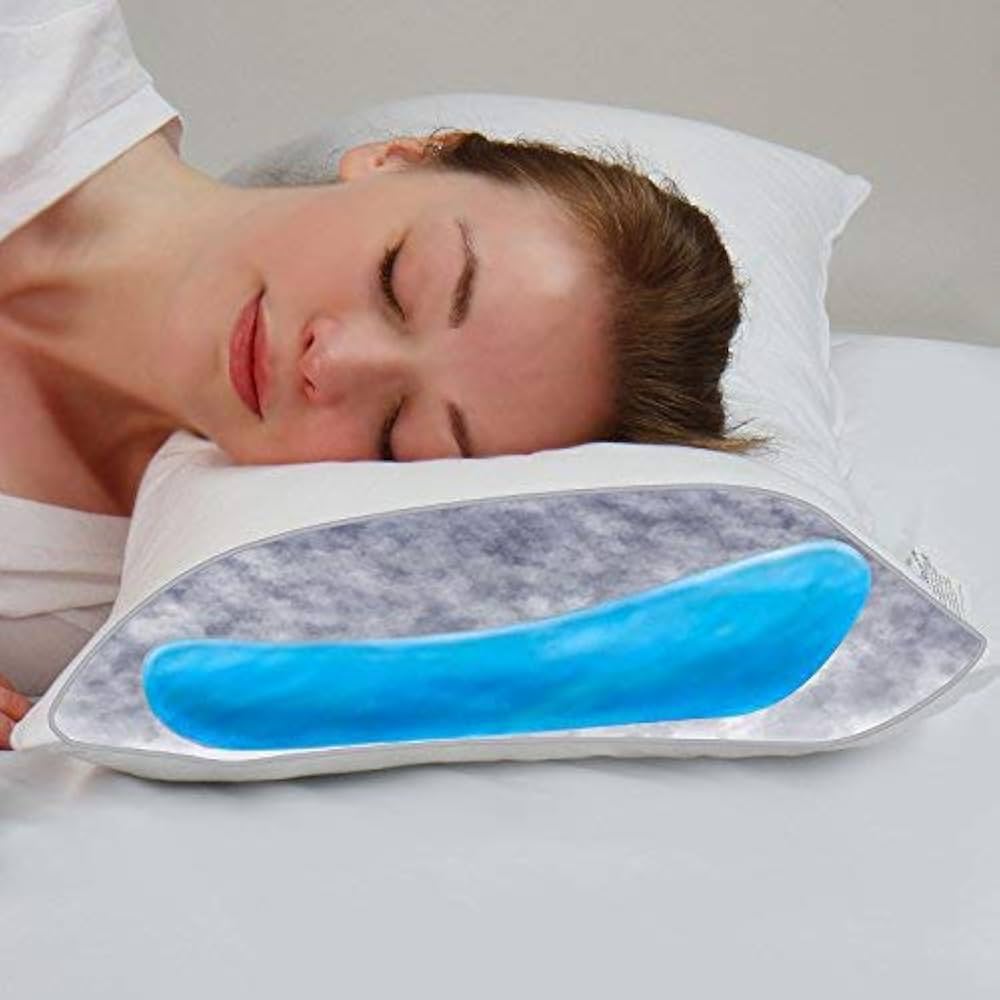
A water pillow is an ergonomic cushion containing a sealed water chamber, usually covered with a layer of foam or polyester fibers to soften the sleeping experience. Its main promise is to allow each person to adjust the firmness and height of the pillow simply by modulating the amount of water introduced through a valve.
This technology was popularized in the 1980s, following the trend of water mattresses. While their mainstream success has been fluctuating, water pillows have managed to maintain a presence in certain niches — particularly in North America and Northern Europe — driven by arguments centered around cervical well-being. The Mediflow brand, whose original pillow has been the subject of a clinical study published in the Archives of Physical Medicine and Rehabilitation, remains the most documented reference on the market today.
How does a water pillow work?
The mechanism relies on simple yet well-thought-out components: a removable water chamber sealed by a waterproof valve, an outer covering made of cotton or memory foam, a variable weight directly linked to the filling level, and on high-end models, anti-wave membranes that stabilize the liquid during the night. Some versions also incorporate thermal properties, as water retains freshness longer than traditional foam.
Real-time adaptive support
One of the major advantages of this system is its dynamic nature: the water reacts to micro-movements of the head and neck throughout the night, maintaining constant support regardless of the position adopted. Unlike a foam pillow that permanently deforms, the water chamber returns to its original shape as soon as the pressure is released, thus offering regularly corrected cervical alignment.
Find a water pillow on Amazon.fr — compare models and customer reviewsWhat are the advantages of the water pillow?
Advanced support customization
The first advantage is modularity: by adding or removing water, one can precisely adjust the height and firmness according to their morphology, preferred sleeping position, and any cervical pain. This flexibility is particularly useful for individuals suffering from chronic neck pain or recurring muscle tension in the shoulders and neck.
Above-average durability
Unlike traditional fiber or foam pillows that sag within a few years, the water chamber retains its volume and mechanical properties over time. The best models boast a lifespan of five to ten years with minimal maintenance — a significant economic argument in the long run.
… but also some limitations to be aware of
Significant weight and delicate handling
Once filled, the water chamber can represent a substantial portion of the total weight of the pillow. Depending on the filling level and dimensions, some models can weigh 2 to 5 kg, making them cumbersome to handle, especially for changing the pillowcase or traveling.
Regular maintenance is essential
The water pillow requires special attention: it is necessary to regularly check the valve’s watertightness, renew the water approximately every six months, and use distilled water to avoid limescale deposits and microbial proliferation. Some manufacturers recommend adding a few drops of a specific antibacterial product during each refill.
An adjustment period is necessary
Some sleepers find the moving sensation destabilizing during the first nights. It is advisable to start with a moderate filling level and gradually increase it to the optimal setting, rather than immediately seeking the perfect adjustment.
Water pillow vs. other technologies
| Type of pillow | Personalized support | Thermal regulation | Durability | Indicative price |
|---|---|---|---|---|
| Water pillow | Excellent | Average to good | Very good | starting at ~€60 |
| Memory foam | Average to good | Low to average | Good | starting at ~€50 |
| Natural latex | Good | Excellent | Excellent | starting at ~€70 |
| Synthetic fiber | Poor | Average | Average | starting at ~€20 |
Prices observed in 2026, for reference.
Practical tips for using a water pillow effectively
To get the most out of your water pillow, here are the essential recommendations:
- Do not fill the pillow to maximum capacity on the first night: start at about half of the capacity and gradually adjust over several nights until you find your ideal setting.
- Use only distilled water to avoid limescale deposits and preserve the internal membrane of the chamber.
- Check the valve at each refill: a slight infiltration can go unnoticed and damage the covering.
- Add a breathable pillowcase made of percale cotton or bamboo to improve thermal comfort, as water tends to retain body heat in summer.
- Store the pillow flat when not in use to maintain even water distribution in the chamber.
If the water pillow does not suit your sleeping profile, there are many quality alternatives available. Check out our complete selection on the pillow comparison page .
View on AmazonFAQ: what you often ask
Does the water move all night and does it disturb sleep?
On entry-level models, a slight movement of the liquid can occur during position changes, which may be surprising at first. However, good models are equipped with internal partitioned membranes that significantly slow down water movements and eliminate wave effects. In practice, the vast majority of sleepers stop perceiving this movement after two to three nights of adjustment. If the sensation persists, it is often sufficient to slightly increase the filling level to stiffen the entire pillow and stabilize the contents.
Is the water pillow noisy?
On quality models, noise is almost nonexistent. The slight sloshing sometimes feared only occurs when the pillow is underfilled and air has entered the chamber. To avoid any residual noise, be sure to properly purge the air during filling by slightly tilting the pillow and gently pressing on the chamber before closing the valve. Sufficient filling eliminates this source of noise in almost all cases.
Can it really help with neck pain?
This is the best-documented argument in favor of the water pillow. The original Mediflow pillow is the only adjustable pillow whose effectiveness on neck pain has been evaluated in a clinical study published in the Archives of Physical Medicine and Rehabilitation. The principle relies on the water's ability to maintain constant cervical alignment regardless of the position adopted during the night, unlike a fiber pillow that compresses under the weight of the head. People suffering from mechanical neck pain (due to poor posture, muscle tension, or mild disc herniation) are most likely to benefit from such support. In cases of confirmed cervical pathology, it is advisable to consult a physiotherapist or doctor before changing pillows.
Is it compatible with all sleeping profiles?
Not necessarily. Side and back sleepers are most likely to find a satisfactory adjustment, as the water pillow can be adjusted to a precise height corresponding to the gap between the shoulder and neck. Stomach sleepers, on the other hand, generally need a very flat and soft pillow; the water chamber, even at its minimal filling level, may prove too firm or too thick for them. Similarly, those who prefer a very soft and enveloping pillow — like some down models — may find the sensation too rigid and mechanical.
How often should the water in a water pillow be changed?
It is recommended to renew the water in the chamber approximately every six months, or as soon as you notice a change in color, slight cloudiness, or an unusual odor. To prevent any bacterial or mold proliferation, the use of distilled water is strongly advised rather than tap water, which contains limescale and minerals that can form deposits in the membrane. Some manufacturers suggest adding a few drops of a compatible antibacterial product during each refill. Take this opportunity to carefully inspect the valve and the perimeter of the chamber for any signs of cracks or leaks before they damage the outer covering.
What budget should be expected for a quality water pillow?
Entry-level water pillows are available starting at ~€30–40, but their manufacturing quality (fragile valve, weak chamber) is often inferior. For a truly ergonomic and durable model, you generally need to budget starting from ~€60–85. This budget is comparable to that of a good natural latex or memory foam pillow. Considering the above-average lifespan of these pillows — often five to ten years with proper maintenance — the annual cost remains very reasonable.
Verdict: should you buy a water pillow?
Far from being a gadget, the water pillow is a serious alternative for anyone seeking personalized cervical support, adjustable comfort night after night, and a product designed to last. Its main strength lies in its unique ability to adapt to each sleeper’s morphology without needing to change pillows: a simple adjustment of the water level is enough.
It may not suit all profiles — stomach sleepers and fans of ultra-soft pillows may find it less appealing — but for those suffering from recurring neck tension or dissatisfied with their usual pillows, it is a path that clearly deserves exploration. It should be integrated into a broader reflection on your bedding for truly personalized sleep.