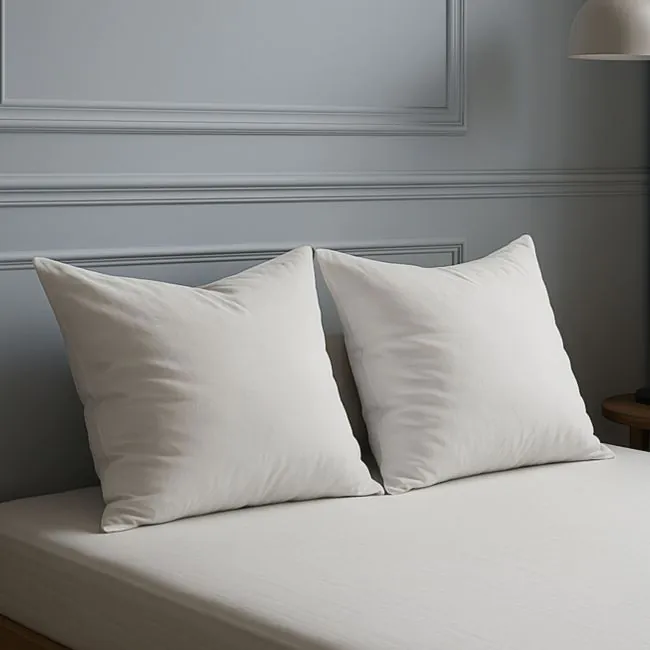
The choice of a pillow is crucial for sleep quality. However, given the variety of materials available, one question often arises: should you opt for a natural or synthetic pillow? This decision, which may seem secondary, actually impacts nighttime comfort, bedding hygiene, health (especially in cases of allergies), and even the environment. This comparison aims to help you see clearly by weighing each criterion precisely.
To delve deeper into the subject, also check out our selection of the best pillows tested by our team .
Quick Comparative Summary
| Criteria | Natural Pillow | Synthetic Pillow |
|---|---|---|
| Materials | Feathers, down, latex, wool, kapok | Polyester fibers, microfibers, foam |
| Comfort | Soft, adaptive, breathable | Uniform, customizable |
| Maintenance | More delicate, often non-washable | Easy to maintain, washable at 40 °C |
| Lifespan | 3 to 5 years (latex: up to 8 years) | 1 to 3 years depending on quality |
| Hypoallergenic | Yes (latex, kapok) | Yes if treated with anti-dust mite |
| Environment | Renewable, biodegradable | Non-renewable, petroleum-derived |
| Price | Starting at ~€40, premium above ~€80 | Starting at ~€15, mid-range ~€30–50 |
Presentation of Compared Options
Natural Pillows
Natural pillows are made from animal-based materials (feathers, down, wool) or plant-based materials (natural latex, kapok). Their main appeal lies in their biodegradable composition, natural thermal regulation, and adaptive comfort — each material having its own specifics that are worth knowing before purchasing.
- Down Pillow: very fluffy and breathable, it gently envelops the head. It is particularly suitable for back sleepers and cold individuals but requires careful maintenance.
- Natural Latex: firm and hypoallergenic, it is the most durable option in the category. Look for GOLS (Global Organic Latex Standard) certification, which certifies a purity of over 95% latex from organic farming.
- Kapok: a plant-based alternative to down, lightweight and breathable, it is an excellent choice for environmentally conscious individuals.
- Wool: a good thermal insulator and adaptive, it stands out for its ability to naturally regulate humidity.
Synthetic Pillows
Synthetic pillows are made from polyester fibers, microfibers, or memory foam. They are very popular for their affordable price, ease of maintenance, and hypoallergenic nature when treated appropriately. The range is wide: from entry-level models available for around fifteen euros to high-end ergonomic models costing over €80.
- Microfiber: soft and machine washable, it represents the most accessible and versatile option.
- Memory Foam: ergonomic and precise in its support, it conforms to the neck and is well-suited for individuals suffering from neck tension.
Detailed Point-by-Point Comparison
Comfort and Feel at Sleep
Natural pillows offer a cocoon-like sensation and softness that is difficult to replicate artificially. Down, in particular, provides a fluffy wrapping that is highly appreciated by back and stomach sleepers. Synthetic pillows, on the other hand, offer a more standardized and reproducible comfort: memory foam retains its shape night after night, which reassures some users but may feel stiffer to others.
Firmness and Support
Firmness varies significantly depending on the filling chosen. In the natural category, latex offers the firmest support while down remains very soft. On the synthetic side, ergonomic pillows made of foam or synthetic latex provide targeted neck support, particularly useful in cases of cervical pain.
Adaptation to Body Shape
Natural latex and kapok offer a good compromise for adapting to most body shapes. However, memory foam stands out with its optimal adaptation: it distributes pressure evenly and maintains alignment of the head, neck, and shoulders, making it the reference for individuals suffering from chronic tension.
Thermal Regulation
This is where natural materials take the lead. Down, wool, and kapok are excellent thermal regulators, capable of absorbing moisture and dissipating it effectively. Synthetic foam, on the contrary, tends to retain body heat—although some ventilated or gel-infused models aim to correct this flaw.
Durability and Maintenance
Natural pillows are sensitive to humidity and require more precautions: regular airing, protective covers, and checking machine compatibility before any washing. That said, a well-maintained natural latex pillow can last up to 8 years. Synthetic pillows are easier to maintain—most are washable at 40 °C—but their fibers tend to crush more quickly, reducing their lifespan to 1–3 years.
Environmental Impact
Natural materials have a significantly more favorable environmental footprint: they are biodegradable, sourced from renewable resources, and some (kapok, wool, GOLS certified latex) can even be produced through organic farming. Synthetic pillows are derived from petroleum and are rarely recycled at the end of their life, although recycling initiatives for textile fibers are beginning to emerge.
Budget / Value for Money
A mid-range synthetic pillow remains the most accessible option (expect to pay around €15 to €50), but its frequent replacement can diminish its economic advantage in the long run. A certified natural latex pillow, more expensive to purchase (often starting at around €60–80), often proves to be more cost-effective over several years due to its superior longevity.
View on AmazonHow to choose according to your profile?
Specific needs
The right pillow primarily depends on your physiology and sleep habits. In case of night sweating, opt for kapok, latex, or wool, whose hygroscopic properties naturally regulate moisture. If you suffer from allergies, certified natural latex or a synthetic pillow treated against dust mites are the safest choices — provided to remember that down can be irritating for some sensitive individuals. Cervical pain directs you towards memory foam or latex, which maintain cervical alignment. Finally, if you are primarily looking for a soft comfort, down and soft microfibers remain reliable options.
Sleep position
The sleep position is often an underestimated criterion in choosing a pillow. Side sleepers need a higher and firmer pillow (latex, foam) to fill the space between the shoulder and the head. Back sleepers are better accommodated with a medium, slightly inclined pillow (thick down, soft latex). Stomach sleepers, finally, should choose a very thin and soft pillow, or even do without one, to avoid forcing cervical rotation.
Priorities
- Tight budget: mid-range synthetic, machine washable
- Durability: certified GOLS natural latex
- Eco-responsibility: kapok, wool, latex, or down with RDS certification (Responsible Down Standard)
Practical Tips Before Buying
How to Test a Pillow
In-store, take the time to lie down on your back and side for at least 5 minutes: the comfort felt after this time is much more representative than a simple hand press. Online, always check the return policy: most reputable retailers offer at least 14 days of legal withdrawal period, and some extend this period to 30 or 60 nights for premium pillows.
Common Mistakes to Avoid
The most common mistake is choosing a pillow that is too firm for a lighter body type, which leads to neck tension upon waking. It is also common to confuse softness with support: a pillow can be very soft to the touch while still providing good cervical support (this is the case with quality kapok). Finally, do not overlook your sensitivity to heat: a dense synthetic foam pillow can significantly increase the perceived temperature at the head, disrupting the deep sleep cycle.
Questions to Ask Yourself Before Buying
- Do I have neck pain upon waking?
- Do I sweat a lot at night?
- Am I prone to allergies (dust mites, dust, latex)?
- What is my main sleeping position (back, side, stomach)?
- How important is the environmental impact of my bedding to me?
FAQ
What is the average lifespan of a pillow?
The lifespan of a pillow strongly depends on its composition. A synthetic pillow made of polyester or microfiber generally needs to be replaced every 1 to 3 years, as its fibers gradually compress and no longer provide adequate support. A down or feather pillow lasts between 3 and 5 years, provided it is properly aired and protected by a cover. Certified natural latex is the most durable of all: with proper care, it can remain effective for up to 8 years. A simple test can determine if it's time to change your pillow: compress it in half, then release. If it does not regain its shape within a few seconds, it’s time to replace it.
Is a natural pillow necessarily hypoallergenic?
No, and this is an important misconception to correct. Only natural latex and kapok are naturally hypoallergenic, as their fibrous structures do not provide a favorable environment for dust mites to thrive. Down and feathers, on the other hand, can pose problems for some sensitive individuals: the animal proteins present in these materials can sometimes cause allergic reactions. If you suffer from respiratory or skin allergies, opt for a pillow made of certified GOLS natural latex or, on the synthetic side, a model with certified anti-dust mite treatment (such as the Oeko-Tex label). In any case, using a washable anti-dust mite protective cover is highly recommended.
How to properly maintain a natural pillow?
Maintaining a natural pillow is more meticulous than that of a synthetic model, but a few simple actions can help preserve its lifespan. Start by systematically protecting the pillow with a dust mite-proof cover that can be washed at 60 °C. Air out the pillow every morning by flipping it or placing it outside for a few minutes. Before any machine washing, be sure to check the label: some down pillows can withstand 40 °C on a delicate cycle, while natural latex should never be machine washed as it will irreparably degrade. For the latter, a simple cleaning with a damp sponge is sufficient. Also, remember to "fluff" your down pillow from time to time to restore volume to the filling.
Are pillows compatible with all types of bed bases and mattresses?
Yes, the choice of a pillow is completely independent of the type of bed base used. The effectiveness of a pillow depends on the relationship between your mattress, your body shape, and your sleeping position — not the bed base. However, the firmness of the mattress can indirectly influence your pillow choice: on a firm mattress, the hip and shoulder sink less, which may require a slightly higher pillow to maintain cervical alignment in a side position. On a soft mattress, the effect is the opposite.
What is the difference between a soft pillow and a firm pillow?
The firmness of a pillow corresponds to its ability to keep the head and neck in a neutral axis, without allowing them to sag or excessively elevate. A soft pillow — made of down or lightweight microfiber — adapts freely to the movements of the head and is particularly suitable for back or stomach sleepers who do not have cervical issues. A firm pillow — made of latex or memory foam — is more suitable for side sleepers, whose shoulder creates a significant gap that needs to be filled. Choosing a pillow that is too firm for your body shape can lead to tension in the neck and trapezius upon waking, while a pillow that is too soft does not provide enough support and can exacerbate existing neck pain. The right level of firmness is one that keeps your cervical spine aligned with the rest of your spine throughout the night.
How often should you replace your pillow?
The replacement frequency varies depending on the material. A synthetic pillow made of polyester fibers should be replaced every 1 to 3 years: the fibers lose their resilience and cervical support decreases significantly. Down or feather pillows last 3 to 5 years, provided they are well maintained. Natural latex is the champion of longevity, with a lifespan of up to 8 years if a protective cover is used and it is aired regularly. If you notice that you have a stiff neck upon waking, that the pillow has permanently flattened, or that a persistent odor emanates from it despite cleaning, do not delay in replacing it — regardless of its age.