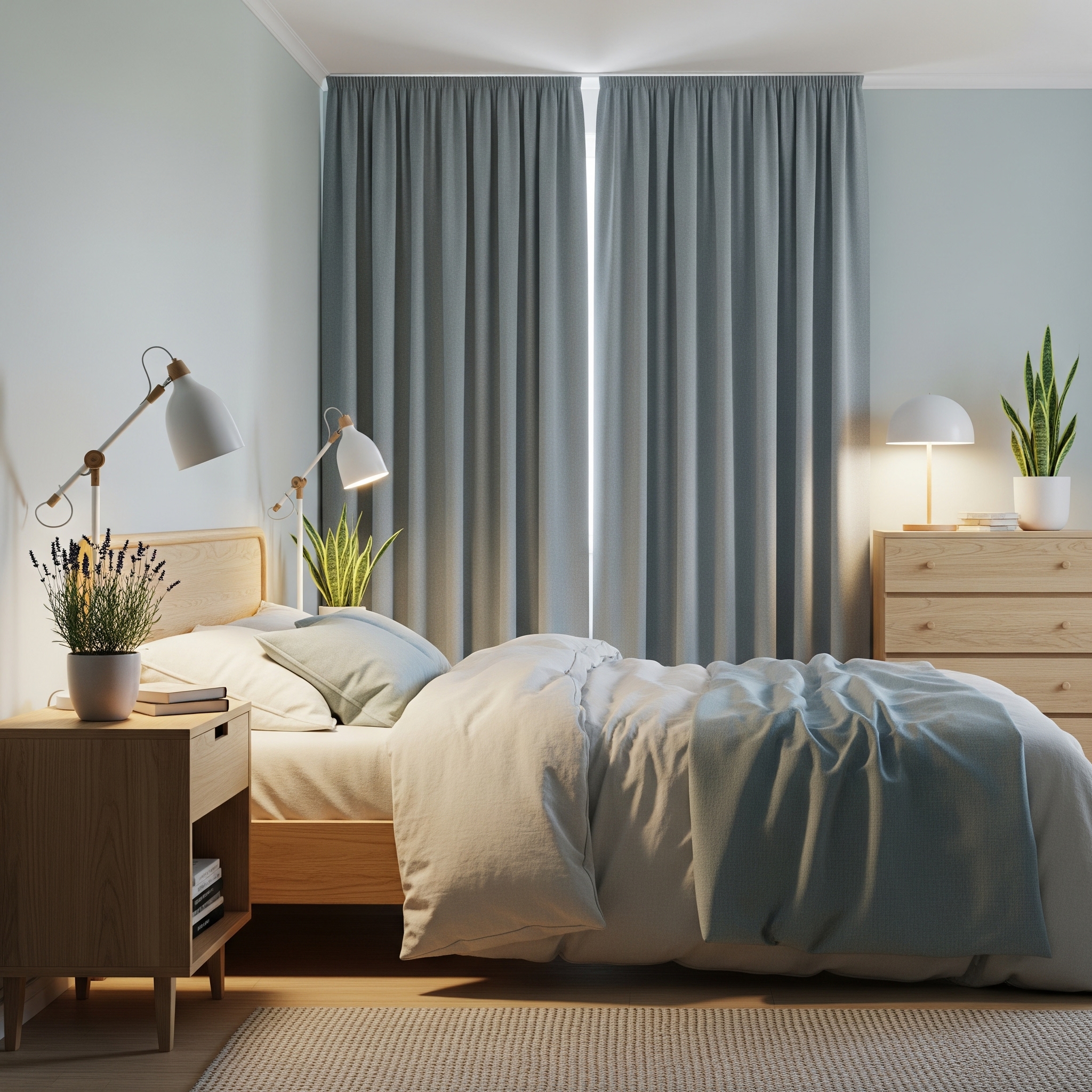
The quality of sleep relies on several pillars: suitable bedding, a balanced lifestyle, and an environment conducive to rest. Often overlooked, the decoration of the bedroom directly influences our nervous system and promotes easier falling asleep. Find more practical tips in our section dedicated to sleeping better .
Why Does Decoration Influence Sleep?
The brain remains sensitive to visual and light stimuli even during the falling asleep phase. Bright light, aggressive colors, or a cluttered environment send alert signals to the autonomic nervous system, delaying melatonin secretion and fragmenting sleep cycles. In contrast, a carefully designed space — soft colors, natural materials, visual order — reduces cortisol levels and prepares the body for a state of rest.
Zen or Nordic styles perfectly illustrate this principle: they prioritize minimalism, soft natural light, and raw materials to establish calm and serenity, without sacrificing aesthetics.
10 decor ideas for a sleep-friendly bedroom
1. Soft and natural colors
Lavender blue, sage green, sandy beige, and powder pink are allies of sleep because they directly affect the nervous system: blue, for example, lowers blood pressure and slows the heart rate, while green stimulates a feeling of calm without weighing down the atmosphere. In contrast, red, orange, and bright yellow increase alertness — it’s better to reserve them for living spaces.
2. Visual decluttering
A cluttered space unconsciously maintains a feeling of incompleteness that hinders mental decompression. Favor closed storage — built-in wardrobes, handle-less dressers, wicker chests — to free up surfaces. The fewer visible objects there are, the less the brain seeks to “process” the environment when falling asleep.
3. Natural materials
Washed linen, organic cotton, solid wood, and rattan bring warmth and authenticity to the bedroom. These materials also have the advantage of being breathable and low in volatile organic compounds (VOCs), contributing to better indoor air quality. A simple change of bedding — towards percale or cotton gauze — can be enough to transform the thermal perception of the bed.
4. Indirect and adjustable lighting
Direct overhead light is the enemy of the wake-sleep transition. Opt for pendant lights with diffusing shades, adjustable bedside lamps with variable intensity, and dimmed LED strips placed behind the headboard or under furniture. Ideally, the color temperature in the evening should not exceed 2,700 K (warm amber light).
5. Care for headboard and bedding
The headboard is the visual focal point of the bedroom. A padded fabric model, brushed wood, or caning immediately creates a cocooning effect. For bedding, focus on soft and breathable materials — organic cotton, 200-thread-count percale, or gauze — in neutral or pastel shades coordinated with the wall paint.
6. Aesthetic blackout curtains
Darkness is an essential physiological condition: even low ambient nighttime light disrupts melatonin secretion. Today’s blackout curtains are far from austere; they come in velvet, thick linen, or layered semi-transparent double curtains, allowing for thermal performance, light blocking, and decorative refinement.
7. Green touches
A few carefully chosen plants contribute to a calming atmosphere and purify the surrounding air. Lavender and jasmine naturally release relaxing molecules; aloe vera and pothos are excellent indoor air purifiers. Just be careful not to overload: two or three plants are enough for the desired visual and olfactory effect.
8. Digital disconnection zone
Reserving a small screen-free corner in the bedroom — a comfortable chair, a reading lamp, a warm blanket — creates a mental transition space before bedtime. This disconnection island helps the nervous system gradually shift from “alert” mode to “rest” mode, much more effectively than a simple decision to “stop looking at the phone.”
9. Designer essential oil diffuser
Lavender, Roman chamomile, and sweet orange are the three best-documented essential oils for promoting relaxation and sleep onset. Lavender, in particular, lowers cortisol levels and increases serotonin and norepinephrine levels involved in sleep regulation. An ultrasonic diffuser used 20 to 30 minutes before sleeping is enough to create a scent environment conducive to rest — and current models, available from ~€30, easily fit into a well-decorated space.
Find a designer essential oil diffuser on Amazon10. Overall harmony
All these ideas only have their full effect if they form a coherent whole. Coordinate wall shades, bedding, furniture, and accessories around a palette of two or three complementary colors. Also, pay attention to the flow in the room: a space where one can move without obstacles contributes to a feeling of serenity.
Advantages and Limitations of Zen Décor
Sleep-oriented décor offers concrete benefits: it facilitates falling asleep by reducing distracting stimuli, limits micro-awakenings related to light or sound in the environment, and improves overall well-being on a daily basis. These effects are cumulative—each improvement reinforces the next.
The limitations to anticipate include an initial investment (paint, linens, furniture), regular maintenance to maintain visual order, and some adaptation if you share the room with a partner who has different tastes. In this case, a compromise on the color palette and level of organization is always possible.
Concrete Examples
- Nordic Adult Bedroom: light pine walls, white down duvet, glacier blue cushions, brushed wood headboard, and articulated arm bedside lamp.
- Soft Children’s Room: matte water green walls, rounded wooden shelves, adjustable intensity animal-shaped night light, natural linen curtains.
- Soothing Studio: textile partition to separate the sleeping area, thick opaque linen curtains, macramé hanging plants, multifunctional light oak furniture.
Practical Tips
Choose a mattress with support suited to your body type and preferred sleeping position — this is the foundation of any successful nighttime environment. Incorporate a matching upholstered base that complements the decor: it harmonizes the whole while absorbing movements. Finally, consider an ergonomic pillow whose height corresponds to the width of your shoulder, in order to avoid neck tension that disrupts deep sleep.
View on Amazon View on AmazonFAQ
Why do colors influence sleep?
Colors affect the nervous system through visual perception: cool shades (blue, green, pearl gray) lower blood pressure and slow the heart rate, thus preparing the body for rest. In contrast, warm and saturated shades (red, orange, bright yellow) stimulate wakefulness by activating the sympathetic nervous system. For a bedroom, prioritize low saturation (pastel or desaturated tones) rather than a specific color: a matte sage green will always be more restful than a bright green, regardless of the shade. If you like warm colors, reserve them for an accent wall behind the headboard in a very muted version, and balance with white or cream bedding.
Are plants in the bedroom harmful?
No, as long as they are not overused. Contrary to popular belief, plants consume a negligible amount of oxygen at night, insufficient to affect the air quality of a normally ventilated room. Some — like aloe vera, pothos, or lavender — even have proven purifying or relaxing properties. The only precaution concerns people allergic to mold: be careful not to overwater, as constantly moist soil can become a fungal breeding ground. Two or three well-maintained plants in a standard-sized bedroom are completely safe and positively contribute to the ambiance.
Should screens be banned from the bedroom?
It is highly recommended to limit them, especially in the hour before bedtime. The blue light emitted by smartphones, tablets, and televisions inhibits the secretion of melatonin — the hormone that triggers sleep — tricking the brain about the time of day. Exposure to a bright screen for 30 minutes can delay falling asleep by 30 to 45 minutes according to some studies. If you cannot do without them, activate your device’s “warm light” or “Night Shift” mode as soon as it gets dark, and keep the brightness to a minimum. Ideally, however, screens should be kept out of the bedroom.
What mattress should I choose for a zen bedroom?
For a calming bedroom, choose a memory foam or natural latex mattress: the former conforms to the body’s curves to eliminate pressure points, while the latter offers more elastic support and better breathability. In both cases, choose a cover made of natural fabric (organic cotton, bamboo) in a neutral color. The aesthetics of the bed frame also matter: a fabric-upholstered frame in linen or a solid wood bed base fits much better in a zen decor than overly industrial metal legs. Also consider the total height of the bed — a sleeping height between 55 and 65 cm makes getting up easier and gives a sense of space in the room.
Does aromatherapy really improve sleep quality?
Yes, and this effect is well documented today. True lavender (Lavandula angustifolia), in particular, acts on the limbic system by increasing serotonin and norepinephrine levels while decreasing cortisol — a direct antagonist of melatonin. Roman chamomile, rich in esters with mild sedative properties, is a valuable alternative for those sensitive to lavender. Sweet orange, on the other hand, reduces situational anxiety and facilitates the transition to sleep. To benefit from it, use an ultrasonic diffuser for 20 to 30 minutes before bedtime, making sure to turn off the device before sleeping. Since essential oils are concentrated active substances, respect the indicated dosages (generally 3 to 5 drops) and ensure to ventilate the room during the day.
How can I improve the sound insulation of a bedroom without heavy work?
Residual background noise — traffic, neighbors, appliances — disrupts sleep even without fully waking you. Several decorative solutions effectively reduce sound reverberation without construction: thick or blackout curtains absorb sounds coming from outside; a padded headboard or an acoustic panel covered in fabric dampens interior reflections; a low-pile rug covering a large area of the floor reduces impact noise. For unavoidable residual noises (partner’s snoring, street noise), white or pink noise played at low volume can mask disturbances without harming deep sleep quality.
Conclusion
The decoration of the bedroom profoundly influences the quality of sleep. By adopting soothing colors, natural materials, adjustable lighting, and harmonious organization, you transform your bedroom into a true sanctuary of rest — accessible regardless of budget, by taking small successive steps.
To go further, find all our practical tips on sleeping better .