A Major Environmental and Domestic Issue
Every year, more than 5 million mattresses are thrown away in France. A mattress weighs between 15 and 40 kg and is made up of foams, springs, textiles, or latex, materials that are rarely biodegradable when mixed. Two major issues arise: the management of these unusual bulky items and the end-of-life treatment of complex products. Mattress recycling is gradually establishing itself as a structured ecological solution, although it is still little known to the general public. To optimize the lifespan of your mattress before reaching that point, also check out our tips for extending the lifespan of your mattress .
Lifespan, Legislative Framework, and Waste Management
A mattress has an average lifespan of 8 to 10 years, depending on its quality and maintenance. In France, their recycling is governed by the European directive aimed at reducing the landfill of household waste. Since 2011, the sector has been organized around the eco-organization Écomaison (formerly Eco-mobilier), funded by an eco-contribution displayed separately when purchasing any new mattress. Thanks to this system, Écomaison currently lists over 12,000 collection points spread across the French territory and boasts an overall recovery rate — reuse, recycling, and energy recovery — that now exceeds 97%.
What is a Recyclable Mattress?
Recyclable Components
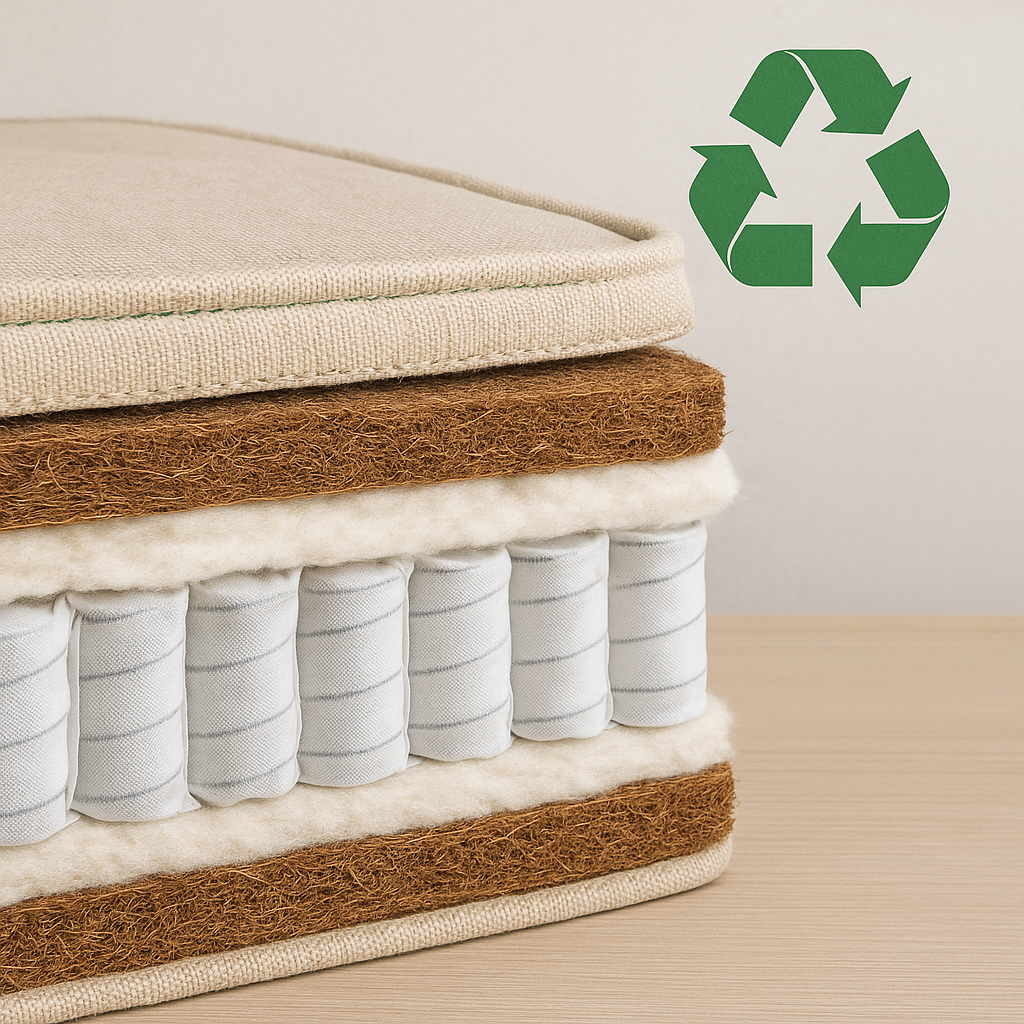
A mattress is a composite product whose several parts can be recovered at the end of its life. Polyurethane foams are crushed and then transformed into insulating panels or underlays for automobiles. Steel springs are sorted and melted down to produce new metal objects. Textile or natural fibers are recycled into industrial felts or padding. Finally, latex — natural or synthetic — can be recovered depending on its composition, with natural latex being more easily reintegrated into new processes.
Reuse vs Recycling
These two pathways do not address the same situations. Reuse involves giving away or reselling a mattress that is still in good condition, offering it a second useful life without transformation. Recycling, on the other hand, applies to a worn or degraded mattress: its materials are dismantled and reintegrated into other industrial sectors. The ideal is to always prioritize reuse when the condition of the mattress allows it, with recycling taking over when that is no longer possible.
Why Recycle Your Mattress?
Benefits
Recycling a mattress is primarily about preventing it from ending up buried in a landfill or incinerated unnecessarily. This helps reduce the volume of bulky waste, recover materials that required a lot of energy to produce, and limit CO₂ emissions associated with incineration. On a national scale, the millions of mattresses collected each year by the Écomaison sector represent tens of thousands of tons of secondary raw materials reintroduced into circulation.
Limitations
Mattress recycling faces some practical obstacles. Not all mattresses are accepted: those that are heavily soiled or infested with bedbugs are systematically refused for health reasons. The number of specialized dismantling sites remains limited (about ten in France), which implies sometimes complex collection logistics depending on the regions. Finally, consumer awareness is growing, but the reflex to drop off a mattress at a waste disposal site rather than abandoning it on the sidewalk is not yet universal.
What Alternatives to Recycling?
| Solution | Advantages | Disadvantages |
|---|---|---|
| Recycle via an eco-organization | Traceability, regulatory framework | Variable network depending on regions |
| Donate to an association | Solidarity gesture, useful | Must be in good condition |
| Collection in-store | Convenient, often free | Only during a replacement |
| Municipal waste disposal | Accessible to all | Transport at the individual’s expense |
Examples of Local Initiatives
Several players in the sector have implemented concrete services to facilitate the end-of-life of mattresses. IKEA offers free pickup when purchasing a mattress in-store. Brands like Emma or Tediber include home pickup services. Solidarity networks like Emmaüs or Recycl’Matelas take care of reuse or transport to approved channels. These initiatives complement the public system and allow everyone to find a solution suited to their geographical situation and the condition of their mattress.
Practical Tips for Managing the End of Your Mattress’s Life
Anticipating the replacement is the first reflex to adopt: organize the pickup of the old mattress even before the delivery of the new one, to avoid storing a bulky item unnecessarily. Check the condition of your mattress — if it is clean and dry, donating it to an association remains the most virtuous solution. Locate nearby collection points via the Écomaison website or directly with your town hall. Finally, think from the moment of purchase to choose mattresses designed to be more easily recycled: models made of natural latex, removable and without glue, or those certified with recyclable foams greatly facilitate end-of-life treatment.
When the time comes to replace your mattress, our complete guide to choosing your mattress will help you find a durable and easy-to-recycle model. To delay this deadline as much as possible, also consider properly cleaning and maintaining your mattress .
If you are looking for a mattress designed from the start to last and be easily recycled, 100% natural latex — removable and mono-material — is one of the most virtuous options at the end of its life. Models certified without glue or synthetic foam are particularly recommended for their ease of dismantling:
Find a recyclable natural latex mattress on Amazon.frYou can also find all our tips for maintaining your bedding and extending its lifespan on our bedding maintenance space .
FAQ
Is my mattress recyclable?
Most modern mattresses are partially recyclable: according to Écomaison, a mattress can be recovered up to 85 to 90% of its mass, and the overall recovery rate of the sector now exceeds 97%. Metal springs are melted down, polyurethane foams are transformed into insulating panels or felt for automobiles, and textile fibers are reused as padding. However, mattresses that are too soiled (significant stains, urine), damp, or infested with bedbugs are not accepted in recycling channels: they are then incinerated for health reasons. To maximize recycling chances, keep your mattress clean and dry until its collection, and protect it with a mattress protector from the moment of purchase — a simple gesture that makes all the difference at the time of pickup.
Where to dispose of an old mattress?
Never abandon your mattress on public roads: illegal dumping can result in a fine of up to €1,500. Several free solutions exist. The municipal waste disposal site accepts mattresses in the “furniture” bin connected to the Écomaison sector. You can also locate a dedicated collection point on the Écomaison website, which lists over 12,000 points in France. Finally, most sellers offer to take back the old mattress upon delivery of the new one, often at no extra cost thanks to the eco-contribution already paid at the time of purchase. Anticipate this pickup at the time of ordering to avoid having to store the old mattress for several days.
What is the cost of recycling?
For the individual, recycling is generally free as it is already funded by the eco-contribution — sometimes called eco-tax — paid when purchasing the new mattress. This amount, displayed separately on the invoice, usually ranges from €2 to €12 depending on the size of the mattress and serves to cover collection and end-of-life treatment. Disposal at the waste site and pickup in-store during a replacement are therefore without additional costs for the consumer. The only case where a cost may arise is for a home pickup carried out by a private provider independent of any purchase, charged per trip according to the professional’s rates.
Can I sell an old mattress?
Yes, absolutely, provided that the mattress is in generally good condition: without visible sagging, significant stains, and free from any infestation. Peer-to-peer resale platforms (Le Bon Coin, Vinted) allow for giving a second life to a still healthy mattress, particularly for occasional uses — guest room, student housing, etc. If resale does not find a buyer, associations like Emmaüs or Secours Populaire sometimes accept mattresses in good condition to redistribute to families in need: inquire directly with the local branch, as acceptance criteria vary. Be sure to indicate the age of the mattress and its precise condition in your ad or donation request, so the recipient can evaluate transparently.
How do I know when my mattress really needs to be replaced?
Beyond 8 to 10 years, several concrete signs indicate that it is time to change: visible sagging in the center or on the sides, regular awakenings with back or neck pain, feeling the springs under the comfort surface, or persistent odors despite careful maintenance. A degraded mattress directly impacts sleep quality and postural health, sometimes insidiously — one gets used to poor sleep without identifying the cause. If you are still unsure, lie down on a new mattress at a retailer: the difference in support is often immediately perceptible and serves as the best indicator for making a decision.
What types of mattresses are easiest to recycle?
The easiest mattresses to recover at the end of their life are those made of a single main material — what are called “mono-material” products. A 100% natural latex removable mattress, for example, can be completely dismantled without glue or complex assembly, which facilitates sorting and recovery of each component. In contrast, multi-layer memory foam mattresses that are glued together are more difficult to dismantle, even though the Écomaison sector accepts them. When purchasing, prioritize models with a removable and washable cover, without glued synthetic components inside: this will significantly simplify their treatment when the time comes for replacement.