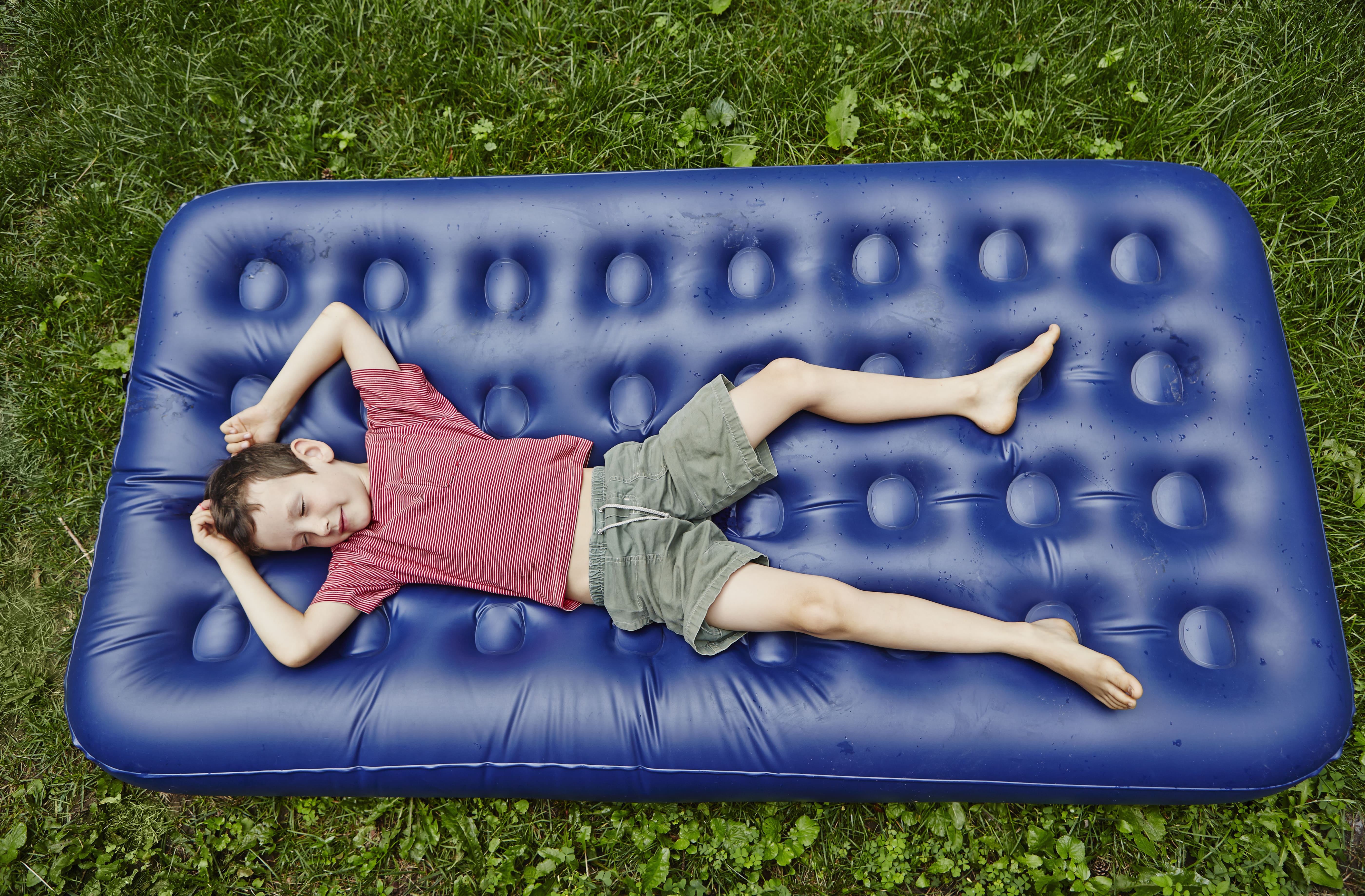
The inflatable mattress attracts many consumers in search of a practical guest bed, whether to accommodate guests, go camping, or temporarily furnish a small space. But can it really compete with a traditional folding or futon mattress? Here is our detailed analysis to help you make the right choice.
Quick Comparison
| Criteria | Inflatable Mattress (air) | Traditional Guest Mattress |
|---|---|---|
| Comfort | Adjustable, less homogeneous | Stable, close to a real mattress |
| Firmness / support | Adjustable (air) | Often firm, constant |
| Morphology | Good (air chambers) | Variable depending on materials |
| Thermal regulation | Average, limited insulation | Often better (foam, cotton) |
| Durability | Vulnerable to punctures | More robust, longer lifespan |
| Maintenance | Quick cleaning | Washable cover |
| Ecology | PVC/plastic, low recyclability | Sometimes eco-friendly |
| Budget | Affordable, very accessible | Variable, often more expensive |
| Bed base | To be placed on the floor | Compatible with bed base (foldable, futon) |
Quick Overview of Options
Air Mattress
The air mattress relies on one or more air chambers inflated with a manual or electric pump — or even with an integrated pump in high-end models. Its main uses are camping, hosting occasional guests, and emergency sleeping arrangements. Today, there is a wide range of variants: ultra-compact models for hiking, thick domestic comfort models with integrated pumps, and medical models with adjustable pressure by zone.
Browse available air mattresses on Amazon.frClassic Guest Mattress
The classic guest mattress comes in three main categories: the foldable model (compact, easy to store), the futon (inspired by Japanese tradition, usable on the floor or on a bed frame), and the rollable model. Common materials include polyurethane foam, cotton, and latex. More stable than the inflatable, this type of bedding is often more suitable for semi-regular use and can be placed directly on a slatted base or floor.
To compare all the sleeping solutions available on the market, our mattress comparison guide provides you with an updated overview.
Detailed Comparison
Comfort
The inflatable mattress offers adjustable comfort: you just need to adjust the amount of air to achieve the desired firmness. However, some entry-level models tend to be less uniform, with a risk of gradual sagging during the night. Premium models that are 30 cm thick or more mimic traditional mattresses more closely, particularly thanks to air chambers structured in columns or cells. The classic guest mattress, on the other hand, provides more stable and predictable comfort — its quality mainly depends on the density of the foam or the thickness of the cotton.
Firmness and Support
The firmness of the inflatable mattress is adjustable, making it versatile. However, this support remains imperfect for individuals suffering from chronic back pain: the air redistributes under the weight of the body, and lumbar support may prove insufficient, especially in single-chamber models. The classic guest mattress offers more uniform and long-lasting support, as it does not depend on internal pressure.
Thermoregulation
This is one of the weak points of the inflatable mattress: the trapped air captures the cold from the ground and can make the night uncomfortable in winter or while camping in cool weather. A wool or memory foam topper placed on the inflatable significantly improves thermal insulation. The classic guest mattress, thanks to its solid materials (foam, cotton, latex), naturally insulates better from the cold of the ground.
Durability and Maintenance
The main risk of the inflatable mattress is puncturing, especially if the ground is not inspected before use. With occasional use and careful maintenance (complete drying before storage, storing away from sharp objects), a good inflatable can last from 3 to 5 years. With daily use, the lifespan drops to about 1 or 2 years. The classic guest mattress is more robust: its cover is generally machine washable, and the foam or cotton withstands repeated mechanical stress better.
Environmental Impact
The inflatable mattress is primarily made of PVC or TPU (thermoplastic polyurethane), two plastics that are difficult to recycle at the end of their life. The classic guest mattress can, depending on the models, use natural fibers (organic cotton, FSC or GOLS certified latex), giving it a more favorable ecological footprint. If environmental considerations are important to you, prioritize OEKO-TEX® or GOTS certifications on classic mattresses.
Budget
The inflatable mattress remains the most accessible option: entry-level models start at around €10, while premium versions with built-in pumps and multi-chamber technology range from about €80 to €150. The classic guest mattress is generally more expensive for equivalent comfort, but its durability-to-cost ratio over time is often better.
View on AmazonChoosing Tips
The choice between inflatable and classic primarily depends on the frequency of use and the context. For occasional use — weekends with friends, camping nights, or occasional emergencies — the inflatable mattress is ideal: compact, lightweight, and inexpensive. For regular or semi-daily use, a classic guest mattress or a futon is necessary, offering better support and increased durability.
Practically speaking, a few simple actions can extend the life of an inflatable: choose a model that is at least 30 cm thick for more comfort, protect it with a fitted sheet, inspect the ground before use, and store it deflated in a dry, cool place. To improve thermal comfort, place an insulating mattress pad between the inflatable and your bedding.
If you are considering switching to a more durable sleeping solution for daily use, Someo mattresses, made in France with certified materials, are a serious alternative:
View on AmazonFAQ
What is the lifespan of an inflatable mattress?
The lifespan of an inflatable mattress varies significantly depending on the frequency of use and the quality of maintenance. With daily use, expect 1 to 2 years before micro-leaks or gradual sagging compromise comfort. For occasional use — a few nights a month or a few weekends a year — a good model can last 4 to 5 years. To maximize this duration, inspect the ground before laying it out (no rough spots, no stones), dry it thoroughly before storing, and store it deflated in a protective cover, away from heat and sharp objects. In case of a small puncture, the repair kits included in many models allow for quick patching of the breach.
Can you place an inflatable mattress on a bed frame?
It is strongly advised against placing an inflatable mattress on a slatted or spring bed frame. The bottom of the inflatable, usually made of smooth PVC, is not designed to withstand the pressure points of the slats: these may cause micro-cracks or punctures, especially with body weight. Additionally, the surface of a bed frame is rarely flat, creating an uncomfortable imbalance. The inflatable mattress is designed to be used flat, directly on the ground or on a rigid and flat surface. If contact with the ground bothers you, place it on a thick rug or a protective foam pad.
How to properly maintain an inflatable mattress?
Regular maintenance is key to a long lifespan. To clean the surface, use a slightly damp sponge with a bit of mild soap or diluted dishwashing liquid; avoid abrasive products or solvents that can damage the PVC. Rinse with a clean sponge and let it dry in the shade — never expose it directly to sunlight, as UV rays degrade the material. Before storing the mattress, ensure it is completely dry to prevent mold growth. Fold it without forcing on the valves and place it in its storage bag, in a dry and temperate space. Avoid storing it under heavy objects that could compress the air chambers.
Is it suitable for children?
The inflatable mattress can be suitable for children for occasional use, under adult supervision. For young children, prefer low models (less than 20 cm in height) to limit the risk of falling during the night. Inflatable mattresses that are too high should be avoided for those under 6 years old. Also, ensure that the surface is non-slip or placed on a rug, and use a well-fitted fitted sheet to avoid any risk of suffocation related to poorly secured bedding. For children with allergies, note that PVC can retain heat and promote sweating.
Does the inflatable mattress make noise at night?
Yes, some inflatable mattresses may emit creaking or rubbing noises, especially when placed directly on a hard floor (wood, tile). This noise comes from the friction between the PVC base and the floor surface, amplified by the movements of the sleeper. To remedy this, place a non-slip base, a thick floor mat, or a folded blanket between the inflatable and the ground. Higher quality models, equipped with a flocked base (soft to the touch), generate significantly less noise and adhere better to the floor. If you are sensitive to nighttime noise, it is worth investing in a mid-range or premium model.