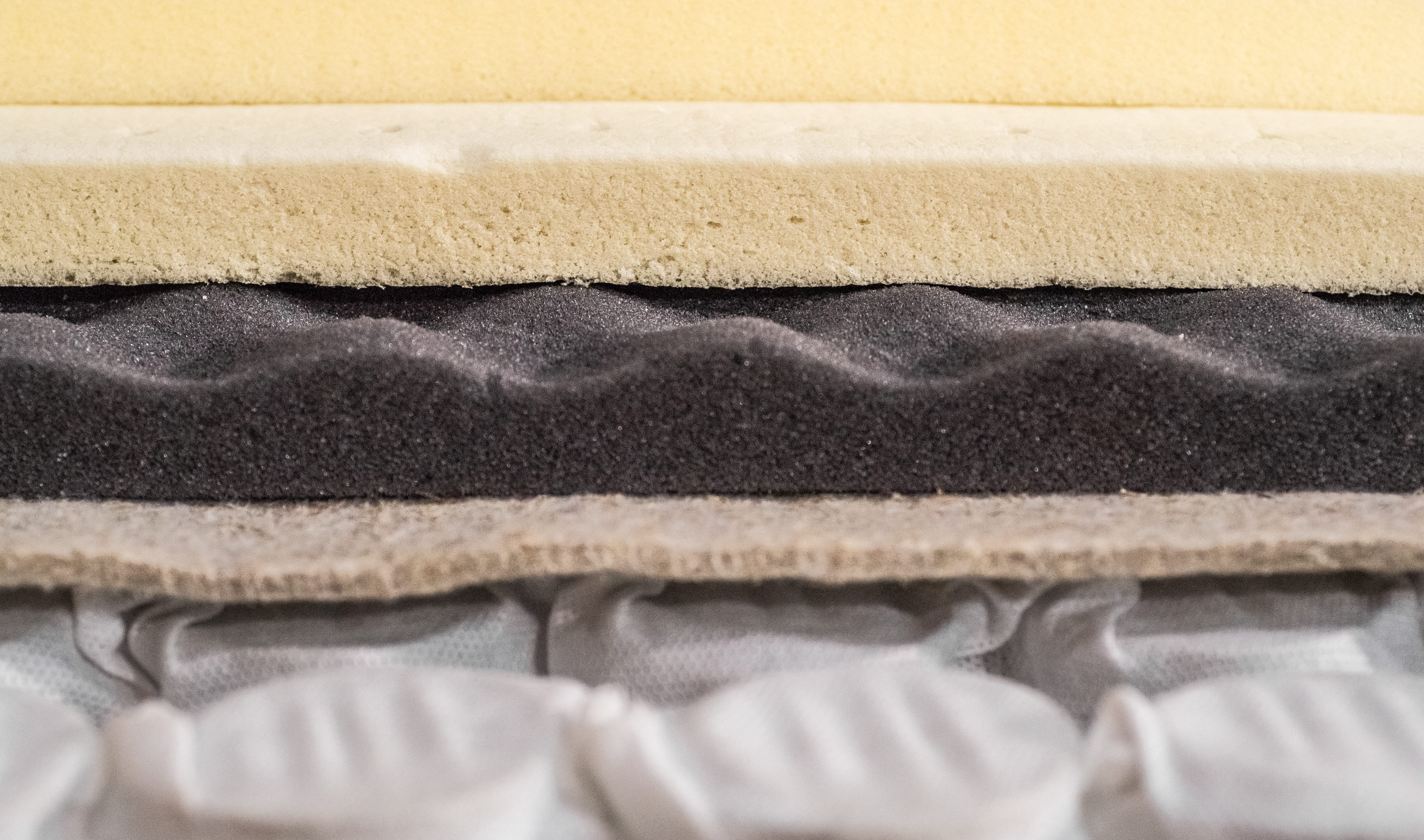
Choosing between a foam mattress or a latex mattress involves understanding the differences in comfort, composition, durability, and price. This structured and factual comparison guides you towards the solution that best suits your profile.
Why is this comparison relevant?
With the rapid evolution of technologies — high-density foams, 100% natural latex, hybrids — it becomes difficult to navigate. The right choice directly impacts sleep quality, back support and muscle recovery.
The stakes for the buyer
An unsuitable mattress can cause back pain, nighttime awakenings, or non-restorative sleep. This guide helps identify the essential criteria for your comfort and health, whether it’s your first purchase or a replacement after several years of use.
Foam vs Latex: Detailed Comparison
1. Comfort
Foam Mattress
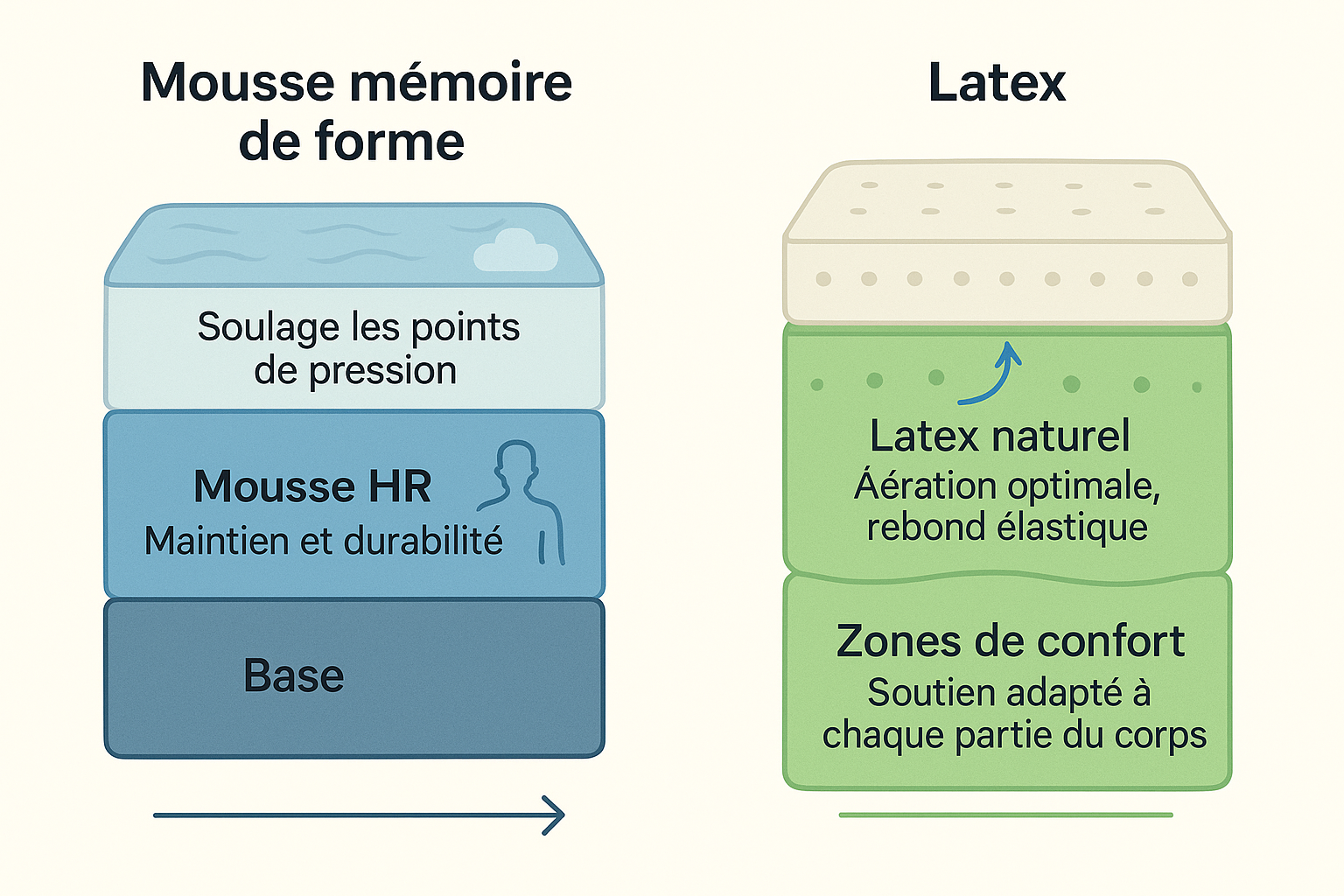
Foam provides a plush or memory foam feel depending on its formulation. Its support is progressive and adapts to the body shape, which appeals to those looking for a “hugging” effect. Motion isolation is good, especially on high resilience (HR) foams. The sensation also changes with ambient temperature: in winter, the memory foam feels slightly firmer before softening upon contact with body heat, a phenomenon to anticipate if your room is cool.
Latex Mattress
Latex is characterized by a bouncy feel and is less enveloping than memory foam. It offers firm support with differentiated zones and very good motion isolation — ideal for couples with different body shapes. Unlike memory foam, latex reacts instantly to position changes, without a “hammock” effect: you can turn over without feeling held back by the material.
2. Composition & Certifications
- Foam: polyether (entry-level), HR polyurethane, viscoelastic (memory foam)
- Latex: synthetic, mixed, or 100% natural (plant-based, from rubber trees)
- Certifications to look for: OEKO-TEX, GOLS (organic natural latex), GOTS (organic cover), Eurolatex
- Lifespan: foam 7–10 years, latex 10–15 years
The GOLS (Global Organic Latex Standard) certification is the most stringent reference for natural latex: it ensures that the rubber comes from certified organic plantations and that the finished product contains no harmful substances. For foam, the OEKO-TEX Standard 100 certifies the absence of dangerous chemicals in the final composition — a minimum requirement regardless of the price range.
3. Breathability
Foam retains more body heat, unless it is perforated or infused with gel (like Emma’s Airgocell foam). Latex, thanks to its naturally ventilated honeycomb structure, is significantly more breathable and particularly suitable for sleepers sensitive to heat or night sweats. This difference is especially noticeable in summer or in poorly ventilated rooms: latex maintains a noticeably cooler sleeping surface throughout the night, while traditional foam accumulates heat under the body within the first hours of sleep.
4. Services
Most online brands offer comparable purchasing conditions:
- Free home delivery
- 100-night trial (free returns)
- Minimum 10-year warranty
These conditions are verified in 2026 at Emma (100-night trial, 10-year warranty) and at Kipli (100-night trial, 10-year warranty). It is important to note that return conditions vary by brand: some companies pick up the mattress directly from your home, while others partner with a charity for donation. Inquire about the procedure before purchase to avoid unpleasant surprises if the trial does not convince you.
5. Value for Money
Foam remains the most accessible technology: a good HR foam or memory foam mattress is available from around €300–400 for a 140×190 cm size (the Emma Original is offered from ~€359 in this size). Latex is more expensive to purchase — expect to pay from ~€800–900 for a 140×190 cm certified GOLS natural latex mattress — but its superior longevity (10–15 years) makes it cost-effective in the long run. When broken down to annual cost, a quality latex mattress often ends up being cheaper than a budget foam model replaced twice over the same period.
6. Reputation & Customer Reviews
Foam mattresses are very popular online, with brands like Emma or Slome (formerly Hypnia) accumulating thousands of positive reviews. On the latex side, Kipli and LatexBio receive excellent ratings for their durability and commitment to eco-design, an increasingly decisive criterion for buyers concerned about environmental impact.
Comparison of Representative Models
Find a memory foam mattress on Amazon View on AmazonSynthetic Comparison Table
| Criterion | Foam (Emma, Slome) | Latex (Kipli, LatexBio) |
|---|---|---|
| Comfort | Soft to balanced | Firm, bouncy |
| Support | Progressive | Differentiated zones |
| Duo sleeping | Very good | Excellent |
| Ventilation | Average to good | Excellent |
| Lifespan | 7–10 years | 10–15 years |
| Labels | OEKO-TEX | GOLS, GOTS, Eurolatex |
| Indicative price (140×190) | Starting from ~300–800 € | Starting from ~800–1,400 € |
Who is each technology for?
- Foam mattress: small budgets, guest rooms, sleepers looking for a cozy feel
- Latex mattress: heavy night sweating, allergies, couples, people prioritizing longevity and eco-design
To absolutely avoid
- A mattress that is too soft if you suffer from chronic back pain
- A poorly ventilated model if you sweat a lot at night
- Any purchase without a trial period: 100 nights is an essential minimum
Your comfort preferences at a glance
- Soft / enveloping → memory foam
- Firm / bouncy → certified GOLS natural latex
- Mixed / balanced → hybrids (foam + springs or latex + springs)
To compare other technologies and refine your choice, check out our mattress comparison section .
FAQ: your questions, our answers
What is the lifespan of a foam or latex mattress?
Memory foam lasts on average 7 to 9 years depending on its density — aim for a minimum of 50 kg/m³ for longevity. Quality HR polyurethane foam lasts 8 to 10 years. Certified GOLS natural latex is significantly more durable: it can last 12 to 15 years without significant sagging, which offsets its higher purchase price. In any case, a suitable foundation (slats spaced a maximum of 6 cm apart) and the use of a mattress protector significantly extend the lifespan of the whole. Also, remember to flip your mattress head-to-foot every six months or so: this simple habit evenly distributes wear and prevents the formation of localized dips, especially on foam.
Is latex suitable for allergic individuals?
Yes, 100% natural latex is naturally hypoallergenic, antibacterial, and dust mite resistant due to its dense structure that prevents allergenic agents from settling. GOLS and Eurolatex certifications guarantee the absence of harmful substances in the formulation. However, caution is advised: individuals with a specific latex allergy (Hev b proteins) should avoid this material and opt for HR foam or pocket springs with a certified OEKO-TEX hypoallergenic cover. If in doubt, consult your allergist before any purchase, as a latex allergy can develop gradually even in individuals who previously did not suffer from it.
Is foam mattress too hot to sleep on?
Classic memory foam can indeed retain body heat, which disrupts sleep for temperature-sensitive individuals or those prone to night sweats. However, several technologies mitigate this flaw: perforated foams (vertical ventilation channels), gel-infused foams (like Emma's Airgocell), and thermoregulating covers made of Tencel or Lyocell fibers. If you sweat a lot at night, prefer a latex mattress (naturally breathable honeycomb structure) or a hybrid mattress with pocket springs, which offer significantly better air circulation and maintain a more stable surface temperature throughout the night.
Can foam and latex be combined in the same mattress?
Yes, this is actually the principle behind many premium hybrid mattresses available in 2026. A layer of natural latex on the surface provides breathability and immediate buoyant comfort, while an HR foam base ensures durable and stable support over time. Some manufacturers add an intermediate layer of pocket springs to further enhance sleeping independence and ventilation. These three-layer mattresses combine the best of both technologies, but their price is generally higher than a single-material model: expect to pay around ~700–800 € for a quality 140×190 cm. They are particularly suitable for couples with different thermal sensitivities.
What mattress should a couple with different body types choose?
For a couple whose sizes or sleeping positions differ, sleeping independence is the number one criterion: one partner's movements should not disturb the other. Natural latex excels in this area due to its density and localized elasticity. Pocket springs combined with HR foam are another excellent option, as each spring works independently. If the body types are very contrasting (for example, one slim person and one heavier person), opt for a dual comfort mattress — two halves of different firmness — or a zippered model that allows for two separate configurations. In any case, take advantage of the 100-night trial to validate the choice together before making any final decision.
Is a special foundation needed for a latex mattress?
Natural latex is a heavy and dense material that requires a rigid and regular support. A slatted base with flexible slats spaced less than 6 cm apart is ideal: it absorbs mechanical stress while allowing ventilation from below, extending the mattress's lifespan. Avoid slatted bases with too wide spacing (beyond 8 cm) that create localized pressure points and accelerate latex wear. A flat box spring is also suitable as long as it is well-ventilated (with raised feet). However, bed frames with very few cross supports should be absolutely avoided with latex, as they risk premature deformation.
What foam density should be prioritized for good back support?
Density is the key indicator of the quality and longevity of a foam mattress. For a primary sleeping surface intended for an adult, aim for a minimum of 35 kg/m³ for HR polyurethane foam and 50 kg/m³ for memory foam — below these thresholds, rapid sagging leads to insufficient lumbar support and medium-term back pain. High-end models reach 60 to 70 kg/m³, ensuring a lifespan close to that of latex. Also, consider the indentation load deflection (ILD or Newton): the higher this number, the firmer the foam. An ILD between 20 and 30 corresponds to medium comfort, suitable for most profiles. If you suffer from lower back pain, a slightly higher ILD, combined with a breathable cover, often represents the best compromise between support and contact comfort.