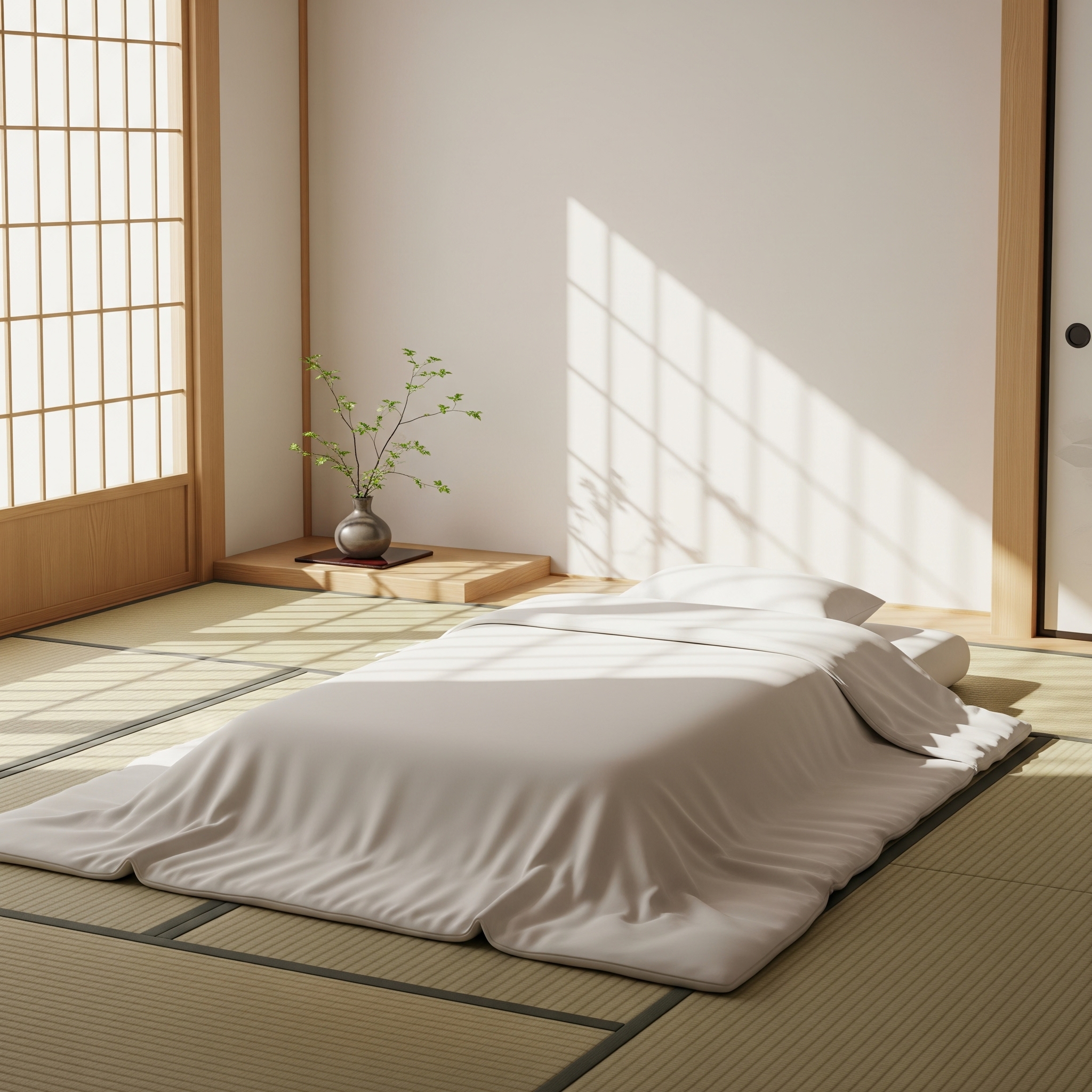
In a world where sleep disorders affect nearly a third of the population, exploring traditions from elsewhere can offer concrete ways to improve our rest. Japanese sleep, rooted in the philosophy of minimalism and the balance of body and mind, is increasingly appealing in the West. At the heart of this approach: the futon — a thin, firm, and rollable mattress placed directly on the floor on a tatami.
If you are looking to improve the quality of your sleep, our complete guide to choosing your mattress can help you find the solution suited to your body type and needs.
Why adopt Japanese sleeping habits?
A benefit for posture and back health
The futon offers firm support that promotes the natural alignment of the spine. Unlike a very soft mattress that allows the pelvis to sink, the firm surface of the futon maintains the lumbar curve in a position close to that adopted while standing. This principle particularly appeals to those experiencing tension in the lower back, although this effect remains individual and in no way replaces medical advice. Individuals suffering from a severe spinal condition should consult a healthcare professional before changing their bedding.
Enhanced hygiene
Easy to roll up and store each morning, the futon allows for natural daily ventilation. This habit—derived from Japanese daily life—significantly limits the accumulation of moisture, dust mites, and dust, creating a healthier sleep environment in the long run. The bedroom regains its function as a living space during the day, freed from the space occupied by a fixed bed.
A simpler lifestyle
The futon fits into a minimalist lifestyle: a clean bedroom, absence of a box spring or bulky furniture, multifunctional space. This lighter relationship with the bedroom aligns with the Japanese concept of ma (間), the empty space experienced as a resource rather than a lack. Less clutter, more serenity.
Criteria for Choosing a Good Japanese Futon
1. Dimensions
- 1 person: 90 × 200 or 100 × 200 cm
- 2 persons: 140 × 200 cm (traditional format) or 160 × 200 cm (wider, more comfortable)
- Thickness: from 5 to 15 cm depending on the desired firmness and use (occasional or daily)
2. Firmness and Comfort
- Dense cotton core: very firm, closest to the Japanese tradition
- Wool core: firm but slightly more enveloping, good thermal insulation
- Natural latex core: firm but softer, better suited for side sleepers who need slight contouring of the shoulder and hip
3. Materials
- Filling: 100% organic cotton, French wool, or natural latex
- Cover: organic cotton, untreated linen, or traditional Japanese fabric (futon-gawa)
- Prefer certifications GOTS (organic cotton) or OEKO-TEX to ensure the absence of harmful substances
4. Foldability and Weight
- The futon should be easily rolled or folded into three for storage in the morning
- A reasonable weight (less than 8–10 kg for a 90 × 200 cm) facilitates daily handling
5. Budget
- Entry-level: starting from ~€150 for a basic cotton futon
- Mid-range: starting from ~€400–600 for models in organic cotton or wool, carefully made
- Premium and artisanal: traditional Japanese futons handmade or imported directly from Japan can exceed €800–1,000
Our Recommendations for Japanese Futons (2026)
1. 100% Cotton Futon – Futons.fr
Filled with densified natural cotton, this futon with a thickness of 14 cm offers a very firm sleeping surface, true to tradition. Its European manufacturing ensures rigorous quality control and reasonable delivery times. It is particularly suitable for back sleepers who want a clear transition to sleeping on the floor.
Discover the 100% cotton futon on Futons.fr
2. Natural Kipli Futon – Wool or Organic Cotton
The Kipli futon is handcrafted to order in Aveyron. It is available in two natural fillings: French wool or organic cotton, all wrapped in an untreated French linen cover. No synthetic foam or chemical treatment is included in its composition. It is a solid choice for those sensitive to materials and concerned about eco-friendly bedding.
Discover the natural Kipli futon – wool or organic cotton
3. JAP Cotton Futon 15 cm – Futon Boutique
With its 15 cm of densified cotton, this artisanal model offers a firm sleeping surface while providing a minimum of softness for long stays on the floor. Its good longevity makes it a relevant investment for daily use.
Discover the JAP 15 cm futon on Futon Boutique
4. Firm Futon or Mattress – Amazon
For a first approach on a budget, Amazon offers a wide selection of cotton or polyester futons, useful for testing floor sleeping before investing in an artisanal model. Filter by thickness (8–12 cm) and check the filling composition before purchasing.
See the available Japanese futons on Amazon.frPractical Tips
Mistakes to Avoid
- Choosing a futon that is too thick right away: start with 8–10 cm if you have never slept on the floor; a very thick futon dampens the characteristic firmness of this experience and will not allow you to assess how your body adapts.
- Using it on a slatted base: the futon is designed to rest on a hard, flat surface — floor, tatami, or low platform. Slats create uneven pressure points that accelerate wear on the filling.
- Leaving it in place without airing it out: body moisture accumulates quickly under a futon placed on the floor. Roll it up every morning, even for a few hours.
Maintenance Tips
- Air out and flip the futon every two to three days for daily use
- Use a cotton percale or linen fitted sheet, breathable and easy to wash
- Lightly beat it with a stick or shake it outside to restore its volume, especially for cotton futons that compress over time
- In case of persistent humidity (poorly ventilated apartment, winter), place an insulating rug or tatami between the floor and the futon
Specific Profiles
- Back sleepers: the traditional cotton futon is ideal, the flat surface perfectly supports the lumbar region
- Side sleepers: opt for a thicker model (12–15 cm) or one with a wool core, to cushion pressure on the shoulder and hip
- Back sensitivity: a hybrid model or one with a wool core offers a better compromise between firmness and enveloping
FAQ
Is sleeping on a futon good for the back?
Sleeping on a futon can relieve some lower back tension, especially for people who previously slept on a mattress that was too soft, causing the pelvis to sag. The firm surface promotes a more natural alignment of the spine during the night. That said, the effect is very individual: certain body types — particularly thin side sleepers or individuals suffering from spinal conditions like a herniated disc — may instead feel increased pressure on the hips or shoulders. In this case, a thicker futon or one with a wool core would be a better compromise. If pain persists, consult a doctor or physiotherapist before changing your bedding.
Can you put a futon on a slatted bed base?
No, it is not recommended. The Japanese futon is designed to rest on a firm and even surface — the floor, a tatami mat, or a low solid wood platform. When placed on spaced slats, the filling (cotton or wool) gradually deforms in the empty spaces, creating bumps and hollows that reduce comfort and accelerate the futon’s wear. If you want to elevate your futon, opt for a low frame with a flat surface, such as a sukiya style wooden bed or a low platform without slats.
What is the lifespan of a Japanese futon?
With daily use and regular maintenance, a quality futon lasts between 5 and 10 years. Densified cotton futons gradually compress over time, especially if they are not flipped and aired regularly. Wool or natural latex futons tend to maintain their shape better over time. To extend the life of your futon, flip it every two to three days, air it daily by rolling it up, and have it beaten or shaken outside once or twice a season. A well-maintained handcrafted futon can easily exceed 7 years.
Is a futon suitable for winter?
Yes, provided you pair it with the right accessories. Cotton alone is a poor thermal insulator: it does not block the cold rising from the ground, especially on poorly insulated tile or hardwood floors. In winter, place a tatami mat or a thick rug between the floor and the futon to break the thermal bridge. Add a warm duvet or a wool blanket on top. Wool-filled futons naturally offer better insulation than those made of pure cotton. In a well-heated home, the comfort difference compared to a traditional bed remains minimal once these adjustments are made.
Do you need a tatami mat to use a Japanese futon?
A tatami mat is not essential, but it significantly improves the comfort and hygiene of your setup. When placed directly on hardwood or tile, the futon fulfills its role perfectly, provided the floor is clean, dry, and flat. However, the tatami provides a slight additional flexibility under the futon, valuable thermal insulation in winter, and natural humidity regulation thanks to the sea rush or rice straw fibers it is made from. If your floor is cold or poorly insulated, investing in one or two quality tatami mats is a very useful addition.
What is the difference between a Japanese futon and a Western futon sold in stores?
The futon sold in Western furniture stores is often very different from the traditional Japanese futon (shikibuton). The Western model is generally thicker (15–20 cm), softer, filled with polyurethane foam or synthetic fibers, and designed to be placed on a sofa or bed base. The authentic Japanese futon is thinner (5–15 cm), firmer, made exclusively of natural fibers (cotton, wool, latex), and designed to be rolled and stored daily. If you are aiming for a Japanese sleeping experience, make sure to choose a model explicitly designed for floor use, with densified natural filling.