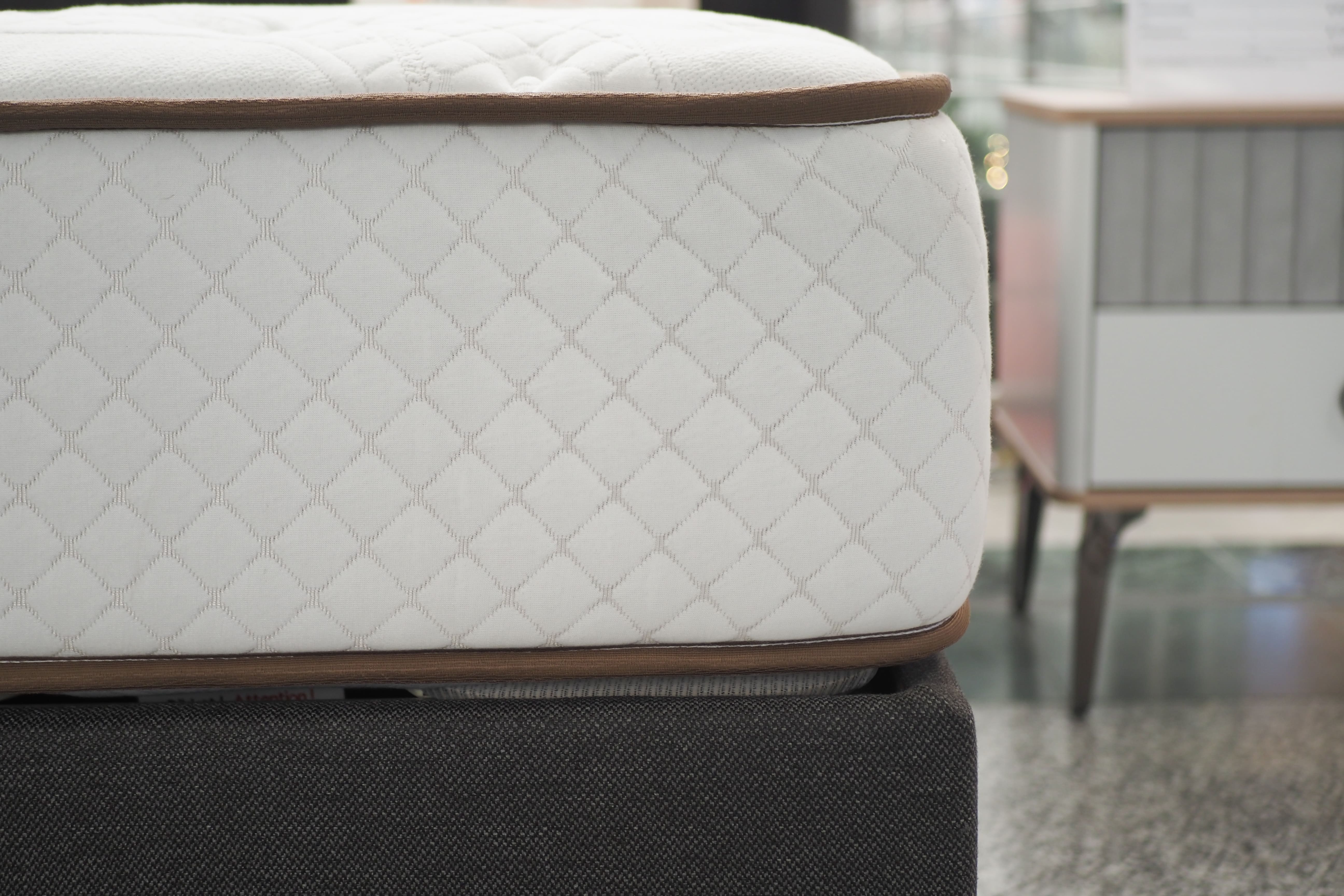
Choosing a mattress is an essential decision that directly impacts your sleep quality, health, and daily well-being. An unsuitable mattress can cause back pain, nighttime awakenings, or a persistent feeling of fatigue. Conversely, a well-chosen mattress promotes recovery, spinal alignment, and deep sleep.

Why is mattress choice essential?

An appropriate mattress is the foundation of restorative sleep. It plays a key role in:

  • Spinal alignment
  • Personalized support based on weight and body shape
  • Optimal muscle recovery
  • Prevention of sleep disorders

According to the National Institute of Sleep and Vigilance (INSV), the quality of bedding directly influences sleep quality.

Important selection criteria

a. Firmness

  • Firm: for heavier individuals (>90 kg), or those sleeping on their back/stomach.
  • Balanced: for average body types (60–90 kg) and mixed positions.
  • Soft: for lighter individuals (<60 kg) or those sleeping on their side.

b. Body shape and weight

  • <60 kg: soft or plush
  • 60–90 kg: balanced or medium-firm
  • 90 kg: firm to very firm

c. Sleeping position

  • On the back: firm or balanced
  • On the side: soft or balanced
  • On the stomach: firm or balanced

d. Technology

  • Pocket springs: good support, ventilation, independence of sleeping.
  • Memory foam: enveloping, relieves pressure points.
  • Latex: natural, breathable, resilient.
  • HR foam: good price/support compromise.

e. Other criteria

  • Dimensions suitable for the sleeper and the room
  • Budget: good mattress from €300–600
  • Maintenance: removable, hypoallergenic cover
  • Ecology: natural latex, European manufacturing, certifications

Firm, balanced, or soft mattress: which one to choose?

Mattress TypeFor whom?AdvantagesDisadvantages
Firm> 90 kg, back/stomachSupport, durability, good for the backToo hard for smaller sizes, pressure points
Balanced60–90 kg, all positionsVersatile comfort, good compromiseLack of support for heavier individuals
Soft< 60 kg, side, seeking comfortPressure relief, soft welcomeSinking, lack of support for heavier weights

Our product recommendations

1. Tediber Hybrid — Balanced mattress

  • High-density foam + pocket springs, balanced welcome
  • Excellent sleeping independence, 100-night trial
  • Washable cover, hypoallergenic, 10-year warranty
  • Entry price ~€430 (frequent promotions)
Discover the Tediber Hybrid mattress

2. Cosy Lit de Mérinos — Firm mattress

  • 580 pocket springs (140x190), double-sided summer/winter
  • Extra firm comfort, 25 cm, reinforced lumbar zone
  • Ideal for back pain, OEKO-TEX® certified, made in France
See the Cosy Lit mattress on merinos.fr

3. Emma Original — Soft mattress

  • Memory foam, three adaptive layers
  • Very soft welcome, progressive support
  • Ideal for smaller sizes and side sleepers
  • 100-night trial, 10-year warranty
See the Emma Original mattress on Amazon

4. Kipli Natural Latex — Eco-friendly and balanced mattress

  • 100% natural latex, organic cotton cover
  • No chemicals, very durable
  • Hypoallergenic, ideal for sensitive individuals, 10-year warranty
Discover the Kipli natural latex mattress

5. Someo Aurore 400 — French and firm mattress

  • High resilience foam, French manufacturing
  • Reversible, excellent ventilation
  • 6-month trial, 7-year warranty, very good value for money
View on Amazon

Expert tips

Mistakes to avoid

  • Choosing a firmness unsuitable for your body shape
  • Confusing comfort and support
  • Relying solely on price
  • Neglecting the trial period

Maintenance tips

  • Air daily
  • Rotate every 3 to 6 months (if reversible)
  • Use a mattress protector + washable cover
  • Vacuum regularly, clean stains locally

Specific profiles

  • Couples: mattress with dual comfort or enhanced independence
  • Allergy sufferers: washable cover, latex, dust mite resistant
  • Reduced mobility: lightweight mattress, suitable height

If you suffer from chronic back pain, consult our dedicated guide: choosing your mattress for back pain .

FAQ – Your frequently asked questions

Should you always choose a firm mattress if you have back pain?No, this is a persistent misconception. A mattress that is too firm actually creates marked pressure points at the shoulders, hips, and pelvis, which can exacerbate back pain rather than relieve it. The goal is to find a mattress that supports the spine in its natural alignment while absorbing the broader areas of the body. For most profiles suffering from back pain, a medium-firm to balanced mattress with a progressive comfort layer (memory foam or latex) offers the best compromise. The practical rule: firmness should be adapted to your body shape, not your pathology. Check our dedicated back pain guide for more information.
How do I know if the firmness is right for me?Several simple tests can validate the right firmness during the trial. First, lie on your back for at least 10 minutes: you should not feel excessive sinking at the pelvis or a hollow under the lumbar curve. Then, turn on your side: the shoulder and hip should sink just enough for the spine to remain straight, parallel to the mattress. If you sleep on your stomach, the pelvis should not sink below the shoulder line. Always take advantage of the home trial period (100 nights with most online brands, 6 months with Someo) — it’s the only true test after 2 to 3 weeks of adjustment.
What density should I choose?Density determines durability and support. For polyurethane foam, count **at least 35 kg/m³** for occasional use and **40 to 50 kg/m³** for daily adult sleeping. For memory foam, aim for **50 to 70 kg/m³** depending on your weight — the heavier you are, the higher the density should be. For latex, the range is between **70 and 85 kg/m³**: 75 kg/m³ for balanced comfort, 85 kg/m³ for marked firmness. A mattress below these thresholds will sag prematurely, usually in 3 to 5 years. The density should be clearly indicated by the manufacturer — its absence is a warning sign.
Is a balanced mattress suitable for everyone?Yes, for the majority of sleepers, but with nuances. The balanced firmness is the most versatile and constitutes the best compromise for couples with similar body shapes, sleepers in mixed positions (alternating back/side), and profiles between 60 and 90 kg. However, it reaches its limits for individuals over 95 kg (lack of long-term support) and for smaller individuals under 55 kg sleeping strictly on their side (the welcome can sometimes be too firm to relieve shoulders and hips). In these cases, directing the choice towards a firm or soft model provides better comfort, or opting for a double-sided mattress with differentiated firmness.
When should you change your mattress?The average lifespan is between 8 and 10 years, but several signs should alert you before this deadline. Regularly check for: visible or marked hollows at the hips/shoulders, springs that can be felt, unusual noises, waking up with aches or stiffness when the bedding is not the issue elsewhere, new allergies that fade while traveling. Entry-level models with low density may show these signs as early as 5 to 6 years. Conversely, a well-maintained natural latex or high-end French mattress can last 12 to 15 years. Beyond 10 years, even without visible sagging, the mattress has accumulated dust, dust mites, and lost hygiene — a renewal is still recommended.