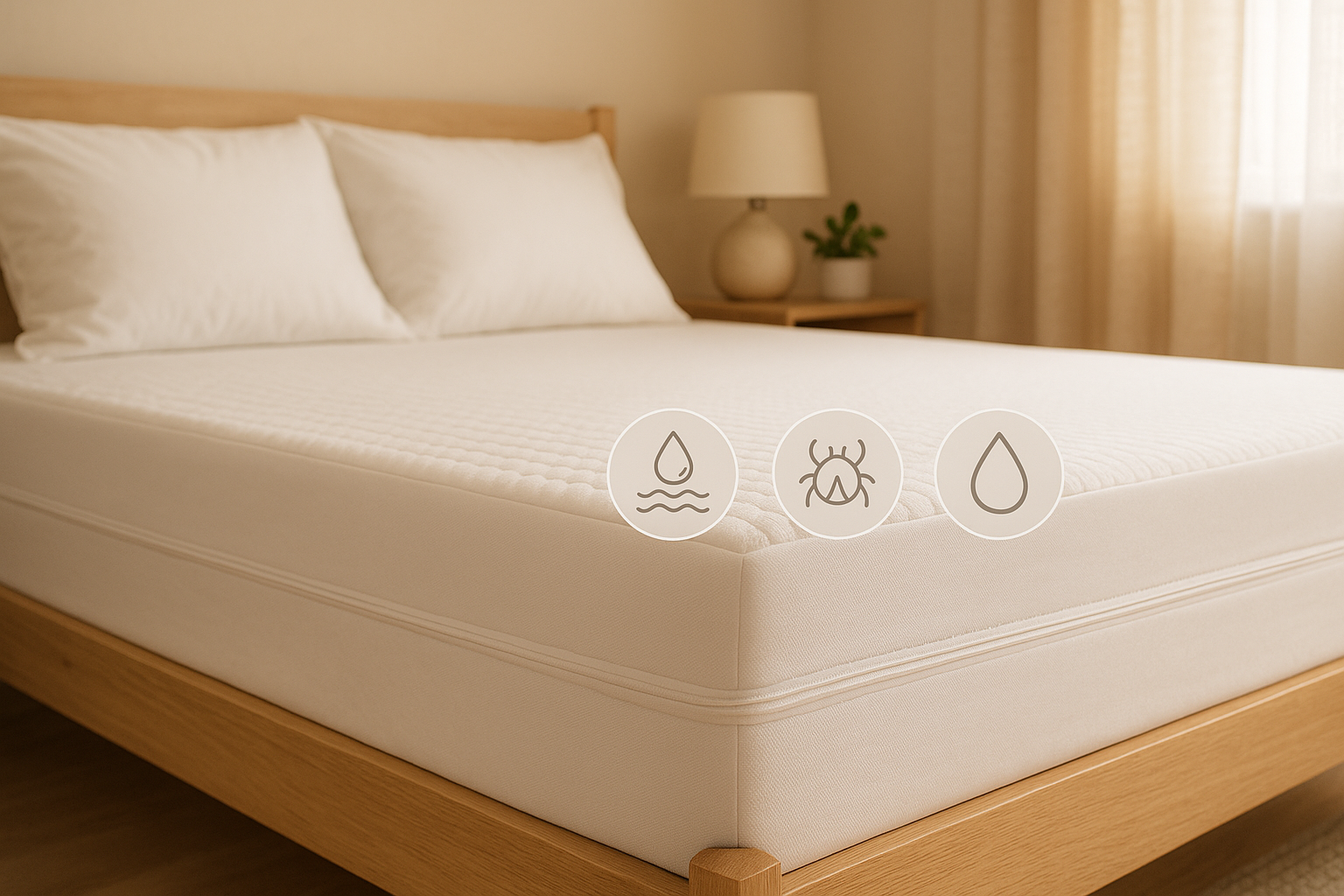
Dust mites are part of the domestic environment of almost all French households. Invisible to the naked eye, these microorganisms thrive in warm and humid environments — and the bed is their preferred habitat. For allergic individuals, prolonged contact with their droppings can trigger rhinitis, asthma, eczema, or simply disrupted nights due to itching and sneezing. However, well-chosen bedding can significantly reduce exposure to these allergens. This guide reviews all the protections available in 2026: dust mite covers, mattress protectors, suitable duvets and pillows, as well as maintenance habits to adopt.
Understanding the problem: why dust mites colonize bedding
Dust mites — primarily Dermatophagoides pteronyssinus and Dermatophagoides farinae — feed on human skin flakes (dead skin cells) and reproduce at an impressive rate as soon as the temperature exceeds 20 °C and the relative humidity hovers around 60 to 70%. An unprotected mattress can harbor several million individuals after a few years of use. It is not the mites themselves that trigger allergic reactions, but their droppings and body fragments, which break down into ultrafine particles and are easily inhaled during sleep.
For allergic individuals, sleeping eight hours a night on unsuitable bedding is equivalent to spending the night in an environment saturated with allergens. The goal of any dust mite protection is therefore twofold: to create a physical barrier that prevents mites from reaching the deeper layers of the bedding, and to facilitate regular maintenance that eliminates already present allergens.
The dust mite cover for mattresses: the fundamental protection
The first line of defense — and often the most effective — is the full mattress protection cover. Unlike a simple mattress protector that only covers the top surface, a dust mite cover envelops the mattress on all six sides and closes with a zipper. It completely isolates the mattress, even if it has already been colonized before installation.
Some covers function as a true physical barrier against dust mites and mattress allergens, without any coating or chemical treatment — which is important for individuals whose sensitivity extends to chemical treatments. The principle is purely mechanical: the tightly woven textile is dense enough that mites and their droppings cannot pass through, while remaining breathable for the comfort of the sleeper.
When choosing a dust mite cover for a mattress, it is important to check:
- The weave density (expressed in threads per centimeter or in microns): for real effectiveness against dust mites, the fabric pores must be less than 6 µm;
- Breathability: a fabric that is too impermeable can generate excessive sweating, which paradoxically promotes humidity and the proliferation of mites outside the cover;
- OEKO-TEX® Standard 100 certification: it guarantees the absence of harmful substances in the textile, which is particularly useful for sensitive skin and children;
- Ease of maintenance: the cover should be washable at a minimum of 60 °C to eliminate mites and their allergens — check that the care instructions confirm this.
The dust mite mattress protector: protection and comfort on a daily basis
The mattress protector differs from the full cover: it mainly covers the sleeping surface and the sides of the mattress but does not fully envelop it from underneath. For optimal dust mite protection, it is ideally combined with a full cover. Used alone, it remains useful as a preventive measure on a still healthy mattress.
The Tediber mattress protector, for example, is OEKO-TEX® Standard 100 certified (certificate 1290/1) and guaranteed for 2 years; it is designed without chemical treatment and offers waterproof protection through mechanical means. Its upper part is made of lyocell, a material derived from eucalyptus pulp, which is naturally soft and breathable. This type of mattress protector is made in France and benefits from the Standard 100 OEKO-TEX certification, without any chemical treatment.
This choice of mechanical protection rather than chemical is increasingly recommended: acaricides applied to certain textiles lose their effectiveness with successive washes, while a physical barrier retains its properties indefinitely, provided the mattress protector is washed regularly.
For highly sensitive individuals, it may be relevant to combine both approaches: a full cover directly on the mattress, topped with an easily washable mattress protector for regular surface hygiene.
Compare dust mite mattress protectors on Amazon.frHypoallergenic duvet and pillow: do not neglect the filling
Protecting the mattress is essential, but it has little effect if the duvet and pillows remain hotspots for dust mites. These bedding elements are particularly exposed as they are in direct contact with the sleeper, at a good temperature, and regularly humidified by night sweating.
Preferred materials
Regarding the filling, hypoallergenic synthetic fibers (hollow polyester, microfiber) have the advantage of being washable at high temperatures — often at 60 °C or even 95 °C — which effectively eliminates dust mites. In contrast, natural down (goose or duck feathers and down) is more difficult to maintain at home and usually requires dry cleaning.
Wool, despite its sometimes bad reputation among allergy sufferers, is actually naturally resistant to dust mites: its alkaline environment and low moisture content make it an inhospitable environment for these microorganisms, provided it is properly treated and certified.
Natural latex also has naturally anti-mite properties in pillows and mattress toppers: its open-cell structure does not promote moisture retention.
The outer cover
Even with suitable filling, the cover of a duvet or pillow can provide an additional barrier if its weave is tight enough. Some manufacturers offer anti-mite woven covers for existing duvets and pillows — an economical solution to protect already appreciated bedding without completely replacing it.
For pillows, rotation is also important: a pillow should be replaced every two to three years, as even anti-mite models inevitably accumulate allergens over time. Regular washing at 60 °C extends their useful life.
View on AmazonCertifications to know for making the right choice
In the face of the proliferation of marketing claims (“anti-mite,” “hypoallergenic,” “natural,” etc.), third-party certifications provide the best guarantee of seriousness. In 2026, here are the main labels to look for:
- OEKO-TEX® Standard 100: certifies the absence of harmful substances in each component of the product. This label does not guarantee anti-mite effectiveness per se, but ensures the safety of the textile, particularly important for atopic skin.
- OEKO-TEX® ALLERJOU® or specific equivalents: certifications specifically focused on resistance to dust mites and allergens.
- Nomite: this German label certifies that the product is suitable for individuals allergic to dust mites; it is mainly used for down fillings.
- Downafresh and Downpass: specifically concern the cleanliness and hygienic treatment of natural down products.
When a product displays no verifiable certification, caution is advised: unverified claims may rely on unpublished internal tests.
To further explore your bedding accessory choices, consult our bedding accessories guide .
Maintenance: protection only makes sense if it is regular
Even the best dust mite cover loses its effectiveness if not properly maintained. Here are the practical recommendations to apply in 2026:
- Wash covers, mattress protectors, and pillowcases at a minimum of 60 °C every two to four weeks. Some anti-mite textiles can be washed at 95 °C; consult the care label.
- Wash duvets and pillows at least twice a year, following the manufacturer’s instructions; prioritize washable synthetic fillings at home.
- Air the bedding every morning for 15 to 20 minutes before making the bed: this reduces residual humidity and limits the proliferation of dust mites.
- Maintain a relative humidity below 50% in the bedroom through regular ventilation or a dehumidifier if necessary.
- Vacuum the mattress when changing sheets with a vacuum cleaner equipped with a HEPA filter, which retains allergenic particles instead of recycling them into the air.
- Avoid excess stuffed animals in the room of an allergic child: they accumulate as many dust mites as the bedding itself.
What budget to plan?
Dust mite protections cover a wide price range. As a guideline, entry-level full covers for mattresses start at a few dozen euros for standard sizes; premium models with tight technical weaving, certified and breathable, fall into a higher price range. Hypoallergenic mattress protectors from recognized brands, certified OEKO-TEX® and washable at 60 °C, are generally positioned in the mid-range. For hypoallergenic duvets and pillows, prices vary greatly depending on the filling (synthetic or treated natural) and the brand.
Investing in complete anti-mite bedding — mattress cover, mattress protector, duvet, and suitable pillows — represents a significant initial cost, but it should be weighed against the health benefits and durability of these products, which can accompany a mattress for several years.
What is the difference between a dust mite cover and a hypoallergenic mattress protector?
A dust mite cover completely envelops the mattress on all six sides and closes with a zipper, creating a complete barrier that isolates the allergens present inside the mattress while preventing new mites from settling in. A hypoallergenic mattress protector, on the other hand, mainly covers the sleeping surface and sometimes the sides, but generally leaves the underside of the mattress accessible. For maximum protection, especially if the mattress is already old, the two products are complementary: the full cover isolates the mattress deeply, and the mattress protector, frequently washed, ensures daily surface hygiene. If your mattress is new and still healthy, a quality anti-mite mattress protector, regularly washed at 60 °C, may suffice as prevention.
How often should anti-mite bedding be washed?
For effective protection, pillowcase covers and mattress protectors should be washed every two to four weeks at a minimum of 60 °C. This temperature is necessary to kill live mites and denature the allergenic proteins contained in their droppings. Washing at 30 °C or 40 °C is not sufficient to eliminate mites, even if it helps sanitize the linen from other impurities. Duvets and pillows should be washed at least twice a year. If you suffer from severe allergies, monthly washing is preferable. Ensure that the products you purchase can withstand these repeated washing temperatures without deforming or losing their barrier properties — this is a fundamental selection criterion.
Is natural latex really anti-mite?
Natural latex has properties that are naturally unfavorable to the proliferation of dust mites, without constituting an absolute barrier. Its open-cell structure promotes air circulation, which limits moisture accumulation — a necessary condition for the development of mites. Additionally, its slightly acidic pH and natural organic compounds make the environment less hospitable for these microorganisms. That said, a latex mattress or pillow is not “immune”: mites can settle on the surface and feed on the flakes present. Physical protection (suitable cover, regular maintenance) remains essential, even with a latex product. Individuals allergic to latex should of course avoid this material and turn to other alternatives such as certified hypoallergenic synthetic fibers.
Does OEKO-TEX® certification guarantee anti-mite effectiveness?
No, OEKO-TEX® Standard 100 certification only certifies the absence of harmful substances in the textile — dyes, residues from chemical treatments, heavy metals, etc. It is valuable for allergic individuals or those with sensitive skin, as it guarantees that the product will not itself be a source of irritation. However, it does not test weave density or barrier effectiveness against dust mites. For proven anti-mite effectiveness, one should look for specific certifications such as the Nomite label (for down fillings) or labels dedicated to allergy sufferers, in addition to OEKO-TEX®. Ideally, a good anti-mite product combines both: textile health safety (OEKO-TEX®) and certified barrier effectiveness.
Does an allergic child need specific bedding?
Yes, and it is even advisable to equip the room of an allergic child particularly rigorously, as children spend more hours in their room and their immune system may be more reactive to allergens. It is recommended to use a full dust mite cover on the child’s mattress, tightly woven washable pillowcases at high temperatures, and a hypoallergenic synthetic filling duvet that is easily washable at home. Avoid excess stuffed animals on the bed and in the room, limit carpets, and keep the room well-ventilated with humidity below 50%. It may also be helpful to consult an allergist to confirm the diagnosis and obtain personalized recommendations, especially if symptoms (night rhinitis, cough, watery eyes) persist despite these measures.
Can a mattress already infested with dust mites be treated chemically?
Acaricide sprays exist and can be applied directly to the mattress and textiles. Their effectiveness is real in the short term, but it decreases over time and with washes. Moreover, for highly sensitive individuals, the application of chemical products on bedding can itself trigger irritative reactions. The most sustainable approach remains the combination of a full anti-mite cover — which isolates the mites already present in the mattress without requiring chemical treatment — and regular hygiene at high temperatures. If the mattress is very old (over ten years), it may be wiser to replace it rather than attempt to sanitize it: after a certain point, the density of allergens is too high to be effectively reduced by a simple surface treatment.
What is the usefulness of a HEPA filter in a vacuum cleaner for an allergic person's room?
The vacuum cleaner is an essential tool for reducing the allergen load in a room, but it must be equipped with a HEPA (High Efficiency Particulate Air) filter. Without this filter, the allergenic particles vacuumed — particularly dust mite droppings, which are smaller than 10 µm — pass through the vacuum cleaner’s motor and are released back into the ambient air, thereby worsening the allergic individual’s exposure instead of reducing it. A vacuum cleaner with a HEPA filter retains at least 99.97% of particles of 0.3 µm, which includes the main dust mite allergens. It is advisable to vacuum the mattress, headboard, and box spring with each sheet change, and to empty the dust bin outside the room.