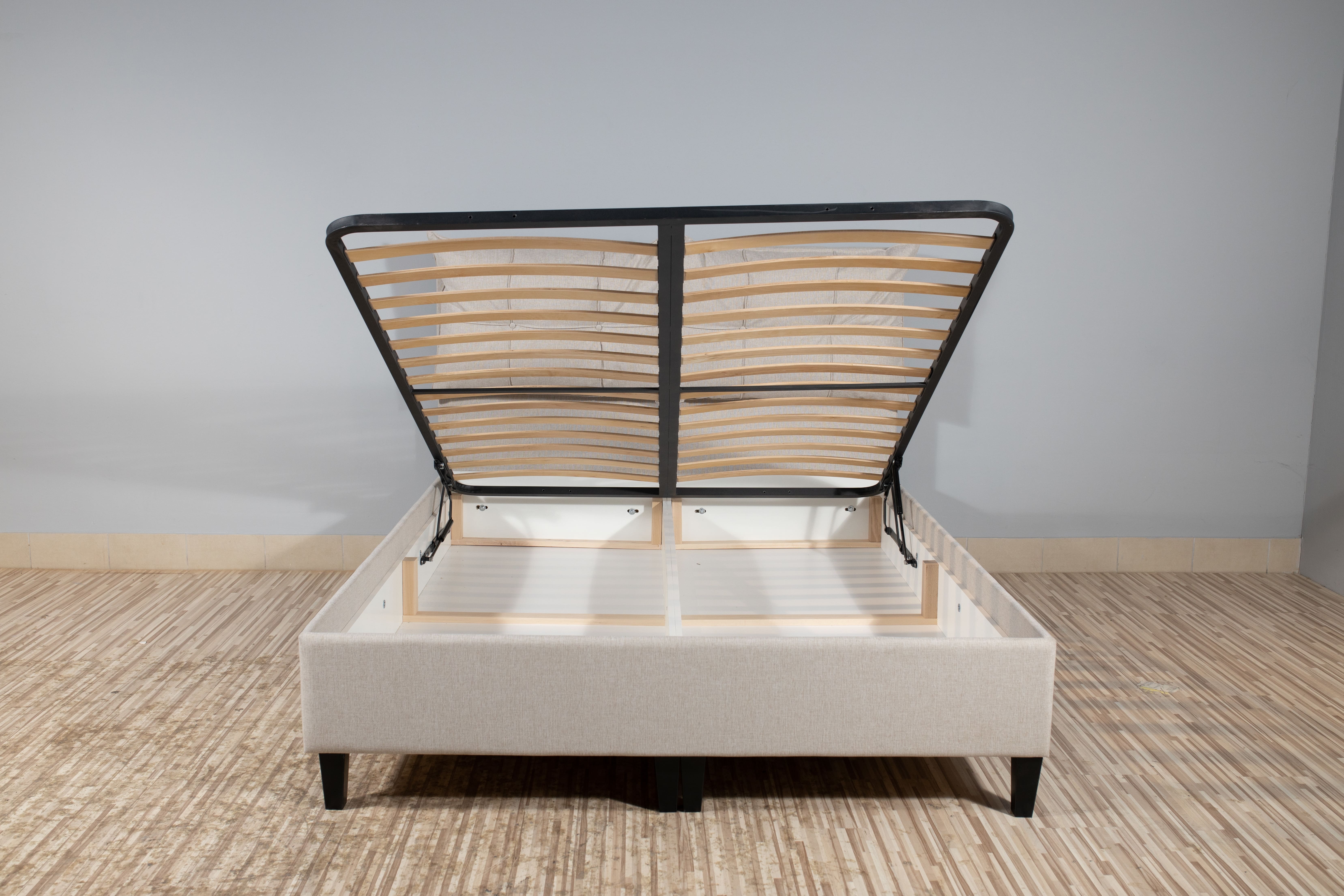
Choosing a bed base may seem simple… until you discover the option of the storage bed base. Popular for its 2-in-1 aspect, this type of bedding is increasingly appealing to households looking to optimize space without compromising sleep quality. But is it really a winning solution? Here is our complete analysis.
Quick Comparative Summary
| Criterion | Storage Bed Base | Classic Bed Base |
|---|---|---|
| Integrated storage | Yes, large volume | No |
| Aesthetics | Simple, often upholstered | More varied |
| Air circulation | Less optimal | Better ventilation |
| Adjustable comfort | Variable depending on integrated base | Highly customizable |
| Average price | Higher | Wide range |
| Installation | More complex assembly | Simpler |
| Durability | Good if the mechanism is reliable | Depends on the material |
Presentation of Compared Options
Storage Bed Base
The storage bed base combines a sleeping support and accessible storage space via a lifting mechanism. Available in front or side opening, it can be upholstered, slatted, or on legs.
Classic Bed Base
Several technologies are available:
- Active/passive slatted bed base
- Upholstered bed base
- Legged bed base
They provide optimized mattress support, excellent air circulation, and can be integrated into a structure with separate storage (drawers, boxes…).
Detailed Point-by-Point Comparison
Sleeping Comfort
- Storage Bed Base: depends on the support used (slats or board). Good performance if well designed.
- Classic Bed Base: often superior in terms of sleeping independence and cushioning.
Firmness and Support
- Storage: generally firm.
- Classic: firmness adjustable according to comfort zones and materials.
Morphological Adaptation
- Storage: more limited, except for rare custom models.
- Classic: excellent adjustment (legs, adjustable slats…).
Air Circulation
This is the structural weak point of the storage bed base. Since the storage box forms a closed space under the mattress, air circulates much less well than under a classic slatted bed base raised on legs. Result: the moisture released by the body during the night (up to 40 cl of sweat depending on the nights) evacuates more slowly, which can ultimately promote mold and dust mites. To limit this risk with a storage bed base, always prioritize a model with exposed slats on the sleeping side (never a solid board), air out the bed for a few minutes each morning by lifting the mattress, and avoid pairing it with a closed-cell foam mattress. The classic bed base, especially with active slats, retains a clear advantage here: ventilation from below is optimal and extends the lifespan of the mattress.
Durability and Maintenance
- Storage: mechanism requires maintenance. Struts need to be replaced after a few years.
- Classic: simple structure, easy maintenance.
Environment
- Storage: more complex structure, often industrial materials.
- Classic: more common eco-design, solid wood available.
Budget
- Storage: more expensive, but integrated space-saving.
- Classic: wide price range, better comfort for the same price.
Compatibility with Accessories
- Storage: pay attention to the thickness and weight of the mattress.
- Classic: compatible with most mattresses.
How to Choose According to Your Profile?
Specific Needs
- Night Sweats: ventilated classic bed base
- Back Pain: morphological bed base (adjustable slats, legs)
- Lack of Space: storage bed base essential
- Allergies: airtight storage or well-ventilated bed base + anti-dust mite covers
Environment
- Humid Climate: avoid poorly ventilated storage beds
- Studio or Small Room: storage = immediate space gain
- Shared Bed: classic bed base with legs or double slats for sleeping independence
Priorities
- Small Budget: classic bed base
- Eco-responsibility: natural materials and European wood
- Longevity: solid wood or reinforced metal structure
Expert Tips
Tips for Testing
- Lie down for several minutes, alone and with a partner
- Check the opening of the storage (smoothness, noise, safety)
- Check the air circulation: does the mattress breathe well?
Common Mistakes
- Storage bed base with solid board + foam mattress = overheating
- Mattress too heavy = damage to the mechanism
- Forgetting that the storage requires space around it to open
To go further, check our comparison of slatted bed bases vs legged bed bases and our complete guide to choosing your bed base .
View on Amazon View on AmazonFAQ
What is the lifespan of a storage bed base?
About 10 to 15 years for a quality model, provided the lifting mechanism is regularly maintained. The hydraulic struts are the most stressed part: they bear the weight of the mattress with each opening. On high-end models (Someo, Slome ex-Hypnia), the struts are replaceable and available as spare parts. To extend the lifespan, avoid overloading the storage beyond the recommended capacity (usually 150 to 200 kg of storage), and do not pull the mattress from one side only to open it — lift it evenly to avoid straining the mechanism.Is the storage bed base compatible with all mattresses?
No, not all. The main constraint concerns the weight and thickness of the mattress: beyond 30 kg or 30 cm in thickness, some mechanisms struggle to keep the storage open in the raised position. Also avoid very dense natural latex mattresses (without checking ventilation compatibility). However, polyurethane or memory foam mattresses up to 25 cm pair well with most storage bed bases on the market. Always consult the manufacturer's recommendations before purchase.How to maintain a storage bed base?
Maintenance of a storage bed base focuses on three points: the mechanism, internal hygiene, and the structure. For the mechanism, check the smoothness of the struts twice a year — a strut that resists or squeaks should be lubricated with an appropriate lubricant (PTFE or silicone spray, never greasy oil that attracts dust). For hygiene, vacuum the inside of the storage every 3 to 6 months and place sachets of baking soda or activated charcoal to absorb odors. For the structure, ensure that the hinges and fasteners remain tight, especially if the bed base is frequently moved.Does the storage bed base promote allergies?
Yes, a poorly ventilated storage bed base can worsen dust mite allergies, as the inside of the storage creates a warm, poorly aired environment often filled with dust — ideal conditions for dust mite proliferation. To limit this risk: choose a model with integrated side ventilation, place anti-dust mite covers on items stored in the storage, air out regularly, and clean it at least twice a year with a vacuum cleaner. A hypoallergenic mattress protector on top of the bed base is also recommended.Is a storage bed base compatible with a natural latex mattress?
With caution. Natural latex is sensitive to humidity and requires good air circulation to avoid premature degradation. A storage bed base with a solid board (without ventilation) is not recommended as it blocks all ventilation from below. Always opt for a model with exposed slats on the sleeping side, with side ventilation on the walls of the storage. Also, remember to air out the bed regularly by lifting the mattress for a few minutes in the morning. If you live in a humid region, a classic slatted bed base remains the safest solution for natural latex.Our Verdict
The storage bed base is an intelligent solution for optimizing space while maintaining good sleep comfort. It is particularly suitable for small spaces, rooms without wardrobes, or for a highly functional guest bed.
However, for advanced morphological support, optimal ventilation, or a tighter budget, the classic bed base often remains more suitable.
Take the time to assess your needs, your mattress, your room, and your priorities. The right bed base is the one that truly suits you.