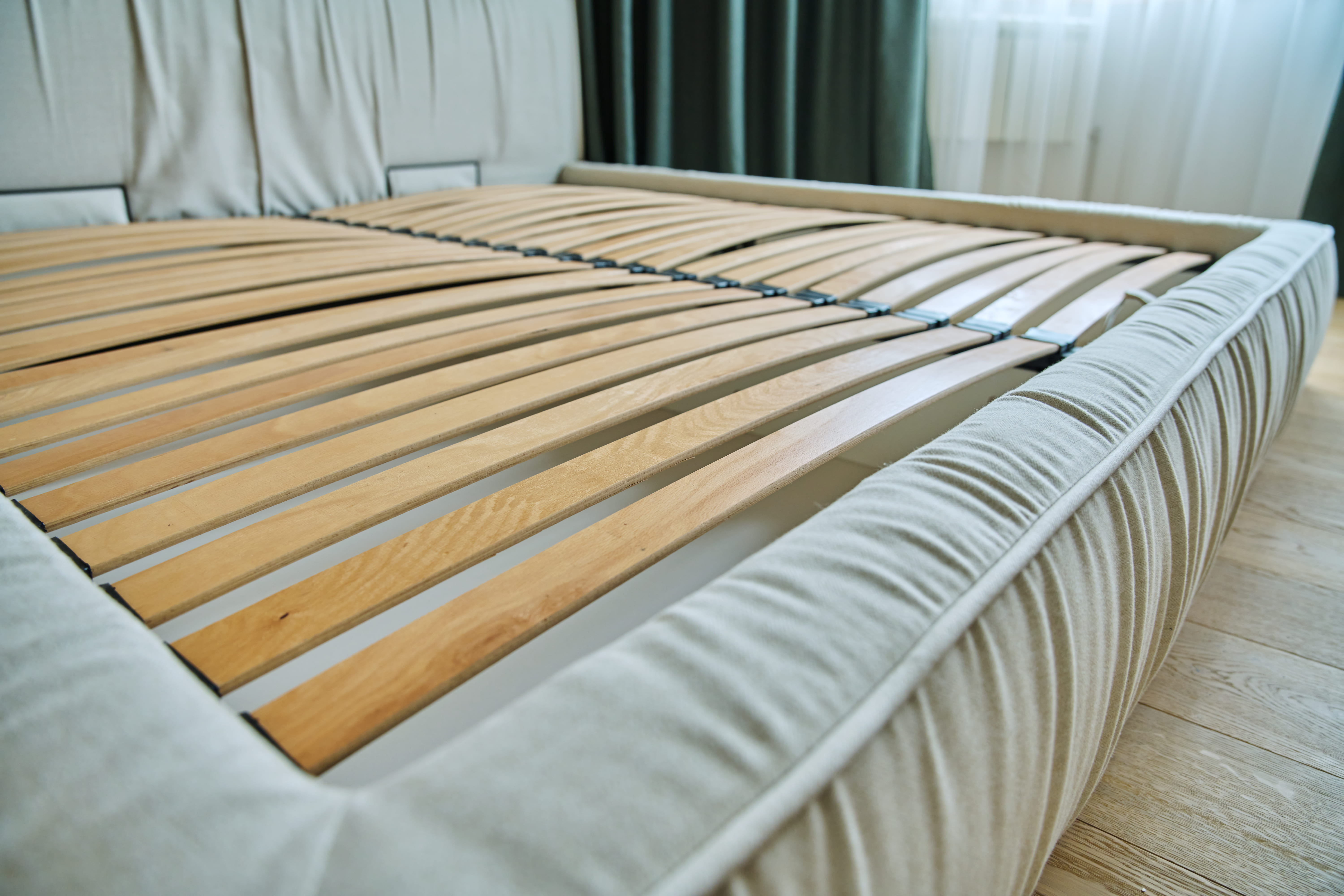
In the world of bedding, the question of custom or standard bed bases frequently arises among individuals seeking optimal comfort. This choice impacts not only the quality of sleep but also the aesthetics, durability, and adaptability of the entire bedding setup. As needs increasingly vary — atypical room configurations, back pathologies, non-standard body types — it becomes essential to understand the advantages and limitations of each option before investing.
To learn more, check out our complete guide to choosing your bed base .
Quick Comparative Summary
| Criteria | Standard Bed Base | Custom Bed Base |
|---|---|---|
| Available Sizes | Only standard dimensions | Any size, to the nearest centimeter |
| Manufacturing Time | Quick availability | Made in 2 to 4 weeks |
| Price | Starting from ~€160 | Starting from ~€300, variable |
| Adaptation to Morphology | Average | Excellent |
| Aesthetics | Standardized | Customizable |
| Accessory Compatibility | Wide compatibility | Sometimes requires adaptations |
Presentation of Compared Options
Standard Bed Base
The standard bed base comes in the common dimensions of the French market: 90×190, 140×190, 160×200 cm and their variants in 200 cm length. Available immediately in stores or with fast online delivery, it fits the vast majority of commercially available mattresses. It is found in several forms: upholstered bed base, rigid or flexible slats, springs, or blocks. Its main advantage remains its financial accessibility — expect to pay from ~€160 for an entry-level 140×190 cm model, and more for high-end versions with multi-layer slats or reinforced structures.
View on AmazonCustom Bed Base
The custom bed base is made to order according to your specific constraints: dimensions to the centimeter, type of structure, finish and upholstery fabric, even support distribution across the surface. It addresses situations that the standard market cannot cover: alcoves or recesses with atypical dimensions, family beds or antique boat beds, specific medical needs. Some artisanal French manufacturers, such as upholsterers or bedding specialists, offer manufacturing times of around two weeks. Prices vary significantly depending on materials and complexity, but you generally need to budget significantly more than for a standard of the same range.
View on AmazonDetailed Point-by-Point Comparison
Comfort and Sleeping
The standard bed base is suitable for the majority of sleepers whose size and sleeping habits are average. It offers uniform support, designed to pair with mattresses sold on the market. The custom bed base goes further: it allows for adjusting the distribution of support according to body shape, combining different firmness zones for two sleepers, or even integrating slats with variable flexibility along the surface.
Firmness and Support
With a standard bed base, the choice of firmness is limited to the available catalog — fixed slats, flexible slats, or upholstered, without real modulation. The custom bed base allows for a more refined design: choice of slat type, spacing, curvature, and sometimes individual adjustment for each side of the bed. This precision is particularly appreciated for couples with very different body shapes.
Body Shape
Very tall individuals (over 1.90 m), people with a large build, or conversely, very light individuals, may find standard bed bases insufficiently adapted. Custom solutions address these limitations by adjusting the length, width, and structural resistance to the actual needs of the sleeper.
Thermal Regulation
Most standard slatted bed bases ensure good air circulation under the mattress, promoting a stable sleeping temperature. Custom solutions can go further by integrating naturally thermoregulating materials — linen, wool, or cotton fabric — for people suffering from heavy night sweats.
Durability
A well-chosen standard bed base lasts on average 8 to 12 years. Its availability on the market makes it easy to replace worn parts (slats, legs). A custom bed base, if made with quality materials, can offer at least equivalent durability; however, it will be more difficult to resell or repair outside of its original manufacturer.
Environmental Impact
The mass production of standard bed bases optimizes logistical flows and reduces material waste. Custom solutions, produced individually, avoid any waste related to unsold items; moreover, artisanal French manufacturers often use local wood species and certified textiles. In both cases, prioritize OEKO-TEX® certifications or French environmental labels to ensure the absence of harmful substances.
Value for Money
The standard bed base represents the best compromise for a controlled budget: competition among brands drives prices down without sacrificing quality in mid-range models. Custom solutions involve an additional cost that is fully justified when a specific format or constraint cannot be met by the standard catalog. There is no need to resort to this if your room and body shape are within the norm.
Accessory Compatibility
The standard bed base easily integrates into most bed frames on the market, and associated accessories — adjustable legs, headboards, fitted sheets — are widely available. Custom solutions may require the creation of specific elements, especially if the dimensions significantly deviate from the norm.
How to choose according to your profile?
Specific needs
Nighttime sweating is best managed by a slatted bed base that offers optimal ventilation between the slats, whether it is standard or custom-made. In the case of lower back pain, a custom bed base with differentiated support zones can be decisive, provided it is paired with a suitable mattress. For allergy sufferers, both types of bed bases can be suitable, as long as treated coverings or certified natural materials are selected. Finally, if you have very specific expectations regarding firmness or support distribution, custom-made is the only option that can faithfully meet those needs.
Bedroom environment
A small bedroom with non-standard dimensions — an alcove of 135 cm wide, for example — often can only accommodate a custom bed base. Similarly, antique-style beds, boat beds, or those with sculpted legs may impose dimensions or structural heights that are not available in standard sizes. The custom bed base then fits naturally into the room, without aesthetic compromise.
Personal priorities
If budget is your primary criterion, the standard bed base is the obvious answer: it offers a quality-price ratio that is hard to beat in mid-range options. If you are looking for a long-term investment with a perfectly adjusted sleeping surface, custom-made is essential. For eco-friendly purchases, inquire in both cases about the sourcing of raw materials and the geographical origin of the manufacturing.
Practical Tips for Choosing Well
How to Test Before Buying
In a physical store, always test the bed base with a mattress at least similar to yours in terms of weight and technology: the same bed base can behave very differently under a spring mattress and under a latex one. Online, prefer brands or retailers that offer a trial period or a clear return policy, even for large orders.
Common Mistakes to Avoid
A classic mistake is choosing a very firm bed base to “compensate” for a mattress that is too soft — this approach does not work and can worsen pain. You should also always check the total height of the mattress + bed base: beyond 55 cm, getting in and out of bed becomes uncomfortable for many. Finally, neglecting compatibility with the existing bed frame can incur unexpected accessory costs.
Key Questions to Ask Before Ordering
Is your current mattress — or the one planned — compatible with the type of bed base considered (some latex requires slats spaced a maximum of 6 cm apart)? Do the dimensions of your room or bed frame impose a particular format? Do you have medical needs or firmness preferences that justify personalized support? These three questions are often enough to clearly guide your choice.
FAQ
What is the lifespan of a bed base?
On average, a well-maintained bed base lasts between 8 and 12 years, whether it is standard or custom-made. This lifespan primarily depends on the materials used — a slatted bed base made of solid wood will age better than a particle board model — and the intensity of use. Maintenance also plays a crucial role: regularly turning and airing the mattress relieves the slats from constant pressure in the same spot, which prevents warping. Also, remember to check the tightness of the fixings once or twice a year. If slats break or bend abnormally before 5 years, it is often a sign of a bed base that is undersized for the weight of the sleepers.
Can I place a standard mattress on a custom bed base?
Yes, absolutely, as long as the dimensions match precisely. A standard mattress placed on a custom bed base that is wider or longer will leave uncovered slat areas, which weakens the structure and creates a risk of falling. Conversely, a bed base that is slightly smaller than the mattress may cause the edges to bulge, accelerating the wear of the comfort layers on the sides. For truly atypical sizes, it is often more coherent to have the bed base and mattress made together by the same manufacturer, who will ensure perfect compatibility between the two elements.
How can I maintain my bed base to extend its lifespan?
Regular maintenance is simple but often neglected. Vacuum the upholstered bed base two to four times a year to prevent the accumulation of dust mites in the upholstery fabric. For a slatted bed base, check the condition of each slat after removing the mattress: a cracked or warped slat should be replaced immediately to avoid creating an imbalance in support. Air out your bedroom daily — good ventilation reduces humidity that promotes mold growth under the mattress. If your bed base is placed directly on the floor (a model without legs), make sure it has sufficient airflow by lifting the mattress for a few minutes each morning.
Is a slatted bed base or an upholstered bed base better for custom use?
The choice between these two types of structures primarily depends on your mattress and your comfort preferences. The slatted bed base, thanks to the spacing between the slats, ensures optimal ventilation under the mattress — a decisive advantage for latex or memory foam mattresses, which need to breathe to avoid retaining moisture. The upholstered bed base, with its continuous surface, provides an extra feeling of softness and pairs very well with spring mattresses, giving them a softer touch. In custom-made options, both formulas are fully customizable: slat spacing, individual flexibility, box height, upholstery fabric — everything can be adjusted according to your morphological profile and expectations.
Can a custom bed base help with back pain?
Yes, in many situations. A bed base adapted to your morphology and perfectly sized for your mattress contributes to better spinal alignment during the night. In cases of chronic lower back pain, a custom bed base with differentiated support zones — firmer under the pelvis, softer under the shoulders — can make a real difference in muscle recovery and sleep quality. However, it is important not to treat the bed base as the only lever: the mattress, sleep position, and, if necessary, medical advice remain essential complementary elements for a holistic approach to back comfort.
What custom bed base sizes are most in demand in France?
Beyond slightly non-standard dimensions (135×190 cm, 150×200 cm), the most frequent requests in France concern double beds with very wide dimensions (180 or 200 cm wide), bed bases for alcoves in Haussmannian apartments with often unpredictable dimensions, and bed bases intended for antique or styled beds (boat beds, canopy beds) whose legs or structure impose a specific box height. Bed bases in two independent parts (useful in spiral staircases or narrow corridors) are also in high demand, even for dimensions that would be available in standard sizes.
The choice between standard bed base and custom bed base primarily depends on your personal needs, space constraints, and comfort requirements. The standard bed base is sufficient for many sleepers due to its immediate availability and accessible price — starting from around €160 for an entry-level model in 140×190 cm. The custom-made option, on the other hand, is aimed at those who want a sleeping solution perfectly adapted, whether for reasons of comfort, space, or aesthetics, with a budget that is generally significantly higher depending on the complexity of the order. Take the time to evaluate your criteria: good sleep always starts with suitable support.