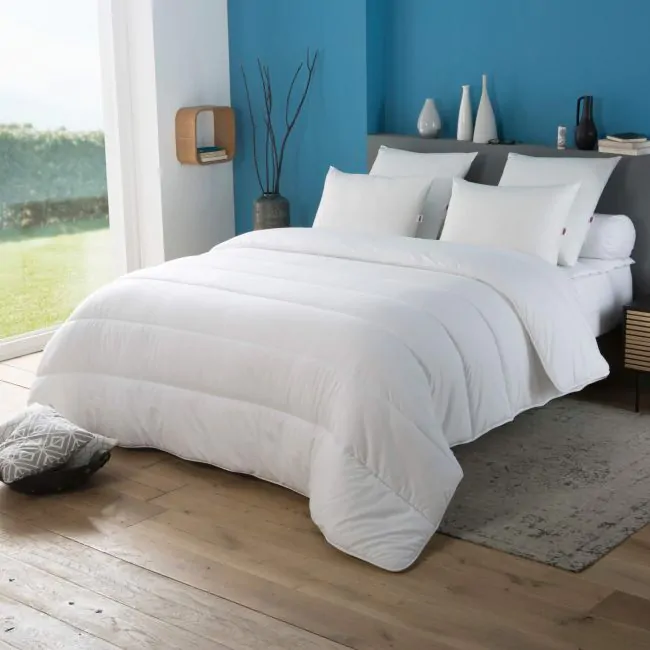
Research confirms: manufacturing in Saint-Avold, Oeko-Tex certification, and the Dodo Maison model available from ~€40 on lematelas.fr (on promotion). The Techno breathable tempered model remains available. I will now rewrite the body applying all the corrections.
A back that gets too hot in January and shivers in March: this is often a sign that a all-season or genuine winter duvet is not suitable. The tempered duvet addresses this specific case — heated rooms between 18 and 22 °C, no heatwaves at night, and no drafts either. Among the French models available in this category, the Dodo Tempered duvet often appears in comparisons: here’s why, and in which cases it truly deserves to be chosen.
1. Brand and Model Presentation
Origin and Positioning
Founded in 1937, Dodo manufactures its duvets in Lorraine, at its historic factory in Saint-Avold. It is a mainstream French brand: accessible without being basic, with a wide range that goes from entry-level models under €50 to goose down versions around €300. The Dodo Tempérée duvet is at the heart of this offering.
Specifics
Designed for rooms heated between 18 and 22 °C, it is available in a synthetic version (silicone hollow fibers) and a natural version (duck or goose down). Both share the same thermal positioning — temperate — but differ significantly in touch, maintenance, and price.
2. Composition and Technologies
The synthetic version uses hollow siliconized fibers, sometimes treated with Greenfirst® — an anti-mite treatment based on plant essential oils (notably geraniol), without aggressive chemical biocides, which retains its effectiveness after multiple washes. The cover is made of polyester or percale cotton depending on the ranges, certified Oeko-Tex® Standard 100 (absence of harmful substances in the fabric).
The natural version uses duck or goose down with a cotton cover. The filling is lighter at equivalent weight and a better thermal regulator over time, but it requires more care in maintenance.
3. Product Analysis: Comfort, Regulation, Durability
Comfort
The feel is soft and uniform. The down version is more breathable and lighter to the touch; the synthetic version is better suited for those seeking a soft feel without allergic reactions to animal down. Heat distribution is good in both cases, without the cold spots characteristic of low-end duvets.
Thermoregulation
The hollow filling (synthetic) or natural (down) traps air well and releases moisture — which is precisely what is expected from a medium-weight duvet. For a room at 20 °C, it is effective. Below 17 °C or in an unheated room, it is better to aim for a higher warmth index.
Durability
Expect 5 to 7 years for the synthetic version, as the fibers eventually compress. The natural version lasts 10 years or more with proper care. In both cases, a duvet that shows hollow areas or uneven loft should be replaced: thermal insulation drops sharply.
4. Value for Money
Prices recorded in early 2026:
- Synthetic (Maison range, Breathable Techno…): starting from ~€40 in 140x200 cm, up to ~€120 for larger sizes (240x260 cm). Regular promotions allow finding the 220x240 cm around €60–70.
- Natural (duck or goose down versions): between €130 and €300 depending on the filling density and dimensions.
It is competitive in both segments. The entry-level synthetic versions are among the cheapest on the market for certified French manufacturing.
View on Amazon5. Advantages and Disadvantages
Strengths
- Versatile for a large part of the year (temperate rooms 18-22 °C)
- Lightweight and comfortable, down versions particularly pleasant
- Good thermal regulation
- Machine washable (especially synthetic versions)
- Greenfirst® anti-dust mite treated versions
- French manufacturing, certified Oeko-Tex® Standard 100
Weaknesses
- Synthetic version less durable (5-7 years)
- May be insufficient for a room below 17 °C
- Down version significantly more expensive
- Slight odor upon first opening on synthetic versions — it disappears after a few airings
6. For what type of sleeper?
The Dodo Tempérée duvet is well-suited for sleepers who do not have a sharp thermal profile: neither cold nor hot, in a room maintained at a good temperature. It is suitable for couples (large sizes available up to 240x260 cm), seniors who appreciate its lightness and easy maintenance, and allergy sufferers who can opt for the synthetic version with Greenfirst® treatment.
It is less suitable for cold sleepers who keep a room at less than 17 °C — for them, a winter or 4-season duvet will be more relevant.
7. Where to buy it?
The Dodo Tempérée duvet is available on dodo.fr, lematelas.fr, Amazon.fr, and in specialized stores. Prices can vary from one channel to another; promotions are frequent on reseller platforms, especially during sales periods.
For large sizes (240x260 cm), make sure to check availability as stock may be limited outside of restocking periods.
8. Alternatives to Consider
| Model | Filling Type | Thermoregulation | Maintenance | Indicative Price |
|---|---|---|---|---|
| Dodo Tempérée | Synthetic or down | Good | Machine at 40–95 °C | 40–300 € |
| Emma Nuage 4 saisons | Synthetic | Good | Machine at 40 °C | 120–200 € |
| Tediber Duvet | Down + microfibers | Good | Machine at 40 °C | starting from ~150 € |
Alternatives exist, but few offer French manufacturing at this price level. To explore other French or European temperature-controlled duvets, Someo offers several references in this segment.
View on Amazon9. The opinion of our bedding expert
The Dodo Tempérée duvet is a solid choice for the majority of sleepers in heated rooms. The entry-level synthetic version is hard to beat under €70 with French manufacturing; the down version requires a larger budget but pays off over time.
It’s not the most innovative duvet on the market — no active regulation technology, no exotic filling — but that is precisely its advantage: it does what is asked of it, simply, with proven reliability. For allergy sufferers, the synthetic version with Greenfirst® treatment remains one of the best options at this price.
To explore your choices further, check out our complete comparison of duvets on the market .
FAQ – Your Frequently Asked Questions
Is this duvet suitable for allergy sufferers?
Yes, several Dodo Tempérée models benefit from the Greenfirst® anti-dust mite treatment, formulated with plant-based essential oils (notably geraniol), without aggressive chemical biocides. This technology creates an unfavorable environment for dust mites and maintains its effectiveness even after several washes. For severe allergies, prefer the synthetic version made of hollow siliconized fibers, washable up to 60 °C (a temperature that destroys dust mite eggs), and complement it with a specific anti-dust mite cover. The Oeko-Tex® Standard 100 label also guarantees the absence of allergenic or irritating substances in the cover fabric. If you suffer from an allergy to animal down, always opt for the synthetic version: it offers the same comfort qualities without any risk of reaction.
Can it be machine washed?
Yes, the majority of Dodo Tempérée models are machine washable, which is one of their great advantages for daily use. The synthetic version generally supports 40 °C on a delicate cycle, and some references up to 60 or even 95 °C for effective anti-dust mite cleaning — always check the care label before washing. Use a machine of at least 7 kg (ideally 10 kg) for 240x260 cm duvets to avoid compressing the filling and altering the fiber structure. Tumble dry on low heat with two tennis balls to restore fluffiness, or lay flat on a well-ventilated drying rack for at least 24 hours. The natural down version is more delicate: prefer a specialized dry cleaner every 2–3 years, and limit machine washes to emergency situations, using a wool program at a maximum of 30 °C.
How long does a Dodo Tempérée duvet last?
On average, 5 to 7 years for the synthetic version, over 10 years for the natural down version with rigorous maintenance. The hollow siliconized fibers of the synthetic version eventually compress irreversibly, losing their ability to trap air and thus thermally insulate. To maximize lifespan, air out the duvet daily by leaving it unfolded for a few minutes, wash it only 1 to 2 times a year (unless necessary), and always use a duvet cover to protect it from sweat and stains. A duvet that begins to show hollow areas, uneven fluffiness, or a pilling cover fabric should be replaced: thermal insulation then drops sharply, and sleep comfort is significantly affected.
Is it compatible with all mattresses?
Yes, the duvet is completely independent of the type of mattress: spring, foam, latex, or natural materials, no mattress imposes any constraints on the choice of duvet. Just choose the right dimensions based on the bed. For a 140x190 cm bed, prefer a 220x240 cm duvet; for a 160x200 cm bed, a 240x260 cm duvet is recommended to ensure a drop of at least 30 cm on each side and to prevent your partner from “stealing” the duvet during the night. For single beds (90x190 cm), a 140x200 cm duvet is generally sufficient.
What is the difference between the synthetic Dodo duvet and the natural version?
The two versions meet different needs, and the choice depends on your budget, sensitivity to allergens, and the importance you place on maintenance. The synthetic version is more affordable (starting at ~€40), easy to wash in a machine at high temperatures, and ideal for people allergic to animal down: it is the practical choice for everyday use. The natural version, made of duck or goose down, is significantly lighter for the same warmth, more breathable over time, and can last up to 10 years; however, it requires more care in maintenance (delicate washing, dry cleaning recommended) and its price ranges from €130 to €300 depending on the filling density and dimensions. For a non-allergic sleeper looking to invest in the long term, the natural version is an expense that pays off over several years.
Is the Dodo Tempérée duvet really made in France?
Yes, the manufacturing is done in Lorraine, at the brand’s historic factory in Saint-Avold. This French origin is verifiable and regularly highlighted by Dodo. Specifically, the quality and control standards applied are those of French and European law, and the product benefits from the Oeko-Tex® Standard 100 certification, which guarantees the absence of harmful substances in the materials used. For consumers concerned about carbon footprint and supporting local industry, this is a real differentiating advantage compared to duvets made in Asia — and an argument that partly justifies the price difference with purely imported brands.
What thickness (weight) should I choose for a room at 20 °C?
For a room maintained between 18 and 22 °C, a filling weight between 270 and 350 g/m² is the recommended range for a synthetic tempered duvet. Below 270 g/m², the duvet may feel too light as soon as the temperature drops slightly; above 400 g/m², it shifts into the “winter” warmth indices and becomes uncomfortable as early as spring. The Dodo Techno breathable tempered duvet is generally offered at 300 g/m², which is precisely within this window. For warm sleepers, the lower end of the range (270 g/m²) will be preferable; for cold sleepers in a room at 18 °C, opt for 350 g/m² and ensure that the manufacturer’s warmth index corresponds to a tempered use rather than mid-season.