The Amazon CTA in the article is missing the parameter &tag=matelascom-21, and an illicit third CTA is found after the conclusion. I will correct this and improve the style/background.
Menopause often tips sleep to the wrong side starting at ages 47-50: one in two women reports significantly degraded nights in the two years following the cessation of menstruation. This is not a fatality, but ignoring what happens biologically prevents the selection of the right levers. Here’s what we know, and what works concretely.
What Menopause Really Does to Sleep
Sleep disorders affect a large majority of women during menopause, directly linked to the drop in estrogen and progesterone, which destabilize both thermoregulation and the overall quality of nights. This double hormonal collapse does not act in just one way: it impacts several mechanisms simultaneously.
Hot Flashes: The Most Known Cause
Hot flashes — hot flashes and night sweats — are the main factor disrupting sleep identified in the scientific literature. The Haute Autorité de Santé (HAS) indicates that these symptoms affect about 80% of menopausal women. Concretely, when they occur at night, they cause a sudden feeling of intense heat, abundant sweating, and sometimes palpitations, which interrupt the ongoing sleep cycle. The body then takes time to regain its baseline temperature, complicating re-sleeping and generating additional frustration.
The link between hot flashes and sleep disorders is now well established. Women who suffer from them see their deep sleep and REM sleep fragmented by micro-awakenings that are sometimes so brief that they do not retain a conscious memory of them, but whose effects on recovery are very real.
Disruption of Serotonin and Cortisol
Beyond the heat, the underlying cause of sleep disorders during menopause is the collapse of estrogen, which disrupts the production of serotonin, a vital neurotransmitter involved in mood regulation and the sleep-wake cycle.
This is compounded by a misregulation of the morning cortisol peak, which is supposed to prepare for waking. At menopause, this peak becomes earlier and more intense. Sometimes, the liver releases sugar to compensate for slight nocturnal hypoglycemia: this unexpected energy boost stimulates wakefulness when one should still be sleeping. It is in this space, between 3 AM and 5 AM, that anxiety and rumination settle in.
Sleep Apnea, Often Underestimated
According to a meta-analysis, sleep apnea affects 47 to 67% of people during menopause, compared to 21% before this transition period. This figure often surprises, as sleep apnea remains associated in the collective imagination with overweight men. However, the loss of muscle tone related to hormonal changes, combined with possible weight gain, promotes this disorder in menopausal women. It deserves to be discussed with a doctor if nights remain unrefreshing despite other measures.
Non-Medical Levers to Improve Nights
Even before considering medical management, several lifestyle adjustments and sleep environment changes have demonstrated their effectiveness. These are detailed here, in addition to medical follow-up that every woman should build with her practitioner.
Working on Sleep Hygiene
The rules of sleep hygiene are known — regular hours, a dark and cool room, no screens before bed — but they take on even greater importance during menopause. A room maintained at around 16-18 °C helps limit nocturnal hot flashes, which are directly aggravated by ambient heat. A stable bedtime routine promotes melatonin production, which is slightly disrupted by the drop in estrogen.
Avoiding alcohol and heavy meals in the evening is also more decisive than it seems: alcohol dilates blood vessels and can trigger hot flashes in the hours following falling asleep. Even a glass of wine can sometimes lead to waking up sweating at 2 AM.
Cognitive Behavioral Therapy for Insomnia (CBT-I)
Cognitive Behavioral Therapy for Insomnia (CBT-I) is now recognized as the first-line treatment for chronic insomnia, validated by recent meta-analyses. It addresses the thoughts and behaviors that maintain insomnia, without medication. Online programs and apps exist, but support from a trained professional remains the most effective route. This is an option to explore with one’s general practitioner or a sleep specialist.
Adapting Bedding: The Often Overlooked Lever
When a hot flash occurs, the immediate environment — mattress, mattress topper, bedding — largely determines how quickly the body regains a comfortable temperature. This is often the least explored angle, yet one of the most accessible.
The mattress plays a fundamental role in nocturnal thermal regulation. Memory foam tends to retain heat, unlike gel foam or latex. For women prone to night sweats, a natural latex mattress or a hybrid mattress (pocket springs + gel comfort foam) will offer much better ventilation than a classic all-foam structure. Pocket springs, in particular, allow air to circulate freely inside the mattress throughout the night.
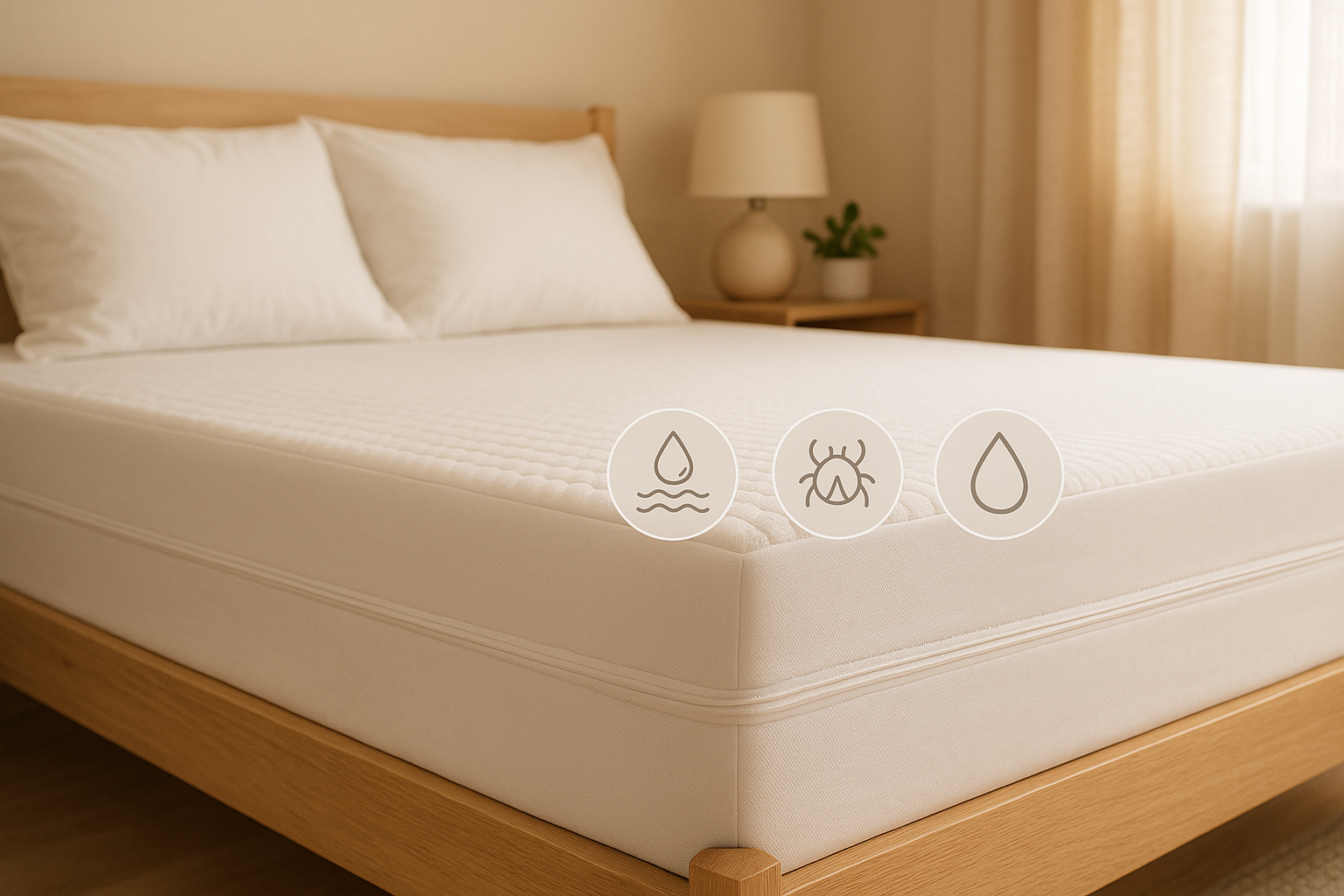
View on AmazonThe cooling mattress topper is a very practical intermediate solution to quickly improve comfort without changing the mattress. Designed with a breathable fabric called “Cool Touch,” they promote moisture evacuation and limit heat accumulation. They fit the vast majority of existing mattresses and represent a significantly less important investment than a complete bedding change.
See cooling mattress toppers for night sweats on Amazon.frBedding is the element most directly in contact with the skin, and therefore the most impactful during a hot flash. Sheets made of linen, bamboo, or cotton percale will be more breathable than any synthetic material. Linen has a naturally high thermal conductivity: it quickly absorbs moisture and dries fast. Bamboo is appreciated for its soft touch, thermoregulating properties, and hypoallergenic aspect, a significant advantage for skin that becomes more reactive during menopause. Avoid polyester and low-quality microfiber, which trap heat and moisture.
The duvet also deserves reconsideration. A thick winter duvet, even of good quality, can become counterproductive if you suffer from night sweats, regardless of the season. The most flexible strategy is to adopt two lightweight duvets that can be layered rather than a single all-season duvet: this way, you can adjust from night to night according to the intensity of symptoms, which often vary greatly. In terms of filling, bamboo and cotton are more breathable than synthetic materials.
You will find more practical tips on sleep disorders in our dedicated section: Sleep Disorders — All Our Tips .
And Hormonal Treatment in All This?
Hormonal treatment for menopause (HT) can improve some sleep disorders related to vasomotor symptoms, on prescription and medical advice. This is a decision that should be evaluated individually with a gynecologist or a primary care physician, taking into account each woman’s personal history and risk factors. It is not an automatic recourse, but for some women whose nights are severely disrupted by hot flashes, it can represent significant help.
This article does not replace a medical consultation. If your sleep disorders are intense, persistent, or affect your daytime functioning, talk to your doctor.
Key Takeaways
Menopause disrupts sleep through several distinct mechanisms: the drop in estrogen and progesterone degrades thermoregulation, the quality of deep sleep, and serotonin balance. Nocturnal hot flashes, present in about 80% of menopausal women, are the most directly measurable factor — and the one on which bedding can act concretely.
Choosing a breathable mattress (latex, hybrid with pocket springs), adding a cooling mattress topper, opting for bedding made of linen or bamboo, and lightening your duvet are accessible adjustments that can significantly transform the quality of nights. Combined with good sleep hygiene and, if necessary, medical management (CBT-I, HT), they form a solid foundation to navigate this period with less fatigue.
Frequently Asked Questions
Why does menopause disrupt sleep so much?
Sleep disruption during menopause is multifactorial. The main cause is the abrupt drop in estrogen and progesterone. These two hormones play a direct role in the body’s thermal regulation, serotonin production (involved in falling asleep), and the quality of deep sleep. When they collapse, the body loses part of its ability to maintain a stable temperature during the night, leading to night sweats and hot flashes. Additionally, the drop in progesterone, which naturally has a mild sedative effect, can make falling asleep more difficult. This is compounded by an early morning cortisol peak that arrives too soon and an increased tendency for nocturnal rumination. All these causes act simultaneously, which explains why the disorders can be so persistent and difficult to treat with a single lever.
What type of mattress is recommended for night sweats related to menopause?
Natural latex mattresses and hybrid mattresses with pocket springs are generally the most suitable. Latex has an open-cell structure that promotes air circulation and effectively evacuates body heat. Pocket springs allow for natural ventilation inside the mattress throughout the night. In contrast, traditional all-memory foam mattresses tend to store heat, which exacerbates the feeling during a nocturnal hot flash. If you are not considering changing your mattress immediately, a cooling mattress topper with Cool Touch fabric is an economical and effective alternative: it interposes a breathable and thermoregulating layer between you and your current mattress, without a major investment.
Can bedding really make a difference during hot flashes?
Yes, and often more than one might think. The fitted sheet and flat sheet are the elements most directly in contact with the skin: they act as a permanent thermal interface. Synthetic materials like polyester retain heat and moisture, which exacerbates the feeling of dampness after a hot flash and slows the return to a comfortable temperature. In contrast, linen has a naturally high thermal conductivity: it quickly absorbs moisture and dries fast. Bamboo is appreciated for its soft and silky touch, thermoregulating properties, and hypoallergenic aspect, a significant advantage for skin that becomes more reactive during menopause. Percale and high-thread-count cotton satin are also good choices. These fabrics do not eliminate hot flashes, but they significantly reduce the discomfort that follows and accelerate re-sleeping.
Is sleep apnea really more common during menopause?
Yes. Studies show that the risk of sleep apnea increases significantly after menopause, with rates reaching 47 to 67% of menopausal women according to some meta-analyses, compared to about 21% before this period. The loss of muscle tone in the upper airway, related to hormonal changes, as well as possible abdominal weight gain, promote this disorder. Sleep apnea is often underdiagnosed in women because its symptoms differ from those observed in men: fewer loud snoring, more chronic fatigue, and non-refreshing nights. If, despite all bedding and sleep hygiene adjustments, you consistently wake up exhausted, report it to your doctor, who can guide you towards a sleep exploration.
Should one change their duvet during menopause?
Not necessarily change, but often adapt. A thick winter duvet, even of good quality, can become counterproductive if you suffer from night sweats, regardless of the season. The most flexible strategy is to adopt two lightweight duvets that can be layered rather than a single all-season duvet: this way, you can easily adjust from night to night according to the intensity of symptoms, which often vary greatly. In terms of filling, bamboo or cotton duvets are more breathable than synthetic ones. Natural goose down duvets also provide good thermal regulation, although they are less suitable in case of allergies to avian proteins. The key is to be able to easily modulate your bedding without having to get up in the middle of the night.
Is CBT-I effective for menopause-related insomnia?
Cognitive Behavioral Therapy for Insomnia, known as CBT-I, is now recognized as the first-line treatment for chronic insomnia, including that associated with menopause. It addresses dysfunctional thoughts around sleep (catastrophizing, performance anxiety) and behaviors that maintain insomnia (compensatory naps, excessive time spent in bed, etc.). Recent meta-analyses confirm its effectiveness, even when insomnia is linked to vasomotor symptoms. It can be followed in person with a psychologist or trained physician, but accessible digital formats also exist. This is an option to discuss with your primary care physician, who can guide you to the appropriate professional.