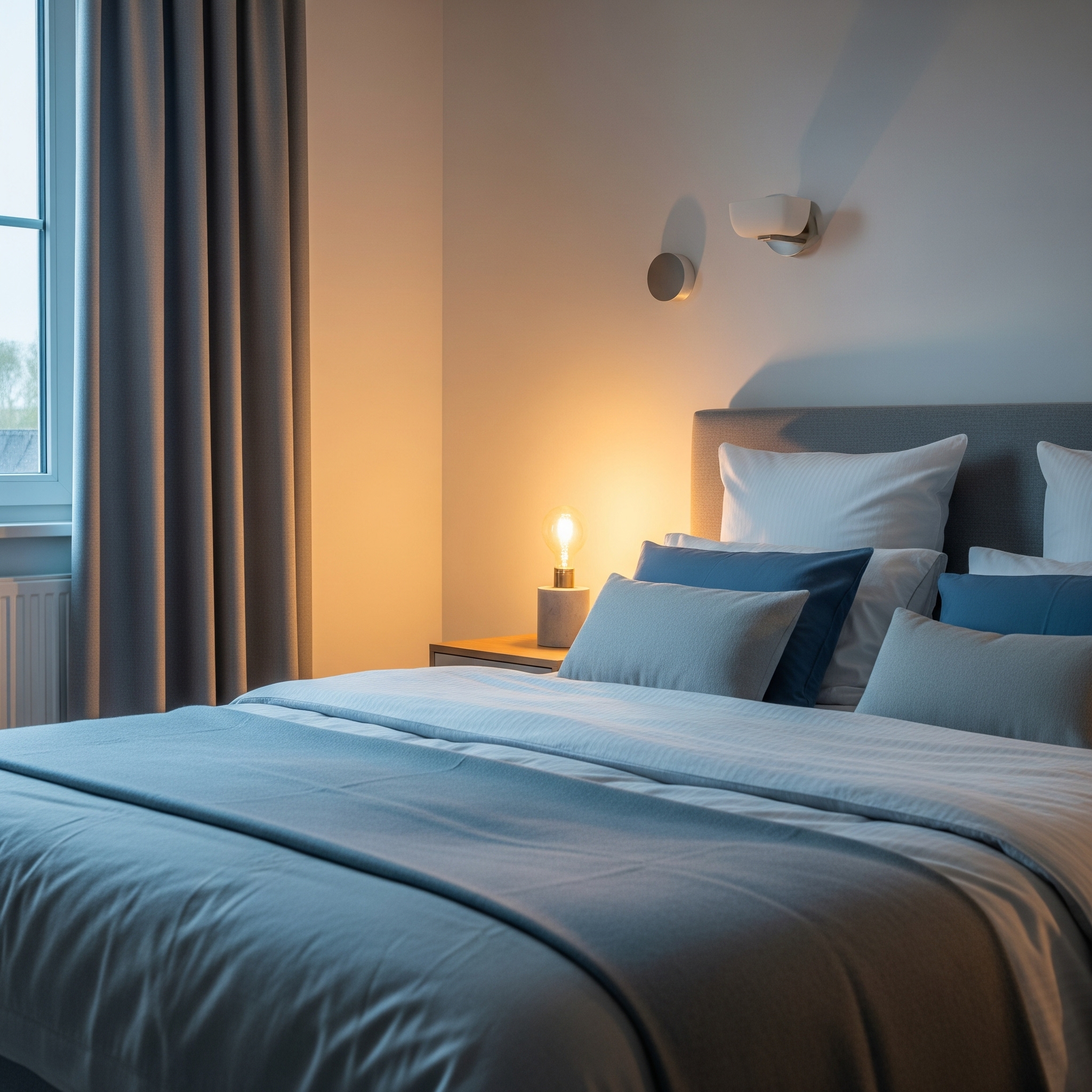
In an environment saturated with artificial light, it is essential to understand the impact of lighting on sleep. The choice of light sources in the bedroom directly influences falling asleep and the quality of nighttime rest. Exposure to inappropriate light can disrupt the biological clock and interfere with the secretion of melatonin, a key hormone for sleep.
Light and Sleep: A Proven Biological Link
Understanding the Biological Clock
Our body follows a circadian rhythm of about 24 hours, primarily synchronized by natural light. The decrease in brightness in the evening signals the brain that it is time to produce melatonin, thus promoting sleep onset. Conversely, exposure to light, especially artificial light, inhibits this production and delays sleep. This mechanism is driven by melanopsin ganglion cells in the retina, which are particularly sensitive to short wavelengths (380–500 nm), specifically the blue spectrum dominant in our modern lighting.
The Impact of Artificial Light
LEDs, screens, and powerful ceiling lights emit light rich in blue wavelengths, close to those of daylight. This light spectrum blocks melatonin secretion and desynchronizes the wake-sleep rhythm, leading to difficulties in falling asleep and a decrease in sleep quality. Numerous studies converge on the same conclusion: evening screen exposure can delay sleep onset by 30 to 60 minutes and reduce the duration of deep sleep. Even a dim light or a nightlight can be enough to disrupt this process, especially in children, whose retinas allow more blue light to pass through than those of adults.
To go further, check out our tips for better sleep and adopt a truly effective nighttime routine.
Decoding the Different Types of Lighting
Color Temperature: A Determining Factor
Color temperature, expressed in kelvins (K), is the first criterion to consider for adapting lighting to sleep. In practice:
- Less than 2,700 K: very warm light (yellow-orange, close to candlelight), ideal in the evening to accompany the descent into sleep without disrupting melatonin.
- 2,700 to 3,000 K: warm light, perfectly tolerated for a bedside lamp or a relaxing atmosphere.
- 3,000 to 4,000 K: neutral light, suitable for calm activities early in the evening, but to be avoided in the bedroom after 9 PM.
- More than 4,000 K: cool light (bluish-white), to be banned in the evening as it significantly delays melatonin production.
Light Intensity: Favor Modulation
Soft and adjustable lighting is recommended in the bedroom. A threshold of 50 lux or less in the evening is generally advised to not hinder melatonin secretion — for comparison, a standard ceiling light can exceed 300 to 500 lux. Prefer dimmable bedside lamps or smart bulbs to adjust the intensity according to your needs, without straining the eyes.
Lighting Technology: LED, Halogen, Incandescent
- LED: now essential for their energy efficiency, provided you choose a color temperature below 2,700 K and a color rendering index (CRI) above 80 for pleasant light that is true to natural colors.
- Halogen: close to natural light and with a continuous spectrum, it remains acceptable for occasional use, although it is gradually being phased out of the European market.
- Incandescent: now banned from sale in Europe, these bulbs emitted a very warm light (around 2,700 K) particularly gentle for sleep — the best current warm LEDs come close to this.
Adjusting Lighting According to Profiles
Light-Sensitive Adults
Opt for indirect, warm, and adjustable lighting. Sunset or twilight simulation devices can facilitate natural falling asleep by reproducing the gradual descent of the sun between 2,700 K and 1,800 K. If you experience persistent eye strain in the evening, blue light filter glasses can effectively complement already optimized lighting.
Find warm 2,700 K dimmable LED bulbs on AmazonChildren
Children are particularly sensitive to light before bedtime, as their lenses allow a significantly higher proportion of blue light compared to adults. Even a low-intensity nightlight can reduce melatonin and disrupt their sleep, delaying falling asleep and fragmenting nighttime cycles. Prefer very soft nightlights (less than 2,700 K) with a programmed automatic shut-off, and turn off the ceiling light at least an hour before bedtime.
Shift Workers
For those working night shifts or irregular hours, recreating a nighttime ambiance during the day is essential for recovery. Combine thick blackout curtains, very low-intensity lamps set to amber tones, and if possible, a quality sleep mask to block any residual light infiltration.
Innovations and Alternatives
Recent technological advancements offer concrete solutions to reconcile modern lighting and sleep quality:
- Connected fixtures: smart bulbs (such as Philips Hue, LIFX, or equivalents) that automatically adjust color and intensity according to the time, programmable from an app. They allow for a gradual transition to warm tones in the evening, mimicking natural twilight.
- “No blue” bulbs: designed to filter blue wavelengths in the evening, they typically have a temperature below 2,200 K and are aimed at individuals particularly sensitive to light disturbances.
- Twilight simulators: lamps or integrated functions that gradually decrease intensity and color temperature over 30 to 60 minutes before bedtime, facilitating effortless falling asleep.
- Dawn simulators: conversely, they gradually increase in intensity in the morning, promoting a natural awakening that respects the circadian rhythm.
Examples of Effective Lighting Arrangements
- Master Bedroom: dimmable pendant light above the headboard, warm LED bedside lamp (2,700 K) with a dimmer, adjustable low-intensity reading light for evening reading.
- Child’s Room: wall nightlight with automatic shut-off (less than 2,700 K), dimmable ceiling light turned off 1 hour before bedtime, possible decorative indirect lighting set to amber tones.
- Premium Hotel Suite: smart home management of ambient lighting, customizable day/night simulations, motorized blackout shades synchronized with indoor lighting.
Practical Tips for Sleep-Friendly Lighting
- Choose warm bulbs (less than 2,700 K, ideally around 2,200 K) for all light sources in the bedroom.
- Limit screen exposure at least 1 hour before bedtime or activate the “night light” mode / blue light filter on your devices.
- Multiply indirect light sources: LED strips behind the headboard, wall sconces directed towards the ceiling, to avoid direct light in the eyes.
- Use a dimmer or smart bulbs to gradually reduce brightness starting from 8 PM–9 PM.
- Avoid leaving a night light on all night if you suffer from sleep disorders; instead, try a scheduled automatic shut-off.
- If you cannot modify your lighting, blue light filter glasses worn from early evening are a validated supplementary solution supported by several studies.
Lighting is just one dimension of a successful sleep environment. The quality of your bedding plays an equally central role in your ability to fall asleep quickly and benefit from deep, restorative sleep.
View on Amazon