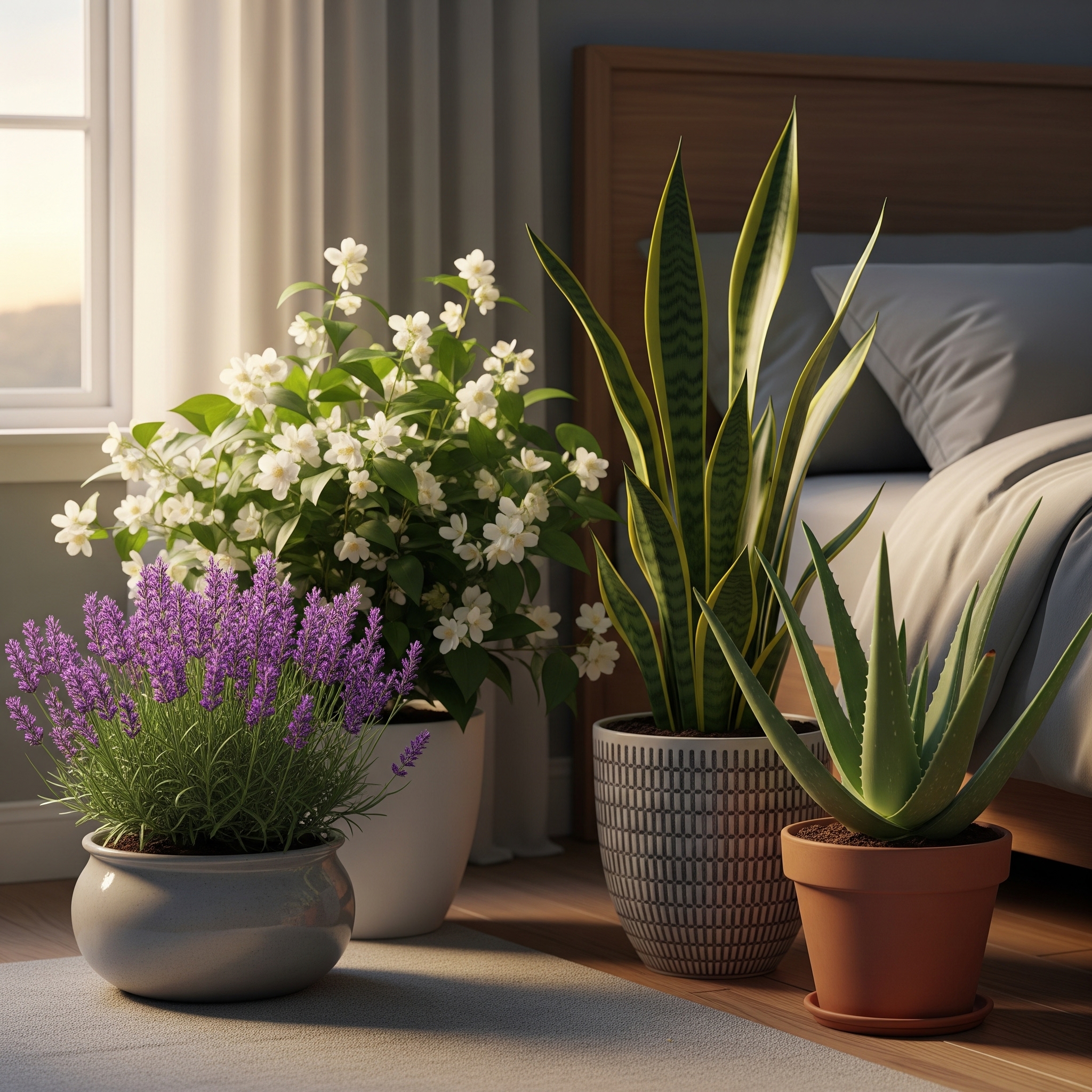
In a world where one-third of the French suffer from sleep disorders, indoor plants prove to be natural allies for a calming environment. They act on air quality, ambient humidity, and contribute to mental relaxation. To further optimize your bedroom, our section tips for better sleep gathers all the levers at your disposal.
Definition and context: nature at the service of sleep
Plants have been used since antiquity for their soothing virtues, and modern phytotherapy and aromatherapy confirm these benefits through clinical studies. Beyond relaxing scents, certain species improve nighttime oxygenation in the room and regulate its humidity — two parameters directly linked to the quality of rest. Combined with suitable bedding and good pre-sleep habits, they constitute a simple, inexpensive, and aesthetic lever to transform an ordinary bedroom into a true sleep sanctuary.
Plants promoting sleep: functioning and specifics
1. Lavender (Lavandula angustifolia)
Lavender is undoubtedly the most documented plant for its effects on sleep. Its fragrant molecules — primarily linalool and linalyl acetate — act on the parasympathetic nervous system by reducing heart rate, blood pressure, and cortisol levels. Several studies have shown that exposure to its scent before bedtime significantly reduces anxiety and facilitates falling asleep. In practice, it can be placed in a pot on a sunlit windowsill, a dried sachet can be slipped under the pillow, or lavender floral water can be sprayed on the sheets a few minutes before going to bed.
Find a potted lavender for the bedroom on Amazon2. Jasmine (Jasminum)
Jasmine improves sleep quality and reduces nighttime awakenings by acting, too, through olfactory pathways. Researchers have shown that certain aromatic compounds in jasmine modulate GABA receptors — the main inhibitory neurotransmitter of the central nervous system — which explains its natural sedative effect. In indoor cultivation, it requires bright indirect light, moderate watering, and cool temperatures at night: constraints that precisely match the ideal conditions of a well-furnished sleep-friendly bedroom.
3. Aloe Vera
Aloe vera purifies the air by capturing volatile organic compounds such as formaldehyde and benzene, found in certain furniture, paints, or indoor textiles. By improving the quality of the air breathed during the night, it indirectly contributes to better nighttime breathing. It is one of the easiest plants to maintain: very resilient, it tolerates missed waterings and only requires standard light exposure, making it an ideal choice for those not well-versed in gardening.
4. Snake Plant (Sansevieria trifasciata, also known as mother-in-law’s tongue)
Unlike most plants that consume oxygen at night, the snake plant uses a special photosynthetic mechanism — Crassulacean Acid Metabolism (CAM) — allowing it to absorb CO₂ and release oxygen even after nightfall. This property makes it an ideal candidate for the bedroom, where a better-oxygenated atmosphere promotes deep sleep. Extremely robust, it withstands drought, varied exposures, and cool temperatures, requiring only watering every two to three weeks.
5. Gardenia (Gardenia jasminoides)
Gardenia is the subject of growing scientific interest for its sedative properties. Researchers at the University of Bochum have shown that two aromatic molecules present in its flowers enhance the action of GABA — the same mechanism as some anxiolytic medications — which explains its powerful relaxing effect. In return, it is a demanding plant: it requires high humidity, a constant temperature (ideally between 16 and 21 °C), and indirect light exposure. These maintenance constraints reserve it for patient indoor gardeners, but the olfactory effect achieved is worth it.
View on AmazonAdvantages and limitations
Indoor plants have several undeniable advantages: they are natural, multifunctional (air quality, aesthetics, olfactory relaxation), affordable, and compatible with an eco-responsible approach. However, their limitations deserve to be mentioned honestly. Their effect varies from person to person depending on olfactory sensitivity and individual predispositions to relaxation. They require regular maintenance and can pose a constraint in case of pollen allergies or pets that might chew on the leaves. Finally, for chronic insomnia or severe sleep disorders, they provide a pleasant complement but cannot replace appropriate medical care.
Comparison: plants vs. other natural solutions
| Natural solution | Mode of action | Main effect | Main limitation |
|---|---|---|---|
| Indoor plants | Air + smell + ambiance | Progressive relaxation | Maintenance, moderate effect |
| Essential oils | Direct olfaction | Facilitates falling asleep | Delicate dosage, not recommended for children |
| Herbal teas | Digestive/nerve action | Deeper sleep | Slow effect, potential drug interactions |
| White noise | Neutral auditory stimulation | Masks noise disturbances | Ineffective if bedding quality is poor |
These approaches are complementary rather than competitive: combining one or two plants, a light diffusion of lavender essential oil, and a valerian tea before bedtime can produce a synergistic effect significantly more pronounced than each solution taken in isolation.
Practical tips for integrating plants into your bedroom
A few simple rules can help you make the most of these plant allies. Place the plants at a good distance from the bed (at least 50 cm) to avoid excessively increasing humidity at the sheet level. Favor indirect light, especially for jasmine and gardenia, which are sensitive to direct sunlight. Water moderately: aloe vera and snake plant tolerate drought very well and suffer more from excess water than from a lack of it. Do not overcrowd the space: one to three well-chosen plants are sufficient to achieve a beneficial effect without turning the room into a tropical greenhouse. Regularly clean the leaves with a damp cloth to maintain their purifying effectiveness. Finally, avoid species known to be allergenic or toxic in case of accidental ingestion, such as certain ficuses or ferns.
View on AmazonFAQ: plants and sleep
Do all plants promote sleep?
No, far from it. Only certain species benefit from studies documenting a positive effect on relaxation or sleep quality — among which are lavender, jasmine, gardenia, snake plant, and aloe vera. Other plants can even be counterproductive: those with strong stimulating fragrances (like certain citrus fruits or peppermint) risk keeping the nervous system awake rather than calming it. Before introducing a new plant into your bedroom, research its specific properties, and pay attention to your own reaction: olfactory sensitivity varies considerably from person to person.
Can you put plants in a child's room?
Yes, provided you choose non-toxic species in case of accidental ingestion and avoid any diffusion of essential oils for children under 6 years old, as their respiratory tracts and nervous systems are still too sensitive. Snake plant and aloe vera are good choices for a child’s room: they are robust, easy to maintain, and pose no notable olfactory risk. In contrast, gardenia and jasmine, whose aromatic effects operate through mechanisms similar to some medications, should be reserved for adult rooms. Also, check for any pollen allergies before introducing any plants.
How many plants should be in a bedroom?
One to three well-chosen plants are sufficient to achieve a measurable beneficial effect without overcrowding the room. Beyond three plants, you risk excessively increasing the ambient humidity, which can promote mold growth and worsen symptoms in people allergic to dust mites. For a standard bedroom of 12 to 15 m², a snake plant for nighttime oxygenation, complemented by a pot of lavender on the windowsill, already constitutes a very effective duo. If you wish to add a third plant, opt for aloe vera, which takes up little space and improves air quality.
Do plants replace sleep therapy?
No, plants cannot substitute for medical or psychotherapeutic care for severe or persistent sleep disorders. They provide a valuable natural complement to improve an already generally satisfactory sleep or to alleviate mild difficulties related to temporary stress, seasonal changes, or everyday minor troubles. For chronic insomnia — defined by difficulties in falling asleep or repeated nighttime awakenings for more than three months, affecting daytime quality of life — a consultation with a doctor or sleep specialist remains essential before resorting to non-drug solutions.
Can lavender replace sleep medications?
No, lavender does not replace a medication prescribed by a doctor. However, it can be an effective natural complement for mild sleep disorders related to temporary stress or difficulty relaxing at the end of the day. Its aromatic molecules — linalool and linalyl acetate — reduce anxiety levels and facilitate falling asleep by acting on the parasympathetic nervous system, but their action remains of moderate intensity, incomparable to that of a synthetic sleeping pill. In cases of chronic insomnia, restless legs syndrome, or sleep apnea, a medical consultation is imperative: lavender has no demonstrated efficacy on the underlying cause in these cases.
What is the best way to use lavender for sleep?
Several methods of use are possible depending on your preferences. The dried lavender sachet slipped under the pillow is the oldest method and one of the most effective: it diffuses a soft and continuous aroma throughout the night. You can also spray lavender floral water on your sheets about fifteen minutes before going to bed, allowing time for the alcohol to evaporate. A cold diffuser (ultrasonic) with a few drops of true lavender essential oil (Lavandula angustifolia) for thirty minutes before turning off the lights is also very popular. However, avoid diffusing essential oils continuously during sleep, and do not use them on children under 6 years old or pregnant women without prior medical advice.