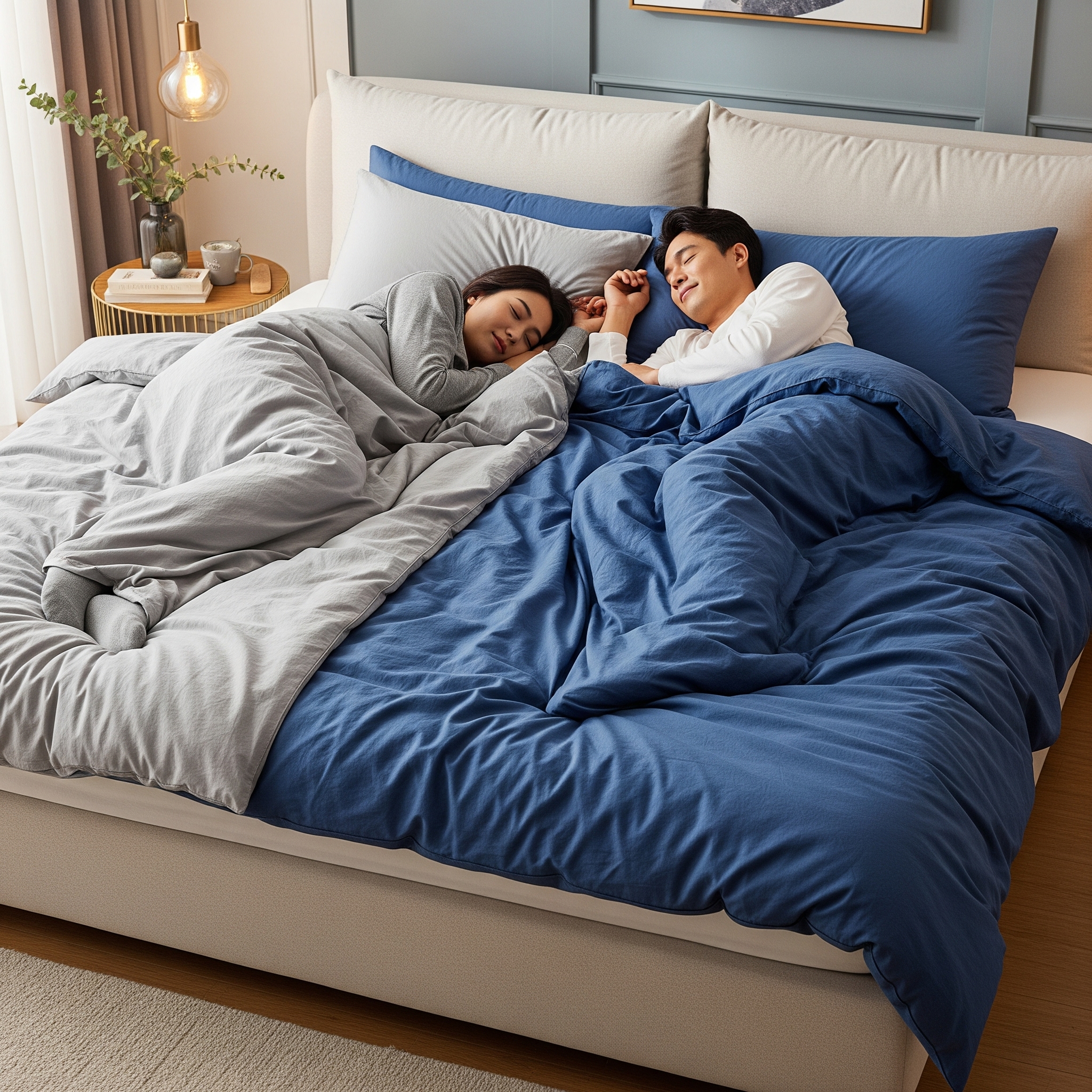
Sleeping together can be a source of comfort as well as a real puzzle. Snoring, differences in rhythm, nighttime movements, sensitivities to heat or light… all these factors can disrupt sleep quality over time. Sleeping well together is not just a matter of comfort: it is a health and balance issue within the couple.
Context and Definition
Nearly one in two French people reports that their sleep is affected by that of their partner, according to data from the National Institute of Sleep and Vigilance (INSV). The most commonly cited causes are snoring, differences in wake-sleep rhythm, excessive body heat, nighttime movements, and disagreements over brightness or noise. Faced with these difficulties, some couples consider sleeping separately — not out of disaffection, but to preserve their health and relationship.
To delve deeper into the foundations of good rest, also check out our tips for better sleep .
Sources of Sleep Disruption for Couples
Physiological and Behavioral Differences
Each individual has a unique sleep profile. Body temperature is one of the primary sources of friction: where one needs to cover up, the other feels stifled under the duvet. Chronotypes — this natural tendency to be more of a morning or evening person — can also shift bedtime by several hours, making nighttime cohabitation tricky. Additionally, there are different sensitivities to noise and light, and conditions such as snoring, sleep apnea, or bruxism, which can fragment the partner’s rest without the “guilty” party even being aware.
Bed Dimensions and Mattress Quality
A bed that is too narrow — typically a 140 cm for two adults — is often the first mistake to correct. Below 160 cm, each partner has only the equivalent of a child’s bed in width. Beyond size, mattress quality plays a crucial role: a mattress that sags, dips, or does not guarantee good motion isolation turns every movement of one into a disturbance for the other.
Lack of Motion Isolation
Motion isolation refers to a mattress’s ability to isolate movements on each side. A low-quality monoblock foam mattress or an old biconical spring mattress will transmit nighttime turns like a wave. In contrast, a quality pocket spring mattress or memory foam mattress significantly limits these motion transfers.
Advantages and Disadvantages of Sleeping Together
Emotional and Psychological Benefits
Sleeping with a partner is not just a social habit: studies confirm that physical closeness promotes the release of oxytocin, the bonding hormone, which generates a feeling of emotional security and reduces stress levels. This connection also fosters REM sleep, an essential phase for cognitive and emotional recovery. Some research indicates that couples who share their bed tend to gradually synchronize their sleep cycles, which can improve overall rest quality in the long term.
Limitations
However, these benefits have their downsides. Shared sleep is statistically more fragmented, especially when one partner snores or frequently gets up at night. The difficulties in falling back asleep after a disruptive awakening are amplified by the presence of a third party. Over time, chronic fatigue can lead to tensions within the couple, creating a vicious cycle where lack of sleep deteriorates the relationship, and a troubled relationship exacerbates sleep deprivation.
Solutions: Duo Mattresses, Twin Beds, Separate Sleeping Arrangements
Duo Mattress
The duo mattress is the most common solution for balancing shared life and individual needs. It consists of two half-mattresses assembled under the same fitted sheet, allowing each person to benefit from the firmness and support suited to their body type. Some models even allow for the combination of two different technologies — pocket springs on one side, memory foam on the other. Starting at around €600 for a 160 cm duo, prices vary significantly depending on brands and technologies, with some premium models exceeding €2,000.
View on AmazonBox Springs and Twin Beds
Two single beds placed close together, sometimes joined by a common frame and a large fitted sheet, offer total independence while maintaining proximity. This configuration is particularly appreciated when there is a significant weight or body type difference between the two partners, or when one suffers from sleep apnea and uses a nighttime ventilation device. The main drawback remains aesthetic and the space required, as a room of at least 12 m² is needed to comfortably accommodate two 90 cm beds.
Separate Bedrooms
Sleeping in separate bedrooms is an increasingly accepted choice, especially among couples over 50 or in cases of severe sleep disorders. Far from being a sign of marital crisis, this arrangement can actually improve the quality of life for both partners and reduce sources of daily irritation. A couple’s intimacy is not determined by sharing a bed, but by the quality of shared time.
Find accessories for better sleep together (earplugs, masks, ergonomic pillows) on AmazonExpert Tips
Choosing the Right Mattress
For couples, the two priority criteria are motion isolation and the ability to customize firmness on each side. Quality pocket spring mattresses and memory foam mattresses are generally the best options. It is highly recommended to test the mattress together in-store, lying in your usual position for at least ten minutes. If buying online, check that the brand offers a home trial period — most reputable brands offer between 60 and 120 nights of trial in 2026.
To further assist in your choice, consult our complete guide to choosing your mattress and our selection of the top universal mattresses of 2026 .
View on AmazonOrganizing Your Bedroom
The bedroom environment influences sleep as much as the mattress itself. A temperature between 16 °C and 19 °C is recommended to promote falling asleep. If both partners have different thermal sensitivities, opting for two individual duvets rather than one large shared duvet is a simple and effective solution, widely used in Nordic countries. Blackout curtains, pillows suited to each body type, and hypoallergenic and breathable bedding complete an environment conducive to restorative sleep.
Creating Routines and Personal Spaces
Negotiating compatible bedtime schedules — or at least respectful bedtime rituals — is often underestimated. Agreeing that reading is done with a directed reading light, that the phone is on silent mode, and that lights are turned off at a reasonable hour for the earliest riser can prevent many tensions. Each partner should also have their own space on the bed, with their pillow and duvet, to maintain comfort without encroaching on the other.
FAQ
Is it normal to sleep poorly as a couple?
Yes, it is very common and is an issue of adaptation, not a sign of romantic failure. According to the INSV, nearly one in two French people reports that their sleep is disturbed by the presence of their partner. The causes are multiple — snoring, rhythm differences, nighttime movements, thermal sensitivities — and they evolve over time and with age. The important thing is to talk openly with your partner and to seek practical solutions together, whether it be a more suitable mattress, sleep accessories, or a new bedroom arrangement. The discomfort felt is never a fatality.
Does a duo mattress solve all sleep problems for couples?
It is often an excellent first solution, but not a universal answer. The duo mattress effectively resolves issues related to different firmness preferences and improves motion isolation, preventing one partner’s movements from waking the other. However, it does not address snoring, time zone differences, or sensitivity to light. For these issues, other complementary solutions are necessary: earplugs, sleep masks, medical consultation for severe snoring, or even organizing twin beds close together. The duo mattress is an important piece, but rarely sufficient on its own.
My partner snores a lot: what concrete solutions exist?
Intense snoring should first be addressed with a medical consultation, as it may indicate obstructive sleep apnea, a serious condition requiring appropriate treatment (mandibular advancement device, continuous positive airway pressure device). In the meantime, or for lighter snoring, several approaches can alleviate discomfort: sleeping slightly staggered in time to fall asleep before the snoring begins, using quality earplugs, positioning the partner to sleep on their side rather than on their back (the supine position worsens snoring), or investing in an anti-snoring pillow that keeps the head in slight extension. In the most severe cases, organizing separate bedrooms may prove to be the most preserving solution for both partners.
Can we sleep in separate beds without harming the couple's intimacy?
Absolutely, and many couples report that this choice has, on the contrary, strengthened their bond, reducing chronic fatigue and irritations caused by poor-quality sleep. A couple’s intimacy is not built solely in a shared bed, but in the quality of moments spent together. When each sleeps better, daytime interactions are calmer and tensions related to sleep deprivation disappear. Clear communication about the motivations for this arrangement is enough for it to be experienced as a positive choice rather than a breakup.
How to choose the right mattress firmness when both partners have different preferences?
The ideal solution is a duo mattress, consisting of two half-mattresses of distinct firmness assembled under the same fitted sheet. Each partner thus benefits from support suited to their body type and sleep habits, without compromise. If the budget does not allow for a duo mattress, a mattress topper placed on the side of the partner who wants a softer or firmer surface can compensate for a difference in preference at a lower cost — expect to pay around €80 for a memory foam topper. Also, consider testing mattresses as a couple in-store or taking advantage of the long home trial periods offered by most reputable brands.
What bed size should be chosen for comfortable sleeping for two?
For two adults, the minimum recommended size is a bed measuring 160 × 200 cm, which offers each person a width equivalent to a single bed of 80 cm. Ideally, a bed measuring 180 × 200 cm ensures much better comfort, especially if one partner is tall or tends to move a lot at night. If the room is spacious, a bed measuring 200 × 200 cm, known as “king size,” offers almost royal comfort. Remember: every centimeter gained in width mechanically reduces the risks of disturbing each other during the night.