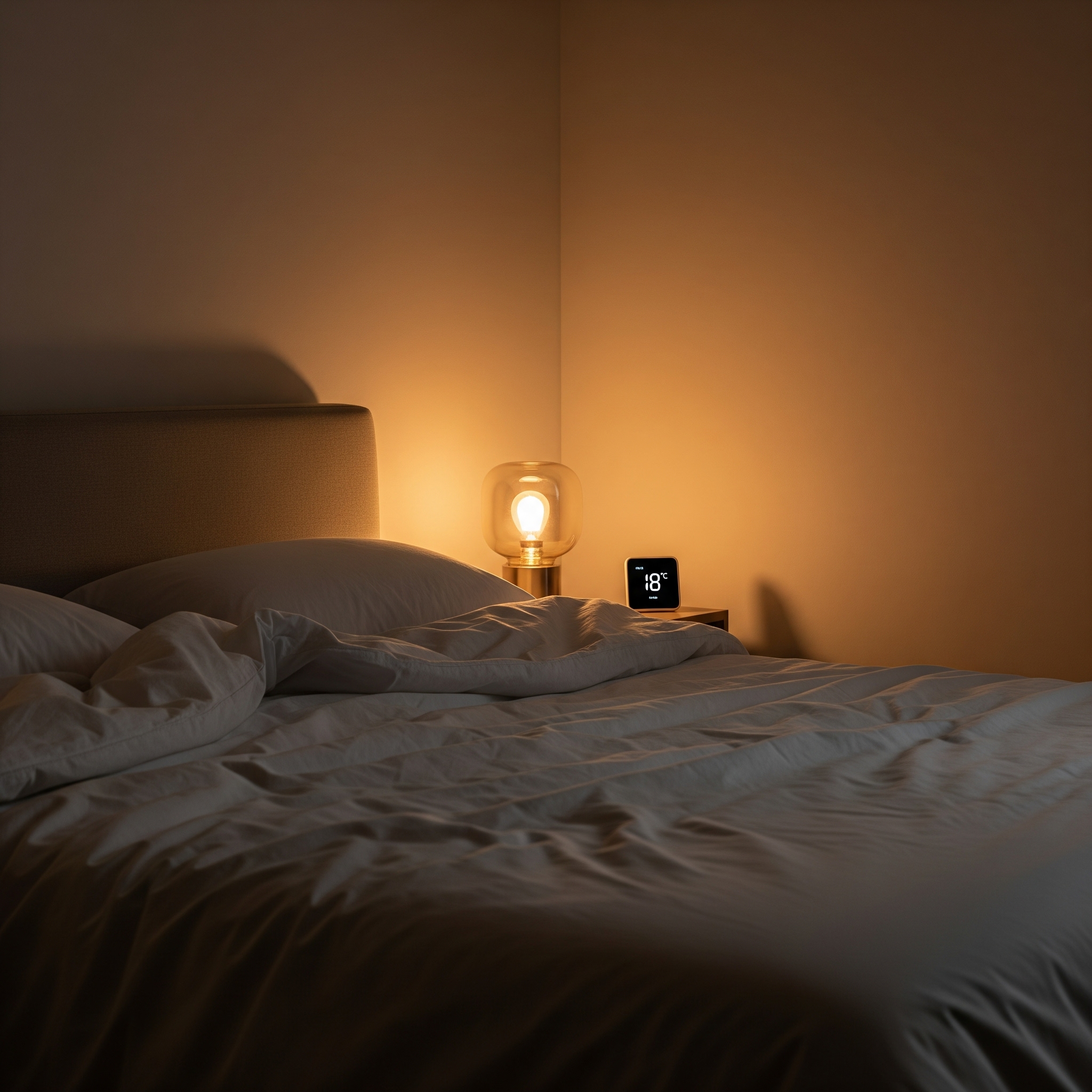
A good night’s sleep does not solely depend on the quality of your mattress or your evening habits. The ambient temperature of your room also plays a crucial role in regulating sleep. Numerous studies show that our body needs specific thermal conditions to fall asleep quickly and enjoy restorative sleep.
Temperature and Sleep: An Essential Biological Relationship
How Our Body Regulates Temperature During Sleep
The body follows a circadian rhythm, a 24-hour internal clock influenced by light and temperature. As bedtime approaches, the body temperature naturally begins to drop by 0.5 to 1 °C. This drop signals to the brain that it is time to sleep by triggering the secretion of melatonin. A room that is too warm or poorly ventilated interferes with this mechanism, delaying the onset of sleep and fragmenting sleep cycles. Conversely, a slightly cool room supports and amplifies this natural cooling, facilitating the transition into deep and restorative stages of sleep.
A Myth to Debunk: “You Need to Heat the Room to Sleep Well”
For a long time, it was believed that sleeping in a warm room was synonymous with comfort. However, scientific data and expert recommendations contradict this intuition. The National Institute of Sleep and Vigilance (INSV) states that the room temperature should not exceed 20 °C and is optimal between 18 °C and 19 °C for most adults. A cool room promotes deep sleep — the most physically and immunologically restorative phase — while excess heat keeps the brain in a light wakefulness and increases micro-awakenings.
Ideal Room Temperature: Recommendations
The recommended ranges vary slightly depending on the profile:
- Healthy Adults: between 16 °C and 19 °C, with an optimal zone at 18–19 °C according to INSV. Below 16 °C, thermal discomfort can disrupt sleep; above 20 °C, the quality of deep sleep deteriorates.
- Infants and Young Children: between 18 °C and 20 °C, for increased thermal safety. Babies are unable to effectively regulate their body temperature, so a room that is too cool or too warm can pose health risks.
- Elderly People: also 18 °C to 20 °C, due to less effective thermoregulation and increased sensitivity to cold.
These recommendations are validated by INSV, Public Health France, and other reference European organizations.
Why a Cool Room Promotes Sleep
A room maintained within the right thermal range acts on several mechanisms simultaneously. It facilitates the natural drop in body temperature necessary for falling asleep, improves the quality of deep sleep (the restorative physical and immune phase), and reduces nighttime awakenings related to thermal discomfort. Furthermore, a moderate temperature limits nighttime sweating, which accelerates the degradation of bedding and is a source of discomfort for those sharing their bed.
Consequences of an Inappropriate Temperature
Room Too Hot
When the temperature exceeds 20 °C, the body struggles to initiate its natural cooling process. The consequences are numerous: difficulties falling asleep, night sweats, lighter sleep with more micro-awakenings, and a slightly increased risk of snoring or episodes of sleep apnea. In the long term, consistently hot nights contribute to sleep debt and chronic fatigue.
Room Too Cold
Below 15–16 °C, the cold also becomes disruptive. Falling asleep may be delayed, muscle tension appears—especially in the shoulders and neck—and nighttime awakenings to warm up increase. Good news: a well-chosen duvet or mattress topper largely compensates for a slightly cool room, without the need to overheat the space.
Adapting to the Climate
In Warm Areas
In hot weather, several combined strategies can help maintain the bedroom within the right thermal range. Ventilate extensively early in the morning (before 8 AM) and in the evening (after 9 PM), then close shutters and blackout curtains during the day to block solar heat. A silent fan directed towards an open window — and not directly at you — improves air circulation without creating unwanted drafts. For bedding, prioritize lightweight and breathable materials: percale cotton, linen, or Tencel. Regarding the mattress itself, pocket spring or natural latex mattresses offer significantly better ventilation than dense foams.
Find a silent fan for the bedroom on AmazonIn Cold Areas
In cold weather, regulated heating with a programmable thermostat remains the most effective solution to keep the bedroom between 18 °C and 19 °C without overheating. Complement this with a duvet suitable for the season — a warmth index above 400 g/m² for winter — and, if necessary, a temperature-regulating mattress topper made of latex or ventilated foam that stabilizes the surface temperature in contact with the body.
View on AmazonPractical Tips for Optimal Temperature
Ventilate the room for at least ten minutes morning and evening, even in winter: air renewal lowers the ambient temperature and eliminates residual humidity. Avoid unnecessary heat sources — standby electronic devices, excessive heating — and turn off or unplug anything that can emit heat into the room. Investing in an indoor thermometer is a small but very concrete gesture: it allows you to monitor the actual temperature of the room throughout the night and adjust heating or ventilation accordingly.
Choose an indoor thermometer for the bedroom on AmazonAlso adapt your bedding to the season and your personal thermal sensitivity. If you have recurring issues with nighttime overheating, consider a highly breathable mattress: it is often the missing link in an otherwise well-thought-out thermal strategy.
The thermal environment is one of the most accessible and least expensive levers to improve sleep. For an overview of other factors related to sleep hygiene, check out our tips for better sleep .
Mistakes to Avoid
Overheating the room in winter “for comfort” is the most common mistake: the effect is actually the opposite on sleep depth. Sleeping with windows closed in summer without any ventilation amounts to depriving oneself of the only moment of the day when the outside air is cooler than the indoor air. Finally, using the same duvet all year round without considering seasonal variations forces the body to compensate by sweating, which degrades both sleep and bedding.
FAQ: Room Temperature and Sleep
Why do we sleep better in a cool room?
The drop in body temperature is a fundamental biological signal that triggers the secretion of melatonin and facilitates the onset of deep sleep. Specifically, the brain interprets this cooling as a “night signal” and gradually reduces its level of activity. A cool room, between 16 °C and 19 °C depending on individual profiles, supports and amplifies this natural process; a room that is too warm, on the other hand, keeps the body temperature high and forces the brain to remain in light sleep. For those who sweat easily at night, a cool room also reduces sweating, thereby improving overall comfort and the duration of uninterrupted sleep phases.
What is the exact temperature recommended by the INSV?
The National Institute of Sleep and Vigilance (INSV) recommends not exceeding 20 °C in the bedroom and identifies the optimal range as between 18 °C and 19 °C for a healthy adult. This recommendation is slightly higher than the range of 16–18 °C sometimes cited in Anglo-Saxon literature, which applies more to rooms with very insulating bedding or to sleepers who naturally feel warm. In practice, the right temperature is one at which you do not feel too hot or too cold under your usual duvet: for most people in France, this is between 17 °C and 19 °C.
Is a temperature of 21 °C too high?
For the majority of adults, yes. Above 20 °C, several studies observe an increase in micro-awakenings and a reduction in the time spent in deep sleep. That said, individual tolerance varies: some people, particularly those who suffer from chronically cold hands and feet (circulation issues), feel better at 20–21 °C and can compensate by using lighter bedding. If you regularly sleep at 21 °C and wake up refreshed, the issue is less significant; but if you suffer from fatigue or frequent nighttime awakenings, testing a room at 18–19 °C for a week is an easy and free diagnostic.
What should I do if I don't have air conditioning in summer?
Without air conditioning, the most effective strategy is to play with time slots: ventilate heavily after 9 PM and before 8 AM, then close everything tightly during the day to trap the cool air. A fan directed towards an open window (and not directly at you) promotes air circulation without creating a draft. In terms of bedding, a simple cotton or lightweight linen sheet is often sufficient; avoid synthetics that trap heat. If nighttime temperatures remain high for several consecutive nights (heatwave), a cold washcloth on the wrists before sleeping or a cold water-filled hot water bottle placed at the feet can help the body initiate cooling.
Is it dangerous to sleep in a room that is too cold?
Below 15 °C, the cold can indeed disrupt sleep and cause muscle tension, especially in older adults, infants, or individuals with circulation problems. For healthy adults who are well covered, a room at 16 °C with an appropriate winter duvet poses no danger. The golden rule is simple: the room can be cool, as long as the bedding keeps the body at a comfortable temperature. A duvet with a warmth index above 400 g/m² largely compensates for a room at 16–17 °C.
Should I adjust the temperature according to age?
Yes, and the differences are significant. Infants (up to about 3 years) and older adults benefit from a slightly warmer room, between 18 °C and 20 °C, due to less effective thermoregulation. For babies in particular, the High Authority of Health recommends not exceeding 20 °C and regularly checking the back of the child’s neck (neither sweaty nor cold) rather than relying solely on the thermometer. For healthy adults, the optimal range remains 18–19 °C; adolescents, whose sleep biology naturally shifts the circadian rhythm to later hours, also tolerate this range well.