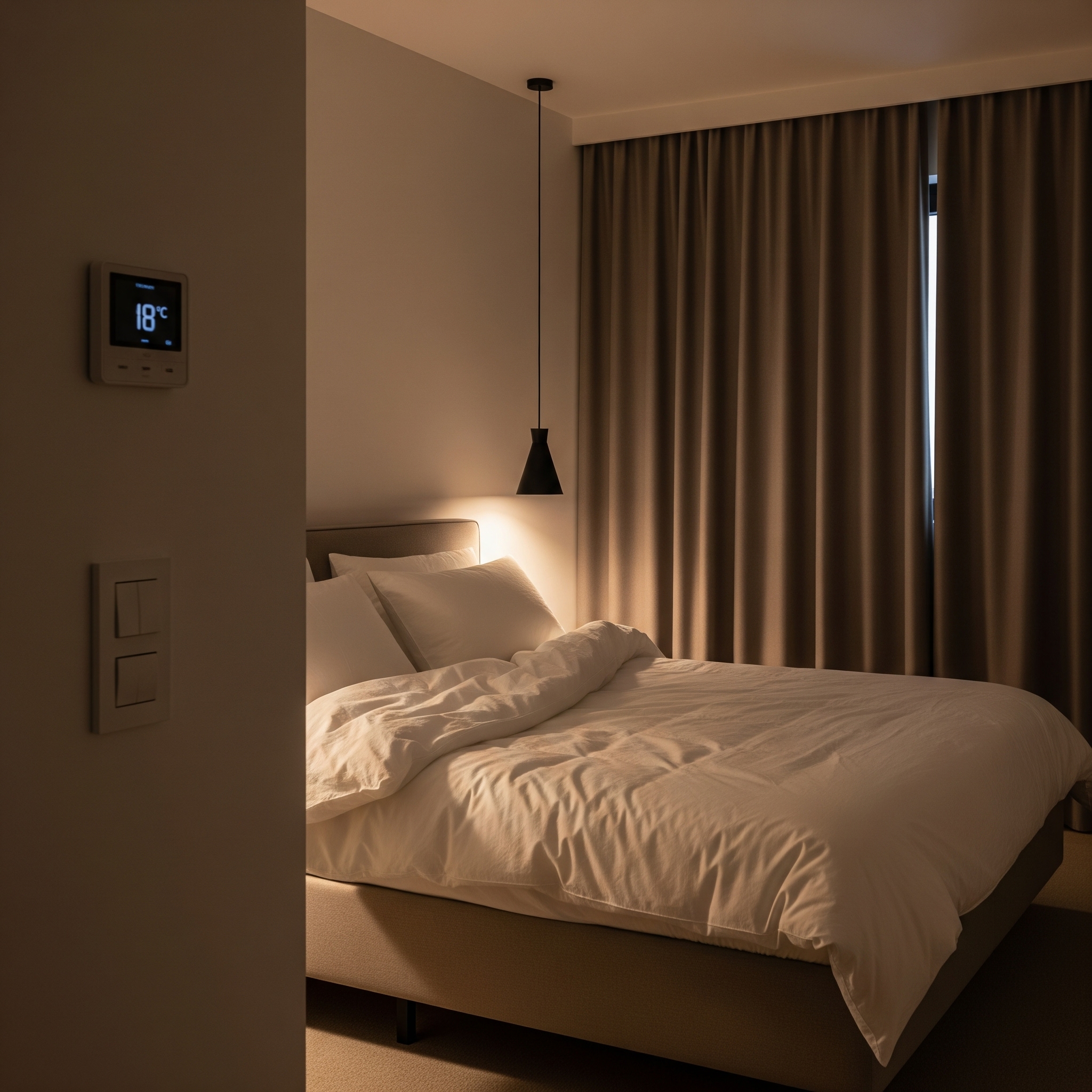
We spend nearly a third of our lives sleeping. Yet, the quality of this rest is often overlooked, particularly regarding the environment in which it takes place. The bedroom, more than just a room in the house, is a true cocoon that influences both physical rest and mental balance. Understanding the parameters that affect it allows us to take concrete actions on the duration and depth of our sleep.
What is a Restful Bedroom?
A restful bedroom promotes falling asleep, limits nighttime interruptions, and optimizes overall sleep quality. This encompasses various dimensions such as space layout, air quality, light, noise disturbances, temperature, colors, textiles, furniture, and of course, bedding.
Historically, many cultures have sought to create this harmonious environment: Chinese feng shui arranges space to promote the flow of energy, Scandinavian cocooning focuses on warmth and softness of materials, while the traditional Japanese bedroom emphasizes minimalism and contact with natural elements. Despite these very different approaches, they all converge towards the same goal: deep and restorative sleep.
To further enhance your efforts for better sleep, also check out our tips for improving sleep quality .
The Keys to a Sleep-Friendly Bedroom
1. The Ideal Temperature
The temperature of the bedroom is one of the most determining factors for sleep quality. According to the National Institute of Sleep and Vigilance (INSV), the room should not exceed 20 °C, and the optimal temperature for most adults is between 18 and 19 °C. A room that is too hot or too cold disrupts the natural drop in body temperature that triggers and maintains sleep onset. Elderly individuals, whose thermoregulation is less effective, may need a slightly higher temperature—around 20 °C—to fall asleep comfortably. In summer, a quiet fan or an air conditioner set to the right temperature can make all the difference.
2. Darkness and Natural Light
Exposure to blue light emitted by LEDs and screens (smartphones, tablets, televisions) inhibits the production of melatonin, the sleep hormone, sometimes for several hours. To limit this effect, it is advisable to avoid screens at least one hour before bedtime. A sufficiently dark room, equipped with blackout curtains or effective shutters, facilitates falling asleep and reduces early awakenings related to outside light. Conversely, in the morning, exposing oneself to natural light right after waking helps resynchronize the biological clock and improves daytime alertness.
Compare blackout curtains for the bedroom3. Quiet and Sound Insulation
Noise disturbances are among the leading causes of nighttime awakenings and fragmented sleep. Even moderate sounds perceived unconsciously (traffic, neighbors, household appliances) can cause micro-awakenings that impair overall rest quality without one remembering it in the morning. To limit these disturbances without necessarily undertaking renovations, several simple solutions exist: placing thick rugs that absorb sound, hanging heavy curtains at the windows, positioning filled bookshelves against shared walls, or using a white noise machine that masks disruptive sounds with a consistent background noise. In cases of significant external disturbances, double glazing remains the most effective long-term solution.
4. Regular Ventilation
Regularly renewing the air in the bedroom is a simple but often underestimated gesture. A confined atmosphere concentrates allergens (dust, dust mites, VOCs emitted by furniture or textiles) and increases CO₂ levels, which harms sleep depth. Ventilating the room for at least 10 minutes each day—ideally in the morning after waking—helps expel moisture accumulated overnight and lowers the concentration of indoor pollutants. In winter, even a short, wide-open ventilation is enough to effectively renew the air without excessively cooling the room.
5. A Quality Bed
Bedding is the heart of the bedroom. A mattress suited to one’s body shape and sleep habits, combined with a well-maintained box spring, forms the foundation of restorative rest. A mattress that is too firm creates pressure points on the shoulders and hips, while a mattress that is too soft does not sufficiently support the spine and promotes lower back pain. The average lifespan of a mattress is estimated to be between 8 and 10 years; beyond that, even a high-end model loses a significant part of its supportive properties. An ergonomic pillow, breathable bedding made from natural fibers (cotton, linen, bamboo), and a quality mattress protector effectively complete the ensemble.
View on AmazonAdvantages and Limitations According to Profiles
Needs vary significantly from one individual to another: some people can only fall asleep in complete darkness, while others struggle with total silence. Children generally need a room that is slightly warmer than adults, and their sensitivity to noise disturbances is often more pronounced during deep sleep phases. Seniors, whose sleep naturally becomes more fragmented with age, particularly benefit from firm and well-supported bedding, as well as a stable temperature in the room. As for night workers who sleep during the day, investing in high-performance blackout curtains and careful sound insulation is often crucial for their long-term health.
Comparison with Other Environments
Sleeping in a hotel room or at a relative’s house can disrupt sleep even when the objective conditions seem to be met — comfortable bed, quiet room, correct temperature. This phenomenon, well documented by sleep medicine researchers, is related to the increased vigilance of the brain in an unfamiliar environment: part of the hemisphere remains “on alert” to detect potential dangers. New smells, different lighting, unfamiliar bedding, or simply the noise of air conditioning are enough to fragment the cycles. This illustrates how much the personal sensory environment of the bedroom is a landmark deeply rooted in our sleep biology.
Reference Scientific Data
- According to INSV, the optimal bedroom temperature for sleeping is between 18 and 19 °C for a healthy adult.
- The presence of indoor plants reduces anxiety and improves the perception of sleep quality (Journal of Environmental Psychology, 2020).
- Reducing exposure to artificial light one hour before bedtime improves the duration of deep sleep, according to research published by Stanford University.
- The public health barometer France 2024 confirms that sleep disorders remain widespread among French adults, with a strong correlation between irregular schedules and poor quality of rest.
Practical Tips for Optimizing Your Bedroom
- Suitable Bedding: choose a mattress that fits your body type, an ergonomic pillow, and breathable bedding.
- Calming Colors: pastel blue, sage green, or beige reduce visual stimulation and promote relaxation.
- Tidy Room: a clear space limits mental load and facilitates the transition to rest.
- No Screens: no television or smartphone on the nightstand; charge devices outside the bedroom.
- Evening Routine: low-light reading, regular bedtime, possibly diffusing lavender or Roman chamomile to create an olfactory signal associated with rest.
To sustainably preserve your bedding investment, consider using a quality mattress protector that maintains the hygiene of your sleeping environment and extends the life of the mattress.
View on AmazonFAQ
Is it bad to sleep with the TV on?
Yes, sleeping with the television on negatively affects sleep quality in several ways. First, the blue light emitted by the screen inhibits melatonin secretion even at low intensity, delaying sleep onset and reducing the duration of deep sleep. Additionally, the sound variations inherent to TV programs — volume changes, music, voices — cause regular micro-awakenings that fragment sleep cycles without necessarily being remembered in the morning. In the long term, this habit is associated with chronic daytime fatigue and poorer physical recovery. Practical advice: if background noise helps you fall asleep, prefer a white noise machine set to turn off automatically after 30 minutes.
Is having a plant in the bedroom bad for sleep?
No, this is a persistent misconception. While some plants consume oxygen at night, the amounts involved in a standard-sized bedroom are negligible compared to human respiration. Conversely, several species offer real benefits: the peace lily and pothos filter certain indoor pollutants like benzene or formaldehyde. Potted or diffused lavender has documented anxiolytic properties that facilitate falling asleep. The snake plant is one of the few plants that produces oxygen at night through CAM photosynthesis, making it particularly suitable for the bedroom. Just be sure not to overwater your plants to avoid excessive humidity.
My mattress is over 10 years old: does it really affect my sleep?
Yes, and often more than one might think. A mattress gradually loses its supportive properties with use: foams compress, springs lose elasticity, and comfort zones sag where the body exerts the most pressure (hips, shoulders, lower back). This phenomenon, invisible to the naked eye, results in morning aches, increased nighttime tossing and turning, and reduced time spent in deep sleep. Beyond 10 years, even a originally good-quality mattress deserves to be replaced. Before reaching that point, regularly check the condition of the box spring, which also affects the mattress’s performance, and rotate or flip your mattress twice a year if it is reversible.
What scent promotes sleep?
Lavender is the most documented aromatherapy for improving sleep onset: its active compounds (linalool, linalyl acetate) act on the parasympathetic nervous system by reducing anxiety and slightly lowering heart rate. Roman chamomile and valerian have similar effects. In practice, a few drops of true lavender essential oil on a diffuser set to turn off before your bedtime, or simply placed on a tissue near the pillow, are enough to create an olfactory signal associated with rest. However, avoid stimulating essential oils like peppermint or camphor rosemary, which are more suited for waking up than falling asleep. Asthmatic or allergic individuals should consult a doctor before using essential oil diffusers in the sleep space.
How can I reduce noise in a bedroom without doing renovations?
Several accessible and effective solutions can improve the acoustic insulation of a bedroom without touching the walls or windows. Thick rugs and carpets absorb sounds traveling in the room and reduce impact noise from the upper floor. Heavy double-layer curtains, installed from floor to ceiling, dampen both external noise and brightness. Bookshelves filled with books placed against shared walls provide an excellent natural acoustic buffer. Inside, a white or pink noise machine masks disruptive sounds by creating a regular and non-intrusive background noise. Finally, memory foam earplugs offer a simple and economical personal solution, particularly useful during travel or in homes highly exposed to urban disturbances.
Should a bedroom be dedicated solely to sleep, or can one work in it?
Ideally, the bedroom should be reserved for sleep and relaxation, as the brain operates through conditioned associations: the more stimulating activities you perform there (remote work, video games, professional calls), the harder it will be for it to associate this space with rest. This is what sleep specialists refer to as stimulus-response conditioning. If you do not have a separate room to work in, visually delineate the workspace (for example, with a screen or a desk facing a window), store work materials out of sight at the end of the day, and establish a clear transition ritual between work mode and rest mode — a short walk, some stretching, or reading — to help your brain make this shift.