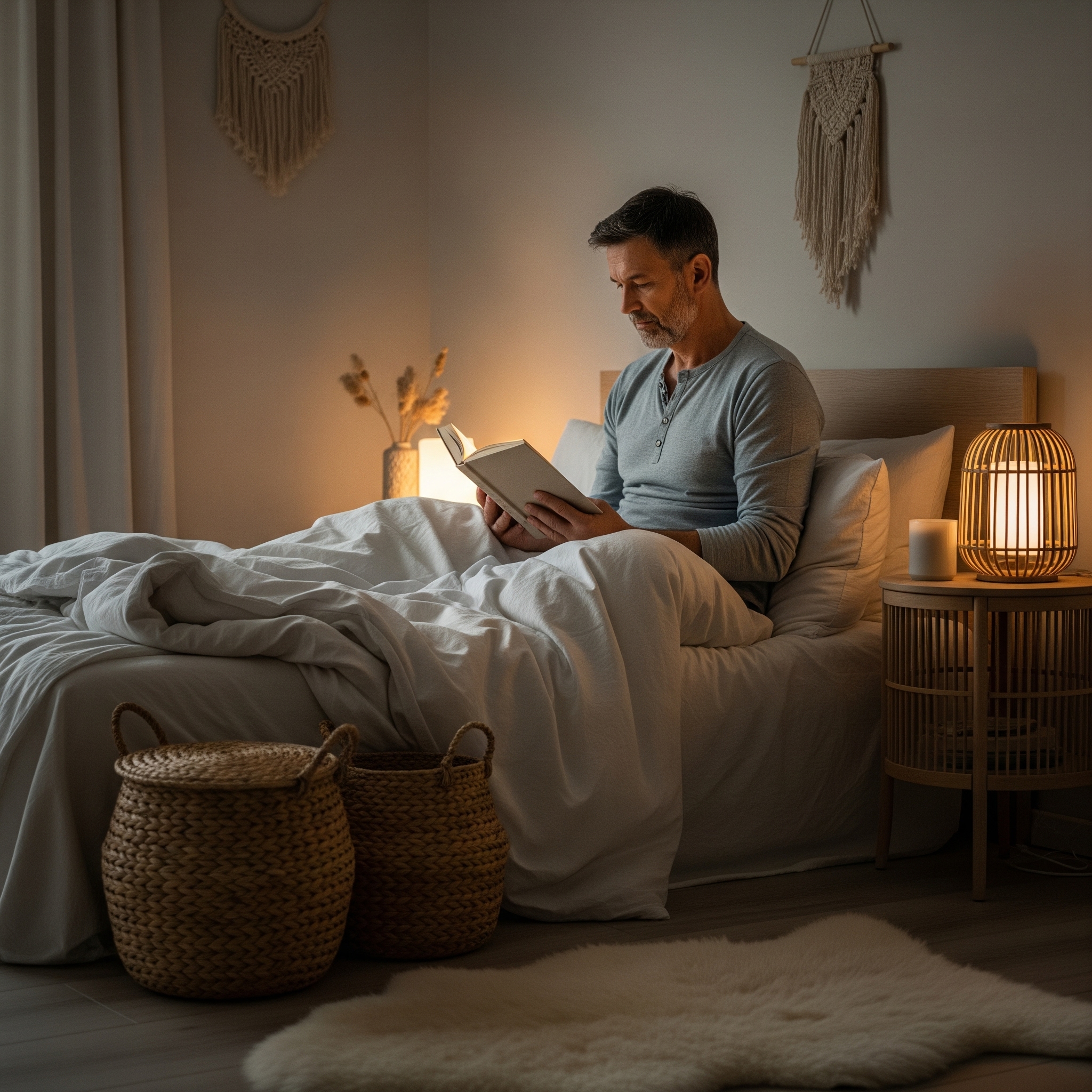
In a society marked by screens, stress, and irregular schedules, establishing an evening ritual validated by neuroscience is a simple and effective solution for falling asleep better and improving sleep quality.
What is an evening ritual?
An evening ritual is a series of actions repeated every night before sleeping, which sends a clear signal to the brain: it is time to unwind and prepare the body for rest. These calming gestures facilitate the transition between the active day and restorative night by activating what specialists call the “parasympathetic brake” — the neurological mechanism that gradually slows the heart rate, relaxes the muscles, and lowers alertness.
An ancient legacy, validated by science
Historically, prayers, herbal teas, or stargazing served to prepare the body and mind for sleep. Today, research in chronobiology confirms that these practices soothe the autonomic nervous system and promote faster falling asleep and deeper sleep. Daily repetition creates stable neural associations between the gestures and the state of drowsiness — a process similar to classical conditioning described by Pavlov.
How does a sleep routine work?
The body follows a circadian rhythm, an internal 24-hour clock that regulates the wake-sleep cycle. The regularity of actions and schedules conditions the brain to anticipate night long before the head hits the pillow.
The main mechanisms involved are as follows:
- Conditioning: the brain eventually associates certain repetitive habits (reading, herbal tea, stretching) with the imminence of sleep, triggering an almost automatic drowsiness response.
- Body relaxation: breathing slows down, muscle tension decreases, and body temperature naturally lowers — a condition essential for falling asleep.
- Reduced light: exposure to soft, warm light in the evening promotes the secretion of melatonin, the sleep hormone produced by the pineal gland as soon as darkness or dim light sets in.
To enhance the effectiveness of your rituals, the entirety of your nighttime environment plays a crucial role: check out our tips for better sleep to optimize light, noise, and bedding in addition to your routine.
The advantages (and limits) of a good bedtime ritual
What it can change
- Faster falling asleep, often within 20 minutes after a few weeks of practice
- Fewer nighttime awakenings, thanks to a better-regulated nervous system
- Reduction of stress at the end of the day, particularly through heart coherence or abdominal breathing
- Overall improvement in sleep quality, with more phases of deep slow sleep
What it does not do
- Does not cure deep sleep disorders (sleep apnea, chronic insomnia) that require medical follow-up
- Does not act immediately: the first effects are generally noticeable after 2 to 3 weeks of consistency
- Does not replace good overall lifestyle hygiene (balanced diet, regular physical activity, management of light and noise exposure)
Useful Alternatives or Complements
An evening ritual is rarely built alone: it is enriched with tools and complementary practices that enhance its effectiveness. Among the most accessible are guided meditation and heart coherence apps (rhythmic breathing at 6 cycles per minute) that allow for quick calming of the nervous system. Mild sedative herbs — chamomile, valerian, passionflower — infused as herbal tea create a ritual in itself, both sensory and physiologically active. Finally, a well-maintained physical environment (blackout curtains, a cool temperature between 16 and 19 °C according to the recommendations of the National Sleep Institute, a pillow suited to your morphology) multiplies the benefits of your routine.
One often underestimated element in sleep quality remains the bedding itself. A comfortable mattress, suited to your morphology and sleeping position, forms the foundation on which all your rituals rest. Without this appropriate physical support, even the best evening routine cannot compensate for back tension or pressure points that fragment sleep.
View on AmazonExamples of Rituals Tailored to Each Profile
For Active Adults
Professional life and digital demands make it difficult to disconnect. The ideal is to schedule a firm “disconnection time” — ideally 60 to 90 minutes before bedtime — after which screens are turned off. This window can be filled with reading a physical novel, listening to a calming podcast or soothing music, enjoying a relaxing herbal tea (chamomile, lemon balm), and spending a few minutes on deep breathing or progressive muscle relaxation.
For Children
For children, predictability is key: the immature brain needs clear time markers to initiate melatonin secretion. A sequence of warm bath → bedtime story → cuddle → gradual dimming of lights (red or orange night light, less disruptive than white or blue) creates an ideal framework, to be maintained with the same chronology every night, including weekends.
For Seniors
As people age, the circadian rhythm naturally shifts to an earlier phase (wanting to sleep earlier, waking up earlier) and deep sleep becomes more fragmented. Gentle stretching or self-massage of the feet and legs helps facilitate muscle relaxation. The bedroom should remain cool — between 17 and 19 °C — to support the necessary drop in body temperature for falling asleep. A light infusion (avoid high doses of valerian without medical advice) and soft music pleasantly complete the routine.
Discover relaxing herbal teas for sleep available on AmazonPractical Tips for an Effective Routine
- Slow down the pace by 9 PM by creating a calm and dim atmosphere — lower the ceiling lights and prefer warm light bedside lamps (color temperature below 3,000 K).
- Be minimalist: two or three simple and enjoyable rituals are better than a list of ten burdensome actions that you will abandon after the first difficult night.
- Keep stable hours, including on weekends, to synchronize your internal clock: variability in bedtime is one of the most destabilizing factors for the circadian rhythm.
- Avoid screens in bed, as the blue light emitted by smartphones and tablets shifts melatonin secretion by 1 to 3 hours according to studies — activating night mode is not enough to eliminate this effect.
- Listen to your fatigue signals: repeated yawning, itchy eyes, and decreased attention are all invitations from your body to move to the ritual phase. Resisting these signals to “finish something” often leads to missing the optimal sleep onset window.
FAQ – Everything You Need to Know About Evening Routines
What is the difference between an evening routine and sleep hygiene?
The evening routine refers to the specific actions taken in the hour or two before bedtime — herbal tea, reading, stretching, meditation, etc. Sleep hygiene is a broader concept that encompasses all factors influencing the quality of rest over 24 hours: caffeine and alcohol consumption, physical activity, exposure to natural light during the day, bedding quality, noise and temperature management. In other words, the evening routine is a subset of sleep hygiene. Good overall sleep hygiene makes the evening routine more effective, and vice versa; the two approaches are complementary rather than substitutable.
Should I establish a ritual if I fall asleep well?
Yes, for two reasons. First, a regular routine consolidates good falling-asleep reflexes and gives them a certain resilience: during a period of work stress or jet lag, your rituals will act as a physiological “anchor” that helps the brain return to a calm state more quickly. Second, prevention is better than cure: sleep habits gradually deteriorate without us noticing, and a well-established routine serves as a safety net against the future onset of sleep onset disorders.
At what age should a ritual be established?
From about 6 months old, babies become sensitive to repetitive signals (lullabies, comfort objects, soft light) that indicate that night is approaching. Before this age, the circadian rhythm is not yet fully established, and sleep needs are too fragmented for a fixed routine to be truly effective. For younger infants, the priority is the safety of the sleeping position (on their back, firm bedding without bumpers) rather than establishing a strict routine. From 3-4 months, gentle and repeated signals already begin to have a positive conditioning effect.
What if I don't have time for a long routine?
Even five to ten minutes is sufficient, provided that consistency is maintained every evening — it is the repetition that creates the neural association, not the duration. In this case, focus your efforts on the two most powerful levers: turning off screens (or activating night mode and significantly lowering brightness) and performing three minutes of slow abdominal breathing. These two actions can be done while brushing your teeth or getting into bed, without adding extra time to your evening.
How long does it take for an evening routine to be effective?
The first effects are generally felt after 2 to 3 weeks of regular practice. The brain needs repetition to associate these actions with falling asleep — this is the principle of conditioning. For some people, especially those suffering from mild insomnia or chronic stress, it may take up to 4 to 6 weeks to observe significant improvement. It is important not to judge the effectiveness of the routine based on one or two difficult nights: disturbed nights are part of the anchoring process, and quitting too early is the most common mistake. The key is consistency — even on nights when you feel exhausted, maintain your rituals to firmly anchor the reflex.
Does blue light from screens really harm sleep?
Yes, and the effect is documented by numerous studies in chronobiology. Blue light (wavelength around 480 nm) directly inhibits the secretion of melatonin by the pineal gland, potentially delaying sleep onset by 1 to 3 hours depending on the intensity and duration of exposure. The night mode on smartphones partially reduces this effect by decreasing the proportion of blue light, but exposure to white light from screens — even dimmed — remains stimulating for the nervous system. The most effective solution is to put away screens at least 60 minutes before bedtime and replace them with a low-visual-stimulation activity, such as reading a physical book under the light of a warm-toned lamp.