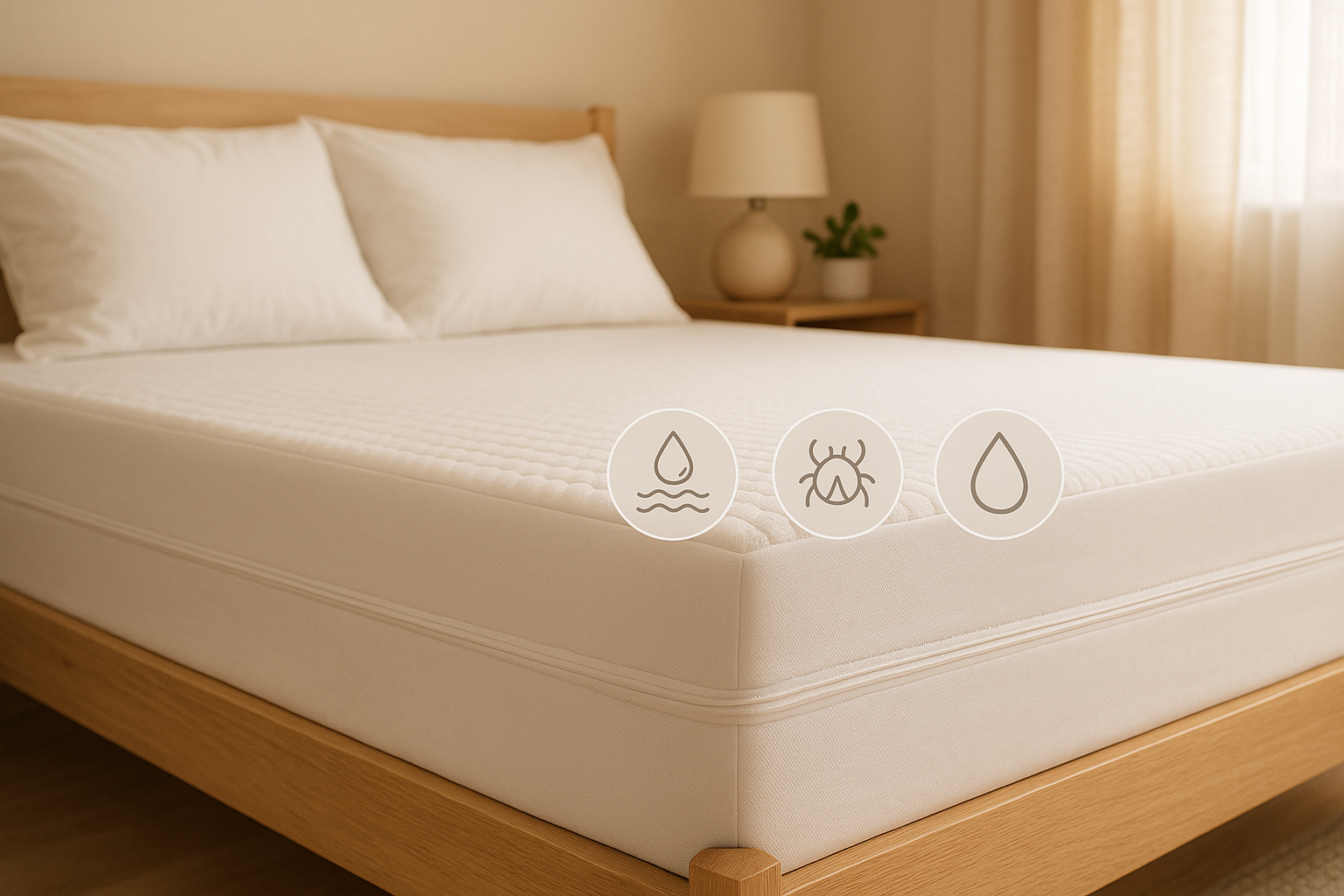
The bed base is something we almost always forget. We flip the mattress, wash the sheets, change the mattress protector — and the bed base collects dust for years without anyone caring. Yet, it bears the entire weight of the mattress and the sleepers, night after night. If poorly maintained, it accumulates dust mites, moisture, and dirt, which can reduce its lifespan and degrade the air quality in your bedroom. Here’s how to take care of it properly, depending on the type of bed base you have.
Why maintain your bed base?
A bed base typically spends ten years in the same room. During this time, it absorbs some of the moisture released by sleepers (about 0.5 liters of sweat per night), accumulates dust, and can become a favorable environment for dust mites. This is not trivial for allergic individuals, and it also accelerates the aging of materials, whether it’s the fabric of an upholstered bed base, the wood of the slats, or the mechanism of a storage bed.
Air out the room for 10 to 15 minutes every morning; this is the simplest and most effective action: it’s enough to expel most of the nighttime moisture before it settles into the fibers.
Slatted bed base: the easiest to maintain
The slatted bed base is the model that requires the least effort. The wooden or composite slats are exposed to air, which naturally limits the accumulation of moisture and dust mites.
Regular maintenance (approximately every two months):
Vacuum the slats, between the slats, and the frame. A brush attachment is ideal to avoid scratching the wood. If your bed base is placed on a fabric frame, also treat the sides with the vacuum.
For wooden slats: a slightly damp cloth (clear water, no product) is enough to remove marks. Avoid soaking the wood: moisture causes the fibers to swell and can weaken the slats in the long term. Allow to dry completely before replacing the mattress.
To check at the same time: the condition of the slats. If some are noticeably bending or if the spacing between slats has widened, the weight distribution is no longer even, and your mattress suffers. On an adjustable slatted bed base (the wider center slats that adjust according to weight), check that the adjustment sliders haven’t slipped.
Upholstered bed base: the most delicate
The upholstered bed base is entirely covered with fabric (cotton, velvet, technical fabric). It accumulates the most dust and dust mites, precisely because its fibers are porous and air does not circulate as much as between slats.
Basic maintenance (at least 1 to 2 times a year):
Lift the mattress and vacuum all accessible sides of the bed base — top, sides, and if you can access underneath, treat that side as well. Use a brush or fabric attachment, never a hard attachment that could snag the fibers.
In case of a stain:
Dab with a clean cloth soaked in warm water and a few drops of liquid Marseille soap. Do not rub; just dab, starting from the edges of the stain towards the center to avoid widening the halo. Rinse with another damp cloth (clear water) and let it air dry before replacing the mattress — ideally for several hours.
To neutralize odors:
Sprinkle baking soda on the surface of the upholstered bed base, let it sit for two hours, then vacuum thoroughly. Baking soda absorbs odors without chemical treatment or excessive moisture.
What to absolutely avoid: the steam cleaner. High temperatures degrade the adhesives and internal structures of the upholstered bed base and can deform the springs if there are any. Some articles recommend it: that’s a mistake.
See mattress protectors on AmazonStorage bed base: two areas to manage
The storage bed (or storage bed base) combines the advantages of storage with the constraints of a semi-enclosed space. The inside of the storage compartment, in particular, retains dust and may lack ventilation if overfilled.
The bed base itself is treated like an upholstered or slatted bed base depending on the model: regular vacuuming on the load-bearing surface, stain treatment with soapy water.
The inside of the storage compartment:
Empty it completely twice a year. Vacuum the corners and walls, paying special attention to the angles where dust accumulates. If the interior is fabric, treat it like an upholstered bed base (vacuuming + baking soda if necessary). If the structure is made of raw wood, a slightly damp cloth followed by complete drying is sufficient.
Be cautious of moisture: the storage compartment is tempting for storing blankets, linens, and clothes. Avoid storing slightly damp textiles or items that emit condensation. In case of a musty smell, place a bag of baking soda or a few sheets of newspaper in the empty storage compartment for a few days.
The lifting mechanism: check twice a year that the pistons or hinges operate freely. A stuck piston can put pressure on the frame and create play in the structure. If you hear creaking when lifting, clean the joints and apply a light coat of linseed oil or silicone spray (never cooking oil that can go rancid).
Good daily habits, regardless of the bed base
A few simple habits make all the difference over time:
- Air the room every morning, even in winter: a few minutes are enough to lower the humidity level.
- Never place damp laundry on the bed base, even for a few minutes.
- Lift the mattress once a month to allow air to circulate between the two surfaces.
- Protect the bed base with a mattress protector or a mattress pad: much easier to wash than a stained upholstered or slatted base.
This last point deserves emphasis. A washable mattress protector placed between the bed base and the mattress captures most of the moisture and residues before they reach the bed base. It’s the best preventive investment, especially for upholstered bed bases that cannot be machine washed.
Should a bed base be flipped?
The answer depends on the model. A slatted bed base does not need to be flipped: the two sides are not symmetrical (one supports the mattress, the other rests on the frame or the floor). However, rotating it 180° lengthwise every six months helps to even out the wear of the slats, especially in the head and foot areas where weight is concentrated differently.
An upholstered bed base with springs can sometimes be flipped if its construction allows it: check with the manufacturer. Most modern models are one-sided.
When to replace a bed base?
A bed base generally lasts between 10 and 15 years, but several signs indicate it’s time to replace it: persistent creaking with the slightest movement, visible sagging of the slats or the bottom, a storage lid that no longer holds, or fabric of the upholstery so degraded that it can no longer be cleaned properly. A poor bed base negates the qualities of a good mattress: if your bedding feels less comfortable despite a recent mattress, the bed base is often to blame.
View on AmazonTo learn more about maintaining your entire bedding set, find our other guides in the bedding maintenance section.
What is the ideal frequency for cleaning an upholstered bed base?
Vacuuming once or twice a year is a reasonable minimum. If you suffer from dust mite allergies, increase this frequency to once a quarter. For stains, treat them as soon as they appear: the longer you wait, the more they embed in the fibers of the fabric. Daily morning airing of the room remains the most cost-effective action: it takes no more than ten minutes and is enough to expel most of the moisture before it settles into the fabric. A washable mattress protector placed on top significantly extends the interval between deep cleanings.
Can a steam cleaner be used on a bed base?
On a wooden slatted bed base, no: steam soaks the wood, causes it to swell, and can weaken it in the long term. On an upholstered bed base, the answer is also no, contrary to what is sometimes read. The adhesives used in assembling the internal layers of the upholstery cannot withstand high temperatures, and if the bed base contains springs, heat can alter their tension. The best method remains vacuuming for dust and a damp cloth (warm water + mild soap) for occasional stains.
How to eliminate dust mites from a bed base?
Dust mites thrive in warm, humid environments rich in organic matter: an upholstered bed base that is rarely cleaned meets all these conditions. To effectively reduce them, start by thoroughly vacuuming all surfaces with a vacuum cleaner equipped with a HEPA filter if possible. Sprinkling baking soda in a thin layer, letting it sit for two hours, then vacuuming helps to disrupt their environment without aggressive chemicals. Daily airing of the room lowers the humidity level, limiting their reproduction. For very sensitive sleepers, a washable anti-allergy mattress protector at 60 °C provides the best long-term barrier.
Is a mattress protector necessary in addition to a mattress pad?
It’s not mandatory, but it’s very useful, especially for an upholstered bed base. The mattress protector protects the mattress; the mattress pad intercepts moisture that passes through the mattress before it reaches the bed base. On a bed with a young child, a storage bed used for linens, or simply in a room exposed to humidity, adding a washable mattress protector significantly extends the lifespan of the bed base and reduces deep cleaning operations. On a well-ventilated slatted bed base, it’s less essential.
When should bed base slats be replaced?
A slat that noticeably bends in the center when pressed with a bare hand, or that has lost its natural camber (it should remain slightly arched upwards), needs to be replaced. A single faulty slat is enough to create a sagging point in the mattress, which eventually leaves a lasting mark. Most bed base manufacturers sell their slats individually: therefore, it’s unnecessary to replace the entire bed base for two or three worn slats. Also check the lateral fixing blocks: if they are cracked or no longer hold the slats in place, replace them at the same time.
How to maintain the mechanism of a storage bed?
The lifting mechanism (gas pistons or hinges) is often forgotten until the first creak. Twice a year, lift the top and visually check the condition of the pistons: they should not show any signs of oil or excessive play. If the joints squeak, apply a thin layer of silicone spray grease, available at hardware stores, on the friction points. Avoid cooking oil or standard machine oil: they attract dust and go rancid. A piston that no longer holds the top in the raised position should be replaced quickly to avoid any risk of injury.