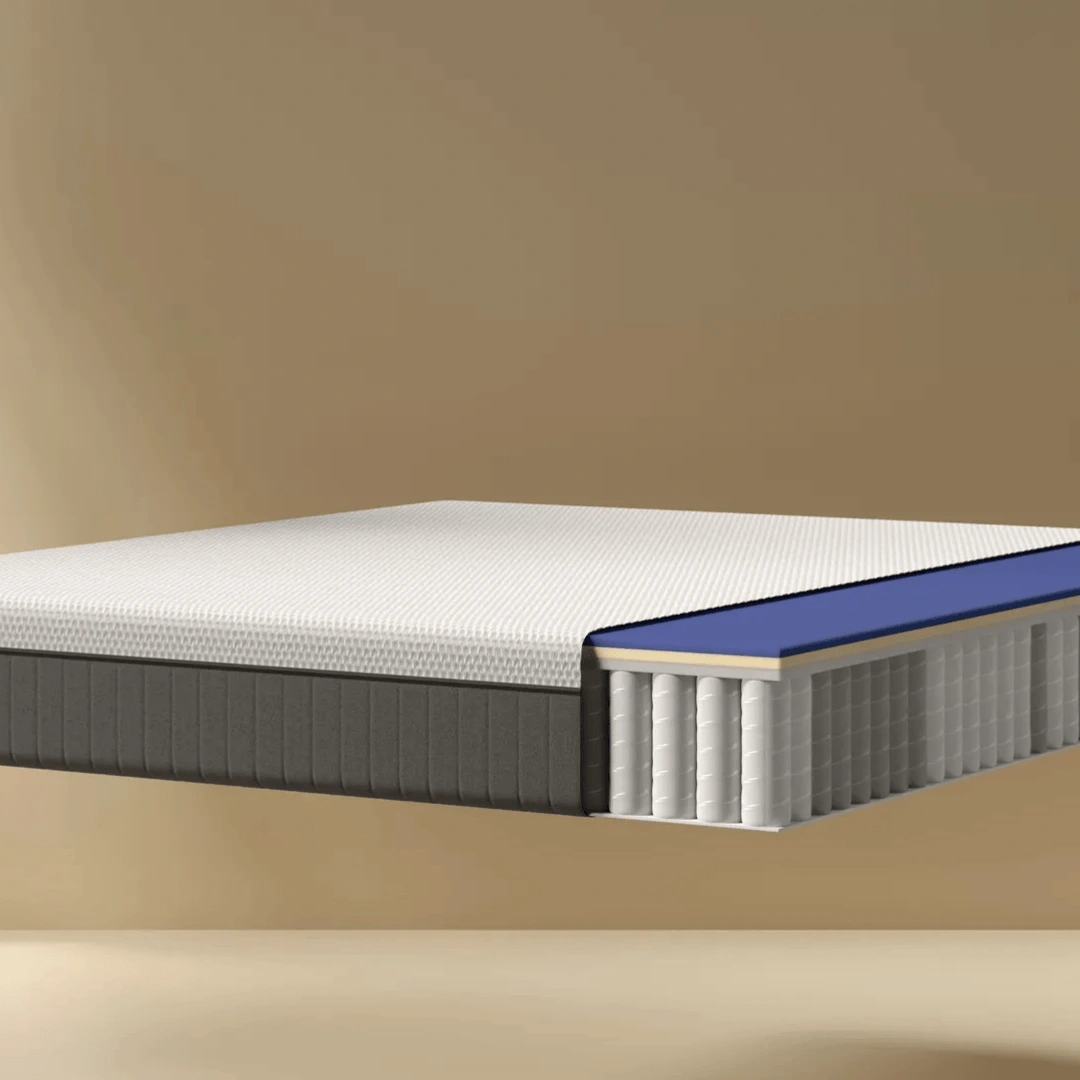
Sleeping together is not trivial. According to a Flash survey reported by franceinfo in March 2026, 25% of the French who share their bed believe it degrades the quality of their sleep. Nocturnal movements, different body types, firmness preferences that do not coincide: finding the perfect mattress for two sleepers is a real design challenge. However, manufacturers have made significant progress in recent years, particularly thanks to independent pocket springs and high-resilience foams, which drastically limit the transmission of vibrations from one side of the bed to the other.
This article is the complementary product selection of our guide on sleeping as a couple. It is aimed at those who want to get straight to the point: which mattress to choose, for which couple profile, and why. We have selected five models available in France in 2026, chosen for their sleeping independence, versatility for different body types, and the clarity of their commercial offer (home trial, warranty, customer service).
What Really Matters for a Couple’s Mattress
Before diving into the details, a quick reminder of the criteria that distinguish a good mattress for couples from a general mattress:
- Sleeping independence: the mattress’s ability to isolate the movements of one partner so as not to disturb the other. This is the number one criterion. It directly depends on the spring technology (pocketed, individual) or the density and structure of the foams.
- Management of different body types: when one weighs 60 kg and the other 90 kg, the mattress must provide appropriate support for each without creating imbalance or rolling towards the center.
- Heat transfer: two bodies in the same bed generate more heat. A mattress that “retains” heat can quickly become uncomfortable, especially in summer.
- Firmness: a medium-firm comfort suits most couples, as it provides enough support for a heavier sleeper without crushing a lighter sleeper.
- Width: in 160 × 200 cm or, better, in 180 × 200 cm, each has enough space to turn over without encroaching on the other.
Now let’s look at our five selections.
1. Tediber Hybrid — The Best Overall Choice for Couples
The Tediber Hybrid is, in 2026, the most cited reference in the couple category. Made in France, it combines several layers of high-density foam — including a 37 kg/m³ polyurethane foam — with pocket springs, resulting in a product that is both welcoming and technically solid. Its main strength is the management of different body types: the zoning of the mattress intelligently distributes support according to body areas, so that two partners of distinct builds can each find their balance.
The medium-firmness is suitable for the majority, particularly for couples where one sleeps on their back and the other on their side — a very common profile. The brand offers 100 nights of home trial, and the quality of manufacturing as well as customer service is regularly praised by users.
Ideal profile: couples with different builds, back or mixed sleepers, those who want a premium mattress made in France.
Discover the Tediber Hybrid on the official site2. Emma Hybrid — The Best Value for Money
The Emma Original is often presented as the best value for money in the hybrid category: accessible, well-rated, and regularly offered on promotion. The German brand, available in France notably via Amazon, has built its reputation on a versatile mattress whose individual pocket springs absorb nocturnal movements, limiting disturbances when one partner turns over in the middle of the night.
For couples with a controlled budget but who do not want to sacrifice sleeping independence, this is a serious and proven option. The brand offers a generous trial period and a multi-year warranty, which secures online purchases.
Ideal profile: budget-conscious couples, sleepers who turn often, first acquisition of a hybrid mattress.
Search for the Emma Hybrid mattress on Amazon.fr3. Kipli — The Best for Couples Sensitive to Materials
Kipli occupies a well-defined niche: couples who want to sleep on natural, healthy, and certified materials, without compromising on sleeping independence. The Kipli mattress is made of natural latex, organic cotton, and wool, without synthetic foam or unnecessary chemicals. This is a rare promise in a market dominated by polyurethane-based hybrids.
Technically, natural latex has excellent resilience: it quickly returns to its shape, absorbs vibrations, and does not create the “suction cup” effect often attributed to memory foams. The result is natural sleeping independence, without resorting to metal springs. Environmental certifications also reassure profiles attentive to indoor air quality and allergies.
Kipli clearly positions itself in the premium range: the price increases in proportion to the quality of the raw materials. But for a couple who considers the mattress an investment over ten years rather than an expense, this is a purchase that fully justifies itself.
Ideal profile: couples sensitive to allergens, aware of environmental impact, ready to invest in a durable and natural mattress.
View on Amazon4. Someo Rêve 600 — For Couples with Very Different Body Types
Made in Wattrelos, in northern France, the Someo Rêve 600 combines 1,026 pocket springs (in 160 × 200 cm) and a 5 cm layer of memory foam at 45 kg/m³, distributed in 7 distinct comfort zones — head, shoulders, back, lumbar, buttocks, legs, and feet. Each spring is isolated in its own fabric pocket, so the movements of one sleeper do not propagate to the other side of the bed.
This is a particularly relevant choice when the morphological gap between the two partners is significant: the precise zoning and high density of the foam ensure lasting lumbar support for a heavier sleeper without crushing a lighter sleeper. For couples with different firmness preferences, Someo also offers biconfort sets in 160 or 180 cm, with each half of the mattress adjusted independently. The French brand offers 6 months of home trial with free return — one of the longest trial periods on the market.
Ideal profile: couples with a significant morphological gap, different firmness preferences (biconfort option), those who want a French mattress with pocket springs.
View on Amazon5. Mello Hybrid — The French Medium-Firm Choice for Demanding Couples
The Mello Hybrid stands out with its 7-zone pocket springs, allowing for remarkable work on sleeping independence, with a medium-firm comfort suitable for a wide majority of profiles. Made in France, it offers fine segmentation of support — soft shoulders to firmer hips and lumbar — which is one of the most precise in the market in this price category.
The medium-firm comfort of the Mello is often cited as the ideal compromise for couples: enough support to prevent sagging, enough welcome to avoid discomfort on pressure points. The brand offers careful delivery service and a rolled mattress that simplifies logistics, even for a large format (160 or 180 × 200 cm).
Ideal profile: couples looking for a quality French mattress, mixed profiles (side/back), those who want zoned design without reaching the ultra-premium segment.
Summary Table
| Mattress | Type | Couple’s Strength | Recommended Profile |
|---|---|---|---|
| Tediber Hybrid | Hybrid (foam + springs) | Zoned support, made in France | Different builds, versatile use |
| Emma Hybrid | Hybrid | Value for money, pocket springs | Budget-conscious, first hybrid |
| Kipli | Natural latex | Bio materials, no synthetic | Eco-conscious couples, allergies |
| Someo Rêve 600 | Hybrid 1,026 springs, 7 zones | Made in France, biconfort option | Significant morphological gap, different firmness |
| Mello Hybrid | Hybrid 7 zones | Precise zoned support, Made in France | Mixed profiles, medium-firm comfort |
How to Choose Between These Five Models?
If you are still unsure, here is a simplified decision grid:
- Controlled budget + good sleeping independence → Emma Hybrid
- Best overall choice, disparate morphologies → Tediber Hybrid
- Natural materials, eco-friendly approach → Kipli
- Significant morphological gap, different firmness (biconfort option) → Someo Rêve 600
- Made in France, precise zoned support, medium-firm comfort → Mello Hybrid
Remember that the width of the mattress is as important as its technology. If your budget allows, opt for the 180 × 200 cm rather than the 160 × 200 cm: the additional 20 centimeters radically change the perceived comfort when both partners turn independently.
Finally, always take advantage of the trial nights offered by these brands — generally between 100 and 120 nights. Sleeping together on a mattress for at least three to four weeks is the only way to validate that the sleeping independence and firmness level truly suit your shared profile.
Find all our selections in our Top Mattresses section to deepen your comparisons by type or use.
What is sleeping independence and why is it crucial for a couple?
Sleeping independence refers to a mattress’s ability to isolate the movements of one sleeper so as not to transmit them to the other. Specifically, when one partner turns over at 3 a.m., a mattress with good sleeping independence will absorb that movement locally, without creating a wave or perceptible vibration on the other side of the bed. This property is directly related to the technology used: independent pocket springs (each spring is encased in its own fabric pocket) are the most effective solution, as they are not mechanically linked to each other. High-density foams can also offer good isolation, but they tend to retain more heat. For a couple where one is a light sleeper easily awakened, sleeping independence is not a secondary criterion: it is often the difference between restorative nights and fragmented nights.
Should you buy a 160 × 200 cm or 180 × 200 cm mattress for a couple?
The 180 × 200 cm is almost always preferable for an adult couple. In 160 × 200 cm, each sleeper theoretically has 80 cm of width — which may seem sufficient, but leaves little room as soon as one of them turns or spreads their arms. The 180 × 200 cm increases this individual width to 90 cm, equivalent to a standard single bed. The benefit is immediate: fewer intrusions into the other’s space, fewer nocturnal disturbances. If your room is too small for a 180 cm wide frame (considering bedside tables and passage), the 160 × 200 remains a viable option, especially coupled with a mattress with very good sleeping independence like those selected in this article. But if space allows, the 180 is an investment that significantly improves the sleep quality of both partners.
Is a natural latex mattress like Kipli really suitable for two sleepers?
Yes, provided you understand how latex works. Contrary to popular belief, natural latex offers good sleeping independence — not because of springs, but due to its cellular structure that absorbs pressures very locally. Latex is also very resilient: it quickly returns to its shape after compression, which avoids the permanent depressions often observed in low-quality foams. For couples, the main advantage is the absence of significant motion transfer, coupled with natural breathability superior to polyurethane foams. The only downside is the weight of the mattress: a large natural latex mattress is heavy, which can complicate the periodic turns recommended to extend its lifespan. For couples sensitive to allergens or concerned about the quality of the materials they sleep on, Kipli remains a difficult reference to match.
What firmness should you choose for a couple's mattress?
Medium-firmness is statistically the most suitable compromise for couples, as it accommodates the majority of body types and sleeping positions. It provides sufficient support to keep the spine aligned for a heavier sleeper while not crushing the pressure points of a lighter sleeper. Very firm mattresses pose problems for side sleepers (pressure on shoulders and hips); overly soft mattresses tend to create a “hammock” effect that accentuates lumbar curvature, especially for back or stomach sleepers. If both partners have diametrically opposed preferences, some brands offer mattresses with differentiated firmness (one side firm, one side soft) or adjustable toppers — a more expensive solution, but one that elegantly resolves this specific situation.
Are the trial nights offered by these brands really useful for a couple?
Yes, and they are particularly valuable in the case of a joint purchase. It generally takes two to four weeks for the body to adjust to a new mattress, and this period may differ for each partner. Taking advantage of 100 trial nights (or more) allows you to move beyond this adjustment phase and evaluate the mattress in real conditions — different seasons, different positions, different nights of more or less restless sleep. For a couple, the trial period is also an opportunity to verify that sleeping independence is satisfactory on a daily basis. In case of a return, the procedure is usually simple: the brand organizes the pickup of the mattress at home and fully refunds the customer within the agreed timeframe.
Should you change the bed base at the same time as the mattress?
Not necessarily, but it’s a good opportunity to think about it. A hybrid mattress with pocket springs works well on a slatted base (with slats spaced 5 to 7 cm apart maximum) as well as on an upholstered base or a flat platform. However, a latex or high-density foam mattress prefers a rigid and uniform support rather than a spring base, which can interfere with its structure and create irregularities in support. The general rule is to check the manufacturer’s recommendations at the time of purchase. If your base is in good condition and compatible with the technology of the new mattress, you can keep it. If your base is old, deformed, or unsuitable, changing it at the same time as the mattress ensures that you get the most out of your investment from the very first night.