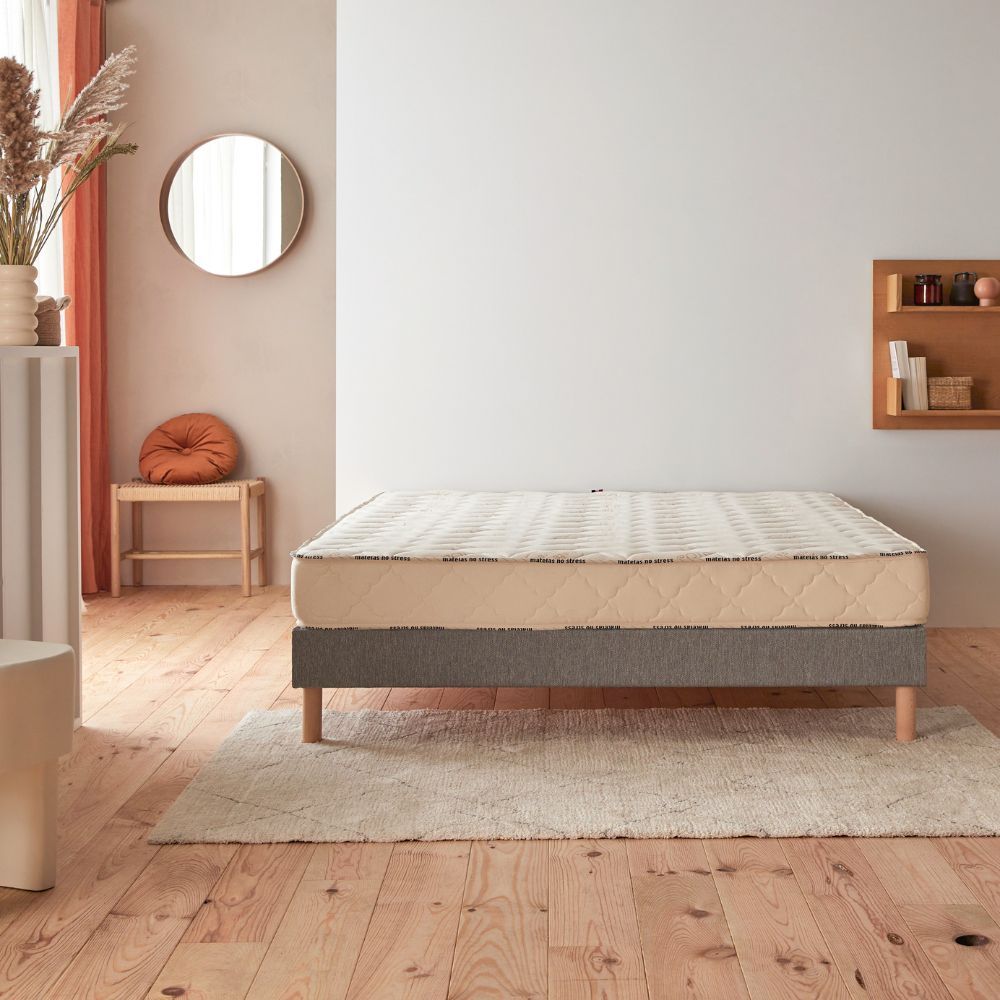
Investing in a high-end mattress is primarily about choosing top-quality materials — certified natural latex, high-density viscoelastic foam, pocket springs designed to last — and enjoying a meticulous finish that is felt night after night. The premium segment is not just about a high price: it implies superior durability (often ten years or more), serious environmental certifications, and a customer service that meets expectations. If you are still hesitant to take the plunge, keep in mind that the cost per night remains very reasonable over the product’s lifespan.
This guide lists the five models that stand out in 2026 in the French market, considering materials, actual comfort, brand commitment, and quality-longevity ratio. This is not a fixed ranking: the best high-end mattress is the one that suits your body type, sleeping position, and priorities (eco-responsibility, firm support, thermal regulation…).
What Really Defines High-End
Before diving into the subject, it is important to establish some benchmarks. A high-end mattress is recognized by several converging criteria.
The density and quality of materials. An entry-level high-resilience foam typically hovers around 30 kg/m³; a premium viscoelastic foam easily exceeds 60 to 80 kg/m³, and even more for the most exclusive references. Natural latex stands out for its elasticity and ability to adapt to the body without creating pressure points, provided it comes from certified sources (GOLS or OEKO-TEX®).
Durability. A standard mattress is generally replaced every seven to eight years. Premium products aim for ten to fifteen years of optimal property maintenance, which justifies a longer manufacturer warranty.
Certifications. OEKO-TEX® Standard 100, GOLS (organic latex), GOTS (organic cotton), CertiPUR® (foams without harmful substances): these labels are not mere marketing arguments. They guarantee the absence of undesirable chemical compounds — a particularly important criterion for sensitive individuals or families with children.
Service. Trial nights of one hundred days or more, in-room delivery, old mattress pickup, long-term warranty: high-end includes a frictionless shopping experience.
1. Tempur — The Absolute Reference for Viscoelastic Foam
Tempur holds a unique place in the global bedding landscape. The Danish brand is the originator of viscoelastic foam as we know it today, a material initially developed for NASA’s space programs in the 1960s and refined since for consumer applications. The price range extends from €1,398 to €5,748. TEMPUR® mattresses come with a ten-year warranty, attesting to the quality of the products; the proprietary foam allows the mattress to maintain its shape for at least ten years without risk of sagging or abnormal wear.
TEMPUR® foam has an exceptional density — over 85 kg/m³ according to European sources — which allows it to absorb point pressures and conform to the sleeper’s morphology with unmatched precision. The result is a “floating” sensation particularly appreciated by those suffering from joint or back pain. The range includes several levels of firmness and height, from the most accessible models (but still distinctly premium) to the thickest and most luxurious editions.
Note: dense viscoelastic foam can retain body heat more than airy latex or a spring system. Tempur has developed ventilated covers and toppers to mitigate this phenomenon, but very warm sleepers will benefit from checking the thermal regulation technology of the targeted model.
Discover available Tempur mattresses on Amazon.fr2. Kipli — Certified and Committed Organic Natural Latex
Kipli is a French brand specializing in mattresses made from certified GOLS (Global Organic Latex Standard) natural latex, meaning made from rubber sourced from organic farming. The positioning is clearly eco-responsible: GOTS organic cotton for the cover, pesticide-free latex, manufacturing in Europe. For consumers concerned about the exact composition of their bedding — particularly those wishing to avoid synthetic materials — Kipli represents one of the most coherent options in the French market in 2026.
Natural latex has remarkable mechanical properties: it is elastic, resilient, naturally antibacterial, and resistant to dust mites. Its ventilation is excellent, making it a preferred choice for hot sleepers. The sleeping sensation differs radically from viscoelastic foam: where Tempur “envelops,” Kipli “supports and responds.” It is not a matter of superior or inferior quality, but rather of sensory preference.
The brand offers a generous trial night and direct delivery, allowing you to test the mattress in your own sleeping environment before making a final commitment.
View on Amazon3. Tediber — Accessible Premium, B Corp Certified
Tediber occupies a unique position in this ranking: it is the most accessible mattress in the selection, but it deserves its place in the high-end segment thanks to its social and environmental commitments. Tediber is a Franco-Belgian brand certified B Corp, a distinction that attests to responsible management throughout the value chain — from material selection to working conditions, including environmental impact.
Tediber’s flagship mattress — simply titled “The Incredible Mattress” — is priced around €650 in the standard large size (140×200 cm), placing it at the boundary between the upper mid-range and entry-level premium. For this amount, you get a construction of high-resilience foam and memory foam, a washable cover, and a long-term warranty. The brand also offers a trial night and commits to picking up the old mattress.
Tediber will be particularly relevant for buyers looking to enter the premium segment without crossing the thousand-euro mark, while ensuring they support a company whose positive impact is verified by an independent third party.
4. Emma Hybrid — Hybrid Technology Matured
The Emma Hybrid represents the logical upgrade of a brand that initially built its reputation on foam. The transition to hybrid architecture — pocket springs combined with layers of technical foams — allows for the natural ventilation of springs to be combined with the surface comfort of adaptive foam. The result is a versatile mattress, appreciated by both solo sleepers and couples, whose firmness needs may diverge.
Emma is a German brand widely distributed in France, with competitive trial nights and a reassuring warranty policy. Its hybrid positioning makes it a serious alternative to fully latex or fully foam mattresses for buyers who want the best of both technologies without heading towards the most expensive references on the market.
See available Emma Hybrid mattresses on Amazon.fr5. Epeda — French Artisan Craftsmanship
Epeda is one of the few French brands to claim a fully luxury positioning, with mattresses made in France in specialized workshops. Epeda is cited among the references of French luxury in premium bedding. The brand relies on proprietary spring technologies, natural fiber fillings (wool, cotton, cashmere depending on the models), and hand-crafted ticking for the highest-end editions.
This artisanal positioning implies high prices and distribution mainly in stores — at specialized retailers (Maison de la Literie, Grand Litier) rather than online directly. For buyers who value the physical touch of a mattress before purchasing, this in-store access is indeed an advantage: you can truly lie down, compare firmness levels, and consult with an expert advisor before making a decision.
How to Choose Among These Five References
The following table summarizes the profiles to which each mattress is primarily addressed:
| Mattress | Ideal Profile | Key Strength |
|---|---|---|
| Tempur | Joint pain, need for enveloping support | High-density proprietary foam, 10-year warranty |
| Kipli | Eco-sensitive, hot sleepers, allergy sufferers | Certified GOLS natural latex |
| Tediber | First premium purchase, controlled budget | B Corp certification, quality-price ratio |
| Emma Hybrid | Couples, mixed hot/cold sleepers | Versatile hybrid architecture |
| Epeda | Lovers of French craftsmanship, in-store buyers | Artisan manufacturing in France |
Firmness is the criterion that takes precedence over all others in your final choice. An ultra-premium mattress that is unsuitable for your sleeping position or body type will not provide you with better rest than a mid-range model perfectly adjusted. If you sleep on your side, a soft welcoming feel on the surface is essential; if you sleep on your back or stomach, firm and even support will be preferable.
Do not forget the question of the bed base: premium mattresses — especially latex mattresses — require a suitable base (with slats spaced precisely) to fully express their qualities. A high-end mattress placed on an old or inadequate base will see its performance compromised from the first weeks.
To deepen your research and compare other models in the same category, check out our dedicated mattress tops section .
FAQ
What is the best high-end mattress for back pain?
Lumbar or cervical pain primarily requires a mattress that keeps the spine in neutral alignment, regardless of sleeping position. On this point, Tempur stands out thanks to its high-density viscoelastic foam (85+ kg/m³) that distributes point pressures and avoids areas of excessive pressure. The enveloping sensation reduces tension in the lower back and shoulders. However, individuals who suffer from pain related to excessive heat at night may find Tempur foam too warm: in this case, a hybrid mattress like the Emma Hybrid, whose pocket springs promote air circulation, constitutes a serious alternative. In any case, it is advisable to take advantage of the trial night offered by the brand to validate comfort over time, as the beneficial effects on the back may take several weeks to fully manifest — the time it takes for the body to adapt to the new support.
Is natural latex really better than viscoelastic foam in high-end mattresses?
There is no universal answer: both materials are excellent, but for different sleeping profiles. Natural latex (like Kipli) is elastic, resilient, naturally breathable, and resistant to dust mites; it is particularly suitable for hot sleepers, allergy sufferers, and those who move a lot at night, as it responds immediately to position changes without creating the “stuck” effect sometimes attributed to viscoelastic foam. Conversely, TEMPUR® foam is designed to absorb movements and maintain position: this is an advantage for couples where one partner frequently turns over, and for joint pain requiring precise pressure point relief. In terms of durability, both materials are comparable in the high-end segment if the densities are up to par. The decisive criterion remains the desired sensation, rather than an objective quality hierarchy.
How long does a high-end mattress last?
A well-maintained premium mattress can last between ten and fifteen years, or even longer for the densest references. Tempur guarantees its mattresses for ten years and communicates a durability of twelve to fifteen years according to European standards EN 1957. This superior longevity radically changes the economic calculation: a €2,000 mattress amortized over twelve years represents less than 50 cents per night, which is often lower than the cost of an entry-level model at €400 replaced every five years. To maximize the mattress’s lifespan, it is advisable to rotate it regularly (or turn it 180° if it is not reversible), equip it with a breathable mattress protector, and ensure the quality of the base that supports it.
What trial night should I expect from a premium mattress?
Premium brands generally offer trial nights of at least one hundred days, and some go up to one hundred twenty or one hundred fifty days. This duration is not trivial: the human body needs an average of four to six weeks to adapt to a new mattress, and the real effects on sleep quality are often measured after two months of regular nights. A trial night that is too short (thirty days) is therefore insufficient to form a definitive opinion on such an important investment. Before purchasing, also check the return conditions: some brands arrange for home pickup, while others require the mattress to be returned in its original packaging — which is practically impossible after use. The best premium offers include frictionless return logistics.
Should I change my bed base at the same time as the mattress?
Not necessarily, but it is strongly advised if the base is over eight years old or if its slats are spaced improperly. A natural latex mattress, for example, requires sufficiently close slats (maximum spacing of six centimeters) to prevent the surface from sagging between supports. A pocket spring mattress can work well on a box spring, provided that it is in good condition. The general rule is simple: the base represents half of the sleeping system. Neglecting its renewal compromises the mattress’s performance from the first weeks of use, with an increased risk of premature sagging that can void the manufacturer’s warranty if a link is established between the two.
Do OEKO-TEX® and GOLS certifications have a real impact on health?
These certifications have concrete and verifiable value. OEKO-TEX® Standard 100 guarantees that every component of the mattress — foam, cover, ties, surface treatment — has been tested and does not contain harmful substances beyond strict regulatory thresholds. GOLS (Global Organic Latex Standard) goes further for latex by certifying the entire chain: from rubber tree planting to the finished product, without pesticides or synthetic fertilizers. For individuals suffering from respiratory allergies, asthma, or for families with young children, these guarantees are not mere marketing arguments — they objectively reduce exposure to volatile organic compounds (VOCs) and potential irritants emitted by low-quality foams. In practice, a mattress certified OEKO-TEX® Standard 100 or GOLS will off-gas well before your first night.
Is Emma Hybrid really a high-end mattress?
Emma Hybrid positions itself at the upper boundary of the mid-range and accessible premium segment. It does not reach the artisanal finishing level of Epeda nor the proprietary density of Tempur, but it offers a hybrid architecture (pocket springs + technical foams) that represents a real advancement over the brand’s all-foam mattresses. Its main advantage is versatility: it suits a wide variety of body types and sleeping positions, regulates temperature well thanks to the ventilation of the springs, and benefits from the distribution network and after-sales service of a well-established international brand in France. For a first purchase in the premium segment, or for a couple with divergent needs, it is often the most relevant choice before investing in a more specialized reference.