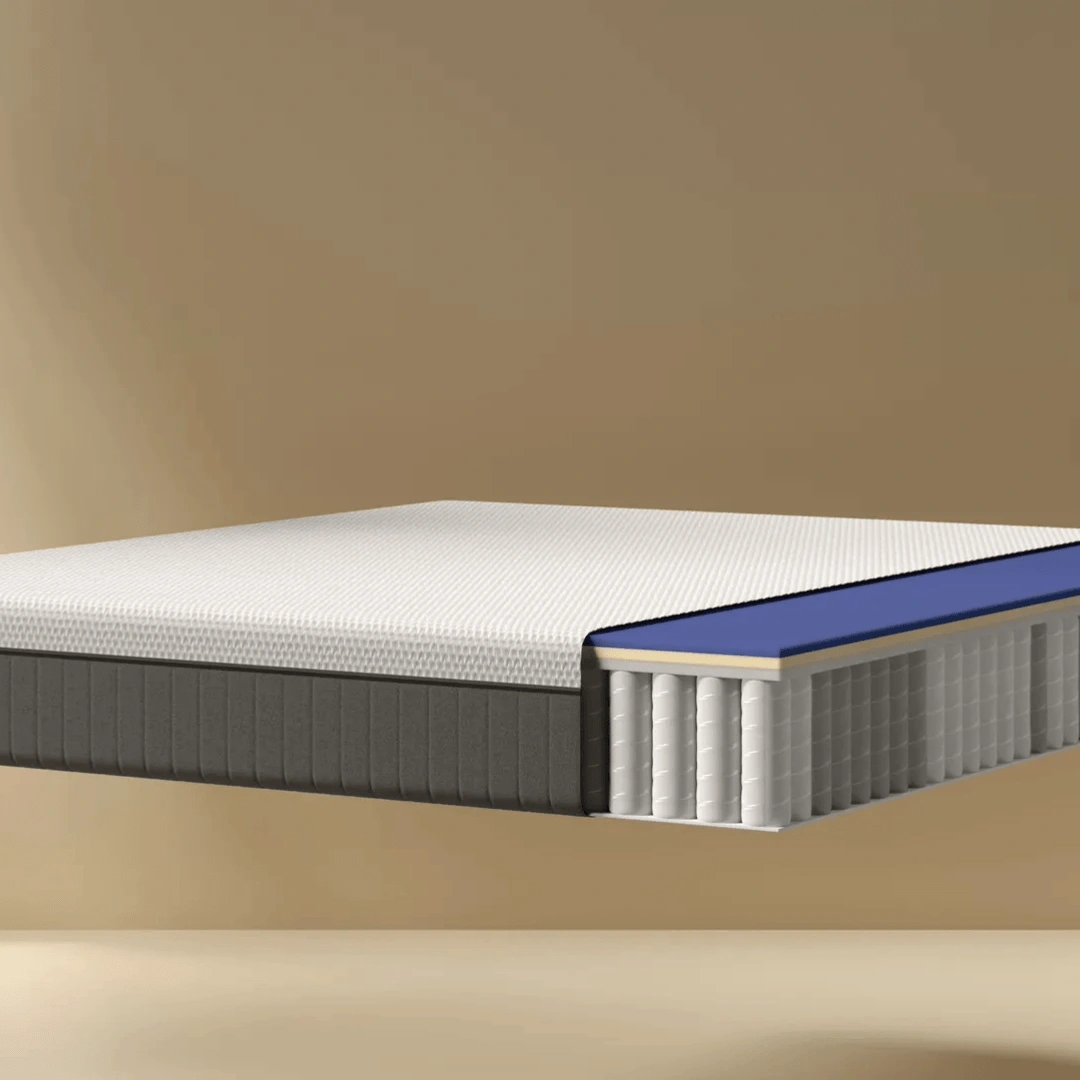
Memory foam mattresses have seen considerable success since their democratization in the early 2000s. This technology, initially developed by NASA in the 1970s, offers personalized support by perfectly conforming to the body’s contours. In 2026, the French market offers a plethora of options, from entry-level models to premium references. Here is our selection of the 5 best memory foam mattresses available in France this year, along with their features, benefits, and verified prices.
Our top 5 memory foam mattresses in 2026
1. Emma Hybrid Premium II — Best value for money
Price: starting from ~€560 (140×190) — up to ~€1,100 (180×200), frequent promotions
The Emma Hybrid Premium II stands out as the benchmark in the French market in 2026. This mattress combines a thick layer of memory foam (7 cm) with pocket springs for optimal support.
Composition:
- Thermoregulating cover made of stretch fabric
- 4 cm of open-cell Halo foam (heat dissipation)
- 7 cm of viscoelastic memory foam
- Independent pocket springs (7 support zones)
- High resilience HRX foam base
Strengths:
- Excellent comfort/support balance
- Very good thermal regulation thanks to the springs
- Suitable for all types of sleepers
- 100-night trial and 10-year warranty
- Free delivery and returns
Weaknesses:
- Slightly higher price than some online competitors
- May feel firm during the first nights (break-in period needed)
2. Simba Hybrid Pro — The most innovative
Price: starting from ~€900 (140×190) — up to ~€1,500 (180×200)
The Simba Hybrid Pro represents the high-end of hybrid memory foam mattresses. Its Aerocoil™ technology combined with 5 layers of foam offers exceptional comfort.
Composition:
- Thermoregulating cover made of recycled wool (removable and washable)
- 3 cm of open-cell Simbatex foam
- 5 cm of viscoelastic memory foam infused with graphite
- 2,500 conical Aerocoil™ pocket micro-springs
- Traditional pocket springs (7 zones)
- High-density foam base
Strengths:
- Exceptional thermal regulation (graphite + wool)
- Ultra-precise support thanks to Aerocoil™ micro-springs
- Perfect for couples (maximum sleep independence)
- 200-night trial and 10-year warranty
- Made in the UK
Weaknesses:
- High price
- Significant weight (difficult to handle alone)
3. Tediber Hybrid — The French balance
Catalog price: starting from ~€430 — frequent promotions up to -40% (often around ~€290)
The Tediber hybrid mattress combines memory foam and pocket springs. Its simple yet effective design makes it an excellent choice for most sleepers. Designed in France, made in Belgium.
Composition:
- Breathable and hypoallergenic Tencel® cover (eucalyptus fiber)
- 3.5 cm of plush comfort foam
- 5 cm of high-density memory foam (55 kg/m³)
- 14 cm of pocket springs (1,000 springs in 140×190)
- High resilience foam base
Strengths:
- French design, European manufacturing
- Very soft and breathable Tencel® cover
- Excellent firmness/welcome balance
- 100-night trial and 10-year warranty
- Responsive customer service
Weaknesses:
- Total height of 25 cm (may require a suitable fitted sheet)
- Fewer innovative technologies than some premium competitors
4. Someo Rêve 600 — Best budget option
Price: starting from ~€490 (140×190) — up to ~€810 (180×200) at catalog price, regular discounts
The Someo Rêve 600 is our favorite budget option: a firm hybrid mattress combining springs and memory foam, made in France by a historic bedding manufacturer.
Composition:
- Breathable stretch cover
- Comfort layer in welcome foam
- Viscoelastic memory foam
- Multi-zone pocket springs
- High resilience foam base
Strengths:
- Very competitive price for quality memory foam
- French manufacturing (historic expertise of Someo)
- Firm and progressive welcome
- 6 months home trial (direct purchase someo-literie.com) and 10-year warranty
- Ideal for small budgets and guest rooms
Weaknesses:
- Delivery times can be long during peak demand
- Fewer innovative technologies than premium hybrids
5. Slome (formerly Hypnia) Supreme Well-Being — The thickest
Price: starting from ~€700 (140×190) — up to ~€1,200 (180×200), frequent promotions
Previously marketed under the Hypnia brand, the Supreme Well-Being is now distributed by Slome. It stands out for its thickness of 30 cm and its 7 layers of comfort. A premium mattress at an accessible price.
Composition:
- Hypoallergenic and breathable Tencel® cover
- 2 cm of high-density memory foam
- 3 cm of natural latex foam (7 zones)
- 5 cm of viscoelastic memory foam
- 18 cm of multi-air pocket springs (1,200 springs in 140×190)
- High-density foam base
- Side reinforcements for durability
Strengths:
- Exceptional thickness (30 cm)
- Luxurious comfort with natural latex
- Excellent support for sensitive areas (shoulders, lower back)
- 120-night trial and 10-year warranty
- Made in Europe (Belgium)
Weaknesses:
- Significant weight (around 40 kg in 160×200)
- Requires a suitable foundation to support the weight
How to choose your memory foam mattress?
Essential criteria
1. The density of the viscoelastic foam
Density is expressed in kg/m³ and determines durability and support:
- 40–50 kg/m³: entry-level, limited lifespan (3–5 years)
- 50–60 kg/m³: good value for money, decent durability (5–8 years)
- 60–85 kg/m³: high-end, excellent durability (8–12 years)
For daily use, prefer at least 50 kg/m³.
2. The thickness of the memory foam layer
An effective memory foam layer should measure between 4 and 8 cm. Below 4 cm, the enveloping effect will be limited. Above 8 cm, you risk feeling “sunk” into the mattress.
3. Hybrid or all foam?
- All foam: cheaper, more compact, but may retain heat
- Hybrid (foam + springs): better ventilation, enhanced support, optimal motion isolation, but more expensive
For those who tend to get hot at night, hybrids are preferable.
4. Thermoregulation
Classic memory foam tends to retain heat. Look for compensatory technologies:
- Open-cell foam
- Gel or graphite infusion
- Breathable cover (Tencel®, cotton, linen)
- Hybrid structure with springs
5. Firmness
Contrary to popular belief, a memory foam mattress can have different levels of firmness:
- Firm: for back and stomach sleepers, or heavier body types
- Medium-firm: versatile, suitable for most sleepers
- Soft: for side sleepers and lighter body types
Which mattress according to your profile?
For couples
Prefer hybrid mattresses with pocket springs that offer excellent motion isolation. The Simba Hybrid Pro and the Emma Hybrid Premium II are perfect for avoiding feeling your partner’s movements.
For those who get hot
Opt for a hybrid with thermoregulating technologies: the Simba Hybrid Pro (graphite + wool) or the Emma Hybrid Premium II (Halo foam) are the most effective.
For tight budgets
The Someo Rêve 600 starting at ~€490 offers excellent value for money with a true memory foam layer and French manufacturing, along with an exceptional trial period of 6 months.
For back pain
The Slome (formerly Hypnia) Bien-être Suprême with its 7 support zones and natural latex layer offers optimal support for sensitive areas (lumbar, cervical). For more information, check out our complete guide on mattresses and back pain .
For side sleepers
Mattresses with a good thickness of memory foam (6–8 cm) like the Tediber Hybrid or the Slome Bien-être Suprême allow for perfect spinal alignment. You can also check our complete comparison of the best mattresses to refine your choice based on your favorite sleeping position.
Advantages and disadvantages of memory foam
Advantages
Pressure point relief
Viscoelastic foam perfectly conforms to the body’s contours, evenly distributing weight. This significantly reduces pressure points at the shoulders, hips, and pelvis.
Spinal alignment
By adapting to your body shape, memory foam keeps your spine in natural alignment, regardless of your sleeping position.
Motion absorption
An excellent property for couples: one partner’s movements do not transfer to the other side of the bed.
Hypoallergenic
The dense structure of memory foam naturally limits the proliferation of dust mites and allergens.
Disadvantages
Heat retention
Classic viscoelastic foam tends to accumulate body heat. Modern technologies (gel, graphite, open cells) largely compensate for this defect in recent models.
Sinking sensation
Some people do not appreciate the feeling of being “enveloped” by the mattress. If you prefer to sleep “on” rather than “in” your mattress, opt for a less thick memory foam (4–5 cm) or a hybrid.
Adjustment time
Memory foam often requires an adjustment period of a few nights for your body to get used to this type of support.
Temperature sensitivity
Viscoelastic foam becomes firmer in cold weather and softer in hot weather. This phenomenon is less pronounced in hybrid models.
Maintenance and Lifespan
How to Extend the Lifespan of Your Mattress?
Regular Rotation
For reversible models (summer/winter side), rotate head-to-foot every 3 months, and flip every 6 months. For non-reversible models, a head-to-foot rotation every 3 months is sufficient.
Protection
Always use a mattress protector or cover to preserve the cover from stains, moisture, and sweat. Our mattress protector guide details the models suitable for each use.
Ventilation
Air out your room daily and let your mattress breathe by removing the duvet for 15–20 minutes each morning.
Suitable Bed Base
Check that your bed base is in good condition and suitable for your mattress (slatted base preferred for all-foam mattresses, slatted or box spring for hybrids). Our comparison of slatted bases vs. box springs will help you decide.
Cleaning the Cover
If your mattress has a removable cover, wash it 2 to 3 times a year at 30–40 °C according to the manufacturer’s recommendations. For a deep clean of the mattress itself, follow our tips for cleaning a mattress .
When to Replace Your Memory Foam Mattress?
The average lifespan of a quality memory foam mattress is 8 to 12 years. Replace your mattress if:
- You feel pressure points or pain upon waking
- Permanent indentations form
- The foam no longer returns to its original shape
- You sleep better elsewhere than at home
FAQ: Memory Foam Mattress
Is memory foam suitable for people who get hot at night?
Yes, provided you choose a model with thermoregulating technologies. Specifically, look for gel or graphite-infused foam, a hybrid structure with springs that promotes air circulation, and a cover made of breathable natural fibers (Tencel®, linen, organic cotton). All-foam mattresses without any of these technologies can indeed retain heat significantly, especially in summer in a poorly ventilated room. If you sweat a lot at night, always opt for a hybrid and complement it with bedding made of linen or organic cotton. Also, remember to ventilate the room for 5 to 10 minutes every morning to expel accumulated moisture.
What is the difference between memory foam and viscoelastic foam?
It’s the same thing. Viscoelastic foam is the technical name for memory foam, sometimes also called thermoplastic foam or “memory foam” in English. It is called this because it reacts to heat and pressure (viscoelastic properties) to conform to the body’s contours, then slowly returns to its original shape when the pressure is removed. This foam was originally developed by NASA in the 1970s to cushion the vibrations experienced by astronauts during takeoff. Its democratization in domestic bedding dates back to the early 2000s. Modern variants (open cells, gel, graphite) correct its main historical flaw: heat retention.
Is a memory foam mattress suitable for a baby or child?
No, memory foam is not recommended for babies and young children. Their lightweight bodies do not generate enough heat and pressure to properly activate the properties of viscoelastic foam: the mattress remains too firm and can hinder postural development. For infants, there is also a real risk of the head sinking into foam that is too soft, which can compromise breathing. Therefore, prefer classic high resilience (HR) foam or springs for children under 8 years old, and look for mattresses certified Oeko-Tex Standard 100, ensuring the absence of harmful chemicals. From adolescence onwards, memory foam can be considered without particular contraindications.
Can you use a memory foam mattress on an electric bed base?
Yes, but make sure the mattress is specifically designed for this use. Mattresses that are too thick (> 25 cm) or have a rigid base are not suitable as they prevent the joints of the bed base from functioning properly. Most manufacturers indicate compatibility with electric bed bases in their product sheets. If in doubt, contact the brand’s customer service before purchase — incompatible use may void the warranty.
How long does it take for a memory foam mattress to regain its shape after unpacking?
A mattress delivered compressed in a box generally takes 24 to 48 hours to fully regain its shape and volume. You can sleep on it after 4 to 6 hours, but optimal comfort will be reached after 48 hours. Leave the mattress in a heated room (at least 18 °C) to speed up expansion: viscoelastic foam is sensitive to cold and expands more slowly at low temperatures. During the first few days, a slight smell of new foam may be noticeable — this is the “off-gassing” phenomenon, which is harmless and disappears within a few days with good ventilation.
Is memory foam recommended for people with back pain?
Yes, memory foam is particularly suitable for people suffering from back pain, provided you choose the right level of firmness. It relieves pressure points and keeps the spine aligned, which reduces nocturnal lumbar tension. Prefer a medium-firm to firm model with a memory foam thickness of 5–7 cm. For a weight under 70 kg, opt for medium-firm; beyond that, a firm mattress will prevent excessive sinking. Combine the purchase with a well-maintained slatted base and an appropriate sleeping position (preferably on your side with a pillow between your knees).
What density of memory foam should you choose based on your weight?
For a weight under 60 kg, 50–55 kg/m³ is sufficient. Between 60 and 90 kg, opt for 55–65 kg/m³. Beyond 90 kg, prefer a density of 65–85 kg/m³ for optimal support and better durability. An insufficient density relative to your body type leads to premature sagging and loss of back support — this is the most common mistake with entry-level models. It is also worth noting that density is not the only quality criterion: the structure of the foam (open or closed cells), its resilience, and the quality of its chemical components also significantly affect longevity and perceived comfort.
Can you wash a memory foam mattress?
No, you should never wash the memory foam itself: water irreversibly degrades the viscoelastic cells. Only the cover (if removable) can be machine washed according to the manufacturer’s instructions (usually 30–40 °C). To clean the mattress, use a vacuum cleaner with a suitable attachment and treat stains locally with a non-aggressive product (mix of water + white vinegar + baking soda). Then air it out for several hours before putting the sheets back on.
What is the difference between a memory foam mattress and a latex mattress?
Memory foam and latex are two very distinct technologies that are often confused. Viscoelastic foam reacts to body heat to gradually adapt to the body’s contours, with a slow and enveloping return to shape. Latex, whether natural (from rubber trees) or synthetic, offers an almost immediate elastic response: it rebounds as soon as the pressure ceases. Specifically, latex is better suited for sleepers who move a lot at night, as it facilitates position changes, while memory foam is preferable for those who suffer from pressure points and sleep relatively still. Some high-end mattresses, like the Slome Bien-être Suprême, combine both materials to take advantage of their respective qualities: the enveloping nature of memory foam and the dynamic rebound of natural latex. In terms of temperature, natural latex is generally cooler than classic memory foam.
Conclusion: which memory foam mattress to choose in 2026?
The French market for memory foam mattresses is particularly dynamic in 2026, with a varied offer for all budgets and all types of sleepers.
Our general recommendation: the Emma Hybrid Premium II remains the best quality-price compromise for the majority of sleepers, with its perfect balance between enveloping comfort and firm support, good thermal regulation, and generous trial period. Prices start at around €560, often on promotion.
For a limited budget: the Someo Rêve 600 starting at around €490 offers true quality of French manufacturing with an effective memory foam layer and a 6-month trial period — the longest on the market.
For demanding sleepers: the Simba Hybrid Pro and its cutting-edge technologies (2,500 Aerocoil™ micro-springs, graphite, wool) justify its premium price with exceptional comfort.
Remember that the best mattress is the one that suits your body type, sleep habits, and personal preferences. Always take advantage of trial periods (100 to 200 nights depending on the brands, up to 6 months with Someo) to test your mattress in real usage conditions. A good mattress is a 10-year investment that directly influences your daily quality of life.