In light of the rising environmental concerns, sustainable bedding is becoming essential in many French households. Several national brands are making concrete commitments to offer healthier, more local, and more responsible bedding. Here is an overview of the major players in 2026.
Committed French Brands
Kipli
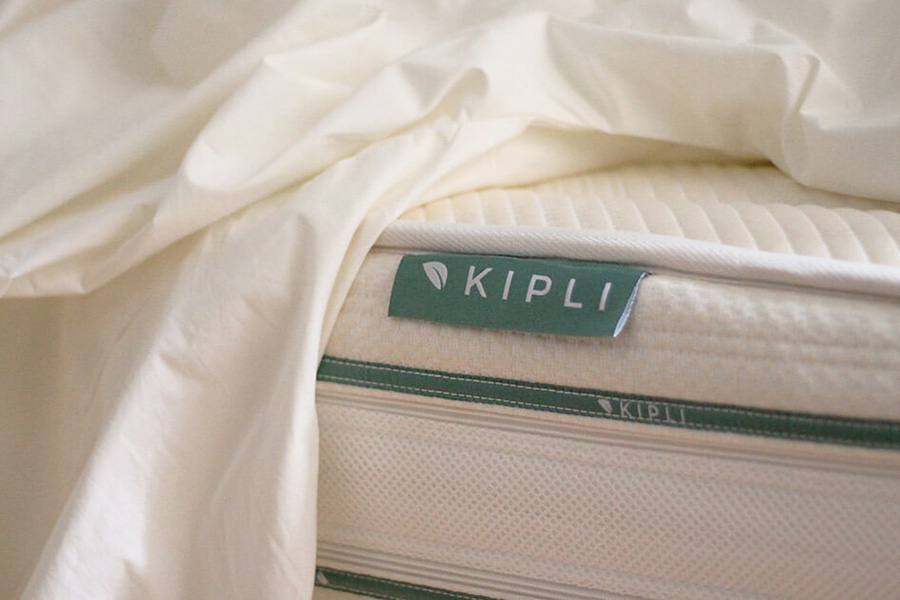
Founded in 2017, Kipli quickly established itself as the French reference for high-end, fully natural mattresses. The brand excludes any petrochemical foam from its manufacturing and relies on 100% natural latex certified by Eurolatex, assembled in France and Italy. Its range includes a double-sided mattress, a solid wood bed base certified by PEFC, a Tencel duvet, and organic bedding. Kipli offers a 100-night home trial — the mattress is picked up for free and donated to charities in case of return — as well as a 15-year manufacturer’s warranty, one of the most generous on the market. The Kipli mattress is available starting from ~800 € in 140x190 cm, clearly positioning it in the premium segment, but its lifespan/cost amortization ratio remains very competitive in the long term.
Discover the Kipli mattress – 100% natural latex, no petrochemical foam, made in FranceNo Stress Mattress
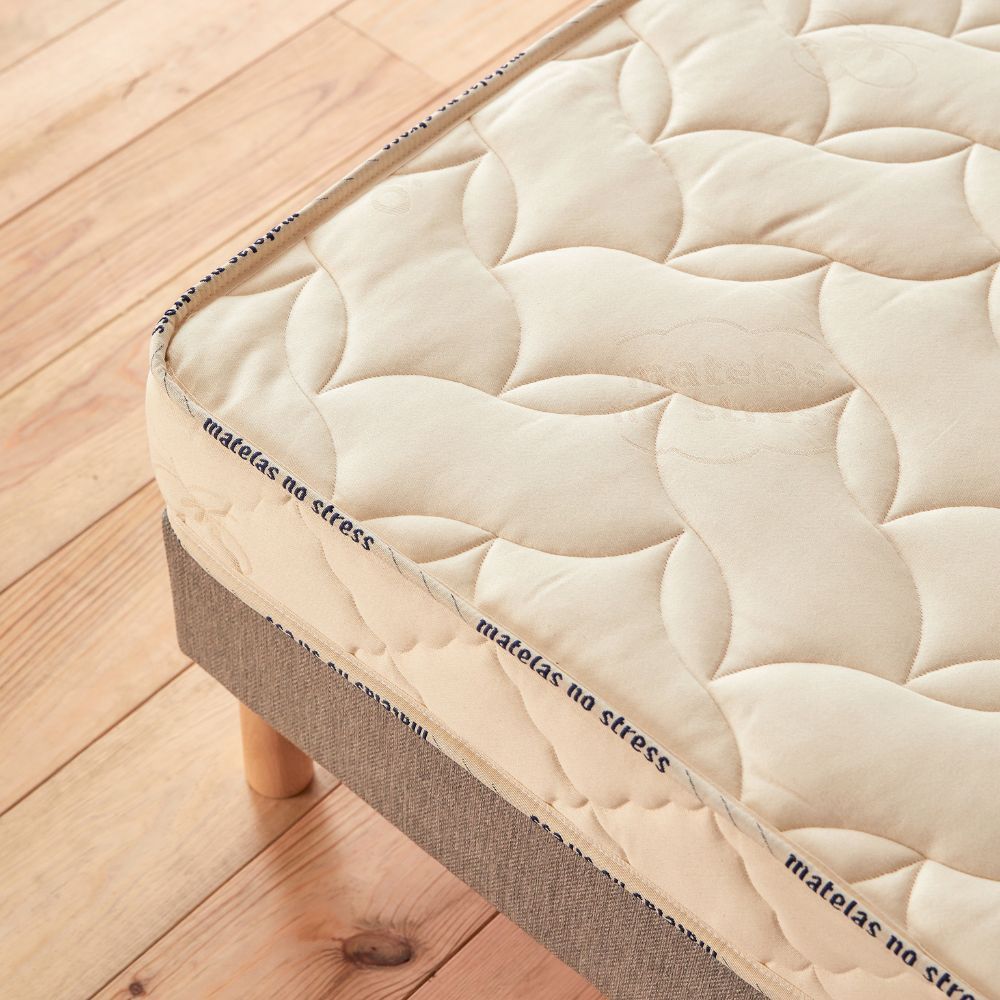
A family-owned and artisanal company, No Stress Mattress focuses on customization and durability. Its products are made without chemical treatment and from selected natural materials: natural latex, pocket springs, orthopedic mattresses, and a baby range. The ability to customize firmness and dimensions makes it a particularly relevant choice for sleepers with specific needs or atypical sizes (90 cm wide, custom length).
Cosme Bedding
Based in Normandy, Cosme Bedding works exclusively with 100% natural materials — latex, French wool, coconut fiber — in a logic of complete traceability, from supplier to end consumer. The artisanal manufacturing and limited volumes ensure rigorous quality control. Expect to pay between ~1,200 and ~2,000 € depending on the chosen composition, making it a premium option but fully justified for those seeking a local and uncompromising product.
Bleu Câlin (Dodo Group)
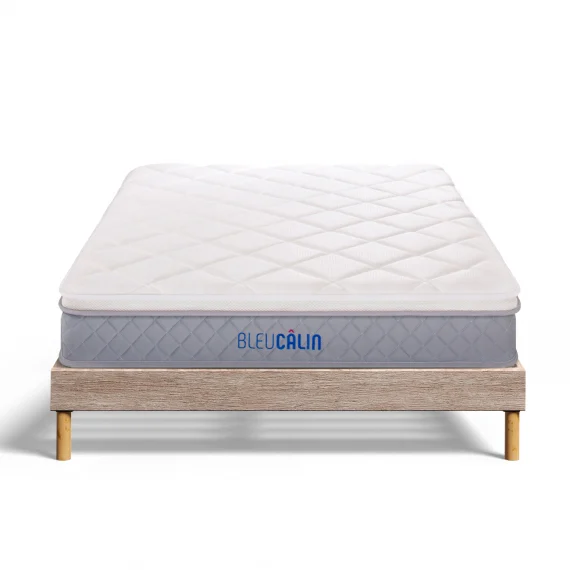
Targeting the general public, Bleu Câlin (Dodo Group) focuses its efforts on night textiles: pillows and duvets made from recycled fibers derived from plastic bottles. The brand has received an RSE assessment from EcoVadis, demonstrating a structured and audited environmental approach. It is the ideal entry point into responsible bedding for tight budgets or those who wish to start by renewing their textiles before investing in a natural mattress.
Someo
Based in Wattrelos in the Hauts-de-France region, Someo combines local production, certified materials (natural latex, organic cotton), and transparency throughout its value chain. The brand offers the collection of old bedding upon delivery, reinforcing its circular commitment. Its Aube collection in natural latex, solid wood bed bases, and recycled or natural pillows cover all the needs of a sustainable bedroom. Someo positions itself in the mid-range, with accessible natural mattresses around ~1,000 €.
Maintenance and Durability
The durability of a natural mattress depends as much on the quality of the materials as on daily maintenance practices. For natural latex mattresses (Kipli, Cosme, Someo), the lifespan reaches 10 to 15 years, compared to only 6 to 8 years for a standard synthetic foam (source: INSV). To maximize this longevity, it is recommended to air out the mattress regularly by lifting the corners, to flip or rotate it head-to-foot every three to six months, and to use a washable protective cover to limit moisture and dust mites. An appropriate bed base — with rigid slats or upholstered — is also essential to avoid weakening the latex core.
To compare the natural mattresses from these brands with other market references, check out our mattress comparison .
Quality/Price Ratio
The budget is often the first barrier to purchasing durable bedding, but it is important to think in terms of annual cost rather than purchase price. A Kipli or Cosme mattress at ~€1,000–€1,200 that lasts 15 years is cheaper in use than a synthetic model at €400 replaced every seven years.
- Kipli: starting at ~€800 in 140x190 cm (premium positioning, 15-year warranty)
- No Stress: customizable entry-level, good quality/price ratio for specific needs
- Cosme: from ~€1,200 to ~€2,000 depending on the chosen composition
- Bleu Câlin: affordable prices, textile range only
- Someo: mid-range, natural mattresses around ~€1,000
Alternatives to Consider
Beyond the five brands presented, other players deserve mention based on your profile:
- Latexbio: 100% natural mattresses assembled with solvent-free glue, at competitive prices for the natural segment.
- Naturalex: ranges in organic foam or memory foam, a good compromise for those who want to move towards less polluting materials without a complete break from foam.
- Hästens (Sweden): high-end 100% natural mattresses (horsehair, cotton, wool), an absolute reference in luxury — expect several thousand euros.
The opinion of our bedding expert
French brands committed to sustainable bedding offer serious alternatives to large industrial companies. Our recommendation by profile:
- For premium and natural comfort: Kipli, Cosme
- For a good local quality/price ratio: Matelas No Stress
- To try a recycled duvet at a low price: Bleu Câlin
- For a wide range, complete service, and fair price: Someo
🟢 Tip: define your priorities (budget, firmness, labels, place of manufacture) before buying. Sustainable bedding is a long-term investment — thinking in terms of cost per year of use rather than face value often changes the perception of quality/price ratio.
FAQ
Are these mattresses suitable for people suffering from back pain?
Yes, the natural latex mattresses offered by Kipli, Cosme, Someo, and No Stress are very suitable for people suffering from back pain, provided that the appropriate firmness is chosen for their body type and sleeping position. Natural latex has the advantage of providing point support: it adapts to the body's curves while keeping the spine in neutral alignment. Side sleepers generally prefer a medium-soft latex, while back or stomach sleepers opt for a medium-firm to firm latex. Some brands like No Stress offer customization of firmness, which is particularly useful for couples with different body types or individuals with specific medical prescriptions. In case of severe pathology, consult your doctor or physiotherapist before purchasing.
Can these mattresses be tested or returned?
The majority of the brands presented offer a home trial period. Kipli offers 100 nights of trial with no conditions: if unsatisfied, the brand will pick up the mattress for free at your home and donate it to charitable organizations (Emmaüs, Secours Populaire), without resale. Someo offers up to 6 months of trial for direct purchases, one of the longest durations on the market. No Stress also offers a trial period, the terms of which vary by retailer. Before purchasing, always check the return conditions: potential fees, required condition of the mattress, refund timeline.
What is the average lifespan of a durable mattress?
A well-maintained natural latex mattress lasts between 10 and 15 years, which is about double that of a conventional synthetic foam mattress, whose lifespan is estimated at 6 to 8 years (source: INSV). This difference is explained by the intrinsic resilience of latex: the material returns to its original shape after each night, whereas polyurethane foam gradually and irreversibly sags. To maximize the lifespan of your natural mattress, flip it regularly (every 3 to 6 months), air it out by lifting the corners every morning, and protect it with a breathable and washable mattress protector. Proper maintenance can easily allow it to exceed 12 years of optimal comfort.
Do you need a specific bed base with a natural latex mattress?
Yes, the choice of bed base is crucial to preserve the performance of a natural latex mattress and maintain the validity of the manufacturer's warranty. A slatted base with rigid slats spaced less than 6 cm apart or an upholstered base are the recommended configurations: they provide firm and even support while allowing sufficient airflow under the mattress, which is essential to avoid condensation and mold development. Flexible slatted bases or frames with slats that are too far apart can create indentations in the latex and void the warranty. Several brands (Kipli, Someo) offer their own solid wood bases designed to be compatible with their mattresses, simplifying the choice.
How can you verify the environmental commitments of a bedding brand?
The best way to distinguish a sincere commitment from a mere marketing argument is to look for independent third-party certifications. For latex, the GOLS (Global Organic Latex Standard) label guarantees that the latex comes from organic farming and that the manufacturing process meets strict social and environmental criteria. For textiles (cover, filling), the GOTS (Global Organic Textile Standard) label certifies the organic origin of the fibers and the absence of harmful chemicals. The OEKO-TEX Standard 100 certifies the absence of hazardous substances in the finished product, even if the raw materials are not necessarily organic. Finally, the PEFC or FSC labels certify that the wood used in bed bases and frames comes from sustainably managed forests. Be wary of vague claims like "natural," "eco-friendly," or "green" without a recognized label: transparency about the geographical origin of raw materials and the assembly location is also a reliable indicator of seriousness.
Is it possible to recycle or repurpose an old mattress at the end of its life?
Yes. In France, the extended producer responsibility (EPR) system for the Furniture Sector, managed by the eco-organization Valdelia for professionals and Ecologic for individuals, requires distributors to take back the old mattress upon delivery of the new one (the "1 for 1" rule). Several brands like Someo include this take-back service in their delivery offer. Natural latex is particularly recyclable: it can be shredded and reused as acoustic underlay or insulation. Before purchasing, check that your distributor indeed offers the take-back of the old mattress, which saves you disposal fees and ensures a responsible end of life.