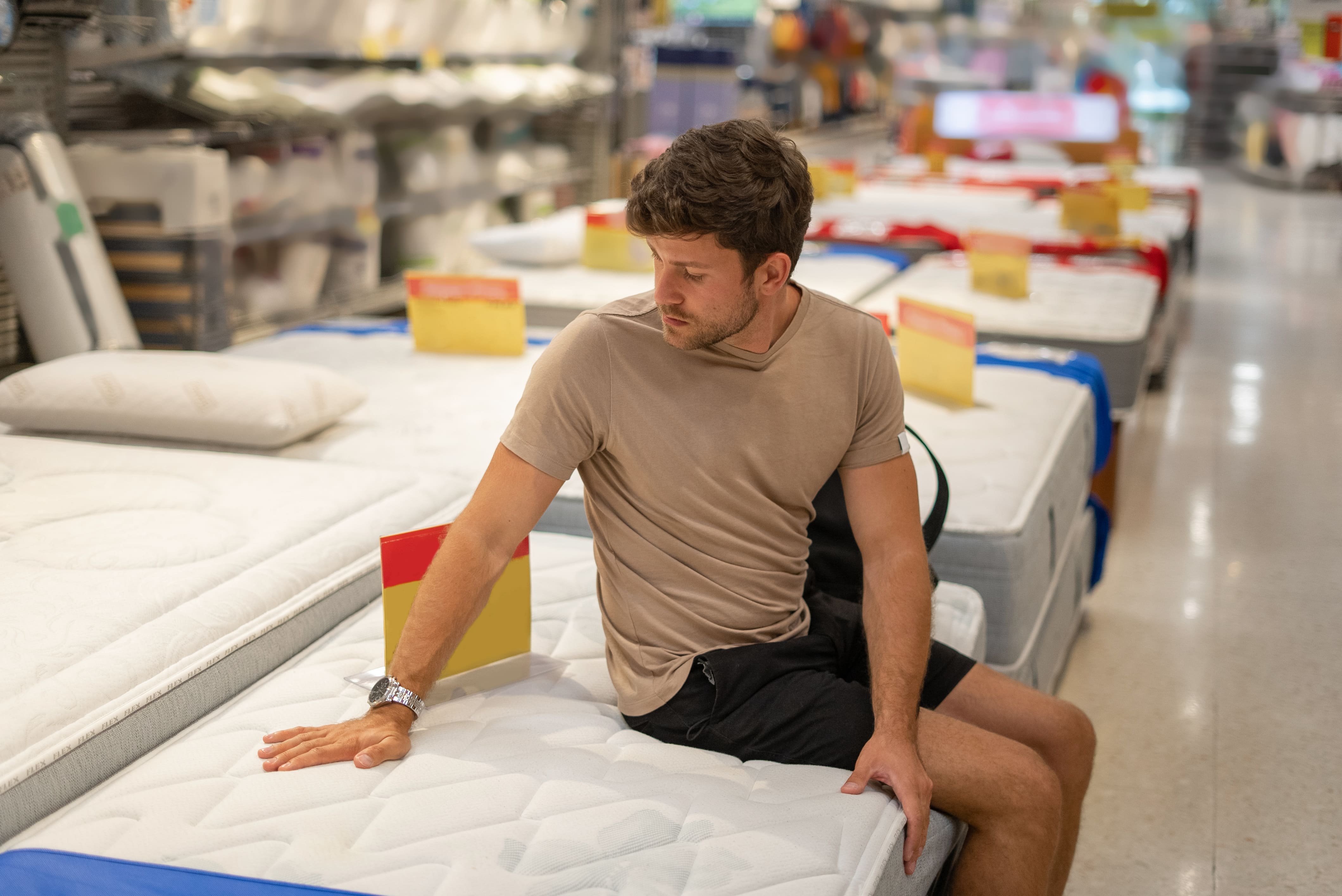
Buying a mattress online allows you to benefit from a good price, a smooth experience, and a long home trial period — now standard in the industry. Buying in-store remains valuable for immediate testing, receiving human advice, and comparing several models side by side. However, these two channels are not as opposed as one might think: understanding their concrete differences helps make the most suitable choice for one’s situation.
What online shopping really changes
The first tangible difference is the price. By selling directly without a network of physical stores or distributor margins, digital brands compress their costs and pass some of the savings on to the consumer. A quality foam or natural latex mattress can thus be found starting at around €400–600 online for a 140×190 cm size, while an equivalent in a large retail store often exceeds €800–1,000.
The second difference is the home trial period. Tediber, Kipli, and their competitors consistently offer 100 nights of trial, sometimes more — far beyond the few minutes spent lying down in-store. This is a real guarantee: if the mattress is not suitable, it is picked up for free and refunded. This practice has profoundly transformed buyer expectations.
The third difference is the transparency of certifications. On a brand’s website, you can easily find labels (OEKO-TEX®, GOTS, CertiPUR…) with their verifiable certificate number. In large stores, this information is rarely found on the shelf label.
Discover the Tediber mattress: hybrid made in France, 100 nights trial, 10-year warrantyWhat the store offers that the screen cannot replace
No product sheet, no matter how detailed, can replace the feeling of a mattress under your body. In-store, you can immediately compare the firmness of several models, lying in your usual sleeping position. For people suffering from chronic back pain or having atypical body shapes, this direct test remains a decisive advantage.
The sales advice is another real added value — provided you encounter a trained representative. In specialized bedding stores (distinct from general retail chains), advisors can guide you towards the right spring technology for a couple with different weights or recommend a latex mattress rather than foam for a hot sleeper.
Finally, some people simply want to see and touch the product before committing to several hundred euros. This is a legitimate preference that online return policies, no matter how generous, do not completely neutralize for all buyer profiles.
Comparison table: online vs large retailers
| Criterion | Online | Large Retailer |
|---|---|---|
| Entry-level price | Generally lower | Often higher |
| Trial period | 100 nights and more | Non-existent or very limited |
| Warranty | 10 years with leaders | Variable (5 to 10 years) |
| Physical test before purchase | Impossible | Yes, immediately |
| Personalized advice | Chat / phone | Face to face |
| Certification transparency | Good (detailed sheets) | Variable |
| Delivery | Free, vacuum-packed | Paid or included depending on the retailer |
| Return in case of dissatisfaction | Often free | According to store conditions |
Who should prioritize online shopping?
Online shopping is particularly suitable for people who:
- already know their firmness preferences (side sleepers, back sleepers, etc.) and know what they liked or disliked about their old mattress;
- have a tight budget and want to maximize the quality of materials without paying the margins of a physical network;
- are sensitive to eco-responsibility and want to verify certifications themselves before purchase;
- do not have a specialized large retailer nearby and prefer to avoid unnecessary trips.
Who should prioritize the store?
The physical channel remains relevant for:
- first-time buyers who have no reference and want to build their preferences from a concrete sensory experience;
- couples with very different body shapes who need to evaluate together the behavior of a mattress;
- people suffering from lumbar pathologies who want advice from a bedding specialist before making any decision;
- those who wish to take the mattress home the same day without waiting for delivery.
Certifications: do not rely on brand claims
Whether buying online or in-store, checking certifications is an essential step. Relevant labels are:
- OEKO-TEX® Standard 100: absence of harmful substances in textile materials.
- CertiPUR®: for polyurethane foams, guarantees the absence of heavy metals and certain plasticizers.
- GOTS (Global Organic Textile Standard): for organic materials (cotton, wool), certification of the organic supply chain.
- GOLS (Global Organic Latex Standard): for latex, guarantees the organic origin of natural rubber.
A “natural” or “eco-friendly” mattress without a verifiable certificate number on the official label’s website deserves caution, regardless of the distribution channel.
To compare several certified models side by side, our mattress comparison lists verified offers available in France.
View on AmazonFAQ
Is the online trial period really risk-free?
Yes, with serious brands, the home trial period is contractually regulated and without hidden fees. Tediber, Kipli, and several competitors offer 100 nights of trial: if the mattress is not suitable within this period, it is picked up for free at home and fully refunded. However, it is important to read the general conditions before ordering: some brands require you to have slept a minimum number of nights on the mattress (often 30) before accepting a return, to give your body time to adjust. Special case: if you purchase through a marketplace like Amazon, the trial conditions may differ from those on the brand’s official site — always prefer to order directly from the manufacturer to benefit from the best guarantees. In summary, read the T&Cs, keep your order confirmation, and do not hesitate to contact customer service before purchase to clarify any ambiguities.
Can you really choose your firmness without testing the mattress?
Yes, with a few simple guidelines. The ideal firmness mainly depends on your sleeping position and body type: side sleepers generally need a softer mattress (low firmness index) to avoid pressure points on the shoulder and hip, while back or stomach sleepers tend to prefer medium-firm to firm support. Overweight individuals prefer a firm mattress that does not sag under their weight. Most online brands publish detailed selection guides and online recommendation tools that take these parameters into account. Moreover, the 100-night trial period serves precisely as a safety net if your initial assessment proves inaccurate. Practical advice: if you are hesitating between two firmness levels, opt for the firmer version — it is easier to soften a slightly too firm mattress with a topper than to correct sagging.
Are in-store mattresses of better quality than online ones?
No, the quality of materials does not depend on the distribution channel. Some large retailers offer excellent mattresses, and some online brands sell poor-quality products — and vice versa. What determines quality are the materials (foam density, proportion of natural latex, type of springs) and verifiable certifications (OEKO-TEX®, CertiPUR®, GOLS, GOTS). A high price in-store often reflects distribution costs rather than an intrinsic superiority of materials. For the same budget, a mattress purchased directly online from a transparent brand can offer better materials than an equivalent sold in a physical store. Special case: high-end mattresses from historical manufacturers (Hästens, Tempur, Treca) are often available both online and in-store, with the same specifications — comparing prices from both channels can reveal significant discrepancies.
Which ecological certifications should be prioritized?
For a foam mattress, the CertiPUR® label is the minimum to require, complemented by OEKO-TEX® Standard 100 for surface textiles. For a natural latex mattress, the GOLS (Global Organic Latex Standard) guarantees the organic origin of the rubber. For organic textile materials (cotton, wool), the GOTS is the reference. Each certificate is verifiable online on the official label’s website by entering the number on the product sheet. Beware of vague terms like “natural,” “eco-friendly,” or “green” without an associated certification number.
Can you negotiate the price in-store, and does it compensate for the price advantage of the web?
Negotiation is possible in many physical stores, especially at the end of the month, during sales periods, or when buying multiple bedding products together (mattress + box spring + pillows). It is not uncommon to obtain a 10 to 20% discount in-store, sometimes accompanied by free delivery or the pickup of the old mattress. However, even after negotiation, the price gap with digital brands often remains significant, as these brands structurally practice low prices rather than temporarily. Advice: if you have spotted a model in-store, check if there is an equivalent version online from the same manufacturer — some brands (Simmons, Tempur) sell through both channels, sometimes with different prices.