Every year, thousands of people type “Que Choisir mattress test” before pulling out their credit card. It’s a good reflex: UFC-Que Choisir and 60 Millions de Consommateurs are the two French references for consumer product testing, and mattresses regularly feature in their comparisons. However, their complete results are paid, their testing scopes vary from one edition to another, and some brands communicate about their distinctions selectively. Here’s how to read these results clearly, what the public data actually confirms, and what can be drawn from it to choose a mattress in 2026.
UFC-Que Choisir: a very rigorous laboratory method
UFC-Que Choisir is by far the association with the most detailed and transparent protocol. Each mattress undergoes a series of rigorous laboratory tests according to a precise protocol that evaluates performance, ergonomics, and durability.
How they test concretely
In the final score, the support for the sleeper is the most important criterion, both when new and after 8 to 10 years of use. The association also takes into account the environmental impact, including the analysis of the product’s life cycle.
To measure support, two people of opposing sizes and builds take turns resting on the mattress in a supine and then lateral position: a small mannequin of 1.55 m and 54 kg, and a large mannequin of 1.90 m and 110 kg. The body’s sinking is evaluated using photogrammetry. This test provides information on the construction’s ability to properly support the spine.
Firmness is classified from “very soft” to “very firm” following the calculation of hardness through the successive application of several pressure points with different forces, according to a standard.
What this protocol has that is particularly useful is that it goes beyond simple subjective impressions: photogrammetry provides objective measurements on spinal alignment, regardless of what a sleeper feels during the first few nights. Durability is also simulated in the laboratory, allowing for an estimate of the mattress’s behavior over the years — a point often overlooked when relying solely on online customer reviews.
The scope of the comparison in 2026
UFC-Que Choisir tested 109 mattresses in its comparison available on quechoisir.org. The database is regularly updated: new models are added with each edition, and the protocol itself was updated in March 2026 to more finely integrate environmental criteria.
The downside: complete results (numerical scores, detailed rankings, sub-scores by criterion) are reserved for subscribers. Non-subscribers only have access to public distinctions — notably the “Best Choice” label — and the main lines of the protocol. Therefore, we will not reproduce here a score table that we cannot fully verify.
What public results reveal
Several distinctions are publicly confirmed by the brands themselves and verifiable on quechoisir.org.
The Tediber Hybrid mattress received the designation of “Best Choice” during a comparison published in October 2024 in UFC-Que Choisir’s publications. The French brand claims to be the first to have been tested with the complete protocol including environmental impact.
The Emma Original Lite (formerly called Emma Original II) earned the title of “Best Choice” from UFC-Que Choisir in March 2025, ranked 5th out of 110 tested mattresses: a particularly notable performance given that the model is positioned in the entry-level hybrid segment.
The Ecomatelas L’Idéal Latex was ranked 3rd out of 20 tested mattresses and received the “Best Choice” designation during a comparison in March 2024.
These distinctions are useful but should be handled with caution: a brand that communicates about a “Best Choice” obtained in a 2024 edition does not guarantee that it still occupies the top positions in the next update. The market evolves, models change, and new entrants are tested in each cycle.
See the Emma Original Lite on Amazon.fr60 Millions de Consommateurs: a complementary approach
60 Millions de Consommateurs publishes its own mattress comparisons in its monthly magazine and on its site 60millions-mag.com. The approach differs slightly from that of UFC-Que Choisir: the editorial team combines technical tests conducted in the laboratory with a more editorial dimension, often focusing on specific angles, such as value for money, the commercial practices of brands, or unverified marketing claims (the solidity of claimed certifications, actual warranty durations).
Their results are also mostly paid. Public data is limited to press articles and excerpts from the front page that the editorial team chooses to make accessible for free. No general ranking is verifiable without a subscription: we will therefore refrain from citing one here.
What stands out from the accessible editions: 60 Millions de Consommateurs is particularly attentive to misleading mentions and poorly explained certifications. Brands that oversell lax labels are regularly called out. This is useful to know when reading a product sheet filled with stars and acronyms.
How to use these tests to choose your mattress
Here’s how to integrate these results into your purchasing process.
Check the test date. A “Best Choice” obtained in 2023 on a model that has since been withdrawn or reformulated has limited value. Look for the publication date on quechoisir.org.
Consider your build. The UFC-Que Choisir protocol uses two opposing body types (54 kg and 110 kg). If you fall within an intermediate build, the results are generally transposable. However, if you weigh more than 110 kg or less than 50 kg, the conclusions of the comparison may not directly apply to you: a mattress deemed very firm for a heavy build will often be too firm for a light sleeper.
Don’t choose solely based on ranking. The “support” criterion dominates the final score, favoring firm or semi-firm mattresses. If you sleep on your stomach or prefer softness, a higher-ranked model may not necessarily be the best fit for you.
Cross-reference with long-term reviews. Laboratory durability tests simulate years of use, but real feedback from customers who have slept on a model for two or three years remains a valuable source: provided you filter recent reviews from older ones on the same model.
To get a broader idea of the available models, our mattress comparison covers a selection of current references in France, detailing characteristics and price ranges.
View on AmazonWhat the tests do not measure
No laboratory comparison can evaluate a few parameters that are nonetheless decisive in the final choice.
Perceived thermal regulation is difficult to objectify. Heat dissipation measurements exist, but they do not accurately reproduce what a sleeper who easily heats up in summer feels.
Couple movement: if you sleep with someone of very different builds, sound insulation and motion isolation are just as important as average support. Individualized tests do not always reflect this reality.
Total budget does not factor into the technical score. A well-ranked mattress may have an out-of-reach price, and conversely, a model absent from the comparison may offer excellent value for money in its segment.
Finally, the home trials offered by most online brands (generally 100 nights) remain the only way to know if a mattress really suits you. No laboratory test, no matter how rigorous, can replace a few weeks of real sleep in your own environment.
See the Tediber Hybrid mattress on Amazon.frWhere to find UFC-Que Choisir mattress test results for free?
Some information is accessible without a subscription on quechoisir.org: the complete test protocol, the “Best Choice” distinctions awarded to certain models, and the main lines of the criteria used. However, numerical scores, the full ranking of the 109 tested mattresses, and sub-scores by criterion (support, durability, environmental impact…) are reserved for subscribers. A digital subscription provides access to all published comparisons. For tight budgets, targeting models publicly identified as “Best Choice” remains an effective strategy without paying for a subscription, even if it gives a partial view of the comparison.
Does a UFC-Que Choisir "Best Choice" mattress from 2024 remain valid in 2026?
Not necessarily, and this is an important point to verify before buying. UFC-Que Choisir regularly updates its database and integrates new models with each testing cycle. A mattress distinguished in one edition may have been reformulated by the brand since (change of foam, cover, density), or simply downgraded by the arrival of new models with better ratings. Always check the test date mentioned on the product sheet and cross-reference it with the date of the last update on quechoisir.org. If a brand communicates about a “Best Choice” without specifying the year, it’s often a signal that deserves further investigation.
What is the difference between UFC-Que Choisir tests and those of 60 Millions de Consommateurs?
Both associations test mattresses in the laboratory and publish comparisons, but their angles differ. UFC-Que Choisir relies on a very documented and public technical protocol (photogrammetry, durability simulation, life cycle analysis), with a large database: over 100 models in comparison. 60 Millions de Consommateurs adopts a more editorial approach: it combines technical tests and surveys on commercial practices, focusing for example on certification claims or the actual conditions of warranties. Both sources are complementary. If you are looking for an objective technical score on a specific model, Que Choisir is more suitable. If you want to understand whether a brand keeps its commercial promises, 60 Millions is often more useful.
Do I need to subscribe to UFC-Que Choisir to choose my mattress well?
It’s useful but not essential. Without a subscription, you have access to the detailed test protocol (on quechoisir.org), public “Best Choice” distinctions, and free articles published by the editorial team. This is already sufficient to avoid unpleasant surprises and identify some safe bets. The subscription makes more sense if you want to compare very specific models on weighted criteria, or if you want access to sub-scores by criterion for a specific sleeper profile (atypical build, proven back problems). Conversely, if you have identified two or three models and are hesitating, long-term customer reviews and a home trial period will often teach you just as much.
Are non-spring mattresses (all foam, latex) well represented in these tests?
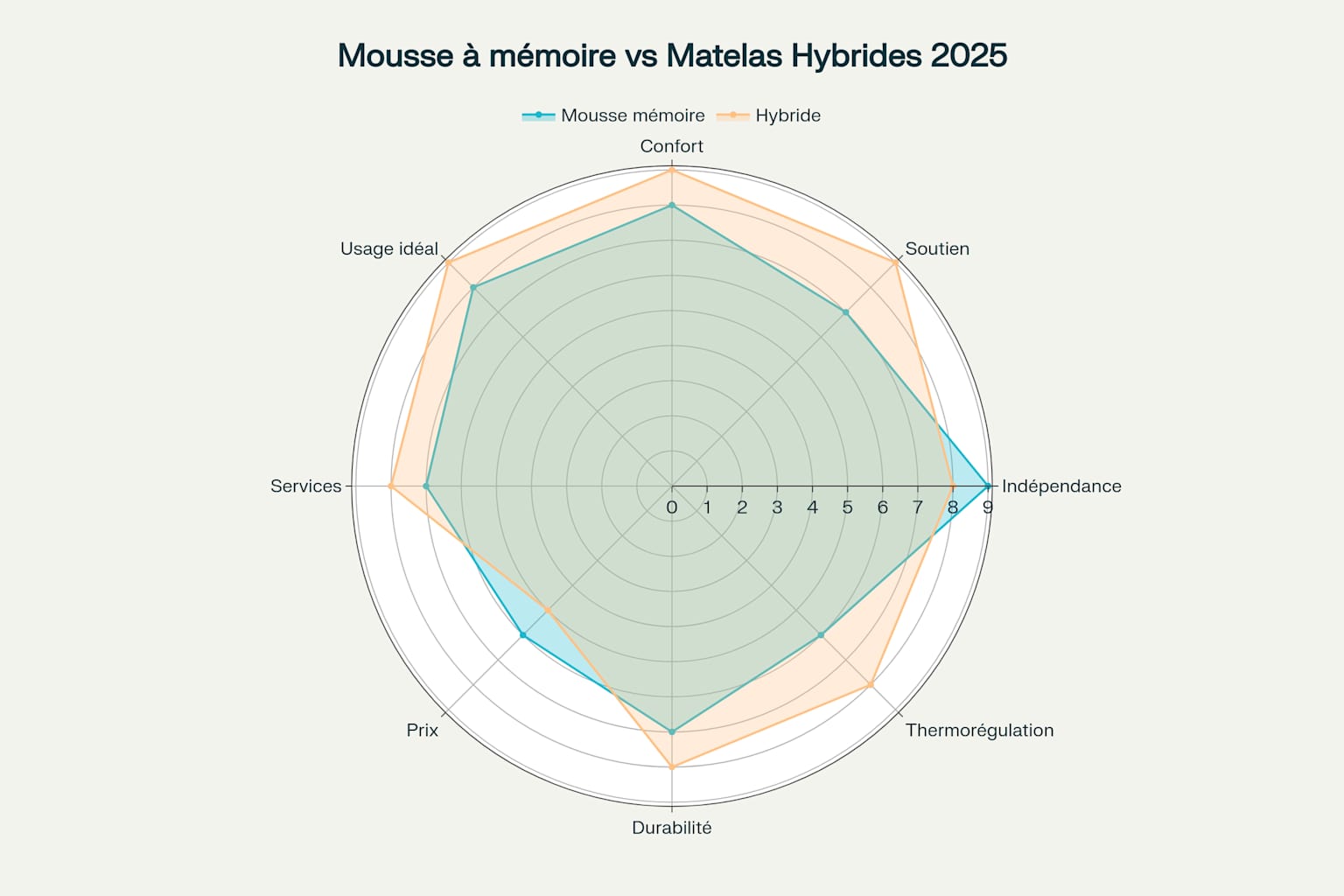
Yes. The UFC-Que Choisir comparison includes all types of mattresses: all foam, latex, memory foam, pocket springs, and hybrids (combining foam and springs). The protocol applies equally to all, with the same mannequins and the same photogrammetric measurements. What varies is the result: hybrid mattresses tend to score well on support due to the resilience of pocket springs, while natural latex often stands out on environmental and durability criteria. Entry-level all-foam mattresses may receive lower scores on simulated durability, even if their short-term comfort is satisfactory. No technology is systematically favored by the protocol, making the comparison useful regardless of your preferred type of mattress.
My build is atypical (very light or very heavy): do the test results concern me?
Partially. The UFC-Que Choisir protocol uses two builds: 54 kg/1.55 m and 110 kg/1.90 m. If you fall within this range, the conclusions apply quite well. Outside of this range, be cautious: a mattress deemed firm for a 110 kg build will often be too firm for a person weighing 45 kg, who will feel like they are on a board. Conversely, a sleeper over 120 kg may not receive the promised support from a mattress rated for 110 kg. In these cases, focus on mattresses whose technical sheet specifies the maximum recommended load, and always prioritize the home trial period: it’s the only way to validate that the support truly suits your build in your usual sleeping positions.