
Facing the growing diversity of mattresses available, two major technologies dominate in 2026: memory foam mattresses and hybrid mattresses. This comparative guide helps you understand their differences to better choose according to your needs for comfort, support, thermoregulation, and budget.
Why this comparison is relevant?
The development of online brands, box delivery, and higher consumer expectations — sleep quality, pain reduction, environmental respect — have profoundly transformed the mattress market. Between a 100% memory foam model and a model combining springs and technical foams, the differences in feel, durability, and usage are real. It is therefore crucial to understand the strengths of each technology before investing several hundred euros.
Positioning of Each Technology
The memory foam mattress is based on a viscoelastic foam that reacts to the heat and weight of the body: it precisely conforms to the curves, relieves pressure points, and offers superior sleeping independence due to its lack of motion transfer. It is the preferred technology for sleepers sensitive to joint pain or seeking a cocooning effect.
The hybrid mattress combines a pocket spring base with one or more layers of technical foams (high resilience foam, memory foam, or latex). This combination provides dynamic support that adapts to movements, better natural ventilation thanks to air circulation between the springs, and versatility suited to a wide range of body types and sleeping positions.
Comparison by Criteria
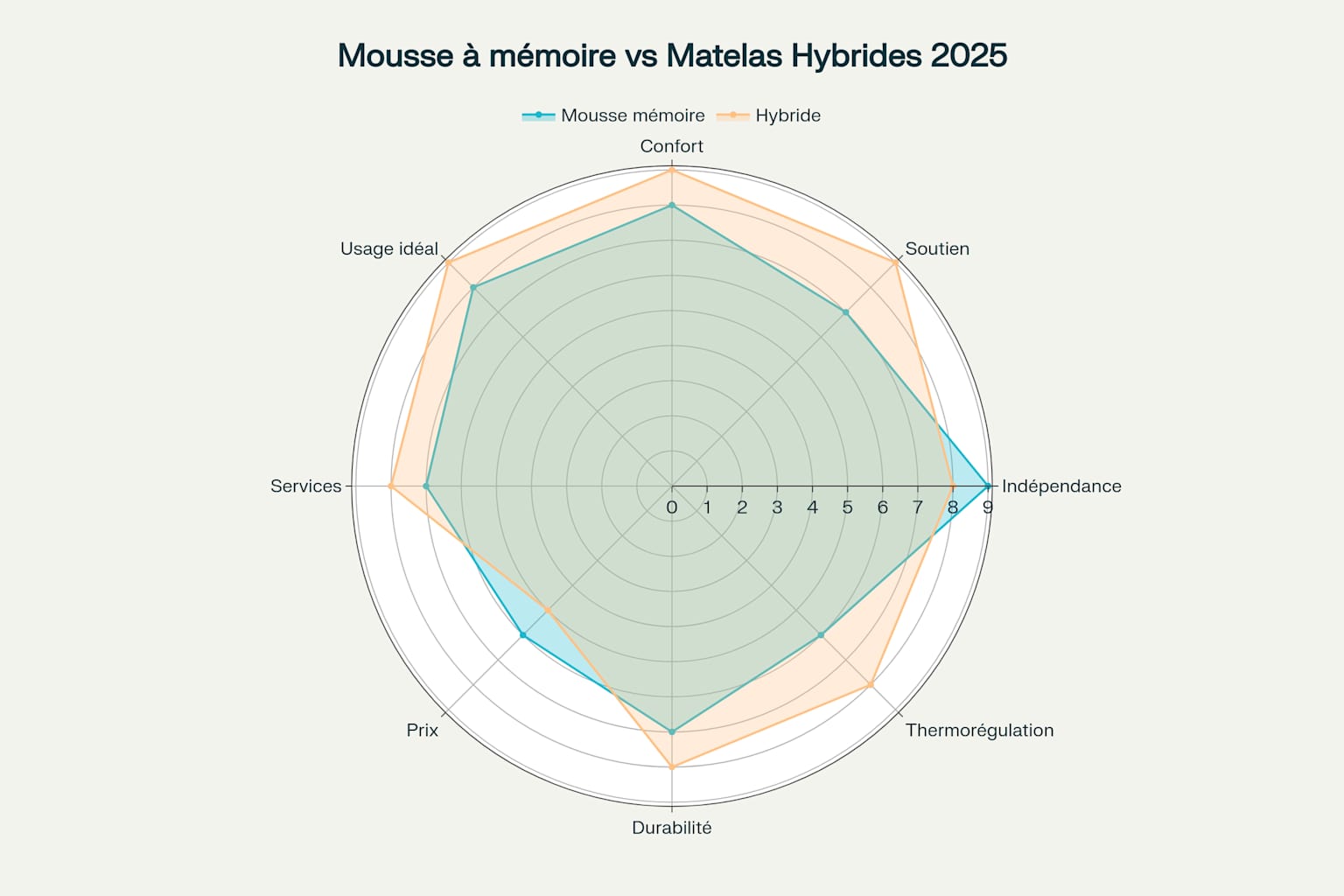
1. Comfort & Support
Memory foam offers a plush welcome and targeted morphological support: the foam contours where the body presses, effectively relieving pressure points at the shoulders, hips, and lower back. It is the preferred solution for side sleepers or those suffering from chronic pain.
The hybrid mattress, on the other hand, provides a more dynamic comfort and adaptive support thanks to its differentiated spring zones. The natural bounce of the springs facilitates position changes, and the distinct firmness zones allow for optimal spinal alignment for back or stomach sleepers.
2. Composition & Durability
A quality memory foam mattress combines a layer of viscoelastic foam (recommended density ≥ 50 kg/m³) with a high resilience (HR) foam base. The certifications to look for are OEKO-TEX® Standard 100 and the CertiPUR label, which guarantee the absence of harmful substances.
The hybrid mattress typically includes independent pocket springs (between 500 and 1,500 depending on size), covered with one or more layers of HR foam, latex, or memory foam. The metal structure provides excellent longevity overall: a well-designed hybrid can last more than 10 to 12 years, compared to 8 to 10 years for an all-foam model.
Compare pocket spring hybrid mattresses available on Amazon3. Breathability
Memory foam has long been criticized for its tendency to retain body heat. Modern formulations mitigate this flaw with cooling technologies (gel infusion, open-cell structure, thermoregulating covers), but the feel remains warmer than a basic hybrid.
The hybrid mattress benefits from natural ventilation due to air circulation between the springs and the breathable fabrics of the cover. It is the recommended choice for those who sweat easily at night or sleep in a poorly ventilated room.
4. Included Services
Both types of mattresses generally offer equivalent services from major online brands:
- Free home delivery
- Minimum 100-night trial period (some brands offer up to 120 or 365 nights)
- Free returns during the trial period
- Minimum 10-year manufacturer warranty
5. Price
Memory foam mattresses are generally accessible starting at ~€300 for an entry-level model and between €500 and €900 for a premium quality model. Hybrid mattresses now present a wider price range: some online brands offer entry-level models starting at ~€300–350, while high-end references range between €700 and €1,400. These price ranges take into account the recurring promotions offered by online brands.
Compare memory foam mattresses available on Amazon6. Customer Reviews
Memory foam mattresses are highly appreciated for their ability to relieve back pain, their absolute silence, and their customized morphological comfort. Side sleepers are particularly satisfied with them.
Hybrid mattresses are praised for their versatility, firm yet elastic support, and cool sleeping experience. They are especially suitable for couples with different body types, individuals over 80 kg, and those who frequently change positions.
Examples of Representative Models
The market today offers a very wide range in both categories. On the hybrid side, models available online illustrate the versatility of the technology, with adjustable firmness levels, up to 920 pocket springs depending on the references, and breathable covers. On the memory foam side, major online brands offer OEKO-TEX® certified models that combine wrapping and morphological support at accessible prices. For an overview of the best references at the moment, check out our mattress comparison regularly updated.
View on AmazonSynthetic Comparison Table
| Criterion | Memory Foam | Hybrid Mattress |
|---|---|---|
| Comfort | Soft, cocoon effect | Balanced to firm |
| Support | Morphological, precise | Dynamic, adaptive zones |
| Independence | Excellent | Good |
| Temperature Regulation | Average (varies by model) | Excellent due to springs |
| Durability | Good (8–10 years) | Very good (10–12 years) |
| Indicative Price | Starting from ~€300 | Starting from ~€300–350 |
| Included Services | Delivery, trial, warranty | Delivery, trial, warranty |
| Ideal for | Pain, calm, isolation | Nighttime heat, heavier body types |
FAQ: Your Questions, Our Answers
What is the lifespan of a hybrid or memory foam mattress?
A quality memory foam mattress (density ≥ 50 kg/m³) lasts on average 8 to 10 years before showing signs of sagging. A well-designed hybrid mattress can exceed 10 to 12 years, thanks to the resilience of pocket springs that maintain their shape longer than foam alone. To extend the lifespan of either type, use a breathable mattress protector, rotate the mattress head/foot every 3 to 6 months if the model is reversible, and choose a suitable bed base (slats spaced a maximum of 6 cm apart). A mattress that is too saggy—even if still usable—harms sleep quality and back health: do not wait until it is unusable to replace it.
Which mattress is best for back pain?
Both technologies can be suitable, but with different mechanisms. Memory foam relieves pressure points by precisely conforming to the body's curves—particularly effective for side sleepers suffering from tension in the hips or shoulders. The hybrid mattress, thanks to its pocket springs, offers more dynamic support and better spinal alignment, which is more suitable for back or stomach sleepers, as well as individuals over 80 kg. In cases of chronic lower back pain, the hybrid is generally preferred as it avoids the gradual sagging inherent to foam alone. Whichever you choose, opt for a model with a sufficiently long trial period (at least 100 nights) to validate comfort in your own sleep environment.
What model should I choose if I sweat a lot at night?
If you suffer from night sweats, the hybrid mattress is clearly the most suitable choice. The pocket spring structure creates natural air channels inside the mattress, allowing body heat to dissipate much more effectively than with dense foam. Additionally, choose a breathable fabric cover (Tencel, organic cotton, or bamboo) and pair your mattress with a temperature-regulating mattress protector. If you still prefer memory foam for its supportive qualities, look for a model that incorporates cooling technology (gel-infused or open-cell structure), and ensure that the cover fabric is labeled breathable. Avoid very dense foams (≥ 60 kg/m³) without integrated ventilation, as they retain more heat.
Are hybrid mattresses noisier?
No, this concern is unfounded for modern models. Pocket springs are individually wrapped in a non-woven fabric pouch that isolates them from one another: they do not rub against each other and do not generate any squeaking, even under significant weight or during position changes. The characteristic noise of old box springs comes from Bonnell springs (continuous and interconnected), a technology that serious brands have abandoned for many years. A recent entry-level hybrid mattress will therefore be just as silent as a quality all-foam mattress.
Can a hybrid or memory foam mattress be used on an adjustable electric bed base?
The answer varies depending on the technology. A memory foam mattress is generally compatible with an adjustable electric bed base, provided that its total thickness does not exceed 25–27 cm and that it does not have a rigid base. The foam is soft and follows the curvature of the bed base without resisting. Hybrid mattresses with pocket springs, on the other hand, are not recommended for adjustable bases: the springs offer resistance to bending that can damage both the mattress and the bed base mechanism over time. Some manufacturers offer "flexible" hybrids designed for adjustable bases, but they remain rare—always check for compatibility in the product sheet before making a purchase.
Is a hybrid or memory foam mattress suitable for couples with different body types?
Both technologies offer good motion isolation, but for different reasons. Memory foam absorbs movement due to the viscosity of the foam: if your partner moves, you won’t feel it. The hybrid mattress offers slightly less motion isolation but compensates with differentiated firmness zones that adapt better to dissimilar body types. For a couple with a significant weight difference (for example, 55 kg and 90 kg), the zoned hybrid will generally be more equitable: the lumbar zone will sufficiently support the larger individual without being uncomfortable for the lighter one. In any case, prefer a long trial period to test cohabitation in your own sleep environment.
Do you need a specific bed base for a memory foam or hybrid mattress?
The choice of bed base directly influences the performance and longevity of your mattress, regardless of the technology chosen. For a memory foam mattress, a bed base with flexible slats or a rigid platform frame with closely spaced slats (spacing ≤ 6 cm) is ideal: they allow slight flexibility that supports the foam without distorting it. For a hybrid mattress, prefer a bed base with rigid slats or a solid platform frame, as the spring structure needs firm and even support to function optimally—a bed base that is too soft prematurely sinks the peripheral springs. In both cases, a slatted bed base with spacing exceeding 8 cm should be avoided: foam mattresses sink into it, creating localized pressure points and accelerating the aging of the filling. If you place your mattress directly on the floor, be sure to air it regularly to avoid any moisture buildup under the foam.