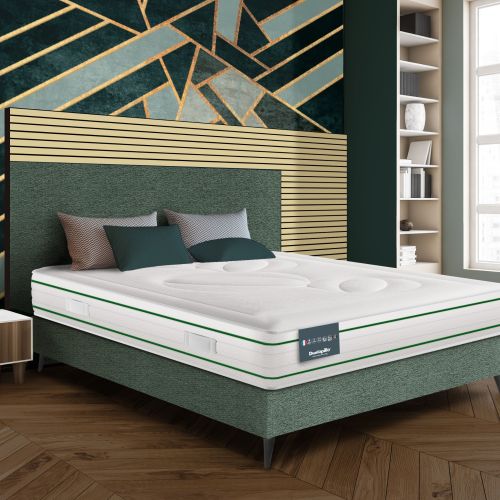
Dunlopillo occupies a unique place in the landscape of French bedding. Founded in 1929 in the United Kingdom, the brand is closely linked to the invention of the latex mattress and continues, nearly a century later, to embody this material in the collective imagination. In France, it enjoys strong recognition among sleepers attentive to natural materials, certifications, and sustainability. But what is Dunlopillo really worth in 2026 — range, quality, price, purchasing channels? This is what we will examine in detail.
Dunlopillo: a history deeply linked to natural latex
It all began in 1929 when the engineers of the Dunlop group managed to vulcanize natural latex to create an elastic foam usable in bedding. This invention revolutionized the industry: for the first time, a mattress could offer homogeneous support, natural elasticity, and superior durability compared to existing technologies. The Dunlopillo brand was born from this discovery and has been its flagbearer for decades.
In France, Dunlopillo established itself as early as 1948 and gradually developed a true industrial sector there. Today, all of its mattresses are manufactured in workshops located in Île-de-France, in Seine-et-Marne — a rare territorial anchoring in a sector where outsourced production has become the norm. This “made in France” is not a superficial marketing argument: it reflects decades of investment in local know-how and mastery of latex manufacturing processes.
The brand is currently active in several European markets — France, Belgium, Switzerland, Ireland, and the United Kingdom — and distributes its products through a network of specialized retailers as well as on its official website dunlopillo.fr .
The Dunlopillo range: models with floral names for a clear positioning
One of Dunlopillo’s particularities is its adoption of a floral nomenclature for its entire range. Thus, we find models named Tulip, Daffodil, Narcissus, Poppy, Iris, Lilac, Lavender, Dahlia, Hortense, and Hyacinth. This naming consistency facilitates product identification and gives the brand a recognizable visual and semantic identity.
Hortense: the reference natural latex model
The Hortense mattress is one of the flagship products of the Dunlopillo range: 100% natural latex, firm support, 7 comfort zones, and 22 cm thick. It is available in many sizes, from 90×190 to 180×200, to suit both single beds and large double beds. Its reversible cover offers two seasonal sides — a winter side that is more enveloping and a summer side that is more breathable — for comfort adapted throughout the year.
According to retailers, the Hortense is described as a 100% natural mattress, with no plastic or synthetic foam in its composition. For sleepers who prioritize a plant-based material, this is a significant argument.
Poppy: Aérial foam technology
The Poppy mattress is a soft and plush model, primarily composed of Aérial foam — a proprietary technology from Dunlopillo — combined with memory foam, for a thickness of 22 cm. It is aimed at sleepers looking for a more enveloping feel, without sacrificing the brand’s characteristic underlying support.
A range that covers all profiles
Beyond the two emblematic models, the Dunlopillo range offers a total of 8 models — in high-resilience foam, natural latex, or hybrid with springs — allowing it to cater to various profiles: light or heavy sleepers, firm or plush preferences, tight budgets or premium. This diversity is one of the brand’s strengths: it does not limit itself to a single type of technology, even though natural latex remains at the core of its identity.
View on AmazonManufacturing and certifications: concrete commitments
Made in France
Since 1948, Dunlopillo has manufactured all of its mattresses in its workshops in Île-de-France, in Seine-et-Marne, combining over 75 years of expertise with patented technologies. In an industry where many brands rely on Asian or Eastern European subcontractors, this French industrial positioning is a guarantee of traceability and real quality control.
Material certifications
Dunlopillo mattresses are certified OEKO-TEX Standard 100 and HomeCare, two recognized labels in the bedding sector. The OEKO-TEX Standard 100 guarantees the absence of harmful substances in the materials — a certification particularly important for sensitive or allergic sleepers. The HomeCare label, on the other hand, certifies the ease of maintenance of the products.
These certifications apply to the entire range, which is a commitment to consistency from the brand — some brands only certify their high-end models.
The Talalay process: what is it?
Dunlopillo uses the Talalay process for manufacturing its latex, which gives it superior uniformity compared to the traditional Dunlop process. Without going into technical details, the Talalay process involves evacuating the air from the mold before vulcanization, thus creating a more regular cellular structure. The result: a more uniform latex in terms of firmness, more breathable, and generally more durable over time. This is one of the technical arguments that distinguishes Dunlopillo from several competitors positioned on natural latex.
Price and quality/lifespan ratio
A justified premium range
Dunlopillo mattresses are available starting at around €499 and can exceed €1,299 depending on the model and size, with free delivery offered from a certain purchase threshold at major retailers. The Cassandre model, for example, is available starting at €915 in double sizes and has a thickness of 27 cm.
These prices place Dunlopillo in the premium segment of bedding. A positioning that the brand justifies by its natural materials, French manufacturing, certifications, and the recognized longevity of quality natural latex.
A profitable long-term investment
Over 15 years, a €900 Dunlopillo mattress represents a cost of about €0.16 per night — a lower ratio than that of a €400 foam mattress that would last 7 years. The argument of durability is therefore central to understanding the brand’s pricing position: well-made natural latex ages well, retains its elasticity, and does not sag as quickly as entry-level synthetic foam.
Warranty
Dunlopillo mattresses come with a 5-year warranty, standard in the premium segment. This warranty covers manufacturing defects and material behavior anomalies under normal use conditions.
Discover the complete range on the official Dunlopillo websiteWhere to buy a Dunlopillo mattress in France in 2026?
Dunlopillo is not a brand sold exclusively online, unlike pure online mattress players. It relies on a network of specialized retailers — bedding stores, furniture shops — that allow customers to test models in showrooms before purchase. This approach is consistent with the brand’s premium positioning: a mattress over €900 deserves to be tried.
At the same time, several serious online retailers feature the Dunlopillo range, allowing for home delivery, sometimes with advantageous conditions (free delivery, installment payments). The official website dunlopillo.fr also centralizes the offer and redirects to partner sales points.
If you want to compare Dunlopillo with other latex mattress brands or those positioned on natural materials, find our reviews and tests of mattress brands and our dedicated page to Dunlopillo for a summary sheet.
Who is a Dunlopillo mattress for?
A Dunlopillo mattress is primarily aimed at sleepers who:
- Prioritize natural materials and want to avoid petrochemical foams;
- Are sensitive to allergens and seek an OEKO-TEX certified mattress;
- Are looking for a durable mattress, willing to invest more at purchase to avoid buying a mattress in 5 or 7 years;
- Appreciate the elastic and bouncy feel of latex, distinct from memory foam (which “holds” the body more);
- Sleep hot: natural latex, especially with the Talalay process, offers excellent air circulation.
On the other hand, if you are looking for a first mattress at a low price, or if you prefer a very enveloping feel like pure memory foam, other brands may better suit your profile.
FAQ — Your questions about Dunlopillo
Does Dunlopillo really manufacture its mattresses in France?
Yes, and this is one of the brand’s strengths. Dunlopillo produces its entire range in its workshops located in Seine-et-Marne, in Île-de-France. This local manufacturing is not a recent argument intended to ride a trend: the brand has been industrially established in France since 1948. This means better traceability of materials, internal quality control, and controlled delivery times for French retailers. For a sleeper who values “made in France” in their purchasing decision, Dunlopillo is one of the few brands in this segment that can sincerely claim it.
What is the Talalay process used by Dunlopillo?
The Talalay process is a method of manufacturing latex that differs from the traditional Dunlop process by an additional step: after partially filling the mold, air is extracted by vacuum before vulcanization. This technique produces a more homogeneous and regular cellular structure within the latex, resulting in more consistent firmness across the mattress surface, better breathability (thus a cooler sleeping temperature), and improved resilience over time. For a sleeper who sweats at night or seeks a more “airy” latex than a foam mattress, Talalay is a real advantage. This is one of the reasons why bedding specialists consider Dunlopillo mattresses a reference in the segment.
Are Dunlopillo mattresses suitable for allergic individuals?
Overall, yes. Dunlopillo mattresses are certified OEKO-TEX Standard 100, which guarantees the absence of harmful chemical substances in the materials — dyes, treatment residues, heavy metals, etc. Natural latex is also naturally resistant to dust mites and bacteria, making it a recommended material for people suffering from dust mite allergies, one of the most common causes of nighttime allergies. A particular case to note: some individuals are allergic to latex itself (rubber allergy). If you are in this situation, a natural latex mattress should be avoided, regardless of the brand. Outside of this specific allergy, Dunlopillo is generally considered a favorable choice for sensitive sleepers.
What is the warranty duration for Dunlopillo mattresses?
Dunlopillo mattresses come with a 5-year warranty, which is the standard observed in the premium bedding segment. This warranty covers manufacturing defects and material performance anomalies. Beyond the commercial warranty, the effective lifespan of a well-maintained natural latex mattress is generally longer than that of a traditional foam mattress — which remains one of the main arguments in favor of the initial investment.
Can you try a Dunlopillo mattress before buying it?
Yes. Unlike 100% online brands that offer home trial periods (often 100 nights), Dunlopillo relies on a network of specialized physical retailers. You can therefore visit a store to test the different models and compare firmness levels. For online purchases through partner retailers, trial and return conditions vary by retailer — it is recommended to check them before ordering. Some retailers also offer payment in 3 or 4 installments without fees, making access to this premium range easier.
Does Dunlopillo only offer natural latex mattresses?
No. While natural latex is the historical core of the brand and what it is primarily known for, the Dunlopillo range also includes models in Aérial foam (a high-resilience foam technology patented by the brand), memory foam, and hybrid versions combining springs and foam. This diversification allows Dunlopillo to cater to various budgets and sleeper profiles while maintaining its commitments to French manufacturing and OEKO-TEX certification across the entire range.