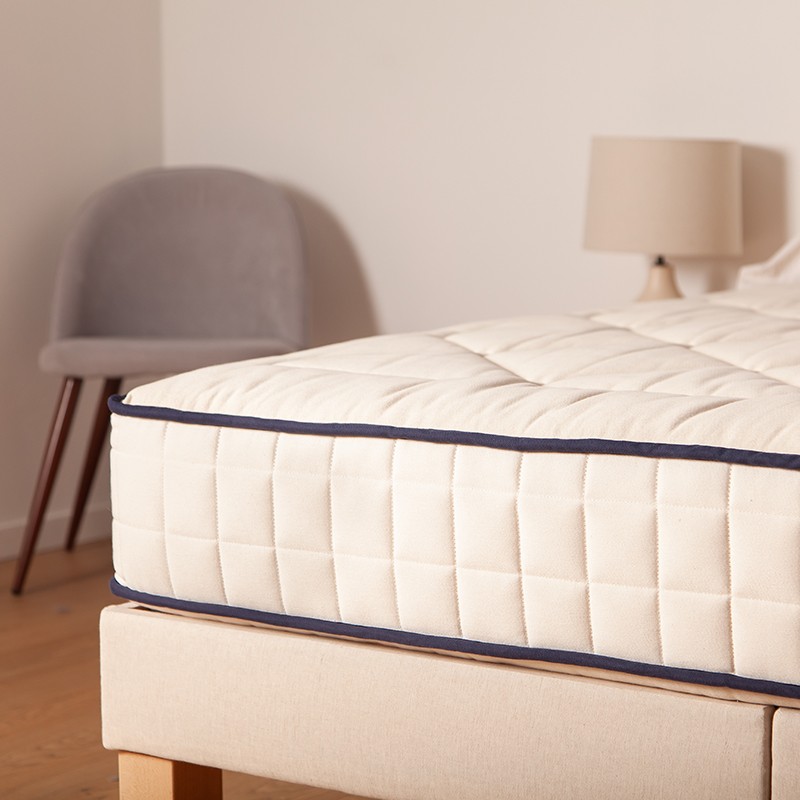
You have just set up your van or have owned a motorhome for years, and the original foam is starting to sag. Or you are building your bed from scratch and don’t know what material to start with. In both cases, you will quickly realize that the bedding aisle of a large store will be of no use to you: the sizes, humidity constraints, and weight requirements specific to nomadic life completely change the game.
Here’s what you really need to know before buying.
Why traditional bedding is not suitable
A standard mattress measuring 160×200 cm will never fit in a Ducato van. That’s the first obvious point. But the problem goes much further than just dimensions.
In a vehicle, air circulation is poor. At night, the temperature difference between the warm interior and the cold body generates condensation, which accumulates under the mattress. On a classic low-density foam or a pocket spring mattress, this phenomenon causes mold, odors, and accelerated degradation of the mattress within a few weeks. A camping mattress that “lasts” two seasons in summer camping can be destroyed in four months of year-round nomadic life.
There’s also the issue of weight. A motorhome’s maximum authorized weight or the payload limits of a converted van do not allow for a 35 kg mattress. And in a 7 m² van, every kilogram counts double.
The most common sizes
This is where things get really complicated. There is no universal standard. Dimensions vary depending on the vehicle model, bed configuration (lengthwise, crosswise, L-shaped, pop-up), and your layout choices.
Some useful benchmarks:
- Lengthwise bed in a van (Transit, Sprinter, Ducato): often around 190-200 cm in length, but the width varies between 70 and 90 cm depending on whether you sleep on the passenger or driver side, sometimes with a cut angle for wheel arches.
- Crosswise bed (more common in basic motorhomes): length is often reduced to 180-185 cm, practical for two people but uncomfortable for those taller than 1.80 m.
- L-shaped or U-shaped bed: common in surf vans or family layouts, this format requires several articulated or assembled foam pieces, never sold as a single product.
- Cab or pop-up bed in a large motorhome: often a proprietary format, sometimes with beveled angles imposed by the vehicle structure.
In most cases, you will need a custom-cut mattress. This is non-negotiable.
What material to choose?
Natural latex: the reference for nomadic life
Natural latex offers excellent support properties thanks to its natural elasticity, and its honeycomb structure ensures exceptional breathability, promoting good temperature regulation and limiting humidity. It is by far the most suitable material for van or motorhome life.
It is also naturally hypoallergenic and resistant to dust mites, making it a healthy choice for all travelers. And unlike ordinary foams, latex is durable and retains its shape well over time.
The density to remember: between 85 and 95 kg/m³ for latex, which guarantees proper support without excess weight. A latex mattress 10 to 12 cm thick is sufficient in the vast majority of van configurations, whereas a standard bedroom mattress typically measures 18 to 25 cm.
See natural latex mattresses for motorhomes on AmazonHigh-density foam: the budget compromise
High-density polyurethane (PUR) foam is less breathable than latex, but it remains usable if you choose a sufficient density. Between 25 and 35 kg/m³ for foam is the target range. Below that, the mattress will sag within a few months of intensive use.
High-density foam at 25 kg/m³ can support up to 150 kg when properly designed. It has a significant advantage: the price, which is considerably lower than latex. If you use your van for a few weeks a year and have good ventilation under the mattress, it will do the job.
Folding mattresses in two or three parts mostly fall into this category. They are appealing for their practicality (they can be folded to create a living space during the day), but the junction between the parts often creates a noticeable discomfort zone. Best reserved for lighter individuals or short stays.
Pocket springs: to avoid
A pocket spring mattress in a van is tempting fate. The metal structure retains moisture and rusts, the perimeter fabric deteriorates quickly in an environment subjected to vibrations and significant temperature variations. Not to mention the weight. Unless in very specific cases (large fully integrated motorhome with active ventilation), steer clear.
The humidity problem: your real enemy
There are simple, effective, and especially preventive solutions to permanently eliminate humidity under the mattress in a vehicle.
The basics: lift the mattress after each night (or at least two to three times a week) and let the air circulate for a few hours. This single action changes everything. In a van with a pop-up roof or side window, propping the mattress against the wall in the morning while having your coffee costs zero euros and significantly extends the mattress’s lifespan.
The underside of the mattress should allow air to circulate: avoid solid boards. If your bed rests on a solid plywood board, drill it with regular holes or replace it with spaced slats. A simple PVC mesh under-mattress or plastic slats saves weeks of humidity.
For the cover, choose a moisture-treated fabric or, better yet, a washable organic cotton cover at 60 °C. Some specialized manufacturers offer waterproof but breathable covers for nomadic mattresses: they are worth their price in this context.
See anti-humidity covers for motorhome mattresses on AmazonCustom-made: how to place an order
Having a mattress cut to size is less complicated than it seems. Several French manufacturers offer this service online with delivery within two to three weeks.
To place a good order, you need:
- The exact dimensions of your sleeping space, measured with a rigid tape measure (not a sewing tape). Measure at the bottom, middle, and top if the shape is trapezoidal or has an angle for the wheel arch.
- The maximum allowed thickness, taking into account any folding of the mattress and the height under the ceiling or storage compartment.
- The shape: standard rectangle, trapezoid, L, U, cut angle. Most manufacturers have templates to download or fill out online.
For small spaces, prefer denser foams that offer excellent support despite a low thickness. Custom mattresses in natural latex and organic cotton are available from around €280 for a standard van size.
If you are unsure about your material or configuration, our general guide to choosing your mattress will provide the basics to compare foam, latex, and hybrid before placing your order.
View on AmazonWhat we recommend based on your usage
Year-round van life, as a couple, with a comfortable budget: invest in a custom natural latex mattress, 10 to 12 cm thick, certified OEKO-TEX® Standard 100, with a washable organic cotton cover. This is the most durable and comfortable investment over time.
Motorhome used on weekends and during summer vacations: a high-density foam (minimum 30 kg/m³) custom mattress will do just fine, especially if the underside of the bed is well ventilated. Still, make sure to air out under the mattress at the end of your stay before closing the vehicle.
Surf van or intensive seasonal use: a folding mattress in two parts may be suitable if you sleep two average-sized people and do not use it more than six months a year. The central junction is not ideal, but the practicality in daily use (folding, surfing, returning) compensates.
L-shaped or U-shaped bed: don’t look for a ready-made model; you will waste time. Order directly two or three pieces of latex or HD foam in the right dimensions, and assemble them on-site with a common enveloping cover. The result is neat and comfortable.
What we advise against
Avoid cheap camping mattresses sold vacuum-packed in travel bags. They are designed for occasional summer use in a tent, not for six months of nomadic life. The foam sags quickly, moisture embeds itself, and support disappears within the first few weeks of regular use.
Beware of excessive thicknesses as well: beyond 15 cm, the comfort gain becomes very marginal in a van, and you lose storage volume under the bed while unnecessarily increasing the vehicle’s weight.
Can you use a memory foam mattress in a van?
Memory foam is technically usable, but it has several disadvantages in a nomadic context. It is more sensitive to heat (it softens with ambient temperature, which is problematic in summer in a sun-exposed van), it retains more body moisture than latex, and it is often heavier at equal thickness. If you like the enveloping sensation of memory foam, look instead for latex mattresses with a layer of HD foam comfort on the surface: you will achieve a similar result with much better breathability. For year-round nomadic life, latex remains far preferable.
What mattress thickness should I choose for a converted van?
Between 10 and 14 cm in the vast majority of cases. Below 10 cm, support becomes insufficient for daily use, especially if the support under the mattress is rigid (wood board). Beyond 15 cm, the mattress becomes cumbersome, more difficult to lift for airing, and increases the loaded mass without notable benefit. A natural latex mattress of 12 cm offers an excellent compromise: sufficient comfort for two people, reasonable weight, and a thickness compatible with most van bed configurations. If you are very heavy or sleep with a pre-existing back pain, 14 cm of firm latex may be relevant, but it is not the norm.
How do I measure my sleeping space for a custom order?
Use a rigid tape measure, not a flexible one. Measure the length and width at the bottom of the sleeping space, then check if the measurements are the same at the top (some frames have slightly slanted walls). If the bed has a cut angle (typical of wheel arches in vans), measure the distance from the right corner to the angle, and the depth of the notch. Most custom mattress manufacturers have online forms with diagrams to indicate these cuts. Allow for one or two millimeters of play compared to the exact dimensions of the frame: a mattress that is too tight will be difficult to place and remove. Take the measurements twice, if necessary with a second tool, before confirming your order.
Is there a specific certification required for a van mattress?
No specific certification for nomadic use exists to date. However, general certifications remain relevant, even more so in a confined space. Prefer the OEKO-TEX® Standard 100 label, which guarantees the absence of harmful substances in textiles and foams, and the CertiPUR® label for polyurethane foams, which certifies the absence of certain problematic chemicals. These guarantees are even more important since you sleep in a small closed volume where volatile organic compound (VOC) emissions concentrate more quickly than in a standard bedroom.
My van mattress smells of humidity: what should I do?
If the smell is light and recent, expose the mattress to the sun for a full day (with the underside facing the sun): UV and heat effectively dry out the foam or latex. If the smell persists or if you notice mold stains, the mattress is compromised and it’s better to replace it: mold embedded in the foam never completely disappears, and it poses a real health risk in a confined space. To prevent recurrence, combine three actions: slats or perforated support under the mattress, daily airing, and a washable cover at 60 °C changed regularly. An electric dehumidifier or silica gel packets in the storage compartment under the bed can also be useful.