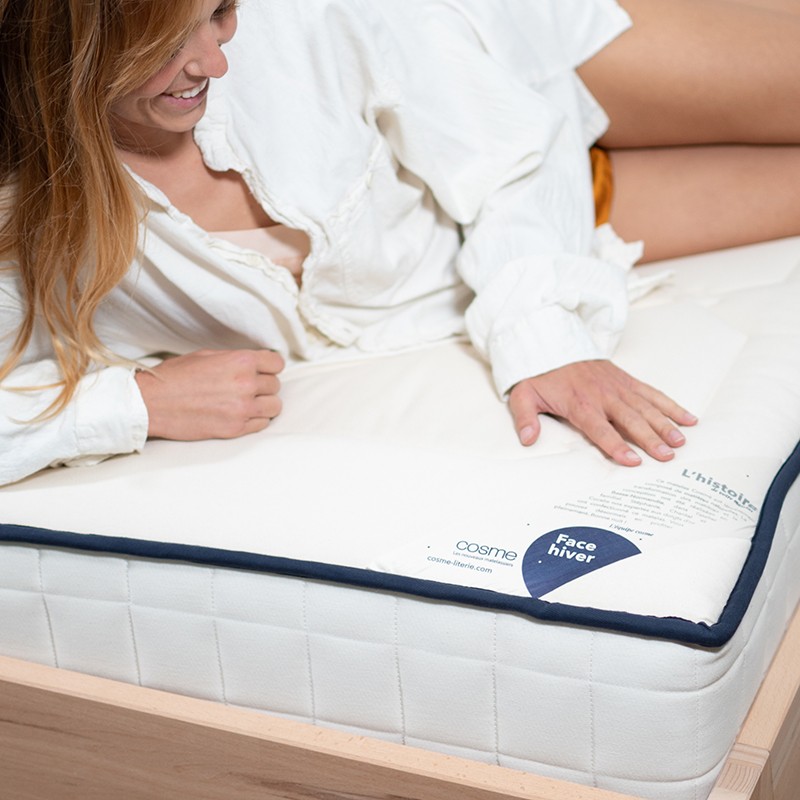
Sleeping on a comfortable mattress is essential, but it is just as important to know what it contains. In a context where eco-responsibility increasingly influences our choices, bedding is no exception to this requirement. Between green marketing, multiple labels, and sometimes vague promises, it can be difficult to navigate. Which labels are truly reliable? How can we distinguish concrete commitments from mere commercial arguments?
This article deciphers the main ecological labels in bedding to help you make an informed choice, beneficial for your sleep and for the planet.
A Favorable Context for Healthier Bedding
Since the 2000s, awareness of the health and environmental impacts of everyday products has increased. Bedding, long absent from this reflection, is now at the center of concerns. Mattresses are often made of foams, glues, and chemical treatments, some of which — volatile organic compounds, endocrine disruptors — can be harmful to health and the environment. In addition, there is a significant carbon footprint associated with manufacturing and transportation, often from Asia.
In light of these issues, eco-labels provide concrete benchmarks based on health, environmental, or ethical criteria. To choose a mattress in line with these criteria, also consult our complete guide to choosing your mattress .
The main labels to know
OEKO-TEX® Standard 100
An international reference in the textile world, the OEKO-TEX® Standard 100 guarantees the absence of harmful substances at every stage of production. Specifically, the certified product contains no pesticides, toxic solvents, heavy metals, or carcinogenic dyes — and the tests cover more than 300 parameters (depending on the final use of the product, the thresholds are even stricter than current national regulations). Its main limitation: it does not guarantee the organic or local origin of the fibers, only their safety for health.
GOTS (Global Organic Textile Standard)
GOTS is the international reference label for organic textiles: it governs the entire production chain, from fiber to finished product. It requires a minimum of 70% of fibers from organic farming (95% for the “organic” label), environmentally friendly manufacturing processes, and monitoring of social conditions (decent work, no child labor). More demanding than OEKO-TEX® in terms of environmental standards, it only applies to the textile parts of a mattress: foam or latex are not covered by this certification.
CertiPUR
Specific to polyurethane foams, CertiPUR certifies low emissions of volatile organic compounds (VOCs) and the absence of controversial substances such as phthalates or heavy metals. It is a useful label to ensure indoor air quality around a foam mattress, but it does not certify the origin of the materials or their renewable nature: a CertiPUR mattress can be made up of 100% petrochemicals.
EU Ecolabel (European Ecolabel)
The official label of the European Union, applicable to many types of products, the EU Ecolabel guarantees a limited environmental impact throughout the entire life cycle — from manufacturing to end of life — and imposes low emissions of pollutants. Its very broad scope makes it less specific to textiles than GOTS or OEKO-TEX®, but it provides a valuable overall perspective.
NF-Environnement
The official French ecolabel issued by AFNOR Certification, an independent organization, NF-Environnement certifies compliance with strict criteria throughout the product’s life cycle, in terms of both quality, safety of use, and ecological impact. The criteria vary according to the families of certified products, which requires checking the exact reference applied to bedding.
GOLS (Global Organic Latex Standard)
GOLS is the reference certification for natural latex. It requires a minimum of 95% certified organic latex, ethical sourcing, and eco-responsible manufacturing. It only applies to natural latex — and not to synthetic or blended latex — making it a particularly strong guarantee for latex core mattresses.
FSC and PEFC (for wooden elements)
The FSC and PEFC labels guarantee that the wood used in a bed base or bed frame comes from sustainably managed forests, with traceability of the resource and respect for ecosystems. They do not cover any potential chemical treatments (glues, varnishes, stains), which is why it is important to combine them with additional information about the finishing of the products.
Advantages and Limitations of Labels
The Benefits
Labels provide reliable and verifiable benchmarks by independent organizations, encourage manufacturers to adopt better practices, and help improve indoor air quality — a major health issue, as we spend an average of one third of our lives in our bedrooms.
The Limitations to Know
Not all labels have the same level of rigor, and some only apply to a part of the finished product. It is therefore essential to understand what each logo specifically certifies before using it as a decisive criterion. Moreover, the absence of a label does not automatically mean danger or toxicity: a local artisanal manufacturer can produce a healthy mattress without having the resources necessary for certification audits.
Concrete Examples in the Market
The combination of multiple labels on the same product constitutes the most reassuring scenario. A natural latex mattress certified both GOLS and OEKO-TEX® thus offers a double guarantee: on the organic composition of the latex on one side, and on the safety of the entire finished product on the other. In contrast, a CertiPUR certified memory foam mattress only controls VOC emissions but says nothing about the overall eco-responsibility of the manufacturing process. As for the untreated solid wood bed base stamped with PEFC, it represents a sustainable option as long as the manufacturing is local.
The Kipli mattress is a good example: certified GOLS, GOTS, and Eurolatex, it guarantees 100% natural latex and is manufactured in Europe (Italy) according to high social and environmental standards. The certifications are subject to annual audits by independent laboratories.
View on AmazonTo explore a broader selection of certified mattresses across all technologies, you will find a useful comparison on lematelas.fr:
View on AmazonPractical Tips for an Informed Choice
Choose products that hold multiple recognized and complementary labels, such as GOLS for latex and OEKO-TEX® for the entire product. Be wary of vague mentions like “eco-friendly” or “healthy” when they are not accompanied by any justification or verifiable certificate number. Preferably choose locally or European-made products, which reduce the carbon footprint related to transportation and facilitate inspections. Finally, do not hesitate to directly ask the manufacturer or retailer for compliance documents: any serious label comes with a certificate that can be consulted online.
To refine your selection, you can also search for labeled mattresses directly on Amazon.fr by filtering by certification in the sorting options:
Search for GOLS and GOTS certified mattresses on Amazon.fr