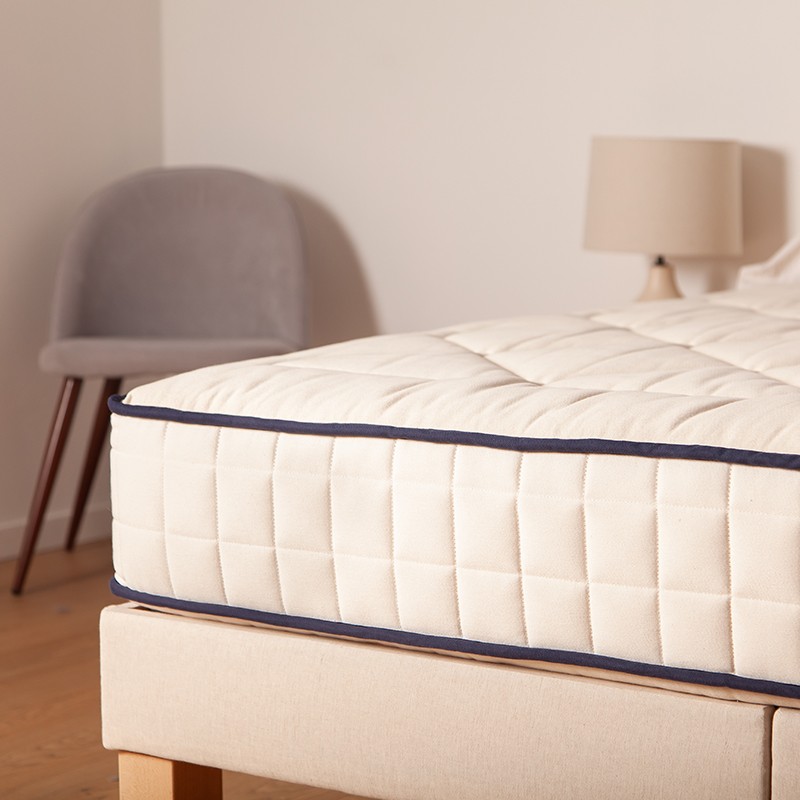
The thickness of a mattress, expressed in centimeters, is one of the first visible criteria on a product sheet — and yet one of the least understood. It is often confused with firmness (the sensation of support, soft or firm), whereas it is a distinctly different piece of information: a 25 cm mattress can be either firm or soft depending on the materials it is made of. This guide helps you untangle these two concepts and identify the thickness that is truly suited to your profile.
Thickness and Firmness: Two Independent Criteria
Thickness does not determine firmness. A thick mattress is not necessarily firmer than a thinner mattress. Thickness measures the total height of the mattress—from the bottom to the sleeping surface—while firmness reflects the resistance you feel when lying down, that is, how the mattress supports or envelops your body.
What influences firmness is the nature of the materials (high resilience foam, latex, pocket springs, memory foam) and their density. What influences thickness is the number of stacked layers and their individual height. A hybrid pocket spring mattress with several centimeters of foam on the surface can reach 28 or 30 cm while offering a very different feel from a compact latex mattress of 22 cm. To delve deeper into the question of feel, check out our complete guide on choosing a mattress .
The main thickness categories
The thickness of a mattress generally varies between 10 and 35 cm. Four main ranges can be distinguished, each corresponding to specific uses and profiles.
Less than 14 cm: only for occasional use and babies
A thickness of less than 14 cm is not suitable for an adult for daily use. These very thin mattresses do not provide the height of foam or latex necessary to properly cushion pressure points (shoulders, hips, lower back). Reserved for camping beds, occasional sleeping arrangements, or toddlers.
14 to 19 cm: occasional use or transitioning children
For convertible beds, a thickness of 14 to 16 cm will accompany your child’s growth. In this range, there are also reasonably good quality guest mattresses, suitable for a few nights per month, but insufficient for intensive daily use over the long term.
20 to 25 cm: the recommended range for most adults
This is the most common range on the market in 2026, covering both entry-level models and many well-developed mid-range models. For the majority of sleepers, 20 to 25 cm offers a good compromise between comfort, support, and price. A standard-sized adult will find it suitable, provided that the materials are of sufficient quality.
25 to 35 cm and beyond: premium comfort and specific profiles
These models typically incorporate several distinct functional layers: a firm base layer, a transition layer, and a comfort layer on the surface. The result is a more gradual feel, often appreciated by heavier sleepers or those suffering from joint pain. Beyond 35 cm, mattresses are very rare on the French market and cater to a very specific clientele. Frankly, beyond 30 cm, the marginal gain per additional centimeter becomes difficult to justify: it mainly depends on the quality of the layers, not their number.
Choosing According to Weight and Build
Weight is probably the most determining factor in choosing thickness. A mattress that is too thin for your build will sag prematurely, lose its supportive power, and lead to back or joint pain.
For average builds (between 60 and 90 kg), the choice will lean towards a mattress between 22 and 27 cm in height, depending on sleeping position. Check the composition of each layer, particularly the density of the support core, as it determines durability over time.
For heavier individuals (over 90 kg), a minimum thickness of 28 cm is recommended to avoid mattress sagging and to maintain good posture during sleep. Pocket spring or high-density latex mattresses offer the best support in this case.
Lighter individuals (under 60 kg) can be perfectly satisfied with a mattress of 18 to 22 cm, provided that the materials are of sufficient quality. There’s no need to overpay for a 30 cm model if your weight does not justify it.
View on AmazonChoosing Based on Sleep Position
The position in which you predominantly sleep influences the pressure points on the mattress and, consequently, the volume of materials needed to cushion them properly.
Back sleepers: this is the most balanced position. It distributes weight over a large surface area, which reduces pressure peaks. A thickness between 20 and 25 cm is suitable for most body types. The key is that the lumbar area is well supported, without excessive arching or sagging.
Side sleepers: this position creates the highest pressures, particularly at the shoulders and hips. These contact points need a sufficient comfort layer to sink in without the spine losing its alignment. A mattress of at least 22 to 25 cm is recommended, with a generous comfort layer on the surface (memory foam or soft latex). This viscoelastic layer generally varies between 2 and 8 cm in thickness depending on the models.
Stomach sleepers: this position puts the most strain on the lower back and neck. It requires a mattress that is firm enough to prevent the pelvis from sinking, but also thick enough to cushion pressure points without creating counter-arching. A thickness of 20 to 25 cm combined with balanced firmness is suitable in most cases.
See the 25 cm memory foam mattresses on Amazon.frInternal Composition: What the Centimeters Hide
The gross thickness of a mattress says nothing about the quality of its construction. Two mattresses measuring 25 cm can be radically different depending on their internal layers. Here are the main elements to watch for.
The Base Layer (Support Core): this is what provides structural support and often represents the largest portion of the total thickness. It can be made of high-resilience polyurethane foam, latex, or consist of a block of pocket springs. Its density (expressed in kg/m³ for foams) determines the durability of the mattress: below 30 kg/m³ for a standard core foam, the lifespan will be limited.
The Comfort Layer (Integrated Topper): placed above the support core, it determines the immediate feel. It can be made of memory foam, soft latex, gel, or textile filling. For quality memory foam, we look for a density between 50 and 80 kg/m³. Its thickness generally varies from 2 to 8 cm.
The Transition Layer (present in mid-range and high-end models): it links the firm core and the soft surface, preventing any sensation of break between the layers.
A 20 cm mattress built on a good density natural latex core will often be more durable and comfortable than a 30 cm mattress whose two-thirds are made of low-density filling foam. Some manufacturers deliberately inflate the displayed thickness with low-density layers to visually position themselves in the high-end market: be cautious. Check for certifications (OEKO-TEX, CertiPUR) that guarantee at least the absence of harmful substances, and request technical data sheets if you have any doubts.
See pocket spring mattresses on Amazon.frThickness and Type of Bedding: Beware of Compatibility
The thickness of the mattress affects the total height of your bedding (mattress + box spring or bed frame) and can pose practical problems that are better anticipated.
With a slatted base: compatibility is generally good for mattresses starting from 18 cm. For latex or memory foam mattresses, ensure that the spacing of the slats does not exceed 5 to 6 cm to avoid any sagging.
With a platform bed frame: these low structures are sometimes designed for thicker mattresses (25 cm and more) to maintain a comfortable sleeping height for sitting and getting up. An 18 cm mattress on a very low frame can make getting up difficult, especially for the elderly or those with reduced mobility.
With a storage bed or trundle bed: some trundle beds or drawer beds impose a maximum mattress height, often around 14 to 17 cm, so that the drawer slides properly. Check the manufacturer’s constraints before opting for a thick model.
With an adjustable frame (electric or manual): adjustable frames work best with sufficiently flexible mattresses. A 25 cm soft latex mattress will articulate without issue, while a very rigid 30 cm model may resist bending and wear prematurely at the articulation points.
Summary: what thickness for which profile?
| Profile | Recommended Thickness |
|---|---|
| Baby / guest bed | 10 to 14 cm |
| Child (convertible bed) | 14 to 16 cm |
| Light adult (< 60 kg) | 18 to 22 cm |
| Average adult (60–90 kg) | 22 to 27 cm |
| Heavy adult (> 90 kg) | 28 cm and more |
| Sleeper with back pain | 25 cm minimum, with memory foam or latex layer |
| Adjustable bed | 20 to 25 cm in flexible material |
| Trundle bed / drawer | Check manufacturer constraints (often ≤ 17 cm) |
FAQ
Does the thickness of the mattress impact back pain?
Yes, but not directly. What matters most is the quality of the materials and the match between firmness and your sleeping position. That said, a mattress that is too thin may not provide enough material height to cushion pressure points and keep the spine in its natural alignment. For good back support, it’s best to choose a model that is at least 25 cm high. If you sleep on your side, a thick comfort layer on the surface (memory foam or soft latex) will reduce pressure on the shoulders and hips. In cases of chronic lower back pain, also check that your bed base is in good condition: a sagging base negates the qualities of even the best mattress, regardless of its thickness.
Is a thicker mattress necessarily of better quality?
No, and this is one of the most common pitfalls. Some manufacturers increase the thickness of their mattresses with low-density foam layers to visually position themselves in the high-end market, without it corresponding to a real improvement in comfort or durability. What guarantees the quality of a mattress is the density of the foams (at least 30 kg/m³ for standard core foam, and 50 to 80 kg/m³ for quality memory foam), the nature of the latex (natural or synthetic), the spring technology, and the presence of certifications like OEKO-TEX or CertiPUR. A well-constructed 22 cm mattress will far outperform a poorly designed 32 cm mattress.
What mattress thickness is recommended for a person over 90 kg?
For heavier individuals, a minimum thickness of 28 cm is recommended to avoid excessive sagging of the mattress and to maintain good posture during sleep. But thickness alone is not enough: beyond 90 kg, make sure that the core support is made of high-density foam (at least 35 to 40 kg/m³) or high-density latex. A quality pocket spring mattress distributes weight better and withstands repeated compression over time better than low-density polyurethane foam, regardless of the displayed thickness. For a couple with very different body types, a mattress with differentiated support zones can be a good solution.
Can a thick mattress (28–30 cm) be used with any bed base?
Not necessarily. Two points need to be checked. First, the total height of the bed: a 30 cm mattress combined with a 35 cm bed base can raise the sleeping surface to 65 cm off the ground, which can pose problems for getting up, especially for elderly individuals. Next, the compatibility of materials: a very thick latex mattress needs slats that are close enough together (maximum spacing of 5 cm) to be properly supported across its entire surface. On a bed base with slats that are too far apart, even a good thick mattress can deform over time and lose its supportive qualities.
What mattress thickness should be chosen for a child?
For infants and very young children, safety takes precedence over comfort: a baby mattress of 10 to 12 cm, firm and flat, is recommended to avoid the risk of suffocation. From around 3-4 years old, one can gradually move to 14 to 18 cm. For convertible beds, a thickness of 14 to 16 cm will properly support growth until adolescence. For a teenager whose body is approaching adult size, a mattress of 18 to 22 cm will be quite suitable. Buying a 28 cm mattress for a 25 kg child does not provide any benefit: it represents an unnecessary expense and may even create a feeling that is too soft, which does not adequately support a still-developing spine.
Mattress thickness and fitted sheets: what are the risks of incompatibility?
This is a practical detail often overlooked. Standard fitted sheets have a pocket height (the elasticated part that wraps around the mattress) of between 25 and 30 cm. If you opt for a mattress of 30 to 35 cm, you will need to buy “extra deep” fitted sheets specifically designed for thick mattresses; otherwise, the sheet will loosen and come off during the night. Always check the pocket depth indicated on the packaging before purchasing your bedding, especially if you have added a mattress topper to your main mattress: the combined thickness can easily exceed 35 cm.
Should a different thickness be chosen for a double bed occupied by two people?
For a shared bed, the ideal thickness depends on the weight of the heavier sleeper. If one of the partners exceeds 90 kg, opt for a mattress of at least 28 cm with a high-density core or pocket springs. If the body types are similar and average, 22 to 25 cm is sufficient. The real question for a couple is often less about thickness than about motion isolation: a pocket spring or latex mattress limits the transfer of movement from one side to the other, which is not always the case with a solid block of polyurethane foam, even if thick. Some couples choose two 90 cm mattresses side by side in a 180 cm frame, allowing each person to choose the thickness and firmness that suits their profile.