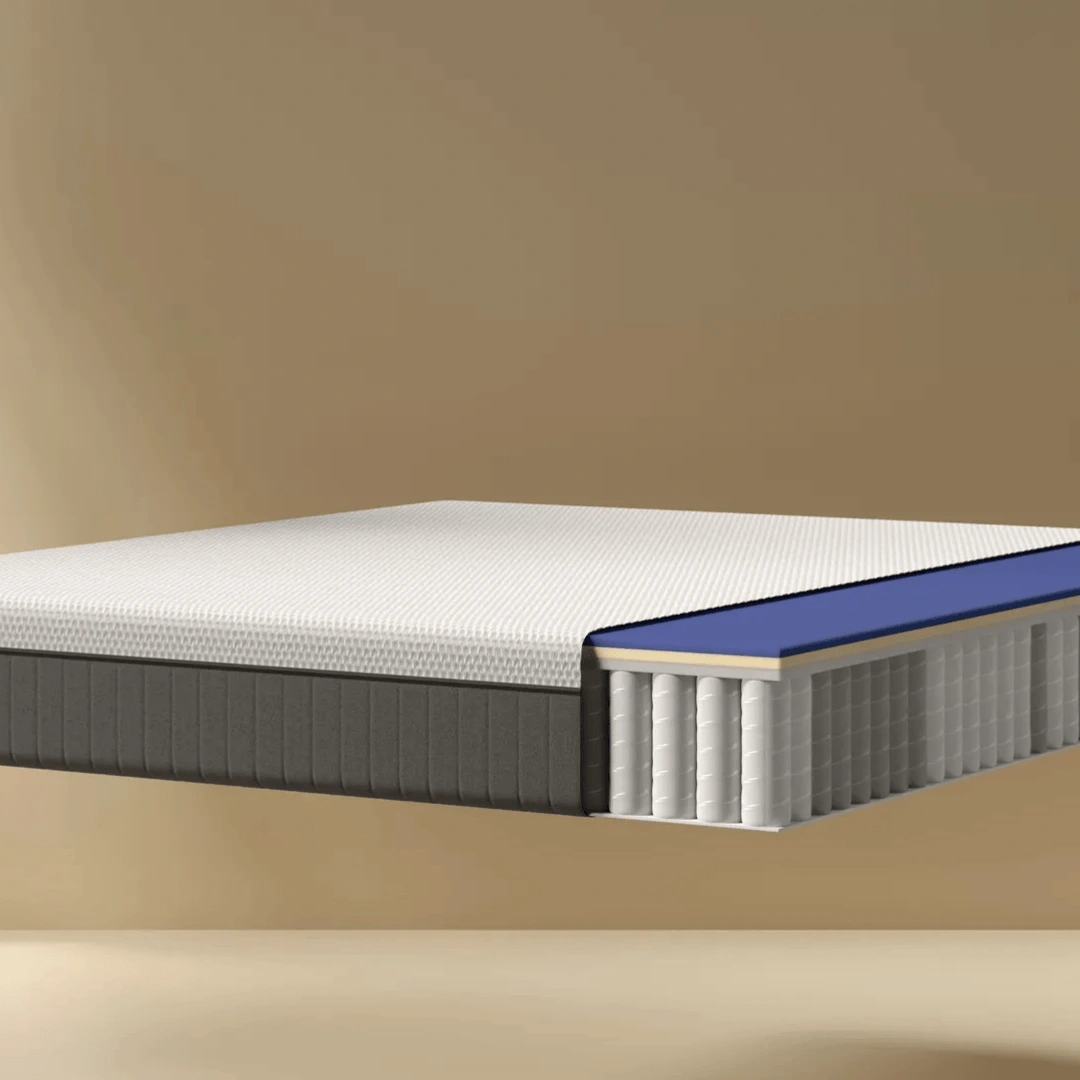
Choosing a mattress often starts with the wrong question: “Foam or springs?” Before even discussing materials or firmness, there is a more fundamental decision that influences everything else — and yet is often settled in a few seconds: what size to choose? Too often, one will stick to the size of the previous mattress out of habit, conform to the constraints of the existing bed frame, or choose the “standard” format without really considering their actual situation.
This comprehensive guide is designed to help you ask the right question before diving into a comparison of models. Once your ideal size is identified, you can consult our guides dedicated to each format to refine your choice based on materials, firmness, and your budget.
Standard Sizes in France in 2026
In France, the standard market sizes are: 90 × 190 cm (single bed), 140 × 190 cm and 140 × 200 cm (standard double bed), 160 × 200 cm (queen size), and 180 × 200 cm (king size). In addition to these formats, there are sizes for children — from 60 × 120 cm for cribs to 90 × 190 cm for teenagers — as well as intermediate formats like 120 × 190 cm, which are less common but useful in certain configurations.
It is now recommended to prioritize a length of 200 cm whenever possible, especially for tall adults. The width, on the other hand, primarily depends on your situation: do you sleep alone, with a partner, or do you need to equip a child’s room?
You Sleep Alone: Balancing Personal Comfort and Room Constraints
The 90 × 190 cm: The Classic for Individual Rooms
For a single person, the recommended standard size is 90 × 190 cm. This format corresponds to the traditional single bed and remains a safe choice for a modest-sized room — a studio, a student room, or a small guest room. The range of mattresses available in this format is very wide, and prices are generally more accessible than for larger formats.
What to keep in mind: 90 cm wide is sufficient for sleeping on your back or in a fetal position, but some people with larger builds or who move a lot in their sleep will quickly find this format cramped. If you exceed 1.90 m, prioritize the 90 × 200 cm version from the start.
The 120 × 190 cm: The Often Overlooked Middle Ground
If you have a more spacious room or if you like to have space to stretch out, the 120 × 190 cm (or 120 × 200 cm) offers a very appreciable intermediate comfort, without taking up as much floor space as a 140 cm. It is also an excellent option for a versatile guest room: large enough to accommodate a couple occasionally, sized for one person on a daily basis.
The 140 × 190 or 140 × 200 cm for Sleeping Alone
Choosing a 140 cm when sleeping alone may seem excessive, but this choice is quite relevant for people who:
- Move a lot at night and tend to fall out of bed;
- Suffer from muscle or joint pain and need space to change positions frequently;
- Occasionally share their bed with a child or a pet.
You Sleep as a Couple: Width, a Challenge for Nocturnal Cohabitation
It is often as a couple that the question of mattress size becomes the most thorny. Each has their habits, body types, sleep cycles — and one person’s movements inevitably disturb the other if the mattress is too small or too sensitive to motion transfer.
The 140 × 190 cm: Still Very Common, but Often Too Tight
The 140 × 190 cm remains the most common double bed format in France, but the 160 × 200 cm is starting to dethrone it. And for good reason: 140 cm wide shared between two adults means only 70 cm per person, barely the width of a standard single bed. When both sleepers have average to large builds or different sleep habits (one restless, the other light), this width regularly leads to nighttime awakenings.
However, the 140 × 190 cm remains a valid option for couples with a small room, where the floor space does not allow for a larger format without making the room impractical.
The 160 × 200 cm (Queen Size): The Best Compromise for Most Couples
With 80 cm per person, the 160 × 200 cm offers a significantly more comfortable space. It is the format that provides the best balance between sleeping comfort for two and reasonable floor space. It is now the best-selling format in the couple category and corresponds to almost all premium ranges from major mattress brands.
This format comfortably fits in a bedroom of about 12 m², provided that there is a passage on each side of the bed (ideally at least 60 cm). It is particularly suitable for couples where one partner is tall or sleeps sprawled out.
Discover available 160x200 cm mattresses on Amazon.frThe 180 × 200 cm (King Size): Great Comfort, Under Conditions
The 180 × 200 cm represents the pinnacle of comfort for two sleepers, with 90 cm per person — as much as an individual bed each. This format is ideal for couples where one partner is tall or large, for those who regularly sleep with a child, or simply for space lovers who never want to feel cramped.
The drawbacks are well-known: this format requires a sufficiently large room (at least 14 to 16 m² to remain comfortable), a compatible bed frame, and bedding (sheets, duvet cover) dedicated to this format. On the budget side, 180 × 200 cm mattresses are also more expensive, regardless of materials.
One often overlooked point: if one partner has very restless sleep, size alone is not enough. It is also important to choose a mattress with good sleep independence, meaning a technology (pocket springs, open-cell foam, latex) that absorbs movements and prevents them from spreading to the other side of the bed.
Children’s Room: Adapting Size to Age and Growth
The children’s room is a special case, as needs evolve quickly from one age group to another. Investing in a format that is too small means buying a new mattress in two years. Investing in a format that is too large too soon can pose safety and comfort issues for a very young child.
From Birth to 4-5 Years: The Crib and Its Dedicated Formats
Among the common sizes for babies, we find 60 × 120 cm, ideal for cribs, and 70 × 140 cm, which can accompany the child’s growth until they are 4 or 5 years old. At this stage, materials are as important as dimensions: high-density foam, natural latex, or coconut fiber are recommended for their firmness and breathability, essential for the bone development of young children.
From 4 to 10 Years: The Transition to a Child’s Bed
The 80 × 160 cm and 80 × 190 cm formats are ideal for the transition between the baby bed and the standard single bed. The 70 × 140 cm bed is primarily designed for children aged 2 to 6 years. Beyond that, a format like 80 × 160 cm or 90 × 190 cm offers better comfort and adapts better to their size.
This is the stage where many parents make the mistake of jumping directly to the adult format of 90 × 190 cm out of concern for economy. This is understandable, but a 5-year-old in a 90 × 190 cm bed may feel lost, or even less secure at night. The 80 × 160 cm format often represents a good intermediate compromise.
From 10 Years to Adolescence: The 90 × 190 cm Becomes Standard
From around 10 years old — and earlier for rapidly growing children — the 90 × 190 cm becomes the reference format. The standard size for a large children’s mattress is 90 × 190 cm. This format will accompany the child into adulthood, making it a durable investment. If your child is already expected to exceed 1.70 m or 1.75 m at 14-15 years old, consider the 90 × 200 cm directly to avoid having to buy a mattress in a few years.
Find a suitable children's mattress on Amazon.frSummary Table: What Size for Whom?
| Situation | Recommended Format | Alternative |
|---|---|---|
| Baby (0-2 years) | 60 × 120 cm | 70 × 140 cm |
| Child (2-6 years) | 70 × 140 cm | 80 × 160 cm |
| Child (6-10 years) | 80 × 160 cm | 90 × 190 cm |
| Teenager / adult alone | 90 × 190 cm | 90 × 200 cm |
| Adult alone (large build or extra comfort) | 120 × 190 cm | 140 × 190 cm |
| Couple (standard room) | 160 × 200 cm | 140 × 200 cm |
| Couple (large room / great comfort) | 180 × 200 cm | 160 × 200 cm |
| Versatile guest room | 140 × 190 cm | 160 × 200 cm |
Criteria Not to Forget Beyond Size
The size of the mattress is not chosen in isolation: it also depends on several practical parameters.
The size of the room is the first filter. For a bed of 160 × 200 cm, ideally, plan for a room that allows for at least 60 cm clearance on each side and at the foot of the bed. Below this, the room becomes difficult to live in on a daily basis.
The existing bed frame or base can also constrain your choice. If you keep a 140 cm base, there’s no need to look at 160 cm mattresses — unless you plan the budget to change the entire bedding.
The budget is the final arbiter. A mattress in 180 × 200 cm always costs more than a smaller format, at the same range. If your budget is tight, it is sometimes better to opt for an excellent mattress in 160 × 200 cm rather than an entry-level mattress in 180 × 200 cm.
To delve deeper into these criteria and compare materials, technologies, and brands available in 2026, check out our hub of complete buying guides .
FAQ
What is the difference between a queen size and king size mattress?
In France, the term queen size generally refers to the 160 × 200 cm format, while king size corresponds to 180 × 200 cm. These designations are borrowed from the Anglo-Saxon market, where the standards differ slightly (the American queen is 153 × 203 cm, the king 193 × 203 cm). In the French market, these terms are used quite loosely by manufacturers, so it is always better to check the exact dimensions in centimeters rather than relying on the commercial name. The real practical difference between the two formats is 20 cm in width, or 10 cm extra per sleeper — a gap that is really felt at night, especially if one partner is large or restless.
Can we place two 90 cm mattresses side by side to replace a 180 cm?
Yes, and this is an increasingly adopted solution by couples with very different sleep profiles (one very heavy, the other very light, or one who prefers firmness and the other softness). Two 90 × 200 cm mattresses placed side by side on a suitable base or bed frame give a visually similar result to a 180 × 200 cm. The main advantage is total sleep independence: each sleeper chooses their own mattress, and one person’s movements do not disturb the other at all. The main drawback is the central seam: depending on the models and the bed frame, a slight line of separation may be felt, especially if you sleep in a central position. To minimize this effect, opt for a unifying mattress topper placed over both mattresses.
My 8-year-old child is already 1.40 m tall. What size should I choose?
In this case, it is better to go directly to a 90 × 190 cm rather than sticking with an 80 × 160 cm. A rapidly growing child will quickly feel cramped in an intermediate format, and buying a mattress in two years represents a significant cost. The 90 × 190 cm is the standard adult format and will accompany your child into adulthood without issue. If your child is already expected to exceed 1.85 m or 1.90 m (due to growth indices or family history), consider the 90 × 200 cm directly: the price difference is minimal and you will avoid any discomfort with feet hanging off the bed.
Is it true that the 140 × 190 cm is too small for a couple?
It depends on the build and sleep habits of both people, but in many cases, yes. 140 cm wide shared between two gives about 70 cm per person, which is exactly the width of a single bed. If both sleepers are slim, calm, and sleep in a fetal position, this format may suffice. But as soon as one of them is of average to large build, or if one moves frequently, nighttime awakenings caused by lack of space or motion transfer become frequent. The 160 × 200 cm is now the recommended reference for couples in terms of comfort, and its footprint remains manageable in a standard room.
Should I choose the length of 190 cm or 200 cm?
The empirical rule is simple: your mattress should exceed your height by at least 10 to 15 cm. If you are 1.80 m or shorter, a 190 cm mattress is generally sufficient. Beyond 1.80 m, a 200 cm mattress is strongly recommended for comfortable sleep without having your feet hanging off the bed. Note that the length of 200 cm is becoming the new standard, even for small and medium sizes, as it provides a comfortable margin and makes it easier to find accessories (sheets, covers). If you are hesitating between 190 and 200 cm and your budget and room allow, choose 200 cm without hesitation.
What size for a guest room that also needs to serve as an office or versatile room?
The 140 × 190 cm format is often the best compromise for a versatile guest room. It is large enough to accommodate an occasional couple without being too bulky, and frees up more floor space than a 160 × 200 cm — which is valuable in a room that also needs to serve other purposes. If you mainly host single guests, a 120 × 190 cm may suffice. In any case, plan for comfortable bedding and suitable pillows: a guest room with a good mattress will always have more impact than the bed’s surface itself.
Does the size of the mattress significantly influence the price?
Yes, and the impact is greater than often thought. The price of a mattress is generally proportional to its surface area, sometimes with a slight premium on larger formats (especially 180 × 200 cm) due to manufacturing constraints. For the same model, moving from 140 × 190 cm to 180 × 200 cm can represent a price difference ranging from 20% to 40% depending on the brands. This means that if your budget is limited, it may be wiser to opt for a higher quality mattress in a slightly smaller format, rather than an entry-level mattress in a large format. Daily comfort depends more on the quality of materials than on the number of extra centimeters.