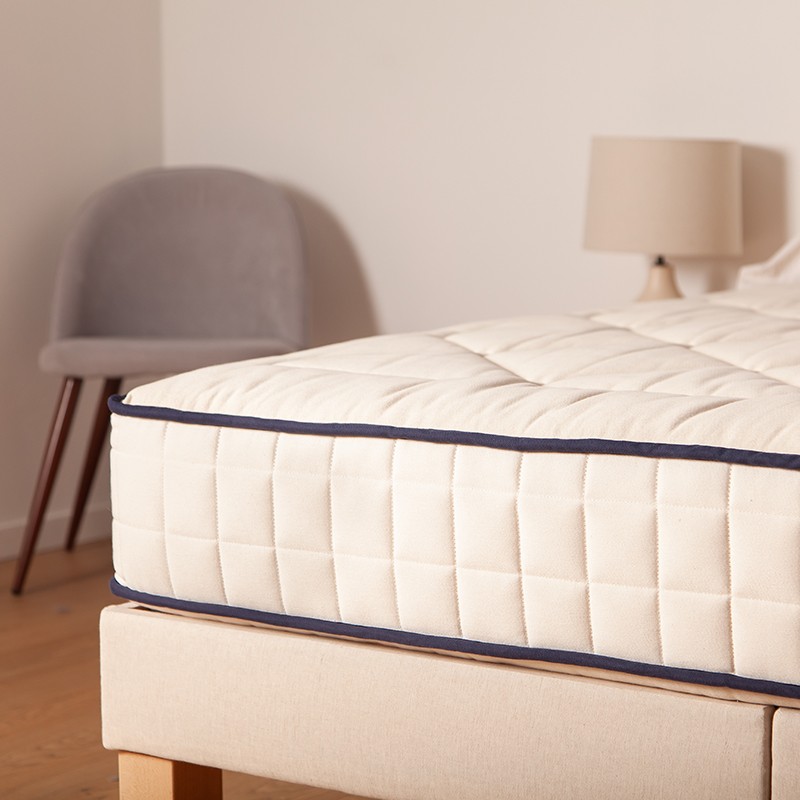
When comparing two foam or latex mattresses, density — expressed in kilograms per cubic meter (kg/m³) — is one of the few objective data points that manufacturers publish. Yet, it is also one of the most misunderstood. It is often said that a high density means quality, but without ever knowing from what threshold or why. This guide unravels all of that: what this figure actually measures, how it is interpreted according to the type of foam, and which ranges to prioritize based on your sleeping profile.
What is mattress density, exactly?
Density does not measure firmness, nor even directly comfort. It measures the amount of material contained in a volume of one cubic meter of foam or latex. Specifically, a foam with a density of 40 kg/m³ contains twice as much material as a foam with a density of 20 kg/m³ of the same volume. This difference has direct consequences on two fundamental qualities: durability and support.
The density of a mattress only concerns foam, memory foam, and latex models. For a spring mattress (Bonnell or pocketed), the concept of density does not apply in the same way: it is the number of springs per m² and the quality of the steel that plays an equivalent role. However, as soon as a hybrid mattress incorporates a comfort layer of foam or latex, the density of that layer becomes relevant for assessing its longevity.
One often overlooked point: the density indicated by a manufacturer generally refers to the main layer of the mattress, not necessarily to all layers. A mattress with an HR foam core at 35 kg/m³ and a low-quality foam topping at 20 kg/m³ should not be sold as a “35 kg/m³ mattress.” Read the technical sheets carefully and, in case of doubt, compare reputable brands that detail the composition layer by layer.
Why does density influence durability?
Denser foam resists sagging better under the repeated weight of the body. A minimum density of 30 kg/m³, or even 35 kg/m³, is recommended: below this, a mattress provides only limited support and sags quickly. This sagging is not just aesthetic: it leads to poor nighttime posture, waking pain, and ultimately forces a replacement of the mattress well before the end of its warranty.
From 35 kg/m³ to 50 kg/m³, the mattress will have good quality and last more than 5 years. This is the range found in the majority of “mid-range” brands positioned between entry-level and premium. From 50 kg/m³ onwards, the density corresponds to memory foam, latex, or high-end High Resilience (HR) foams. These materials generally offer significantly superior longevity, often advertised at 10 years or more by manufacturers.
The three main families of foam and their density ranges
Classic polyurethane foam (often called “cold”)
This is the most common foam found in entry-level mattresses. Low-density models, close to 25 kg/m³, offer limited support and low durability: their use as occasional bedding is preferable. For daily use, aim for at least 30 to 35 kg/m³. In practice, polyurethane foam beyond 40 kg/m³ becomes rare: we then switch to HR foams or memory foam.
High Resilience (HR) foam
HR foam differs from classic foam not only by its density but also by its cellular structure, which gives it very good elasticity — that is, the ability to return to its original shape after compression. Classic HR foam generally has a density between 35 and 85 kg/m³, while very high-end foams can exceed 90 kg/m³.
For a mattress, it is recommended to choose a minimum density of 40 kg/m³ in HR foam. Below this threshold, some manufacturers misuse the term “HR”: a foam labeled HR at 30 kg/m³ offers little real guarantee of longevity. Although the benchmark of 50 kg/m³ on average is often cited to identify HR foam, each type of mattress has its own specific density.
One of the major advantages of HR foam is its sleeping independence: its open cells allow each area of the mattress to react independently, which limits motion transfer between partners. An HR foam mattress can achieve a lifespan of 12 years with regular maintenance, and it has the advantage of being healthy, protected against dust and mites.
View on AmazonMemory foam (viscoelastic)
Memory foam operates on a different logic: it slowly conforms to the shape of the body in response to heat and weight, then returns to its original shape once the pressure is removed. Its density typically ranges from 50 to 80 kg/m³. Below 50 kg/m³, the memory foam will be less pronounced and the lifespan limited. Above 70 kg/m³, we are talking about truly premium products, often used in orthopedic mattresses or high-end ranges.
Note: a high density in memory foam can mean a warmer mattress at night, as the dense cellular structure limits air circulation. Reputable brands compensate for this drawback with perforation technologies (perforated foam) or by adding gel particles into the foam.
The specific case of latex
The density of a latex mattress is interpreted differently than that of polyurethane foam. Latex, whether natural or synthetic, is inherently denser than most foams. Densities of 65 to 75 kg/m³ provide soft support for a latex mattress. Latex mattresses with a density greater than 80 kg/m³ offer very firm comfort, suitable for those seeking increased support.
Natural latex (from rubber trees) generally has a more homogeneous structure and superior elasticity compared to synthetic latex of equivalent density. For this reason, two mattresses displaying the same density in kg/m³ will not feel identical if one is 100% natural and the other is synthetic or mixed. Density remains a useful indicator, but it should always be read in conjunction with the chemical composition of the latex.
The user’s weight must also be taken into account, as a higher density is necessary for optimal comfort in the case of higher weight. A person weighing more than 90 kg should choose latex with a density exceeding 75 kg/m³ to ensure sufficient support and avoid premature sagging.
Compare available natural latex mattresses on Amazon.frDensity and morphology: how to adapt the choice to your profile?
Density alone is not enough to choose a mattress: it must be combined with firmness (soft, medium, firm) and morphology (weight, height, sleeping position). Here are some practical guidelines:
- Light person (under 60 kg): a median density (35-40 kg/m³ in HR, 65-70 kg/m³ in latex) is sufficient. A mattress that is too dense may be perceived as too firm and cause pressure points on the shoulders and hips.
- Standard build (60-90 kg): this is the most versatile range. HR foam between 40 and 55 kg/m³, or latex between 70 and 80 kg/m³, will suit the vast majority of profiles.
- Heavy person (over 90 kg): prioritize high densities (55 kg/m³ and more in HR, 80 kg/m³ and more in latex) to ensure durable support and avoid premature sagging in the lumbar area.
- Stomach sleeper: a higher density is generally recommended to keep the spine aligned and avoid lumbar hyperextension.
- Side sleeper: a median density with a soft to medium firmness is often more comfortable, as it allows the shoulders and hips to sink slightly.
What density does not tell you
It would be misleading to reduce the quality of a mattress to its only kg/m³. Density does not inform about:
- Firmness: a dense foam can be soft if its formulation allows it, and a less dense foam can be firm.
- Breathability: the cellular structure (open or closed) and any perforations matter more for thermal regulation.
- Quality of raw materials: a foam at 40 kg/m³ made from certified materials (Oeko-Tex, CertiPUR, GOLS for latex) will always be preferable to a non-certified foam of the same weight.
- Ergonomics by zones: a mattress with 7 differentiated support zones often provides more comfort than a monoblock mattress with uniform high density.
Density is thus a minimum reliability signal, not a guarantee of absolute comfort. That is why the most reputable brands publish not only the density but also the layer-by-layer composition, certifications, and warranty conditions — elements that we detail in our comparisons and mattress buying guides .
Explore HR foam mattresses available on Amazon.frSummary table of density ranges by type of foam
| Type of foam | Low density | Recommended density | Premium density |
|---|---|---|---|
| Classic polyurethane | < 25 kg/m³ | 30 – 40 kg/m³ | > 45 kg/m³ |
| HR Foam | < 35 kg/m³ | 40 – 55 kg/m³ | > 60 kg/m³ |
| Memory foam | < 50 kg/m³ | 50 – 70 kg/m³ | > 70 kg/m³ |
| Latex (natural or synthetic) | < 65 kg/m³ | 65 – 80 kg/m³ | > 80 kg/m³ |
FAQ — Mattress density: your frequently asked questions
Does the density indicated on the product sheet refer to the entire mattress or only certain layers?
This is a fundamental question, and the answer varies by manufacturer. Ideally, the technical sheet of a multilayer mattress should specify the density of each layer individually — support layer (the core), comfort layer, any surface layer. In practice, some brands only communicate the density of the core, which is often the highest, which can give a flattering impression of overall quality while the upper layers are made of cheap foam. Others indicate an “average” density of the whole, which obscures disparities. The best practice is to demand layer-by-layer detail: if a manufacturer refuses or is unable to provide it, it is generally a bad sign. Direct brands (online sales) usually communicate better on this point than generalist large retailers.
Is a denser mattress necessarily firmer?
No, and this is one of the most common confusions. Density and firmness are two distinct parameters. Density measures the amount of material per unit of volume; firmness describes the resistance to sinking under a given load. It is entirely possible to formulate an HR foam at 50 kg/m³ in a soft version or a firm version depending on the cellular structure and chemical additives used. Conversely, a foam at 25 kg/m³ can be sold in a “firm” version — but this firmness will not last, as the insufficient material will sag quickly. In summary: density guarantees durability, formulation determines firmness. To choose well, one must consider both, cross-referencing them with your weight and sleeping position.
What minimum density is recommended for daily use?
For a mattress used every night, the generally recommended threshold is 30 to 35 kg/m³ for classic polyurethane foam, and at least 40 kg/m³ for HR foam. Below these values, the risk of premature sagging is real, especially for people of standard or above-average weight. For latex, a density of at least 65 kg/m³ is recommended for daily use. These thresholds are minimums: if you want a mattress that lasts 10 years or more without losing its supportive properties, aim for the intermediate to premium ranges detailed in the table above. Occasional bedding (sofa beds, futons, guest mattresses) can drop below these thresholds without too many consequences, as they are only used occasionally.
Is kg/m³ the only criterion to consider when evaluating mattress durability?
No. Density is an important indicator, but other factors influence durability. The quality of raw materials and their certification (Oeko-Tex Standard 100, CertiPUR for foams, GOLS or GOTS for natural latex) guarantees the absence of harmful substances and reflects a certain level of quality control. The thickness of the mattress also plays a role: a very thin mattress, even at good density, will provide less cushioning in the long term. The nature of the base (slatted, upholstered, floor) also affects wear: a poor base accelerates sagging even of an excellent mattress. Finally, maintenance — flipping or rotating regularly according to the manufacturer’s recommendations — significantly extends lifespan. Density remains the primary filter for evaluation, but it does not exempt one from examining these other criteria.
How does density impact the price-quality ratio of a mattress?
Intuitively, the higher the density, the higher the manufacturing cost — since more material is incorporated into the same volume. That is why entry-level mattresses rely on low-density foams to keep their prices down, while premium ranges display high densities. However, high density does not automatically mean good value for money: some brands charge very high prices without density or certifications justifying the extra cost. Conversely, some direct brands (online sales only) manage to offer HR foams at 40 or 50 kg/m³ at competitive prices by cutting out intermediaries. To assess value for money, it is better to relate the price to the density and certifications obtained rather than just the comfort felt during a brief lie-down in-store.
Is the density different for a natural latex mattress and a synthetic latex mattress?
Two mattresses can display the same density in kg/m³ while offering different performances depending on whether the latex is natural, synthetic, or mixed. Natural latex (from rubber trees) generally has superior natural elasticity and durability compared to synthetic latex (made from styrene-butadiene). At equal density, 100% natural latex will recover its shape better after compression and tends to last longer. Mixed latex (a blend of both) falls in between. To distinguish these qualities on a product sheet, look for GOLS (Global Organic Latex Standard) certifications for natural latex and the detailed chemical composition. Density remains a valid indicator for comparing products within the same family, but it is not sufficient to compare natural latex to synthetic latex.