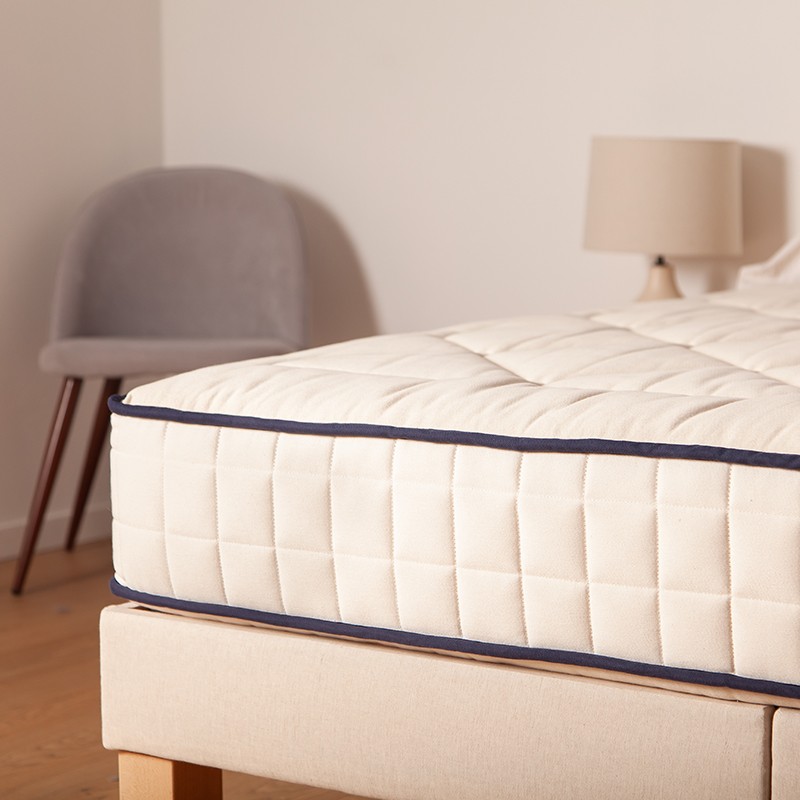
Choosing a vegan mattress ensures that no animal-derived components—neither wool, nor down, nor silk fiber, nor even certain latex vulcanization agents—are included in the bedding composition. This is not a niche whim: by 2026, the demand for ethical and transparent bedding is on the rise, and several French or European brands now offer clearly documented options in this regard. However, one must know how to read a technical sheet and distinguish a “natural” mattress from one that is truly free of any animal material.
Why the vegan question is more complex than it seems
Most consumers know that wool and down should be avoided. But the list of potential animal components in a mattress is longer than one might think.
Wool is the most common animal ingredient in high-end natural bedding. It fills the covers of many latex or pocket spring mattresses because it is an excellent temperature regulator and naturally fire-resistant—allowing for the avoidance of chemical flame-retardant treatments. For a vegan sleeper, it must be replaced with thick cotton, Tencel (eucalyptus lyocell), recycled polyester, or hemp.
Down and feathers mainly concern mattress toppers and duvets, but they can occasionally be found in some high-end quilted covers.
Casein is the least known trap. Some natural latex vulcanization processes use casein—a protein derived from milk—as a stabilizing agent. A latex labeled GOLS (Global Organic Latex Standard) alone does not guarantee the absence of casein: it is necessary to check with the manufacturer if their vulcanization process is indeed 100% plant-based. This is a point that few brands spontaneously document.
Silk is included in the composition of a few very premium covers, mainly in the luxury hotel segment. It remains marginal in the mass market.
Suitable plant-based and synthetic materials
A vegan mattress generally relies on a combination of several materials, each fulfilling a specific function:
Natural rubber latex is the undisputed star of eco-friendly mattresses. Extracted from the sap of the Hevea brasiliensis tree, it is 100% plant-based in its raw state. Its high density (often between 70 and 85 kg/m³ in premium models) provides elastic and durable support, excellent resistance to dust mites, and a longevity of 12 to 15 years, far exceeding that of conventional foam. GOLS and EuroLatex certifications attest that it is produced without pesticides and under controlled growing conditions—but, as we have seen, they do not guarantee the absence of casein, hence the importance of asking the manufacturer.
Coconut fiber (coir) is a filling derived from the coconut husk. It is often used as an intermediate layer in latex mattresses to provide additional firmness and good air circulation. It is 100% plant-based, naturally resilient, and biodegradable.
Organic cotton is the must-have for eco-friendly covers. Certified GOTS (Global Organic Textile Standard), it guarantees the absence of pesticides in cultivation and harmful chemicals in dyeing or fabric treatment. It serves as a direct alternative to wool for cover filling, although its temperature-regulating capacity is lower.
Hemp is an increasingly present material in natural bedding. Grown without pesticides, highly durable, and naturally antibacterial, it can be used both as a textile fiber for covers and as supplementary filling.
Tencel (lyocell) is a cellulosic fiber produced from eucalyptus wood in a closed-loop process that recycles over 99% of the solvents used. Very soft, breathable, and naturally temperature-regulating, it is often presented as the most effective plant-based substitute for wool in terms of heat regulation.
Memory foam and polyurethane foams are 100% synthetic materials, thus devoid of animal components by definition. They are not “natural” in the ecological sense, but they fully meet vegan criteria. CertiPUR-US or Oeko-Tex Standard 100 certifications attest to the absence of harmful chemicals for health.
Recycled polyester (rPET) is made from recycled plastic bottles. It is often used as padding in covers as a vegan substitute for wool or down. Its ecological footprint remains nuanced (it releases plastic microfibers during washing), but it is clearly free of any animal material.
Discover Kipli's natural latex mattresses, made in Europe with GOTS certified organic cottonBrands available in France in 2026
Before naming a brand as “vegan,” a warning is necessary: few brands explicitly use this qualification on their product sheets. What follows is based on publicly documented compositions, but it is always advisable to contact customer service to confirm the total absence of casein in the latex and verify the exact composition of the chosen cover.
LatexBio has established itself as a benchmark for discerning sleepers regarding ecological criteria. Its mattress combines two blocks of 100% natural latex sourced from 97% rubber tree milk, separated by a layer of coconut fiber. The brand also selects organic cotton and hemp among its raw materials, and its latex is certified EuroLatex. The plant-based composition is at the heart of its positioning, making it one of the most coherent references for a vegan purchase—provided that the vulcanization process is verified.
Tediber offers a mattress explicitly labeled “100% vegan latex” in its range, composed of a block of natural latex, coconut fiber, organic cotton, and microfiber, with a thickness of 24 cm and a 15-year warranty. The French brand focuses on price accessibility while maintaining solid environmental criteria.
Kipli offers a dense natural latex mattress (85 kg/m³), with a GOTS certified cover, and the entire product is certified GOLS and CATAS. The brand manufactures its mattresses in Europe from natural rubber latex, with a cover made of organic cotton. However, caution is advised: depending on the configurations, the cover may include organic wool— a 100% recycled polyester option is available for sleepers wanting a 100% vegan composition. It is important to specify this at the time of ordering.
View on AmazonHow to verify that a mattress is truly vegan
The verification process relies on a few simple reflexes, but it requires some attention.
Read the complete composition—not just the core of the mattress, but also the cover, any filling, and the seams. Wool often hides in the padding of the cover, sometimes simply mentioned as “natural filling.”
Ask the manufacturer about the vulcanization of the latex. This is the question that almost no one asks, yet this is where casein can come into play. A serious and transparent manufacturer will be able to provide precise answers.
Look at the certifications in combination: GOTS for textiles, GOLS for latex, Oeko-Tex or CertiPUR for synthetic foams. None of these certifications alone certifies vegan status, but their combined presence is a signal of seriousness and traceability.
Beware of marketing terms like “natural,” “organic,” or “eco-friendly” that do not presuppose the absence of animal components. A mattress can be 100% organic and contain certified organic wool—which is still animal-derived.
Search for vegan natural latex mattresses on Amazon.frVegan and ecological certifications: two distinct subjects
It is important not to confuse the two angles. A vegan mattress is not necessarily ecological (a synthetic polyurethane foam is vegan but not particularly durable), and an ecological mattress is not necessarily vegan (a natural latex mattress with an organic wool cover remains partially animal-derived).
To obtain a mattress that is both ecological and vegan, one must therefore cross-reference the two criteria: 100% plant-based or recycled synthetic materials on one hand, and solid certifications on the absence of harmful substances on the other. This is demanding, but it is a combination that is entirely achievable with the brands available in 2026 on the French market, provided one takes the time to read the technical sheets in detail.
To deepen your selection criteria and compare the different types of mattresses available, consult our complete guide to choosing your mattress .
Is a natural latex mattress always vegan?
Not necessarily. Natural latex is extracted from the sap of the rubber tree, a plant—so it is plant-based in its raw state. However, the vulcanization process, which transforms liquid latex into solid foam, may involve casein, a protein derived from cow’s milk. Not all manufacturers use this process, but few mention it spontaneously on their product sheets. To ensure this, the most reliable approach is to directly contact the brand’s customer service and explicitly ask if the latex is vulcanized without animal protein. Furthermore, even if the core of the latex mattress is vegan, the cover may contain wool: both elements need to be checked separately.
What materials replace wool in a vegan cover?
Wool serves two essential functions in a mattress cover: it regulates temperature (it absorbs moisture and insulates against cold) and acts as a natural flame retardant, avoiding chemical treatments. For a vegan mattress, several plant-based or synthetic substitutes exist. Tencel (lyocell made from eucalyptus) is the most effective thermal alternative: it efficiently wicks away moisture and remains cool to the touch. Thick organic cotton offers good comfort but has lower temperature regulation. Hemp fiber is durable and naturally antibacterial. Finally, recycled polyester (rPET) is often used as padding in covers: it contains no animal components, but its ecological footprint is nuanced due to the plastic microfibers it may release during washing.
Does the GOLS certification guarantee that a mattress is vegan?
No. The GOLS (Global Organic Latex Standard) label certifies that natural latex comes from controlled cultivation, without synthetic pesticides, and that the chemical additives used in manufacturing meet strict safety criteria. But it does not determine the animal or plant nature of the vulcanization agents. Similarly, the GOTS certification for textiles guarantees organic farming and the absence of harmful chemicals, but it does not exclude organic wool. In practice, these certifications are solid indicators of quality and traceability, but they do not replace direct verification with the manufacturer regarding the absence of animal components.
Is a memory foam mattress vegan?
Yes, in the vast majority of cases. Memory foam (viscoelastic) is a fully synthetic material, derived from polyurethane. It does not contain animal components by its chemical nature. Oeko-Tex Standard 100 or CertiPUR-US certifications attest to the absence of toxic substances in its composition, but these are health guarantees, not vegan labels. The real point of vigilance concerns the mattress cover: even for a synthetic core, some covers may incorporate wool or down in their filling. As always, it is the complete composition sheet—core + cover + filling—that should be read carefully.
Is recycled polyester a good vegan alternative to wool?
On the strict criterion of veganism, yes: recycled polyester (often derived from plastic bottles, referred to as rPET) contains no animal material. It is used as padding in several natural mattresses to replace wool while retaining some softness. However, its ecological footprint is more nuanced: during washing, it releases plastic microfibers that end up in wastewater. For a consumer who is both vegan and environmentally conscious, Tencel or thick organic cotton remain preferable alternatives when available. Nonetheless, recycled polyester is still a reasonable choice if plant-based alternatives are not offered in the desired model.
Can affordable vegan mattresses be found in France?
The vegan segment in bedding is still predominantly positioned in the mid to high-end range, as certified natural materials (GOLS latex, GOTS cotton, Tencel) are more expensive to produce than standard synthetic foams. That said, options have multiplied and diversified since 2024. Brands like Tediber offer vegan natural latex mattresses in ranges accessible compared to premium references in the sector. To manage one’s budget, it is advisable to monitor promotional periods (sales, Black Friday), compare warranties (a long warranty period better amortizes the price of a premium mattress), and prioritize the quality of the core—which determines support and durability—even if it means opting for a simpler cover.
Should certain labels be avoided specifically to choose a vegan mattress?
Not “avoided,” but learned to interpret. No existing label is a dedicated vegan label for bedding. Certifications like GOTS, GOLS, Oeko-Tex, EuroLatex, or CertiPUR speak of organic quality, traceability, or the absence of harmful substances—they say nothing about the presence or absence of animal materials. In practice, a mattress bearing both the GOLS (latex) and GOTS (cover) labels is likely to be transparent about its composition and offer options without wool. But direct verification with the manufacturer remains irreplaceable. The ideal is to combine reading the certifications with communication with customer service to obtain written confirmation of the complete composition.