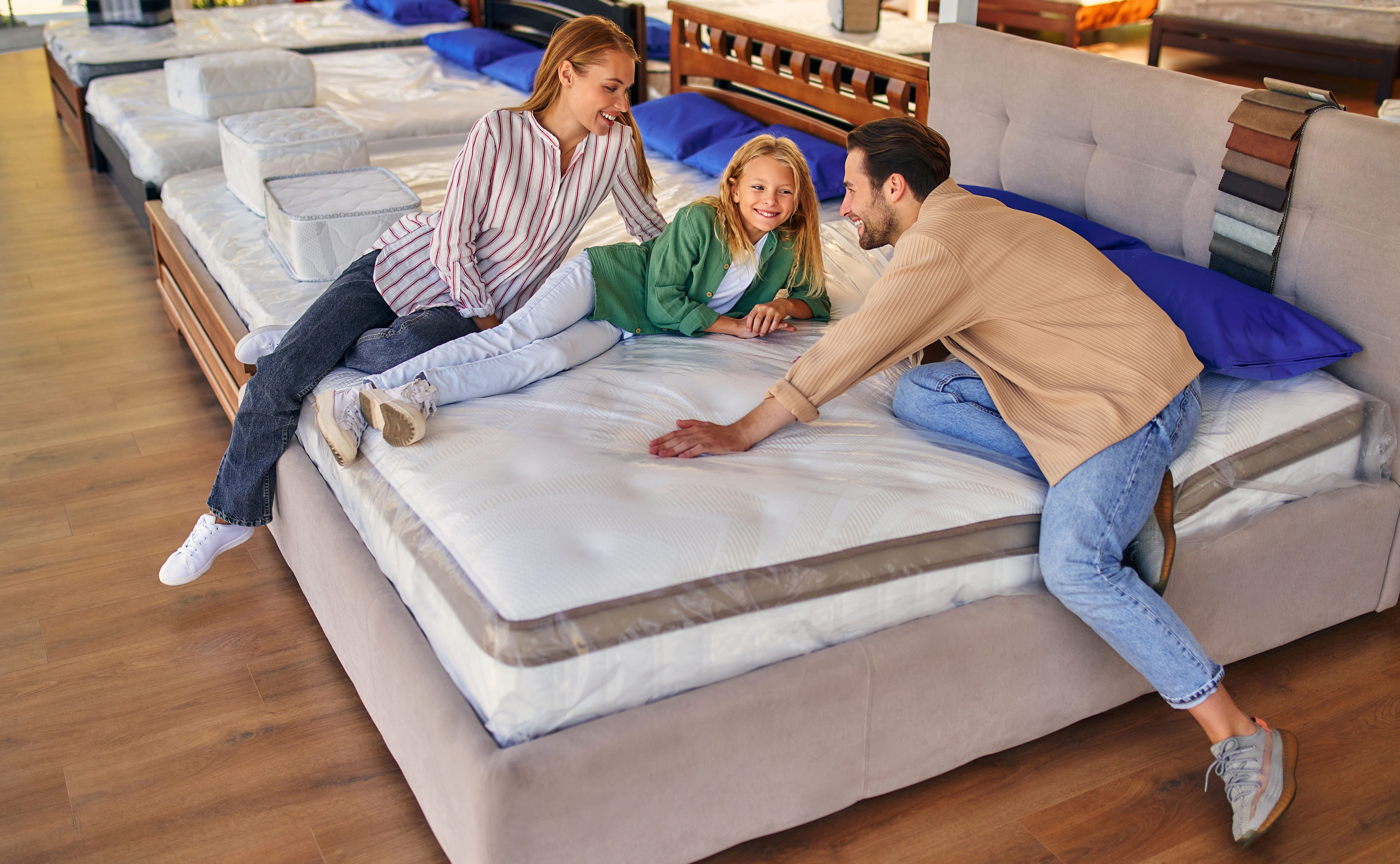
You walk into a bedding store or browse a specialized website, and you find yourself faced with dozens of models with mysterious names: HR foam, natural latex, Bonnell springs, hybrid… It’s hard to find your way without a minimum of reference points. However, mattresses can be grouped into four main families, each with its logic, strengths, and limitations. This guide gives you the keys to quickly understand these differences and guide your choice.
Why are there so many types of mattresses?
The ideal mattress does not exist in a universal version. Each sleeper has a weight, a body shape, a sleeping position, and comfort expectations that are unique to them. Manufacturers have therefore developed several technologies to meet these varied needs: some prioritize support, others enveloping, others still breathability or durability.
Understanding a mattress’s family means understanding its basic mechanics — which then allows you to refine your choice based on your budget, weight, or any potential pain.
Foam mattresses
Foam is the most common technology on the market, and it actually covers several very different sub-families.
Polyurethane foam (PU)
This is the entry-level foam, soft and lightweight. It compresses quickly and is not recommended for daily long-term use. It is mainly found in guest mattresses or budget options.
High resilience foam (HR)
HR foam is the improved version of polyurethane. Denser (at least 35 kg/m³), it offers good support, durability, and a solid quality/price ratio. It suits most profiles and is the standard for mid-range mattresses.
Memory foam (viscoelastic)
Memory foam molds to the body’s curves thanks to its reaction to heat. It effectively relieves pressure points (shoulders, hips) and is particularly suitable for side sleepers or people suffering from joint pain. Its main drawback: it retains heat and can be too enveloping for sleepers who move a lot.
Ideal for: small frames, side sleepers, people sensitive to pressure points.
Average budget: €300 to €800.
Latex mattresses
Latex is a naturally elastic material that combines support and enveloping. It is distinguished by its great breathability and its naturally hypoallergenic properties.
Natural vs synthetic latex
Natural latex comes from the sap of the rubber tree. It is more durable, more breathable, and more environmentally friendly. Synthetic latex (or SBR) is less expensive but less effective in the long term. There are also mixed latex mattresses, which combine both.
For a reasoned purchase, prefer latex certified OEKO-TEX or Eco-INSTITUT, which guarantees the absence of harmful substances.
Advantages: excellent resilience, hygienic, durable (10 to 15 years), suitable for allergy sufferers.
Disadvantages: heavier than foam, higher price.
Ideal for: allergy sufferers, people looking for a natural mattress, profiles seeking a good support/enveloping ratio.
Average budget: €500 to €1,200.
To go further, check out our natural latex mattress buying guide .
Spring mattresses
Spring mattresses are the oldest on the market, but their technology has evolved significantly. There are three main types.
Bonnell springs
Bonnell springs are steel springs connected to each other. They provide good support and a certain firmness, but their connection creates a trampoline effect: the movement of one sleeper transmits to the other. This type is increasingly not recommended for couples.
Pocket springs
Each spring is wrapped in an individual pocket, allowing it to function independently. The result: excellent sleeping independence and better contouring of the body’s curves. This is now the most popular technology for spring mattresses.
Multi-zone springs
A variant of pocket springs, multi-zone mattresses have differentiated firmness zones (head, shoulders, lumbar, legs) for precise anatomical support.
Advantages: very good ventilation, longevity, ideal for people who get hot at night.
Disadvantages: thicker and heavier, can be noisy (Bonnell springs).
Ideal for: people who sweat, couples (pocket springs), heavier sleepers.
Average budget: €400 to €1,000.
Hybrid mattresses
The hybrid mattress combines a pocket spring structure with one or more layers of foam (HR, memory foam) or latex. The goal: to combine the advantages of each technology — the support and breathability of springs, the enveloping and comfort of foams.
It is currently the fastest-growing family on the market, particularly driven by online brands like Emma, Simba, or Tediber.
Advantages: versatile comfort, good sleeping independence, excellent durability.
Disadvantages: higher price, significant weight, quality varies greatly by brand.
Ideal for: most profiles, couples, people who want a single “all-terrain” mattress.
Average budget: €600 to €1,500.
To compare hybrids and memory foam mattresses, check out our article hybrid mattress vs memory foam 2026 .
See the entire selection of mattresses on lematelas.frSynthetic comparison table
| Type | Comfort | Average Price | Ideal for |
|---|---|---|---|
| HR Foam | Firm to balanced | €300–600 | Versatile, good quality/price ratio |
| Memory Foam | Enveloping, soft | €400–800 | Side sleepers, joint pain |
| Natural Latex | Balanced, resilient | €500–1,200 | Allergy sufferers, seeking natural options |
| Pocket Springs | Firm, airy | €400–1,000 | Couples, people who get hot |
| Hybrid | Versatile | €600–1,500 | Mixed profiles, couples |
For an in-depth comparison of these technologies, read our comparison of latex, foam, and springs mattresses .
How to choose based on your profile
- You sleep on your side: prioritize memory foam or a hybrid with a soft top layer to relieve shoulders and hips.
- You weigh over 90 kg: choose a firm mattress with high-density foam (40+ kg/m³) or robust pocket springs.
- You are allergic: certified natural latex or an HR foam with an anti-allergic cover are your best options.
- You sleep with a partner of different sizes: a multi-zone pocket spring mattress or a quality hybrid ensures good sleeping independence.
- You get hot at night: avoid classic memory foam; prefer pocket springs or breathable latex.
- Your budget is tight: a good density HR foam (35–40 kg/m³) offers the best quality/price ratio.
For a choice focused on how to choose your hybrid mattress , we detail the specific criteria to watch for.
The Emma Original mattress is a safe bet in the hybrid/foam category for intermediate profiles: see the Emma Original on Amazon .
FAQ – Your frequently asked questions
What is the difference between an HR foam mattress and a memory foam mattress?
High resilience foam (HR) returns to its shape immediately after pressure: it offers dynamic support and suits most body shapes. Memory foam, on the other hand, reacts slowly to body heat to mold gradually. It is more enveloping and better relieves pressure points, but it retains more heat and can give an uncomfortable sinking feeling for some sleepers. In practice, an HR foam mattress will be better for people who move a lot at night or tend to sweat, while memory foam will be preferred by those seeking cocooning comfort and suffering from shoulder or hip pain. Both technologies can be combined in the same mattress (often: HR base + memory foam layer on top).
Is natural latex really worth the extra cost compared to synthetic latex?
In the vast majority of cases, yes. Natural latex, derived from rubber tree sap, is more breathable, more durable, and less likely to deform over time than its synthetic counterpart. A good quality natural latex mattress can last between 12 and 15 years without significant loss of comfort, compared to 7 to 10 years for synthetic latex. From a health perspective, certifications like OEKO-TEX or Eco-INSTITUT guarantee the absence of allergenic or undesirable chemical substances. For allergy or asthma sufferers, certified natural latex is often recommended by sleep specialists. The initial extra cost (often €200 to €400 more) is thus amortized over the mattress’s lifespan. However, be careful: some mattresses sold as “natural latex” actually contain a blend; check the percentage of natural latex (ideally over 85%) and the certifications.
Are pocket springs really better than Bonnell springs?
For modern daily use, pocket springs are indeed superior on almost all criteria. Their main advantage is sleeping independence: each spring works individually, so the movement of one partner does not transmit to the other. This is a decisive criterion for couples. Pocket springs also offer better contouring of the body’s curves, increased durability, and silent operation. Bonnell springs, connected to each other, create a rocking effect and tend to creak over time. They remain present in entry-level models or in mattresses intended for occasional use (guest room). If you are investing in a primary mattress, always prioritize pocket springs, and check the number of springs per m²: beyond 400 springs/m², support and sleeping independence are generally very good.
Does a hybrid mattress suit all types of sleepers?
The hybrid mattress is often presented as a universal solution, and this is largely justified: it combines the advantages of springs (ventilation, support, sleeping independence) and foams (enveloping, surface comfort). However, it all depends on the quality and composition of the hybrid in question. A good hybrid should have at least 15 to 20 cm of quality pocket springs and a comfort layer (HR foam, memory foam, or latex) of at least 3 to 5 cm. Very light individuals (under 55 kg) might find some hybrids too firm; very heavy individuals (over 110 kg) should ensure that the mattress is designed for their size. For couples with different profiles, a hybrid with distinct firmness zones on each side can be an ideal solution. In summary: the hybrid mattress suits the vast majority of sleepers, provided you choose a quality model suited to your size.
How to assess the durability of a mattress before purchase?
The durability of a mattress depends on several factors that you can evaluate before purchase. For foam mattresses, check the density: an HR foam of less than 35 kg/m³ will compress quickly; aim for 40 kg/m³ and above for intensive use. For latex, prefer a high natural latex content and recognized certifications (OEKO-TEX, Eco-INSTITUT). For springs, inquire about the thickness of the steel wire and the number of springs per m². Reputable brands provide this information in their technical sheets. Beyond materials, look at the warranty offered: a manufacturer that offers a 10-year warranty generally trusts its materials. The home trial period (100 nights on average with online brands) is also a good indicator of the manufacturer’s confidence in its product. Finally, customer reviews over time (beyond 2 years of use) are a valuable source of information on the actual aging of the mattress.