Sharing a bed is a given for most couples, but what is less obvious is the impact that one partner’s nighttime movements have on the other’s sleep. On average, a sleeper changes position forty times a night — for a couple, this represents eighty risks of sleep interruption. Yet, when searching for a mattress, people often focus on firmness, thickness, or price, rarely on motion isolation, a technical criterion that actually determines the real quality of your nights together.
This is often the first thing people regret not having checked. Here’s what this term exactly covers, why some technologies lend themselves better to it than others, and how to evaluate it concretely before buying.
What is motion isolation?
Motion isolation refers to a mattress’s ability not to transfer one sleeper’s movements to the other side of the sleeping surface. In other words: when your partner turns over at three in the morning, do you feel it?
This phenomenon is often called “motion transfer” or “vibration transfer.” A mattress with low motion isolation acts a bit like a trampoline: the energy produced by a movement propagates in waves across the entire surface, disturbing the other sleeper, sometimes without them being aware of it upon waking. These repeated micro-awakenings, even if brief, degrade the overall quality of sleep and promote chronic fatigue.
Motion isolation is not a subjective comfort criterion like firmness. It is a mechanical criterion related to the mattress’s internal structure — it can therefore be evaluated relatively objectively by observing how each technology behaves in response to localized stresses.
Why is this criterion often overlooked?
Bedding is an area where commercial communication focuses on what can be touched or seen: the height of layers, the softness of the surface fabric, the density of foams. Motion isolation, on the other hand, is invisible to the naked eye and difficult to simulate in-store, especially when lying down alone on a display model for two minutes.
This is precisely why it is so often underestimated during purchase — and so often regretted once the mattress is installed at home. Couples who suffer from this problem tend to blame the firmness of the mattress or their own sleep habits, without identifying the real cause: a surface that cannot isolate movements.
To consult other criteria to consider before choosing, browse our complete guide to choosing a mattress .
Technologies face to face: which offers the best motion isolation?
Not all mattress technologies are equal in this regard. Here’s an overview of the major families, from best to least effective.
Pocket springs: the reference
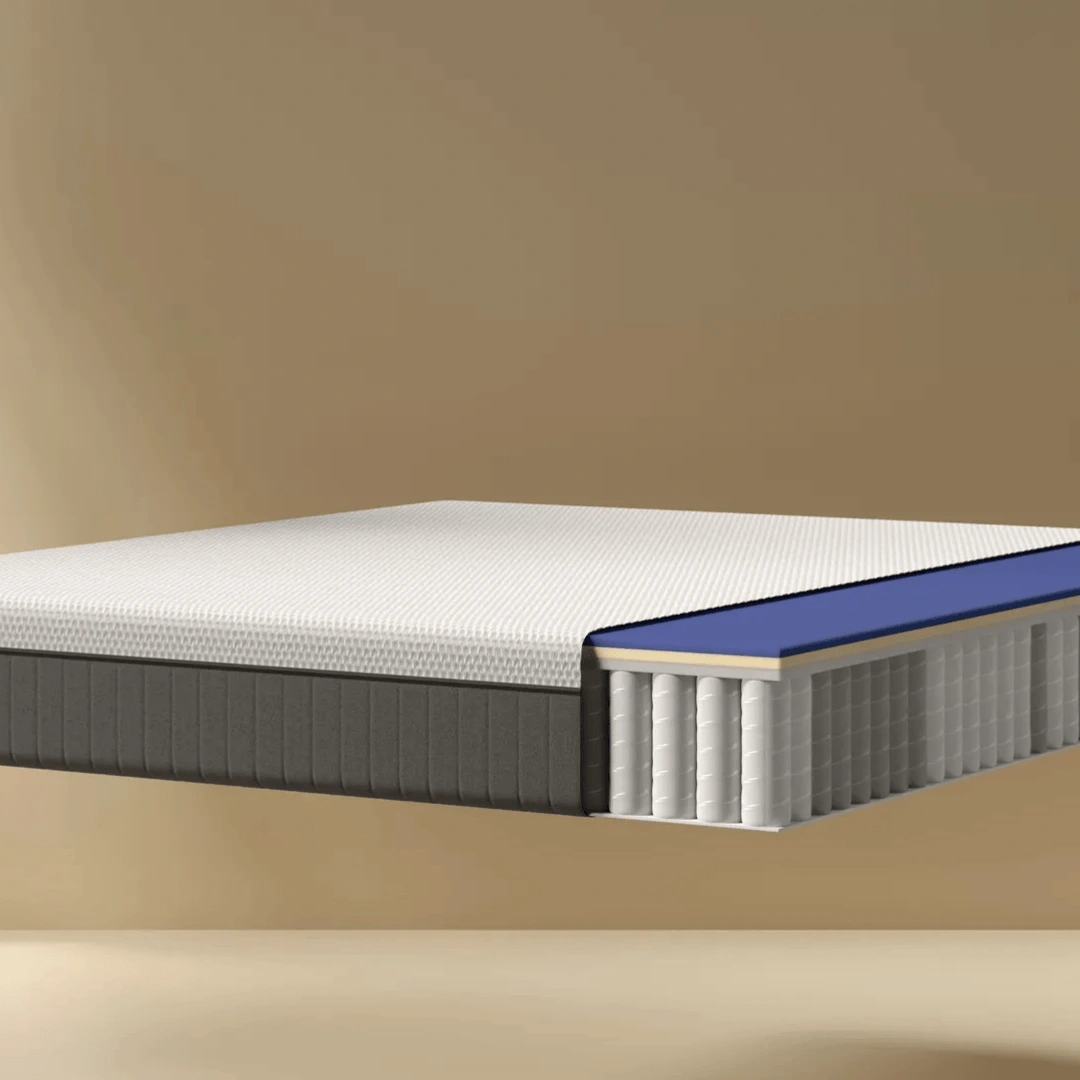
Pocket springs are the reference technology for motion isolation. Each spring is individually wrapped, absorbing movement without transmitting it to the rest of the mattress. This compartmentalization is key: unlike a continuous or bonnell spring system, pocket spring units work independently of one another, allowing each sleeper to maintain their own resting space without feeling the position changes of the other, even if their sleep rhythms differ.
The higher the number of springs per square meter, the finer the isolation. A model with a high density of springs will react very locally to a point pressure, without “distorting” the area occupied by the other sleeper. Pocket spring mattresses start at around €300 for entry-level models; high-density or zoned models typically start around €600-800.
View on AmazonNatural latex: flexible and absorbent
Natural latex is an excellent alternative to pocket springs for its ability to absorb vibrations. Its open-cell structure dissipates kinetic energy locally, providing good motion isolation — though it does not reach the isolation level of a high-density pocket spring structure. The advantage of latex also lies in its other qualities: naturally thermoregulating, breathable, and durable, it is a healthy choice for couples sensitive to synthetic materials. Generally, expect to pay from €500 for a quality 100% natural latex mattress in 160 × 200 cm.
Explore natural latex mattresses for couples on Amazon.frMemory foam (viscoelastic): a pleasant surprise
Memory foam mattresses provide good to excellent motion isolation. By molding precisely around the body, viscoelastic foam concentrates deformation in the pressure area and does not propagate it laterally. For couples where one partner is a restless sleeper, this is a serious option — provided they accept the enveloping sensation and the tendency of this material to retain body heat, which can be problematic for hot sleepers or those who frequently change positions.
Hybrid mattresses: the best of both worlds
Hybrid mattresses combine a pocket spring base with one or more layers of foam (memory foam, latex, high-resilience foam). This combination helps avoid micro-awakenings related to an agitated partner’s movements while benefiting from firm support and adaptive surface comfort. Hybrids combine motion isolation, orthopedic support, and breathability: it is currently the category that dominates recommendations for couples. The Tediber Hybrid, for example, is made in France, offers 100 nights of trial, and 10 years of warranty, with prices starting at around €640 on promotion.
Search for a pocket spring hybrid mattress on Amazon.frBonnell and continuous springs: to be avoided
Not all types of springs offer good motion isolation. Bonnell and continuous springs provide only mediocre isolation. These structures, in which the springs are linked to one another or share a common frame, behave like a cohesive network: pressure applied at one point is transmitted throughout. If your current mattress is of this type and you sleep together, this is likely where your problem lies.
How to evaluate motion isolation before buying?
A few practical methods allow you to test this criterion under real conditions.
The water glass test. Place a full glass on the mattress, then apply firm pressure about fifty centimeters away. A good mattress will not cause the water to move. This simple test, often demonstrated in videos by manufacturers, is a reliable indicator of motion transfer.
The home trial. The best way to test motion isolation is to experience it with your partner, in your own bed, over several nights. Most brands selling online offer trial periods of one hundred to one hundred twenty nights. Take advantage of this: it is the only way to know if the mattress truly suits your couple’s situation.
Targeted customer reviews. When reading reviews, filter those that explicitly mention sleeping as a couple, mattress noise, or motion transfer. These experiences are often more revealing than technical sheets.
Certifications and labels. They do not directly measure motion isolation, but certifications like OEKO-TEX or Eurolatex are indicators of manufacturing rigor, which indirectly affects the durability of mechanical performance.
Do you need a large bed to sleep well as a couple?
Motion isolation is related to the mattress technology, not just its dimensions. A 160 × 200 cm high-density pocket spring mattress will isolate movements better than an 180 × 200 cm bonnell spring mattress. That said, the available surface area per person remains a factor in overall comfort: each has their own area on which the mattress does not have to manage weight conflicts.
For couples with very different body types (weight, height, sleeping position), one solution is to opt for two twin mattresses of 90 × 200 cm placed side by side in a 180 cm bed frame. Each can then choose their own firmness, and motion isolation is complete by design. This approach, very common in Nordic countries, is gaining ground in France among discerning sleepers. Its main drawback: the central junction, noticeable when sleeping in the middle or frequently changing sides.
Other criteria to consider alongside motion isolation
Motion isolation is rarely the only purchase criterion for a couple. It should be balanced with:
- Firmness. Two partners do not always have the same body type or sleep habits. A medium or medium-firm mattress is suitable in most cases and represents a reasonable compromise.
- Thermoregulation. Pocket spring mattresses are naturally more breathable than solid foam mattresses. For couples who suffer from nighttime heat, this is a decisive additional asset.
- Noise. A mattress that squeaks with every movement will disturb the other’s sleep just as much as poor vibration transfer. Quality pocket springs are silent; entry-level models are less so.
- Durability. The mechanical performance of a mattress, including its motion isolation, degrades over time. A good pocket spring will hold its promises for ten to fifteen years; low-quality foam will lose its memory in three to five years.
FAQ — Motion Isolation
What exactly is motion isolation?
Motion isolation is the ability of a mattress to confine one sleeper’s movements to their own sleeping area without transferring them to the other side. When one partner turns over, gets up, or lifts their legs, a mattress with good motion isolation absorbs these movements locally without creating a perceptible wave on the other side. It is a purely mechanical criterion, related to the internal structure of the mattress: it does not depend on perceived firmness or surface comfort, making it an often underestimated indicator at purchase but crucial in daily life for couples.
Which mattress technology offers the best motion isolation?
Pocket springs are the reference for this criterion. Each spring is housed in its own fabric pocket, working independently and absorbing pressure applied at one point without linking adjacent areas. Hybrid mattresses, which combine a pocket spring base with adaptive foam or latex layers, also offer excellent performance while adding surface comfort. Natural latex performs well too. In contrast, bonnell springs and continuous springs, whose units are mechanically linked, easily transmit vibrations and are not recommended for couples sensitive to nighttime disturbances.
Is memory foam a good option for a couple?
Yes, memory foam (or viscoelastic foam) offers good to excellent motion isolation, thanks to its ability to deform locally around the sleeper’s body without propagating mechanical stresses to the rest of the surface. It is therefore a viable option for couples. However, it has two drawbacks to consider: on one hand, it retains more body heat than pocket spring or latex mattresses, which can be problematic for hot sleepers; on the other hand, its enveloping sensation is not appreciated by everyone, especially those who sleep on their stomach or frequently change positions. A hybrid mattress incorporating a layer of memory foam combined with a pocket spring base often represents the best compromise for couples.
Can you improve the motion isolation of an existing mattress?
To some extent, yes. A natural latex or memory foam topper placed on a bonnell spring mattress can reduce vibrations felt on the surface. This is not a perfect solution — the problem lies in the mattress’s deep structure — but it can significantly reduce micro-awakenings. If the mattress is relatively new and in good condition, this intermediate solution is worth trying before considering a complete replacement. However, if the mattress is sagging, deformed, or over ten years old, a topper will not compensate for structural deficiencies: replacement becomes the only effective option.
Does motion isolation also concern solo sleepers?
In theory, no: if you sleep alone, the motion transfer from one sleeper to another does not exist. In practice, however, this criterion can still play an indirect role: a mattress with good motion isolation reacts locally to each position change, which can facilitate turning and make nighttime movements less “costly” in energy. Some very restless solo sleepers find that a pocket spring mattress disturbs them less in their own movements. But in absolute terms, if you sleep alone and your priorities are lumbar support or thermoregulation, motion isolation does not have to be at the top of the list.
Should you prefer two twin mattresses rather than one large mattress for couples?
The solution of two twin mattresses of 90 × 200 cm in a 180 cm frame is particularly suitable for couples whose body types or firmness preferences are very different. It guarantees absolute motion isolation, as the two surfaces are physically separated, and allows each to choose their own firmness level without compromise. The main drawback is the central seam, noticeable when sleeping in a median position or frequently changing sides. For a couple with similar body types and habits, a large high-density pocket spring mattress remains the simplest and most homogeneous solution.
How to test motion isolation before purchase?
The simplest test is to place a lightweight object on the mattress — a glass of water, for example — and apply firm pressure about fifty centimeters away: a mattress with good motion isolation will not cause the object to move. In-store, lie down together and ask your partner to turn over or lift a leg while you remain still, eyes closed, to perceive the vibrations. If buying online, always take advantage of the home trial period — usually between one hundred and one hundred twenty nights — to evaluate this criterion under your real sleep conditions: it is the most reliable method, and the only one that leaves no room for doubt.
What budget should be planned for a mattress with good motion isolation?
An entry-level pocket spring mattress starts around €300 for 160 × 200 cm, but truly convincing models for motion isolation — with sufficient spring density and quality comfort layers — are generally priced from €600. High-end hybrids or natural latex mattresses often exceed €800 to €1,000 for a large format. It is a significant investment, but over ten years of use, it represents less than €100 per year per person. If the budget is tight, prioritize a simple pocket spring model over a costly solid foam model: for the criterion we are interested in here, spring technology will always be more effective.
Motion isolation is neither a marketing argument nor an accessory detail. For couples, it is often the factor that makes the difference between a mattress that is bearable and one that truly improves nights. Pocket springs and hybrids clearly dominate the market on this criterion, at increasingly accessible prices. Take advantage of trial periods at home: they exist precisely to validate what technical sheets cannot tell you.