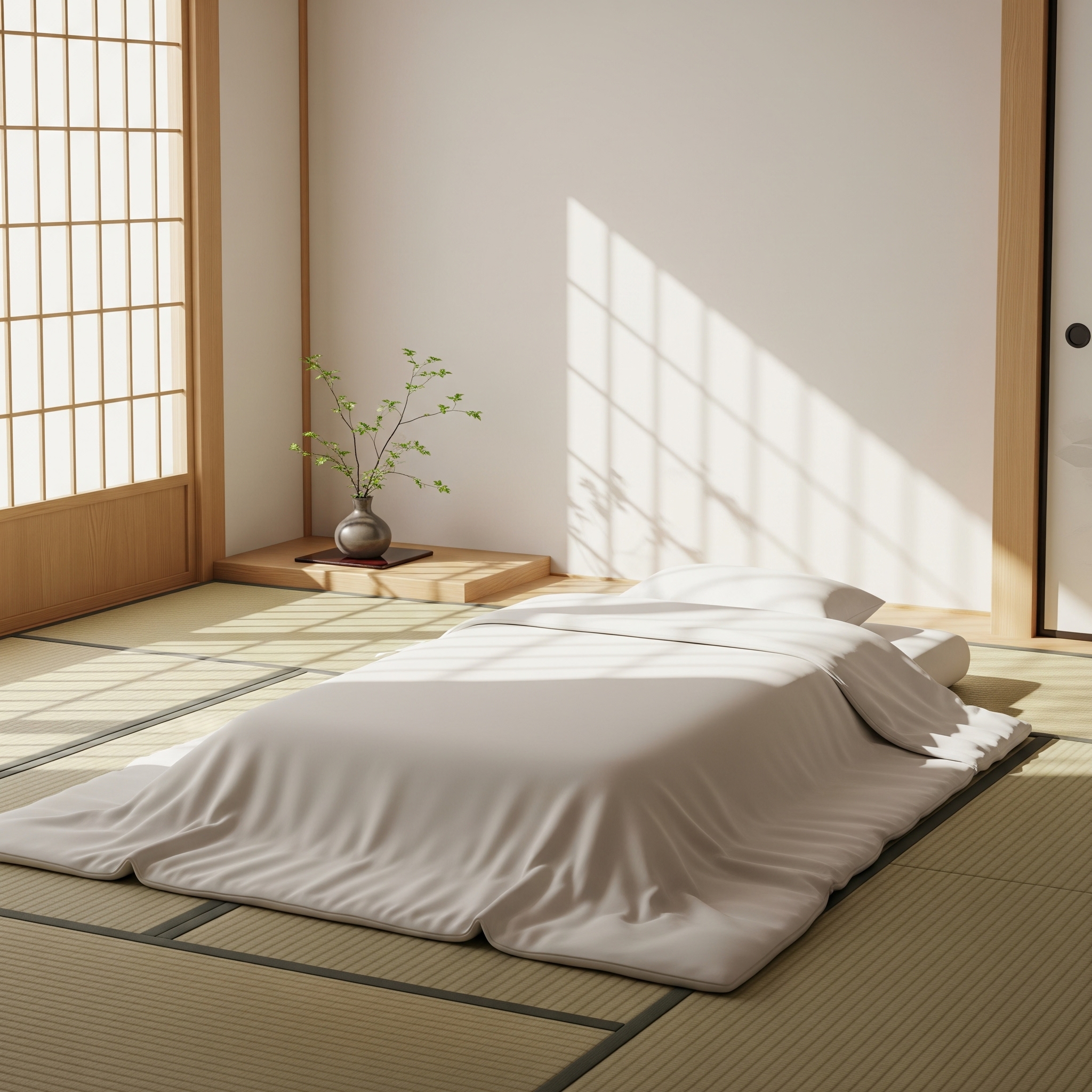
In a world where sleep disorders affect nearly a third of the population, exploring traditions from elsewhere can offer us concrete ways to improve our rest. Japanese sleep, rooted in the philosophy of minimalism and the balance of body and mind, is increasingly appealing in the West. At the heart of this approach: the futon.
If you are looking to improve the quality of your sleep, our complete guide to choosing a mattress can help you find the solution that suits your body type and needs.
Why adopt Japanese sleep?
A benefit for posture and back health
The futon offers a firm support that promotes spinal alignment. It may be suitable for people prone to lower back pain (not a medical claim). To learn more about this topic, check out our guide to mattresses for back pain .
Enhanced hygiene
Easy to roll and store, the futon allows for daily airing and prevents the accumulation of moisture and dust, creating a healthier sleep environment.
A simpler lifestyle
The futon fits into a minimalist lifestyle: a decluttered bedroom, absence of a bed frame or bulky furniture, multifunctional space. Less clutter, more serenity.
Criteria for choosing a good Japanese futon
1. Dimensions
- 1 person: 90x200 or 100x200 cm
- 2 people: 140x200 cm (traditional) or 160x200 cm (wider)
- Thickness: 5 to 15 cm depending on the desired firmness
2. Firmness and comfort
- Core made of densified cotton: very firm
- Natural latex: firm but softer, suitable for side sleepers
3. Materials
- Filling: 100% cotton or natural latex
- Cover: organic cotton, traditional Japanese fabric (washi, futon-gawa)
4. Foldability and weight
- Must be able to be rolled or folded in 3
- Lightness recommended for daily use
5. Budget
- Entry-level: from €150
- Premium models: €400 to €600 and more, handcrafted
Our recommendations for Japanese futons (2025)
1. 100% Cotton Futon – Futons.fr
- Description: futon filled with natural cotton, thickness 14 cm, very firm
- Advantages: European manufacturing, traditional sleeping
2. Natural Kipli Futon – Latex and organic cotton
- Description: core made of natural latex and organic cotton
- Advantages: firm yet soft comfort, very good compromise
3. JAP Cotton Futon 15 cm – Futon Boutique
- Description: densified cotton, thickness 15 cm, daily sleeping
- Advantages: handcrafted, good longevity
4. Memory Foam Futon – Someo
- Description: firm mattress with a memory foam core, ideal for beginners
- Advantages: gradual adaptation, good alternative for starting with a firm sleeping surface
Expert Tips
Mistakes to avoid
- Choosing a futon that is too thick if you are a beginner
- Using it on a slatted base (not recommended)
- Leaving it in place without airing it out
Maintenance tips
- Air out and flip the futon regularly
- Use a cotton fitted sheet
- Beat it with a stick or on a tatami to restore its volume
To maximize the lifespan of your bedding, also check out our tips for extending the lifespan of your mattress .
Specific profiles
- Back sleepers: ideal traditional futon
- Side sleepers: opt for a thicker or latex model
- Back sensitivity: prefer a hybrid model or one with a memory core