Sleeping well is essential for health. But for “hot” sleepers — those who sweat profusely at night — the choice of mattress becomes crucial. An unsuitable mattress can exacerbate discomfort, multiply micro-awakenings, and hinder both physical and cognitive recovery.
Why is it important to choose the right mattress when you sweat?
Sweating at night is a natural mechanism for thermal regulation. However, in cases of significant sweating, a poorly designed mattress exacerbates the situation in three main ways. First, heat retention: dense synthetic foams absorb body moisture and slowly redistribute it, creating a stifling environment. Next, bacterial proliferation: a warm and humid environment promotes the development of dust mites, mold, and bacteria, which can trigger allergic reactions and quickly degrade materials. Finally, disrupted sleep: the sensation of humidity causes repeated micro-awakenings, preventing deep sleep cycles from completing, resulting in persistent fatigue upon waking.
According to the National Institute of Sleep and Vigilance (INSV), suitable bedding significantly improves sleep quality. To understand the medical or environmental causes of night sweating, check out our article on night sweating .
Essential Criteria for a Breathable Mattress
1. Breathability and Thermoregulation
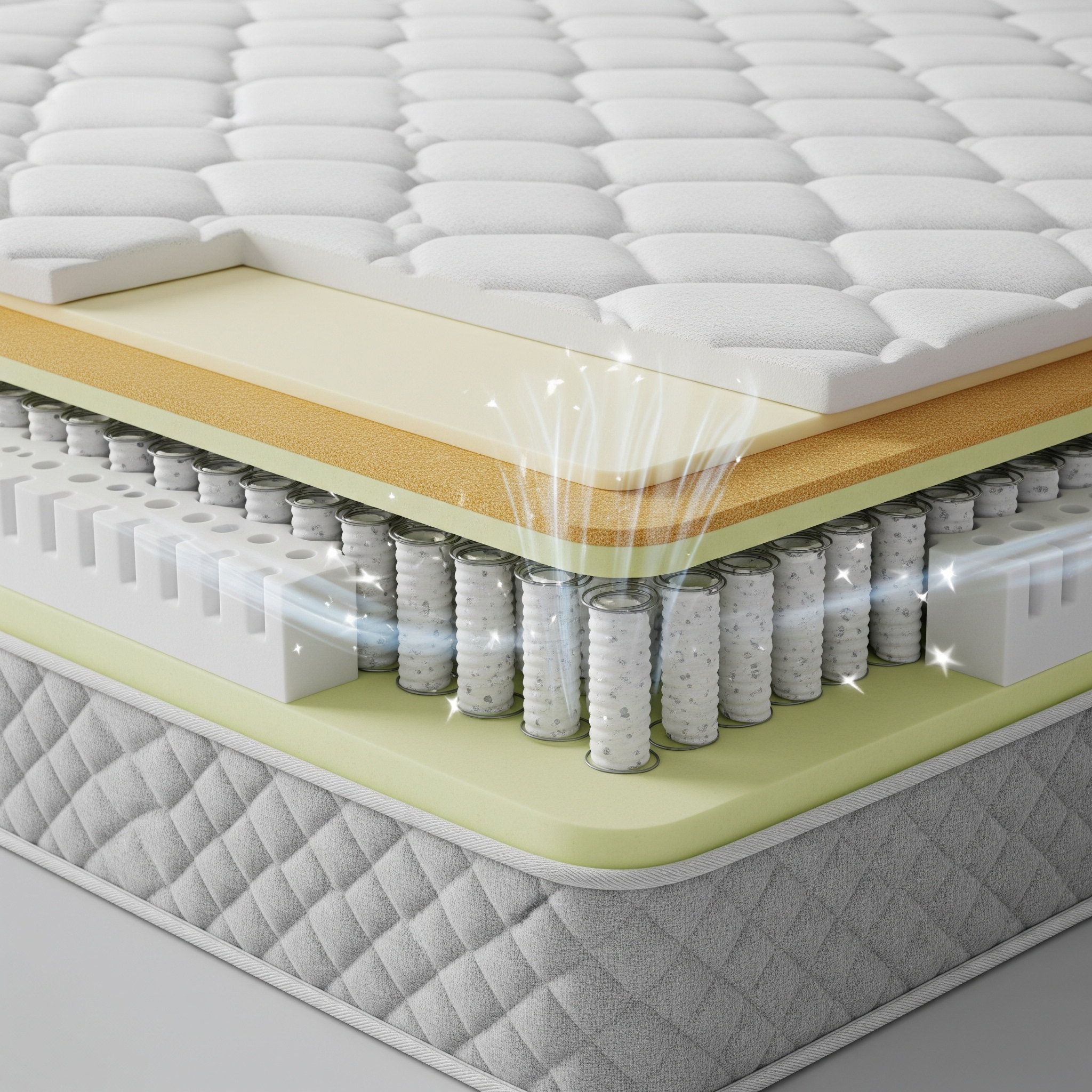
The first criterion to examine is the mattress’s ability to dissipate heat and moisture rather than retain them. Several materials meet this challenge. Perforated natural latex has ventilation channels that promote continuous air circulation. Pocket springs allow air to circulate between their coils with every movement, creating a true ventilation effect. Open-cell HR (high resilience) foam offers good breathability while providing firm support. Finally, the fabric of the cover plays a crucial role: organic cotton, Tencel (eucalyptus fiber), linen, or gel-infused fibers are significantly more breathable than polyester.
2. Mattress Technology
The technology directly influences nighttime ventilation. Pocket spring mattresses remain the most effective for air circulation due to their open structure. Natural latex has the advantage of being naturally moisture-resistant and does not absorb body heat like dense foam. Hybrid mattresses (foam layers combined with a pocket spring base) provide a good balance between enveloping comfort and ventilation, making them suitable for most hot sleepers. On the other hand, it’s better to avoid entry-level memory foam, which is the most thermally insulating material on the market.
3. Firmness and Support
A mattress that is too soft creates a “cocoon” effect where the body sinks in, reducing the surface area in contact with the air and increasing the sensation of heat. It is preferable to choose a firmness level suitable for your body type and sleeping position, neither too soft nor excessively firm. For couples, sleeping independence (each zone reacts separately to weight) limits heat transfer between the two sleepers — a point often overlooked.
4. Removable and Washable Cover
The cover is the first barrier between your body and the mattress. It must be removable and machine washable (ideally at 60 °C to eliminate dust mites) to maintain a satisfactory level of hygiene over time. Prefer Tencel or organic cotton fabrics, which absorb moisture and quickly release it outward, rather than synthetic fabrics that retain it.
5. Certifications to Look For
Several labels guarantee the absence of harmful substances and traceability of materials:
- OEKO-TEX® Standard 100: absence of hazardous chemicals in all tested components;
- GOTS / GOLS: organic certification for fibers (cotton) and latex;
- CertiPUR: quality control of polyurethane foams (VOC emissions, absence of heavy metals).
Our selection of breathable mattresses for hot sleepers
1. The Incredible Tediber Mattress
Tediber completely revamped its range in 2026 to offer a 100% hybrid line. The Incredible Mattress combines several layers of high-resilience foam with a refreshing Tencel cover, known for its moisture-wicking properties. The multilayer structure creates ventilation zones across the entire sleeping surface, making it a solid choice for hot sleepers. Starting at ~€440 depending on size, with home trial and free delivery in France.
Discover the Tediber mattress range (official site)2. Emma Original+ (Hybrid)
The Emma Original+ (formerly Hybrid II) combines an airy memory foam layer with a base of 7-zone pocket springs. The cover is washable at 40 °C, making maintenance easier for heavy sweaters. Expect to pay around ~€499 for a 140×190 cm. The brand offers a 100-night trial and a 10-year warranty, two reassuring points for an online purchase.
See the Emma Hybrid mattress on Amazon3. Slome (formerly Hypnia) Supreme Well-being
This 30 cm thick mattress combines pocket springs, latex, and foam in a particularly airy structure. Its bamboo fiber cover contributes to thermal regulation and has good moisture absorption capacity. It is particularly suitable for heavy sleepers or couples seeking high-end comfort with careful ventilation.
See the Slome Supreme Well-being mattress on Amazon4. Kipli 100% Natural Latex Mattress
The Kipli mattress is made from GOLS certified natural latex, with no synthetic foam. Natural latex is inherently moisture-resistant and does not retain body heat like conventional foams. Its perforated structure ensures effective passive air circulation. It is the reference choice for those sensitive to synthetic materials and high nighttime temperatures.
Discover the Kipli 100% natural latex mattress (official site) View on AmazonExpert Tips
Common Mistakes
Hot sleepers often make the same mistakes when purchasing. Choosing a mattress that is too soft or enveloping is the most common: a mattress that “envelops” reduces the surface area in contact with the air and traps body heat — our mattress firmness guide helps you find the right balance according to your body type. Forgetting the slatted base is also detrimental: a solid base or upholstered bed frame blocks ventilation from underneath the mattress, negating some of the product’s breathable qualities. Using polyester bed linen is another common mistake; it is better to opt for cotton, linen, or bamboo. Finally, neglecting the mattress protector is a hygiene mistake: choose a breathable one (Tencel, waterproof organic cotton with microporous membrane) — our mattress protector guide details the most suitable options for heavy sweaters.
Maintenance Tips
Proper maintenance prolongs the lifespan of the mattress and preserves its breathable properties. Air out the mattress and the room every morning for at least 20 minutes, folding the blankets rather than putting them back immediately. Wash the cover regularly — ideally every 4 to 6 weeks for heavy sweaters. If the model is reversible, flip the mattress every 3 to 6 months to distribute wear and avoid moisture buildup on one side. A washable mattress protector greatly facilitates these operations.
Specific Profiles
Needs vary according to age and body type. Teenagers in growth spurts, often heavy sweaters, benefit from choosing a firm, breathable mattress that is sufficiently adaptable to accommodate morphological changes. Seniors have specific requirements: appropriate support for joints, combined with optimal ventilation, is essential to maintain restorative sleep despite hormonal fluctuations that promote night sweats.