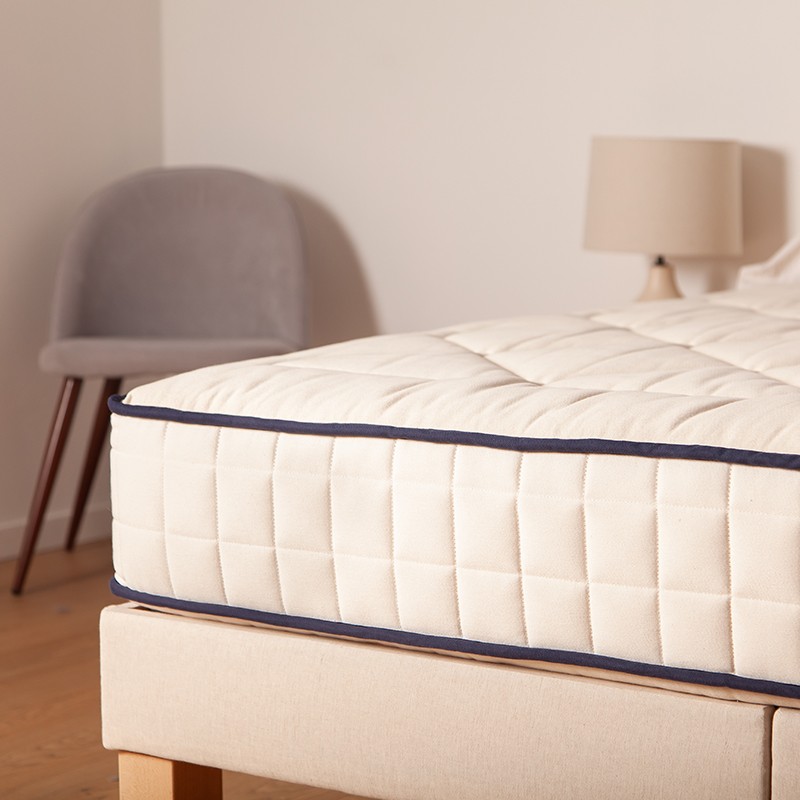
The second-hand market is booming in France. Clothing, appliances, furniture… the logic is undeniable: why pay full price when you can find the equivalent for half the price? This question inevitably arises for bedding. A memory foam or pocket spring mattress from a big brand, offered at €150 on Leboncoin when it cost €600 new — the deal seems too good to be true. But is it really a good deal? Before finalizing the payment, here’s everything you need to seriously consider.
What the second-hand market promises
The economic argument is real, and it would be dishonest to brush it aside. A mattress loses 20 to 30% of its value as soon as it leaves the store, and up to 70% after a few years of use. In theory, this allows access to high-end models for a fraction of the original price. There is also an undeniable ecological dimension: extending the life of a bulky product that is difficult to recycle means less bulky waste.
But these two arguments — economy and ecology — deserve to be weighed against the real risks, which are numerous and often underestimated.
The central problem: hygiene
This is the point that should make any buyer think. A sleeper loses an average of 40 cl of water per night, which amounts to over 1,400 liters in 10 years, promoting the proliferation of dust mites and bacteria. This moisture gradually seeps into the layers of foam, latex, or between the springs, and no surface cleaning can eliminate it entirely.
Beds are real dust nests, and the risks include dust mites, bed bugs, and microbes. This is not a marketing formula: dust mites feed on dead human skin cells, millions of which settle in the mattress each night. A new mattress already contains them after a few months of use. A mattress that is several years old contains millions.
The threat of bed bugs
The second-hand market is one of the main vectors for introducing bed bugs into a home. A second-hand mattress constitutes a particularly risky potential entry point. These insects are experts at hiding: they settle in seams, hems, and any possible tears in the fabric cover. Bed bugs hide and are not visible to the naked eye. An infestation, once established, costs several hundred euros to treat and may require professional intervention. The savings made on the purchase of a second-hand mattress can disappear entirely — and beyond.
The remaining lifespan: a major unknown
A mattress has a lifespan of about 10 years, or nearly 30,000 hours of use. It is advisable to replace it around the 8 to 10-year mark, or even 12 years for well-maintained quality models. When you buy a second-hand mattress, you generally do not know the actual age of the product — the seller often has lost the receipt — nor the conditions under which it was used (weight, number of people, used with or without protection).
If a mattress retains the shape of the body upon rising or tends to sag, it no longer provides effective support. These deformations are sometimes invisible in low-resolution photos posted in an ad. A mattress that seems fine when lying flat can reveal its dips as soon as the first night of sleep. Marked indentations or visible sagging, back pain upon waking, or a reduced feeling of firmness are all signals indicating that action is needed.
In short: you are buying a remaining lifespan that you cannot estimate, on a product whose internal condition is invisible to the naked eye.
The warranty: zero
Every new mattress sold by a reputable retailer is covered by a manufacturer’s warranty — often 5 years, sometimes 10 years depending on the brands — as well as the two-year legal warranty of conformity imposed by European law. If the mattress sags abnormally or has a defect, you have recourse.
With a second-hand mattress purchased from an individual, there is no warranty, no legal recourse in case of a problem, and no quality standards to be met by the seller. The mattress is sold as-is. If it turns out that the springs are broken or the foam has collapsed under the cover, you have no leverage.
View on AmazonSituations where second-hand may (possibly) be justified
It would be excessive to say that buying a second-hand mattress is always a mistake. A few rare situations deserve nuance.
A little-used mattress, almost new, from a friend. If you personally know the seller, the mattress has been used in a guest room for barely two years, and you can inspect it in person, the risk is considerably reduced. Trust in the source changes everything in the hygiene equation.
A purchase with an immediate new mattress protector and anti-dust mite treatment. If you still opt for a second-hand mattress, investing in a new waterproof and hypoallergenic mattress protector, as well as a professional anti-dust mite treatment, is essential. This represents an additional cost to factor into the overall calculation.
For occasional and temporary use. A temporary room during a housing transition, a spare mattress for a few weeks — in these specific cases, the long-term stakes are limited. But even in this scenario, vigilance regarding bed bugs remains crucial.
The real calculation: accessible new vs. risky second-hand
Many people considering a second-hand mattress do so because they think they cannot afford to buy new. This is often a false belief. The entry-level new mattress market is now very competitive: you can find decent models, with warranty and delivery, at prices that rival what second-hand offers once you factor in transportation costs (renting a van to pick up a mattress), time spent, and the risk of unpleasant surprises.
You should also consider home trial offers, now standard with most online brands: 100 days or more to test the mattress at home, with full return and refund if the product does not suit. This type of guarantee obviously does not exist in the second-hand market.
See new mattresses available on Amazon.frHow to inspect a second-hand mattress if you are decided
If after weighing all these elements you still wish to buy second-hand, here are the essential inspection points to physically check on-site before any payment.
Examine the cover from all angles. Look for small black spots (bed bug droppings), signs of mold, yellowish stains (sweat infiltration), or discolored areas. Turn the mattress over and inspect the back.
Lie down on it. This is essential. Check that it does not sag under your weight, that it does not creak, and that the support is evenly distributed across the entire surface. A softer area on one side indicates deformation of the foam or damaged springs.
Ask for proof of purchase. This allows you to know the actual age of the mattress and the exact model. Without it, you are buying a total unknown.
Smell the mattress. A persistent odor of dampness, mold, or even antiseptic should raise immediate alarms.
Avoid mattresses retrieved from outside or abandoned. Picking up an abandoned mattress poses a maximum risk in terms of possible infestation.
For everything related to choosing a new mattress suitable for your body type and sleeping position, consult our complete guide to choosing your mattress .
Our verdict
Buying a second-hand mattress is rarely a good idea, and almost never the good financial calculation it seems at first glance. The hygienic risks — dust mites, bacteria, bed bugs — are real and potentially costly to correct. The remaining lifespan is impossible to seriously evaluate without the complete history of the product. And the total absence of warranty exposes the buyer to a total loss in case of a problem.
Reserving second-hand for furniture, textiles, or electronics remains an excellent ecological and economic approach. But for the mattress, a product on which you spend a third of your life and which directly affects the quality of your sleep and the health of your back, new and guaranteed remains the most reasonable choice — even in the entry-level range.
Does buying a second-hand mattress really pose health risks?
Yes, and they should be taken seriously. A sleeper loses an average of 40 cl of water per night, promoting the proliferation of dust mites and bacteria in the internal layers of the mattress. These microorganisms gradually accumulate in the foam or between the springs, and no surface cleaning — even with a disinfectant — can eliminate them deeply. For people allergic to dust mites or suffering from asthma, sleeping on a second-hand mattress laden with these allergens can significantly worsen their symptoms. Additionally, there is the risk of bed bugs, whose detection is difficult as they hide in seams and folds. A confirmed infestation requires professional intervention that can cost several hundred euros, completely erasing the savings made on the purchase.
At what age is a second-hand mattress really too old?
A mattress has a lifespan of about 10 years, or nearly 30,000 hours of use. In practice, a second-hand mattress over 5 years old should be approached with great caution, even if it appears satisfactory on the surface. Internal deformations of the foam or sagging springs are not always visible to the naked eye but can be felt from the first nights. It is advisable to replace your mattress around 8 to 10 years, or even 12 years for very good quality models that are well maintained. If you buy a second-hand mattress that is 6 or 7 years old, you are potentially buying a product at the end of its life, with 2 to 3 years of proper use at best — a very short duration to amortize even a second-hand price, not to mention the absence of warranty.
Can a second-hand mattress be disinfected to make it safe?
Partially, but not completely. A professional anti-dust mite treatment can reduce the allergenic load on the surface and in the upper part of the mattress. A new waterproof and hypoallergenic mattress protector, applied immediately, creates an effective barrier against new allergens. However, bacteria and fungi embedded deep in the foam layers remain inaccessible to any home treatment. As for bed bugs, their elimination from an already infested mattress is nearly impossible without professional thermal (high temperature) or intensive chemical treatment — interventions that cost more than most second-hand mattresses. In summary: serious disinfection improves the situation but never guarantees a return to a sanitary state comparable to that of a new mattress.
What physical signs indicate that a second-hand mattress is too worn?
If a mattress retains the shape of the body upon rising or tends to sag, it no longer provides effective support. Marked indentations, visible sagging, creaking (for a spring model), or reduced firmness are all warning signals. During the inspection, lie down on the entire surface and change positions to check the uniformity of support. Turn the mattress over to inspect the back: deformations are often more visible there. Yellowish stains betray significant sweat infiltration. Small black dots along the edges or seams are a classic signal of bed bug presence.
What does the warranty of a new mattress cover that is not found with second-hand?
A new mattress purchased from a professional retailer benefits from two levels of protection. The legal warranty of conformity, imposed by European regulations, covers any defect that existed at the time of delivery for two years. The manufacturer’s commercial warranty, often 5 to 10 years depending on the brands and models, covers manufacturing defects and abnormal sagging of the foam or springs beyond a defined threshold. With a second-hand mattress purchased from an individual, none of these protections exist. The sale is considered concluded as-is, which means that if the mattress reveals a defect the day after delivery, you have no legal recourse against the seller. Peer-to-peer selling platforms like Leboncoin or Vinted offer no warranty on this type of product.
What alternatives exist for buying a new mattress on a budget?
The online mattress market now offers accessible entry-level options, with free delivery and home trials of several weeks, for budgets that can be close to what a second-hand mattress actually costs once all expenses are included (transport, mattress protector, anti-dust mite treatment). Sale periods, flash sales, and clearance offers also allow access to mid-range models at attractive prices. It is also possible to monitor end-of-collection sales from direct online brands, which sometimes discount older models with warranty and possible returns — a much safer option than second-hand between individuals.
Are there situations where a second-hand mattress is acceptable?
Yes, but they remain rare and very specific. The most favorable situation is when you personally know the seller, can verify the actual age of the mattress (ideally less than 3 years), the product is visually impeccable, and it has been used in a little-used guest room. In this specific case, the hygienic risk is much lower. Outside of this trust scenario, buying second-hand for temporary use of a few weeks can also be justified, provided you invest immediately in a new waterproof mattress protector. However, for a mattress intended for daily use over several years, new is almost always the most reasonable decision.