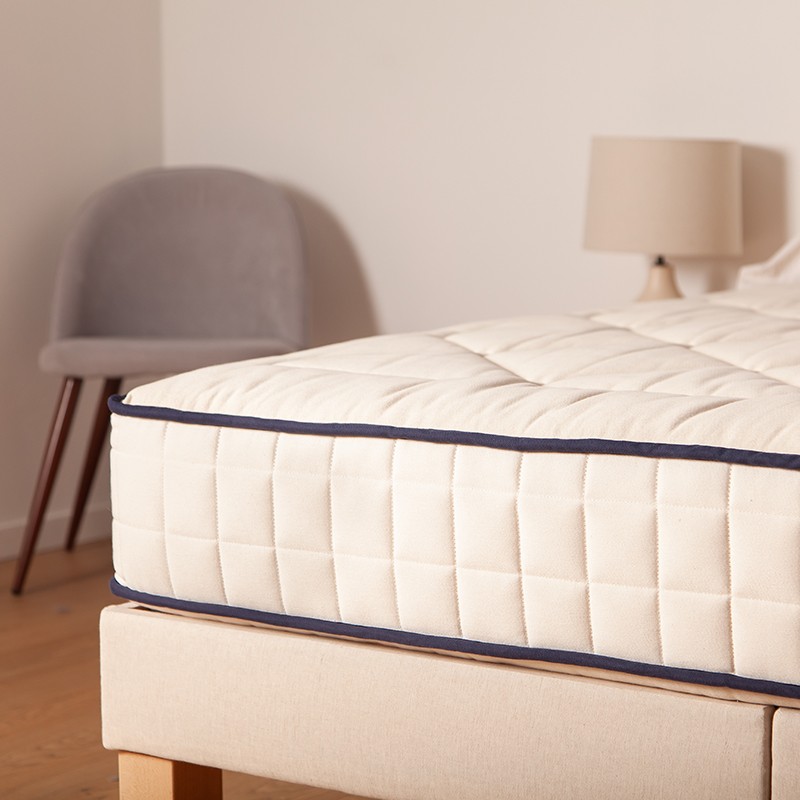
A bunk bed undeniably frees up space. But sliding any mattress into the top bunk is the most common — and riskiest — mistake. Too thick, and the safety barrier no longer protects anything. Too heavy, and the structure vibrates with every turn. Too soft, and a growing child’s spine is not properly supported. This guide reviews the real constraints, with verified figures, so you can choose with peace of mind.
The golden rule: thickness is not a comfort choice
On a standard bed, you can indulge in a 25 cm mattress. On a bunk bed, the top sleeping area follows an opposite logic: it is the height of the safety barrier that sets the ceiling.
The European standard EN 747 (transposed in France under the reference NF EN 747) requires that the protective barrier exceeds the top of the mattress by at least 16 cm. In practical terms, if the guardrails of your bunk bed are 26 cm high (a common height for entry-level models), the mattress must not exceed 10 cm. With a 30 cm barrier, you can go up to 14 cm — and not much more.
In practice, a thickness between 12 and 15 cm is recommended for the upper sleeping area, provided that the barriers of your bed are sufficiently high. Beyond 15 cm, the risk of falling increases significantly, regardless of the mattress quality.
For the lower bunk, the constraint disappears: the mattress of the lower bed benefits from greater flexibility, and models up to 18 cm remain perfectly suitable. Some parents even opt for a standard 20 cm mattress, without safety issues.
See bunk bed mattresses on Amazon.frMeasure before buying: the two-step procedure
Before consulting any product sheet, take out a tape measure. Two measurements are sufficient.
First measurement: the interior height of the safety barrier, from the bottom of the bed base to the top of the guardrail. This is the total height available for the mattress and the safety margin.
Second measurement: subtract 16 cm (the minimum regulatory margin). The result is the maximum allowed thickness for your mattress.
Concrete example: barrier at 28 cm → maximum mattress of 12 cm. If the bed has not yet been purchased, prefer a model with barriers measuring at least 30 cm: you will have more latitude in choosing the mattress and a more comfortable level of protection.
A useful note: the EN 747 standard also imposes a maximum gap of 7 cm between the bars to avoid any risk of trapping a head or limb. This is not a constraint related to the mattress, but check it at the same time.
The weight of the mattress: often overlooked, rarely trivial
A 15 cm natural latex mattress measuring 90 × 200 cm can easily weigh between 18 and 25 kg. It’s heavy to lift to the top bunk during installation, and even more so when making the bed or flipping the mattress every two months.
On a bunk bed, HR foam (high resilience) remains the most practical choice for the upper sleeping area, as it is significantly lighter than latex while providing adequate support. An HR foam mattress of 12 cm for a 90 × 200 cm typically weighs between 8 and 14 kg, depending on density, which remains manageable.
Latex, on the other hand, will be reserved for the lower sleeping area if you value its durability and natural hygiene qualities. The lower bunk is accessible, and flipping it is not an issue.
Thin pocket spring mattresses (between 12 and 15 cm) also exist and offer a good weight/breathability ratio, but ensure that the height is compatible with the barrier first.
Density and firmness according to the user’s age
Thickness is constrained, but density differentiates good mattresses from bad ones.
For a child or teenager, a density between 25 and 35 kg/m³ is recommended for HR foam. Below 25 kg/m³, the mattress quickly sinks under the weight of a growing child, and it will need to be replaced after two or three years. That’s a false economy.
For an adult using the top bunk (in a shared room, a studio, or a guest room), the minimum acceptable threshold is 30 kg/m³, with a strong recommendation at 35 kg/m³ to ensure durability over time.
Regarding firmness: on a bunk bed, a firm to medium-firm level is generally advised for the upper sleeping area. The reason is simple: a mattress that is too soft allows the body to sink in more, which practically reduces the effective height of protection of the barrier and is not suitable for a growing child’s back.
View on AmazonLatex, foam, or springs: what to choose based on the bunk?
Here’s how to reason according to the position in the bunk bed:
Top bunk: child (6-14 years): an HR foam mattress of 12 to 14 cm, density 28 to 32 kg/m³, firm. Simple, lightweight, easy to air out. Reasonable lifespan between 7 and 10 years depending on quality.
Top bunk: adult: same thickness constraints, but density at a minimum of 35 kg/m³. An HR foam or thin pocket spring mattress (check thickness/barrier compatibility) will be suitable. Memory foam should be avoided: it heats up, is heavy, and its viscoelastic behavior is not well-suited for children.
Bottom bunk: child or adult: here, you have a choice. A natural latex mattress of 14 to 18 cm, a thicker HR foam, or a hybrid spring/foam model: all are viable. You can get close to the comfort of a standard mattress.
One often overlooked point: breathability. A child sweats more than an adult, and a poorly ventilated mattress promotes humidity, dust mites, and unpleasant odors. Natural latex and open-cell foams (perforated on the surface) are much more breathable than classic compact foams.
Search for breathable children's mattresses on Amazon.frDimensions to know
Bunk beds in France are most often sold for sleeping areas of 90 × 190 cm or 90 × 200 cm. Some junior models accept 70 × 140 cm or 80 × 200 cm. Always check the interior dimensions of the frame, not the external dimensions advertised by the manufacturer: a 2 cm discrepancy can make installation impossible or, worse, create a dangerous gap on the sides.
The safety rule regarding lateral spaces aligns with that regarding barriers: the EN 747 standard also regulates spacing to avoid any risk of trapping. A mattress that is too small that slips in its frame is just as dangerous as a mattress that is too thick.
Certifications to check
For a mattress intended for a child, two labels deserve your attention:
OEKO-TEX® Standard 100: guarantees the absence of harmful substances in every component of the mattress (foam, cover fabric, glue). This is the minimum to require for children’s bedding.
CertiPUR®: specific to polyurethane and memory foams, this label certifies the absence of heavy metals, formaldehyde, and PBDE (problematic flame retardants). Useful for comparing foam mattresses.
Certified natural latex GOLS (Global Organic Latex Standard) goes even further: it guarantees the organic origin of the latex. This is a relevant choice if you prioritize natural materials for the lower bunk, where thickness is not constrained.
To further your overall choice, our mattress selection guide details these criteria for all types of bedding.
What we strongly advise against
A few situations to avoid, stemming from the most common mistakes:
- Reusing an old mattress that is too thick thinking “it will fit.” If the barrier does not exceed 16 cm, the risk is real, even for a calm child.
- Buying a memory foam mattress for the top bunk: too heavy, too hot, and its behavior (the body sinks in more slowly) amplifies the effective height problem.
- Neglecting the cover: a washable dust mite cover at 60 °C is an investment of €20 to €40 that makes a real difference over 8 years of use.
- Forgetting to flip the mattress regularly. On a bunk bed, it’s more cumbersome, but a mattress that is not flipped sinks in much faster.
FAQ
What is the maximum thickness for the mattress on the top bunk?
The answer directly depends on the height of the safety barriers of your bed. The NF EN 747 standard requires that the barrier exceeds the top of the mattress by at least 16 cm. Measure the interior height of the guardrails from the bottom of the bed base, subtract 16 cm: you get the maximum allowed thickness.
In practice, with barriers of 26 cm (entry-level), you are limited to 10 cm. With barriers of 30 cm (more common on mid-range models), you can go up to 14 cm. For the upper sleeping area, a mattress with a maximum thickness of 13 to 15 cm ensures optimal protection thanks to the safety barriers, provided your bed allows it. If you haven’t purchased the bed yet, choose a model with high barriers: you will have more leeway.
Can you put a spring mattress in a bunk bed?
Yes, but with two conditions. First, the total thickness of the mattress (springs + comfort layers) must remain compatible with the height of the safety barrier. However, pocket spring mattresses often have a base thickness of at least 18 to 20 cm, which frequently exceeds what the barriers allow for the top bunk. There are thin models (12 to 14 cm), but they are less common.
Next, the weight: a spring mattress is generally heavier than an HR foam of the same thickness. On the top bunk, every extra centimeter and every extra kilogram complicates installation and flipping. For the bottom bunk, no objections: a spring/foam hybrid or a classic spring model works very well.
What foam density do you recommend for an 8-year-old child?
For a child or teenager, a density between 25 and 35 kg/m³ is recommended. For an 8-year-old child weighing around 25 to 30 kg, a foam density of 28 kg/m³ offers a good compromise between firmness, back support, and durability. Below 25 kg/m³, the mattress will sag in two to three years: you will need to replace it well before the end of the bunk bed’s use.
Firmness is as important as density: favor a firm to medium-firm level. A mattress that is too soft does not properly support the growing spine and, as mentioned earlier, allows the body to sink in more, which practically reduces the protective guard of the barrier.
At what age can a child sleep in the top bunk?
The EN 747 standard and most manufacturers recommend a minimum age of 6 years for the upper bunk. Below that, the risk of falling is too high, even with compliant barriers: a younger child may attempt to climb or pass between the bars. Some manufacturers even indicate 9 years on their notices, for an additional safety margin. Beyond the legal age, the key is to ensure that the child understands the rules: do not jump on the bed, use the ladder every time they go down, do not sit abruptly against the barrier.
Is a bed base required under the mattress of a bunk bed?
In general, no. Bunk beds are designed with a slatted bed base or an integrated platform that serves as a rigid base. Adding a traditional bed base would increase the total height and make the top mattress incompatible with the safety barriers. If a slatted bed base is present, check that the spacing between the slats does not exceed 6 to 8 cm for a foam mattress (otherwise, it sags between the slats) and no more than 3 cm for a natural latex mattress, which is more sensitive to lack of support. A spring mattress, being more rigid, tolerates slightly wider spacing.