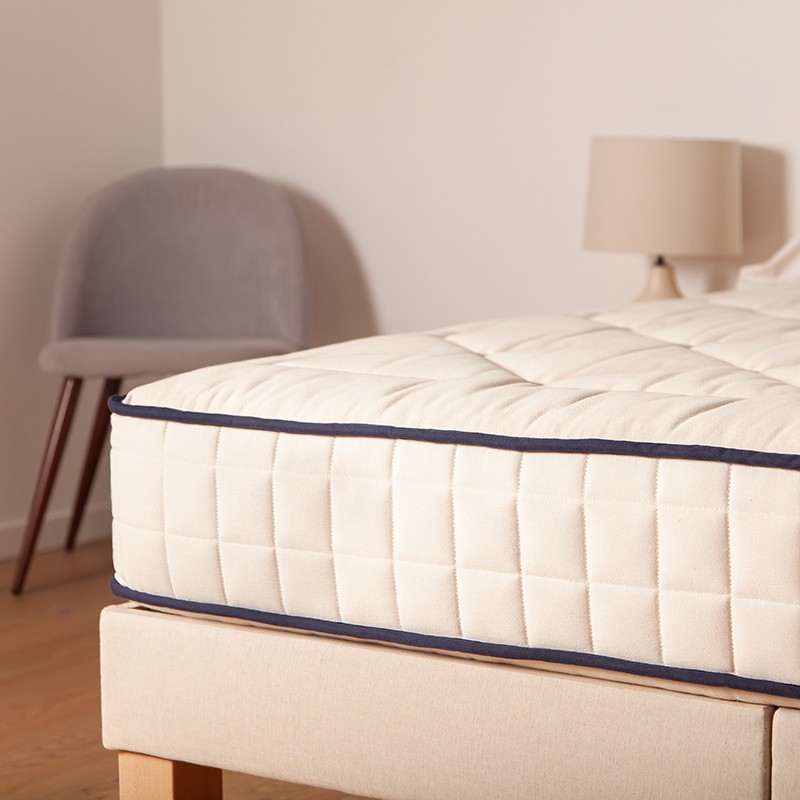
A friend drops by for the weekend, your parents stay over after the holidays, your child wants to invite a friend at the last minute: the air mattress is one of those items that we underestimate until the day we really need it. The problem is — the market is full of models ranging from simple inflatable sleeping pads for a few dozen euros to artisanal organic cotton futons costing several hundred. Choosing the wrong one can mean an uncomfortable night for your guest, unnecessary clutter in your closet, or worse, a mattress that deflates at 3 a.m.
This comprehensive guide helps you sort through the three main families of air mattresses, identify the determining criteria, and find the solution suited to your actual use — whether for an occasional guest room, child use, or camping.
The three families of temporary mattresses
1. The inflatable mattress
This is the most common solution. Compact, lightweight, and easy to store in a cover, the inflatable mattress is perfect for occasional sleeping arrangements: a few nights a year, a surprise guest, or a camping trip. Models typically include a built-in or external electric pump, and some high-end versions feature a flocked non-slip surface and a multi-chamber air structure to prevent the “barrel roll” effect.
Points of caution: durability remains the Achilles’ heel of inflatable mattresses. A poorly positioned valve, repeated friction with the ground, or a sharp object, and the mattress is out of service. For intensive use — that is, more than a few nights per month — other solutions are necessary. Thickness usually ranges from 20 to 50 cm: beyond 30 cm, it approaches a real raised bed, much more comfortable for getting up at night. You should also allow for inflation time (5 to 15 minutes depending on the models) and a dry storage space to avoid mold.
2. The foldable foam mattress
More robust and often more comfortable than the inflatable, the foldable mattress is made of one or two layers of polyurethane foam — or even memory foam in premium versions. It typically has a thickness between 5 and 15 cm, folds in two or three parts, and can be stored in a transport bag. It is an excellent option for regular temporary sleeping arrangements: a child sleeping at grandparents’ every week, a guest room without a real fixed bed, or a convertible playroom.
The most advanced models feature a removable and machine-washable cover, which is a real advantage for guests staying several days. Children’s versions (approximately 60 × 120 cm or 70 × 140 cm) are particularly practical: compact, lightweight, and often offered with colorful covers. For adult use, it is advisable to choose a thickness of at least 10 cm to ensure sufficient support throughout the night.
3. The temporary futon
The temporary futon, or travel futon, is a lightweight version of the traditional Japanese futon. Made of cotton, it offers breathability and flexibility, is easily rollable, and can be stored in a provided bag. Some models include a linen and cotton cover for a more natural look. Unlike a standard futon (8 to 15 cm thick for daily use), the temporary futon is designed to be as light and compact as possible — generally around 5 to 8 cm thick.
It particularly appeals to those sensitive to synthetic materials, fans of natural decor, and those seeking a durable product rather than a disposable accessory. In return, it requires more careful maintenance (regular drying to avoid moisture) and its comfort is firmer than that of a foam or inflatable mattress — which suits some sleepers perfectly, but not all.
Discover 100% cotton handmade travel futons at Futon BoutiqueThe chair bed, the alternative that also serves as a seat
Alongside these three families, the chair bed deserves a special mention: it is not strictly a temporary mattress, but a small piece of furniture that unfolds into a bed. The principle is clever — a low armchair by day, a one to two-person mattress by night. The most common version rests on a block of accordion-folded foam covered with a removable cover, available in widths ranging from a child’s single (60 to 70 cm) to an adult double (120 to 140 cm). Unlike the inflatable or rolled futon, it is always “ready to use” and naturally fits into a child’s room, a studio, or a living area.
For whom? The chair bed appeals to those who lack space but do not want to pull out and store a bed each time a visitor comes: it lives in the room permanently. In return, its sleeping comfort remains that of a temporary foam — adequate for a few nights, rarely matching that of a real mattress for prolonged use — and its unfolded thickness (often 8 to 12 cm) makes it more suitable for a light sleeper or a child. Again, check that the cover is machine washable and, for a child’s room, the presence of an OEKO-TEX® Standard 100 certification.
Essential Criteria for Choosing Well
Frequency and Duration of Use
This is the first filter to apply. If you only take this mattress out two or three times a year for a night or two, a quality inflatable will suffice. If you regularly host guests (once a month or more), invest in a thick foam folding mattress or a futon: the comfort and durability will be significantly better. For near-daily use — such as for a child in shared custody — consult our complete buying guide on choosing a mattress to consider a full mattress rather than just a temporary solution.
Thickness and Density of the Foam
For foam folding mattresses, thickness is an indicator of comfort, but density (expressed in kg/m³) is equally important. A foam that is too light collapses quickly and loses its support after the first uses. Without access to the technical sheet, be wary of very cheap models that seem thick but compress under the slightest pressure: quality foam resists compression and returns to its shape after use. For an adult, a minimum thickness of 10 cm is recommended; for a child, 7 cm may suffice depending on their weight.
Dimensions
An adult needs a mattress that is at least 190 cm long and 80 cm wide for comfortable sleep. For two people, a 140 × 190 cm or 160 × 200 cm mattress is necessary. For children, sizes from 60 × 120 cm to 90 × 190 cm cover most needs based on age. Always check the dimensions of the room where you will deploy the mattress: a mattress that is too large in a hallway or alcove may become unusable.
Portability and Storage
For camping or travel, weight and storage volume are crucial. A travel futon measuring 90 × 200 cm can weigh around 10 to 12 kg and is transported in a provided bag; an inflatable of the same size, once deflated, weighs only a few kilograms and fits in a backpack. Also consider the storage space available at home: a 60 cm deep closet easily accommodates an inflatable or a rolled futon but may be just right for a mattress folded into three parts.
Material Certifications
For bedding in direct contact with the skin — especially for children — check for the presence of the OEKO-TEX® Standard 100 certification, which guarantees the absence of harmful substances in textiles and foams. For cotton or organic cotton futons, some manufacturers indicate French or European production. This information should be clearly stated on the product sheet; in its absence, remain cautious.
Explore the selection of inflatable guest mattresses on Amazon.frWhich Air Mattress for Which Profile?
You rarely host, are short on space, and have a tight budget: an inflatable mattress with a built-in pump is your best option. Choose a raised model (30 cm or more) to facilitate getting in and out of bed.
You have regular guests and want real comfort: a high-density foldable foam mattress (10 to 15 cm) with a removable washable cover is clearly superior. It lasts much longer and requires no inflation.
You are looking for a sleeping arrangement for a child: children’s foldable mattresses (foam, size 60 × 120 or 70 × 140 cm) are ideal. Ensure they have a removable anti-dust mite cover. For small toddlers, refer to current safety standards.
You love natural materials and are willing to accept more careful maintenance: the cotton travel futon is an excellent durable and healthy alternative. It suits sleepers who prefer a firm sleeping surface and those sensitive to synthetic materials.
You are going camping or van life: prioritize lightness and compactness. An auto-inflating mattress or a lightweight travel futon (size 70 × 190 cm) will do the trick.
View on AmazonWhat to Avoid
Some classic mistakes to avoid when buying an air mattress:
- Choosing solely based on price: an inflatable mattress under 20 euros will often be uncomfortable and won’t survive a few uses. A slightly higher investment guarantees a product that lasts and that your guests will truly appreciate.
- Neglecting thickness: a 5 cm soft foam mattress on a hard floor may work for a light child but will leave an adult with aches the next morning. The minimum recommended thickness for an adult is 10 cm.
- Forgetting the cover: an air mattress without a removable and washable cover quickly becomes unhygienic. This is a non-negotiable criterion, especially if the mattress is used by several different people.
- Underestimating weight: if you need to carry the mattress upstairs or transport it by car, a 12 kg futon without handles can quickly become problematic.
FAQ — Air Mattress
What is the minimum thickness for comfortable sleeping on an air mattress?
For an average-sized adult, a thickness of 10 cm of dense polyurethane foam is the minimum recommended. Below that, the sleeper risks feeling the hardness of the ground through the mattress, particularly at the hips and shoulders — the two most important pressure points in a side position. For a heavier sleeper (over 90 kg), 12 to 15 cm is preferable. For a child under 10 years old, 7 cm may suffice, provided the foam is of good density. On an inflatable mattress, thickness is less crucial than adjustable firmness: a mattress inflated to the right pressure and at least 25-30 cm high offers comfort comparable to a regular bed for one or two nights.
Can a foldable air mattress be used every day?
An air mattress is not designed for long-term daily use. Its foam, less dense than that of a standard mattress, collapses more quickly under repeated use. Similarly, a thin guest futon (5-8 cm) does not provide sufficient lumbar support for daily use by an adult. If you need a sleeping arrangement every day — whether in the context of shared custody, a studio, or a convertible space — it’s better to opt for a proper mattress suited to your body type. However, for a few nights a week or intense occasional use (holiday seasons, parties), a thick foldable foam mattress with quality cover can last several years without issue.
How to maintain an inflatable mattress so it lasts?
Maintaining an inflatable mattress involves a few simple but important rules. After each use, completely deflate it and let it air dry before storing — residual moisture is the main cause of mold and unpleasant odors. Store it in its protective cover, in a dry and temperate place, away from heat sources (radiator, direct sunlight) that can weaken the PVC. Avoid placing it on a floor with rough surfaces, wood chips, or any potentially sharp objects. Clean the surface with a slightly damp cloth and a mild product — never use solvents. With these precautions, a decent quality inflatable mattress can last 5 to 10 years with occasional use.
Is a travel futon suitable for camping?
Yes, under certain conditions. A lightweight travel futon (size 70 × 190 cm, about 6 to 9 kg) is easily transportable and can advantageously replace an inflatable mattress during car or van camping, where weight is less of a constraint than in hiking. Its comfort is superior to most synthetic camping mattresses, and natural cotton breathes better in warm weather. However, for tent camping where every gram counts, a lightweight inflatable or self-inflating mattress remains more suitable. Note that the cotton futon absorbs moisture: remember to air it out and dry it regularly if you are camping in humid weather.
Is a base needed under an air mattress?
No. Air mattresses — whether inflatable, foldable foam, or travel futons — are designed to be used directly on the ground. This is even one of their main advantages: no additional accessories are needed. Just ensure that the floor is clean, dry, and free of foreign objects that could puncture an inflatable or damage a cover. If the floor is particularly cold or hard (tile in winter), a rug or carpet can significantly improve the thermal and acoustic comfort of the sleeping arrangement.