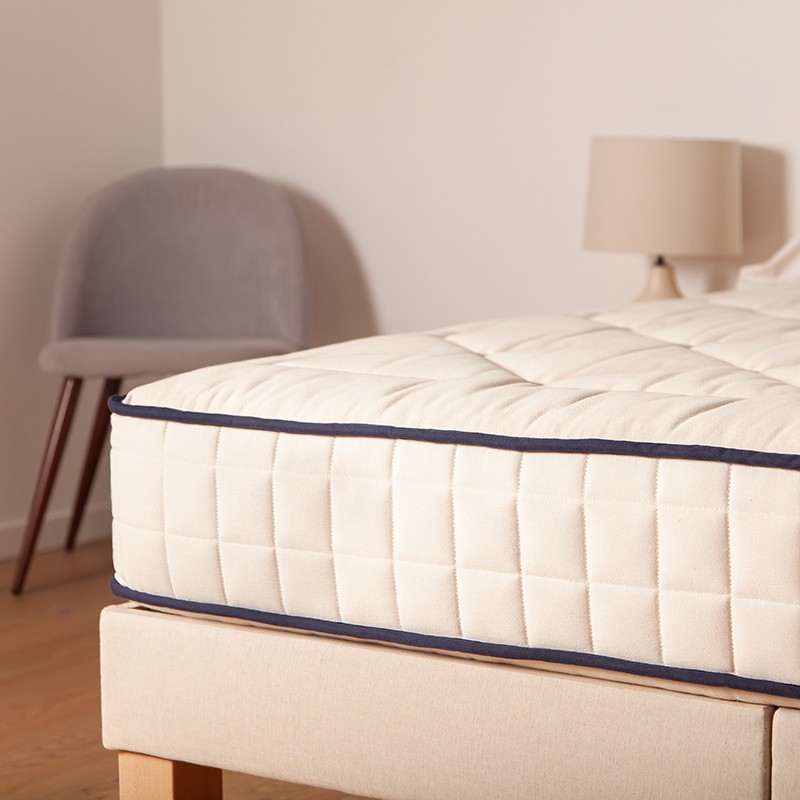
The BZ sofa is often seen as a compromise between living room furniture and a sleeping solution. However, with the right mattress, it can offer quite respectable comfort, even for daily use. The problem is that choosing a mattress for a BZ is not trivial: the mechanical constraints of this type of structure impose specific criteria for thickness and flexibility that most traditional mattresses do not meet. This guide explains everything you need to know before buying in 2026.
BZ vs clic-clac: two structures, two mattress logics
Before looking for a mattress, it is essential to understand the difference between a BZ and a clic-clac, as the two mechanisms impose different constraints.
The clic-clac works by tilting: the backrest lowers and complements the seat to form a sleeping surface. The mattress (often in three parts) must be able to articulate and flatten quickly. The BZ mattress, on the other hand, does not fold: it slides. It is laid flat on the structure, perpendicular to the wall, allowing it to be thicker and more comfortable than a clic-clac mattress. This forward sliding frees the structure and transforms the sofa into a bed.
This difference is fundamental: a thickness of 12 to 14 cm offers good sleeping comfort for adults on a BZ. Below 9 cm, the mattress is only suitable for occasional use or for children.
The BZ mechanism is also quieter, more stable once unfolded, and generally allows for a wider sleeping surface than the equivalent clic-clac. That’s why many people living in small spaces choose a BZ sofa as their main bed — making the choice of mattress even more important.
Thickness: the number one criterion
Below 12 cm, sleeping comfort significantly deteriorates, particularly for sleepers of normal build. Beyond 16 cm, folding mechanisms may encounter difficulties in closing. The ideal range is therefore between 12 and 16 cm, with a target around 13 to 14 cm for the vast majority of users.
The mechanical constraints of BZs impose a specific thickness between 12 and 16 cm maximum. Beyond this limit, the closing mechanism becomes difficult or even impossible to operate.
Here’s how to calibrate your choice according to actual use:
- Occasional sleeping (guests a few times a year): 10 to 12 cm is sufficient, provided you maintain good foam density to avoid rapid sagging.
- Regular sleeping (2 to 3 nights per week): aim for 12 to 14 cm with intermediate quality material.
- Daily sleeping (the BZ is your main bed): for daily use, it is recommended to choose a BZ mattress of at least 15 cm thick, with a density greater than 38 kg/m³.
A practical tip: measure the available space between the floor and the base of your BZ structure before placing any order. Some older models have height constraints that limit to a maximum of 10 or 12 cm.
View on AmazonFoam density: the durability indicator
Thickness is not everything. A thick mattress but low in density will sag quickly and lose all quality of support within a few months. Density — expressed in kg/m³ — is the key indicator of the durability and quality of support of foam.
Here are the benchmarks to remember:
- 25 to 35 kg/m³: suitable for occasional sleeping, for occasional guests.
- 40 to 43 kg/m³: suitable for regular sleeping, 2 to 3 nights per week.
- 50 kg/m³: recommended for daily adult sleeping, intensive use.
Below 25 kg/m³, the foam does not provide sufficient resistance to maintain proper support over time, even for very occasional use. These very low densities are mostly found on entry-level mattresses sold with convertible sofas in large stores — and often constitute the first source of disappointment.
For daily use by an adult of normal build, a density of 40 kg/m³ minimum is a reasonable threshold. For heavier individuals or for intensive use, prefer 50 kg/m³ or more, and consider a latex mattress that offers better natural resilience over the long term.
Materials: HR foam, latex, or memory foam?
High Resilience Foam (HR)
This is the most common material for BZ sofa mattresses. A high resilience polyurethane foam, possibly complemented by a layer of memory foam, offers a good price-quality ratio for this type of sleeping arrangement. HR foam has the advantage of being lightweight, making it easier to handle the mattress daily during the opening and closing of the BZ. It also provides good elastic response — the mattress quickly returns to its shape after decompression.
However, be careful: not all HR foams are equal. Density remains the only objective and verifiable indicator. Beware of vague marketing terms (“comfort foam,” “premium foam”) without indicated density.
Latex
Latex — natural or synthetic — has several advantages for BZ mattresses. It is naturally thermoregulating, hypoallergenic, and offers excellent durability. Its high resilience allows it to withstand repeated opening and closing cycles without losing its supportive properties. The main drawback is its weight: a latex mattress is significantly heavier than an equivalent HR foam mattress, which can make daily handling more cumbersome.
For a BZ used daily, a latex mattress of 12 to 14 cm with a density around 60 to 70 kg/m³ (in natural latex) constitutes a solid premium solution.
Memory Foam
Memory foam offers excellent surface comfort due to its adaptation to the sleeper’s morphology. However, it is not recommended alone for a BZ mattress: too heavy, too slow to react to decompression (it retains the body shape for a few seconds), and too sensitive to heat to ensure good performance over repeated openings and closings. However, a layer of memory foam (2 to 4 cm) positioned above an HR foam base constitutes an effective combination.
View on AmazonDimensions: what sizes for a BZ mattress?
BZ sofas come in several standard widths. Before buying, carefully measure the sleeping space of your structure, as variations from one manufacturer to another can be several centimeters.
The most common sizes are:
- 120 × 190 cm: tight two-seater or single person with comfortable space
- 130 × 190 cm: the most common size on the French market
- 140 × 190 cm: standard two-seater
- 160 × 190 cm: comfortable two-seater, available on large format BZs
For length, 190 cm is the standard, but some models offer 200 cm. If you measure over 1.80 m, absolutely check this dimension before ordering.
A gap of 2 cm between the mattress and the structure can be acceptable, but a mattress that is too small will slide, and a mattress that is too large simply won’t fit — or will force the mechanism. In case of doubt, contact the manufacturer of your BZ sofa to obtain the exact dimensions of the sleeping area.
Certifications to Check
When you sleep on a mattress several nights a week — especially daily — the issue of chemical emissions is not trivial. Several certifications ensure that the materials used are safe.
- OEKO-TEX® Standard 100: the most well-known certification, which guarantees the absence of harmful substances in the entire finished product, including the fabric. It is a reassuring quality assurance when present.
- CertiPUR®: specific to polyurethane foams, guarantees the absence of certain concerning chemicals (heavy metals, formaldehyde, brominated flame retardants…).
- GOLS (Global Organic Latex Standard): for natural latex mattresses, this certification guarantees the organic origin of the rubber.
By 2026, these certifications will become widespread, including on entry-level products: their presence is a valuable plus. However, their absence does not mean that a mattress is harmful: all products sold in the European Union must already comply with the REACH regulation, which strictly regulates the use of chemical substances. Therefore, certification provides an additional and voluntary guarantee from the manufacturer, but it is not a sole disqualifying criterion.
What to avoid
Some common mistakes when buying a BZ mattress:
Keeping the original mattress delivered with the sofa. These mattresses are systematically undersized (often 8 to 10 cm, density below 25 kg/m³) and designed to limit the manufacturing cost of the furniture, not to guarantee good sleep. Replacing them is almost always wise.
Buying a mattress that is too thick. The fact that a mattress is thicker does not automatically make it better for a BZ. An 18 cm mattress may not allow the mechanism to close properly.
Neglecting weight. A BZ mattress is handled every time it is opened and closed. A mattress that is too heavy (thick latex, thick memory foam) can become a real burden daily, especially for individuals living alone.
Relying solely on price. Price is a partial indicator. A low-priced mattress with good density (40 kg/m³) will always outperform a more expensive mattress with light and hollow foam.
To go further in your approach, consult our complete guide to choosing your mattress , which covers all types of sleeping arrangements with the same objective criteria.
Maintenance and lifespan
A well-chosen BZ mattress can last between 8 and 12 years with regular use, provided you follow some basic maintenance rules. Turn it head-to-foot every 3 to 6 months to even out wear. Air it out regularly by leaving the BZ open for a few hours. Use a protective cover — especially if the mattress accommodates children or is used intensively — to prolong the lifespan of the cover.
Avoid placing the mattress directly on the floor when it is out of the structure: this promotes moisture and mold on the underside. If possible, lean it against a wall or place it on an aired support during long periods of disuse.
View on AmazonFAQ — BZ Mattress
What is the difference between a BZ mattress and a clic-clac mattress?
The difference is primarily mechanical. The BZ mattress does not fold: it slides. It is laid flat on the structure, perpendicular to the wall, allowing it to be thicker and more comfortable than a clic-clac mattress. The clic-clac, on the other hand, works by tilting the backrest and requires a three-part articulated mattress that flattens completely. This difference in mechanism directly translates into the criteria for choosing the mattress: the BZ tolerates a greater thickness (up to 16 cm depending on the structures) and does not impose segmentation of the mattress. It is therefore often more comfortable for daily use, as the absence of folds eliminates pressure points related to the hinges.
What thickness should I choose for a BZ mattress for daily use?
For daily use on a BZ, aim for 14 cm with a minimum density of 35 kg/m³. Other sources even recommend going up to 15 cm with a minimum density of 38 kg/m³ to ensure sufficient support over the long term. In practice, the range of 13-15 cm with HR foam or latex of adequate density constitutes the best compromise between comfort, durability, and compatibility with the BZ mechanism. If your structure allows for up to 16 cm, you can consider a slightly thicker model for a noticeable comfort gain, especially if you are of heavier build.
Can I use a standard mattress on a BZ sofa?
No, in the vast majority of cases. A standard bed mattress (20 to 30 cm) is incompatible with the structure of a BZ: it will not slide properly, will prevent the mechanism from closing, and could damage it. Moreover, a standard bed mattress is designed to rest on slats or a fixed base, not to be manipulated daily. If you want to maximize comfort, the right approach is to invest in a mattress specifically designed for BZs, with the appropriate density, rather than trying to adapt a bedroom mattress.
What foam density is needed for a durable BZ mattress?
For occasional sleeping, a density of 25 to 35 kg/m³ is suitable. For regular sleeping (2 to 3 nights per week), aim for 40 to 43 kg/m³. For daily adult sleeping and intensive use, opt for 50 kg/m³. Below 25 kg/m³, rapid sagging of the foam is almost inevitable, even with very occasional use. Density is the only easily verifiable objective indicator in a product’s technical sheet — never trust a marketing term without this figure.
Is latex suitable for a BZ mattress?
Yes, latex is an excellent material for BZ mattresses used daily. Its natural resilience allows it to withstand repeated opening and closing cycles without losing its properties. It is naturally thermoregulating and hypoallergenic, making it a good choice for sensitive individuals. Its main drawback is its weight: a 14 cm latex mattress is significantly heavier than an equivalent HR foam mattress, which can make handling more cumbersome. If you live alone and use your BZ as your main bed, weigh this aspect before deciding. For occasional guest room use with infrequent openings, weight is a secondary consideration.
Should I replace the mattress provided with my BZ sofa?
Yes, almost systematically. The mattresses delivered with BZ sofas from large stores or general furniture retailers are optimized for manufacturing cost, not for comfort. Their thickness is often less than 10 cm and their density rarely exceeds 20 to 25 kg/m³. They are just barely suitable for one or two nights a year. As soon as the use becomes regular — and even more so daily — replacing them with a quality mattress suited to the BZ structure is essential. The investment is generally recouped in a few months through the improved quality of sleep gained.