A loved one is hospitalized at home or resides in a nursing home with very limited mobility: the question of an anti-decubitus mattress then becomes urgent. This is not an ordinary comfort purchase. It is a medical device, reimbursable by prescription, with regulated classes and precise criteria. Here’s how to navigate this, without unnecessary jargon.
Important clarification: this article exclusively addresses the medical prevention of bedsores. If you are looking for a comfortable mattress for an active senior without issues of prolonged bed rest, our mattress guide for all buyers will be more useful — as will our specific comfort comparison for seniors, already published on this site.
What is a bedsore, and why is the mattress crucial?
A bedsore forms when prolonged pressure on a body area compresses tissues and cuts off blood circulation. The heels, sacrum, shoulder blades, and hips are the most vulnerable contact points for a bedridden person. Within a few hours of immobility, redness may appear; within a few days, a deep wound can develop, with serious infection risks.
The mattress plays a central role: its ability to distribute pressure across the body’s surface, limit maceration (sweating, moisture), and reduce shear forces during movements largely determines whether the skin holds up. A regular foam mattress, even if comfortable, is insufficient once the risk level is high.
The Norton or Braden scale allows for quantifying this risk: a score below 14 justifies the prescription of a therapeutic mattress. It is the doctor who evaluates, prescribes, and specifies the class of the necessary device.
The three classes of anti-decubitus mattresses
French regulations distinguish three levels, listed on the LPPR (List of Reimbursable Products and Services):
Class 1: for patients at low risk, mobile but bedridden 10 to 15 hours a day. Class 2: for patients at moderate risk, with reduced mobility and more than 15 hours of bed rest daily. Class 3: for patients at high or very high risk, completely dependent or already presenting established bedsores — these are generally alternating air systems.
This classification is not administrative: it directly conditions what type of mattress will be effective and what amounts the Health Insurance will cover.
Medical viscoelastic foam vs. alternating air mattresses: the two main families
Medical class viscoelastic foam
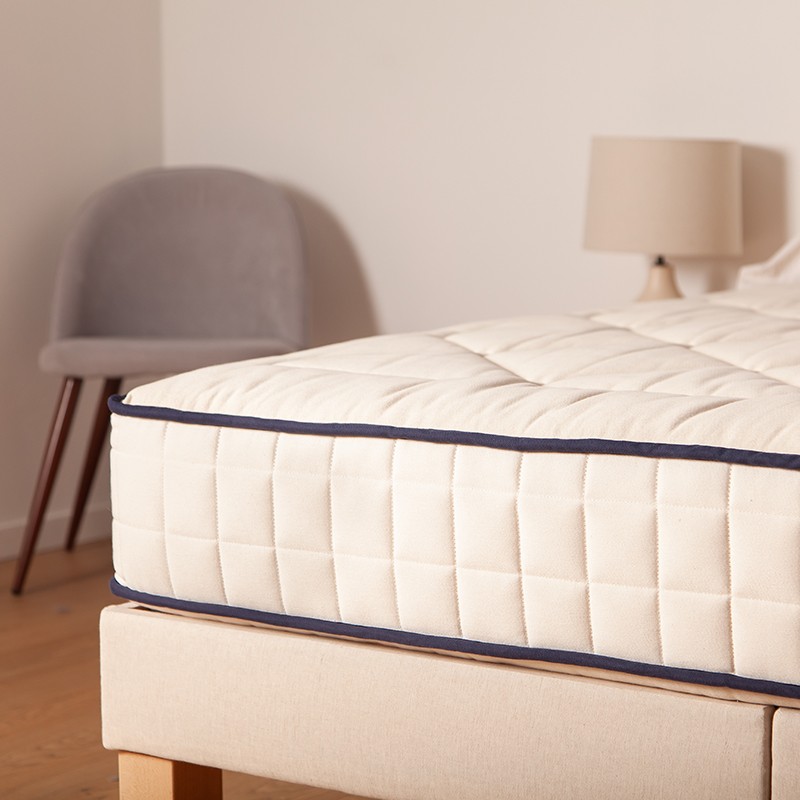
Do not confuse consumer memory foam with medical class viscoelastic foam. The latter is formulated to offer significantly better pressure distribution, with density and cushioning verified by standardized tests. It is suitable for low to moderate risks (classes 1 and 2), for patients who can still change position or are regularly repositioned by their caregivers.
Its advantages: durability, simple maintenance, controlled purchase cost, usable on both medical and standard beds. Its main drawback: it remains passive — it distributes pressure better than a regular mattress but does not compensate for total immobility.
The alternating air mattress
For high risks (class 3), the alternating air mattress is often the only truly effective response. It consists of inflatable cells that deflate and inflate alternately, constantly changing the pressure zones under the body. Result: no pressure point experiences continuous compression.
These systems exist in static version (constant pressure, quieter) and dynamic version with alternating cycles. Dynamic models are more effective in prevention but generate a slight compressor noise: a point to anticipate if the person is a light sleeper or if the room is shared. Some recent systems have significantly reduced this noise level.
See available alternating air mattresses on Amazon.frPrescription and reimbursement: the step-by-step process
This is often the most opaque part for families. Here’s how it works in practice.
The prescription, a mandatory starting point
A reimbursable anti-decubitus mattress must be prescribed by a doctor: general practitioner, geriatrician, or coordinating physician of a nursing home. The prescription must mention the class (1, 2, or 3) and may specify the type of technology (foam or air). Without a prescription, no reimbursement is possible.
The approved supplier
To ensure coverage, the equipment must be provided by a contracted healthcare professional: pharmacy, medical equipment store, or home healthcare provider (PSAD).
LPPR base rates and reimbursement rates
Class 2 viscoelastic foam models receive a reimbursement of €296.62 from Health Insurance, and for class 1 models, the reimbursement is €135.45.
The Social Security reimbursement rate is generally 60% of the base rate. For patients with long-term illness (ALD), coverage can reach 100% of the LPPR rate, eliminating the co-payment. Health insurance often covers all or part of the remaining costs depending on the contract.
Renting: when is it preferable to buying?
Renting an anti-decubitus air mattress represents an economically accessible solution on medical prescription, with a standard weekly reimbursement of €10.88.
In practice, renting is necessary when the situation is temporary (post-operative recovery, discharge from hospitalization) or when the risk level is likely to change rapidly. It also allows immediate access to an alternating air mattress without advancing a significant amount.
Buying becomes more interesting for long-term use, especially for foam mattresses. A new mattress can be prescribed after 3 years of use for class 2 models and after 1 year for class 1 models. Early replacement remains possible when health status changes or when the equipment becomes unsuitable.
View on AmazonWhat the mattress alone cannot do
An anti-decubitus mattress, even class 3, does not eliminate the need for regular repositioning. Medical recommendations generally suggest changing position every two to four hours for high-risk patients. The mattress reduces pressure, it does not eliminate it.
Moreover, nutrition, skin hydration, and moisture management (breathable underpads, appropriate changes) play a role as crucial as the support. An anti-decubitus mattress placed on a bed with a poor-quality base loses some of its effectiveness: always check that the base provides a flat and stable surface, without broken slats or sagging.
Finally, a thick enveloping cover can negate the effect of the mattress by creating an additional layer of tension. You can place a regular flat sheet on top, but never an enveloping cover. Specific breathable underpads exist for individuals with associated incontinence.
Who is each solution really for?
To clarify the most common situations:
Autonomous senior but bedridden for several hours a day (post-operative, chronic fatigue): a class 1 medical foam mattress, prescribed and reimbursed, is sufficient in most cases. Coupled with regular position changes, it effectively prevents persistent redness.
Dependent patient with very limited mobility (stroke, neurological condition, advanced age with frailty): class 2 viscoelastic foam is a minimum. If the Braden or Norton assessment indicates a high risk, class 3 alternating air is necessary.
Established bedsore: the anti-decubitus mattress is part of the treatment protocol, but the prescription then falls to a specialized doctor (dermatologist, wound and healing team). Class 3 is almost always required.
Care in a nursing home: the facility is usually equipped. If not, or if the proposed equipment is insufficient, the family can assert a right to appropriate equipment through the coordinating physician.
FAQ
Who can prescribe a reimbursable anti-decubitus mattress?
Any doctor can issue the prescription: general practitioner, geriatrician, palliative care physician, or coordinating physician of a nursing home. It is not necessary to go through a specialist for classes 1 and 2. However, for a class 3 alternating air mattress, some providers require a more detailed prescription explicitly mentioning the desired technology. If you are at home, your primary care physician is the first contact: clearly explain the bed rest situation and request a formal assessment of the risk of bedsores.
Is reimbursement automatic with a prescription?
No, three conditions must be met simultaneously: a valid prescription mentioning the class, a purchase or rental from an approved supplier (Social Security contracted), and a mattress listed on the LPPR under the correct code. If you buy directly online without going through a contracted provider, you will not be reimbursed, even with a prescription. Home healthcare providers (PSAD) often manage the entire reimbursement process for you, simplifying the procedures. For patients with ALD, the doctor can check the exemption box on the prescription, which brings coverage to 100% of the LPPR rate: always check this point systematically if you are in this situation.
Can an anti-decubitus mattress be used on a regular bed?
Yes, in most cases. Medical foam mattresses (classes 1 and 2) adapt easily to a standard bed frame, provided the base is flat and in good condition. Alternating air mattresses require space for the compressor (placed next to the bed, often on the floor) and a permanent electrical access. Some systems are designed to be installed on height-adjustable medical beds, which facilitates care. If the regular bed is too low or too narrow (less than 90 cm wide), consider simultaneously adapting the bed: a process sometimes funded through other aids such as AGEFIPH or housing adaptation assistance.
What is the difference between a commercial memory foam mattress and a medical anti-decubitus mattress?
Confusion is common, and consumer manufacturers sometimes perpetuate this ambiguity in their communication. A memory foam mattress sold in a bedding store is not a medical device: it is not tested according to anti-decubitus standards, is not listed on the LPPR, and is therefore neither prescribable nor reimbursable. Medical class 2 viscoelastic foam, on the other hand, meets precise specifications for density, pressure distribution, and durability, validated by standardized tests. For medical preventive use, only equipment listed on the LPPR offers the necessary guarantees.
Renting or buying: how to choose concretely?
The simple rule: if the bed rest situation is temporary (less than three months), renting is almost always more suitable, especially for alternating air mattresses. If dependence is established long-term, purchasing a medical foam mattress (class 1 or 2) is often more economical in the long run, with a renewal covered every one to three years. For class 3 alternating air, renting remains dominant because these systems are expensive to purchase, require regular compressor maintenance, and must be adapted to the patient’s evolving condition. The home healthcare provider delivering the equipment can guide you based on your specific situation.
Does the anti-decubitus mattress replace regular repositioning?
No. Even the best class 3 alternating air mattress does not eliminate the need for repositioning. It reduces pressure and extends the tolerable time between two position changes, but medical recommendations maintain the goal of repositioning every two to four hours for high-risk patients. The mattress is a tool among others, which also includes regular skin monitoring, appropriate nutrition, and moisture management.