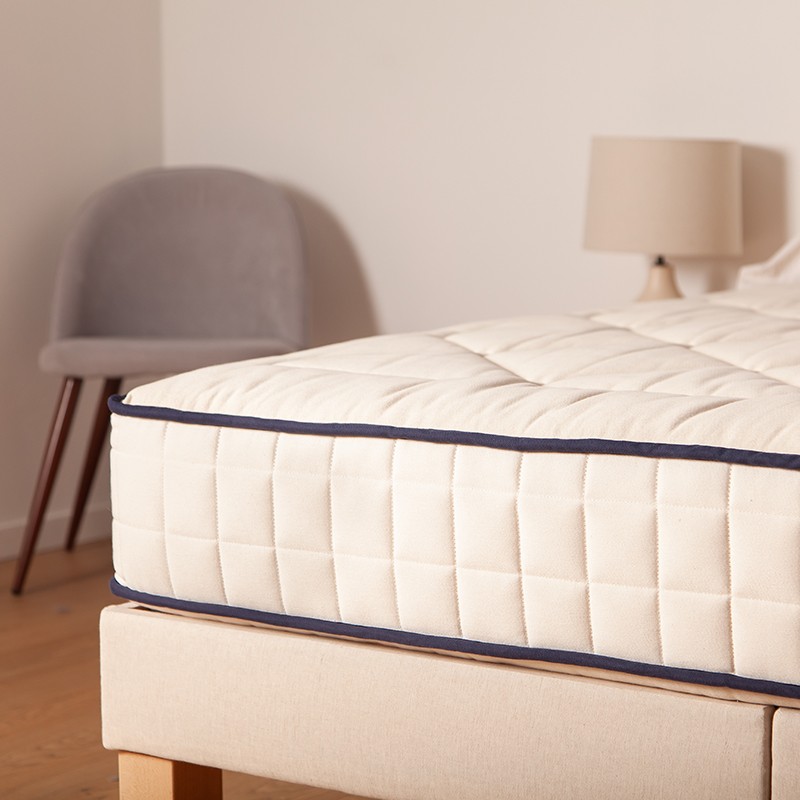
The 90×190 cm size occupies a special place in the world of French bedding. Not too large for a studio, nor too small to accommodate a growing teenager, this size represents the historical standard for a single bed in our homes. However, faced with the multitude of available options — foam, latex, springs, memory foam, varying thicknesses — it is not always easy to find your way. This guide helps you identify the 90x190 mattress that truly corresponds to your situation, your morphology, and the use you will make of it.
Who is the 90x190 mattress for?
The 90×190 cm dimension represents the standard size for a single bed in France. It primarily addresses three distinct profiles of sleepers.
The teenager is undoubtedly the most emblematic user of the 90x190. At this age, sleep quality directly influences concentration, growth, and mood. Investing in a quality mattress for this age group is not a luxury; it is a necessity often underestimated.
The solitary sleeper in a studio or compact apartment constitutes the second major profile. A well-chosen 90x190 allows for proper recovery while leaving room in a narrow bedroom. For a student or a young professional, it is often the best compromise between comfort and space.
The guest room represents the third use case. Here, the mattress must be versatile: capable of accommodating various morphologies and people of different ages, without mobilizing an excessive budget for a bed that will only be used occasionally.
If you are significantly taller or wider than most people, the 90x190 may not be the ideal choice, and you should consider models of 90x200 cm or even longer. For adults measuring less than 1.75 m, however, this length remains quite comfortable.
Thickness: the most underestimated criterion
There is much talk about mattress technology (foam, latex, springs…), but thickness is often the first indicator of comfort and durability. Here’s how to navigate it.
Below 15 cm, we enter the category of temporary or replacement mattresses. These products may be suitable on occasion but are not recommended for daily long-term use: support is often insufficient, and lifespan is reduced.
Between 15 and 20 cm, we find the majority of entry-level mattresses at accessible prices. For infrequent use in a guest room or for a lightweight young child, this thickness may suffice. However, a standard morphology adult sleeping every night on this type of mattress is likely to quickly feel the limits of support.
Between 20 and 25 cm, we reach the intermediate segment that represents the best quality/durability ratio for most users. At this thickness, brands can integrate transition layers between the comfort surface and the support core, which significantly improves pressure distribution. This is the recommended range for a teenager or an adult using the bed daily.
Beyond 25 cm, we move into the premium segment. Some high-end models reach 30 cm in thickness, incorporating an integrated mattress topper that provides immediate comfort as soon as you lie down, with a breathable structure to regulate temperature. For a 90x190, this investment is justified if the sleeper suffers from back pain or sleeps on their stomach, a position that requires more precise support.
Available technologies in 90x190
Polyurethane foam and memory foam
Foam is the most widespread and accessible technology. It offers good sound insulation (useful in studios), comes in all firmness levels, and remains lightweight to handle — a significant advantage for a mattress that is regularly flipped. Memory foam, on the other hand, conforms to the contours of the body and relieves pressure points: shoulders, hips, knees. It is particularly suitable for sleepers who tend to wake up with joint pain.
Its main disadvantage remains thermal management: classic memory foam retains more heat than other technologies. If you sleep hot, prioritize ventilated models or integrated gel versions.
Natural or synthetic latex
The 90×190 latex mattress adapts well to all morphologies and sleeping positions. Natural latex, derived from rubber trees, has the advantage of being elastic, breathable, and naturally resistant to dust mites — an important criterion for allergy sufferers. Its lifespan is generally longer than that of entry-level foams.
The price of a 90×190 latex mattress generally starts around €269 for an entry-level model made in France. 100% natural latex models with multiple comfort zones can reach significantly higher price levels. This is a technology to seriously consider for intensive daily use.
Compare 90x190 latex mattresses on Amazon.frPocket springs
The pocket spring mattress offers dynamic support and excellent natural ventilation. Each spring works independently, which limits movement transfer — a less critical point for a single bed, but important if you move a lot during the night. Pocket spring mattresses start at around €550 in the mid-range from specialized manufacturers. This is often the recommended technology for heavier individuals (over 80-90 kg), as the springs maintain their support capacity over time.
Hybrid models
Hybrids combine a pocket spring core with one or more layers of foam or latex on the surface. They seek to combine the best of both worlds: the breathability and bounce of springs, the precision and softness of foam. In 90x190, they represent an interesting premium option for a demanding sleeper or someone suffering from chronic pain. To delve deeper into this topic, the mattress buying guides section of the site compares the different technologies in detail.
Firmness: how to choose according to your morphology?
Very firm firmness is recommended for individuals over 90 kg or those who sleep on their back and need strict support. Conversely, lighter sleepers — particularly teenagers and young adults of slender build — will benefit more from a medium or medium-firm comfort that better conforms to curves without allowing excessive sinking.
Side sleepers are often the most sensitive to firmness choice: too firm, and the hips and shoulders suffer significant pressure; too soft, and the spine is no longer aligned. A medium soft or medium firmness generally works well for this position. Stomach sleepers, on the other hand, need firm support to avoid excessive arching of the lower back.
In summary:
- Light build (under 60 kg) → medium soft to medium
- Intermediate build (60–80 kg) → medium to medium-firm
- Heavy build (over 80–90 kg) → firm to very firm
Budget: what to expect in 90x190?
The 90x190 format is generally one of the cheapest in a manufacturer’s range, as the surface is reduced. As a benchmark:
- Entry-level (simple foam, ~15–18 cm): starting from ~€80–160. Acceptable for very occasional use.
- Mid-range (HR foam, memory foam, or entry-level latex, ~20–25 cm): starting from ~€200–400. The quality/durability ratio starts to become interesting for daily use.
- Intermediate to premium segment (natural latex, hybrid, quality pocket springs): starting from ~€400–700 and beyond. For a teenager who will spend several years on this mattress or for a main adult bedroom.
Do not be swayed by abnormally low prices without checking the actual thickness, the density of the foam (expressed in kg/m³), and the presence of recognized certifications such as OEKO-TEX® Standard 100 or CertiPUR®, which guarantee the absence of harmful substances in the materials.
Explore available 90x190 mattresses on Amazon.frTrial period and warranty: criteria not to be overlooked
Most online brands now offer a home trial period, generally ranging from 30 to 100 nights. This is a particularly useful criterion for the 90x190, as this format is often purchased for a third party — a teenager or a future guest — and not for oneself. Having the option to return the mattress if the comfort is not suitable significantly reduces the risk of purchase.
Regarding the warranty, entry-level mattresses are often covered for 2 years, while premium models display warranties of 10 years and sometimes more. A long warranty is an indirect indicator of the manufacturer’s confidence in the durability of their product.
Is the 90x190 mattress suitable for an adult or only for children and teenagers?
The 90x190 is perfectly suitable for an adult, provided two conditions are met: height and build. For a person measuring less than 1.75 m and of light to intermediate build, this format is perfectly adapted for daily use. It is frequently chosen by students, young professionals living in studios, or adults looking to optimize space in a small bedroom. However, if you measure more than 1.80 m, the length of 190 cm may prove insufficient, and you should consider the 90x200 cm format. Similarly, a heavy individual (over 90 kg) would benefit from choosing a firm mattress with a pocket spring core or high-density latex for durable support.
What is the minimum thickness for good back support on a 90x190?
For daily adult use, it is advisable not to go below 18 to 20 cm in thickness. Below this threshold, the mattress may prove insufficient to properly distribute the pressures exerted by the body throughout the night, which promotes morning pain in the lower back, shoulders, or hips. For a child under 12 years old, a thickness of 15 cm may still be suitable, but from adolescence onwards, it is preferable to aim for 20 cm and more. Individuals suffering from chronic back pain will benefit from opting for models of at least 22 to 25 cm, combining a precise comfort layer (memory foam or latex) with a robust support core.
Is a particular box spring needed for a 90x190 mattress?
The choice of box spring largely depends on the mattress technology. A foam or latex mattress tolerates soft slatted bases well (maximum recommended spacing: 6 cm between slats). A spring mattress, on the other hand, generally prefers a rigid slatted base or an upholstered base, which provides a flat and stable foundation. Some manufacturers sell their mattresses with a specific box spring recommendation, or even invalidate the warranty if you choose an incompatible support — check the warranty conditions before purchasing. In a studio, a mattress placed directly on a slatted bed frame remains the most common solution; however, avoid placing it directly on the floor permanently, as this may disrupt ventilation and promote humidity.
How can I tell if my 90x190 mattress needs to be replaced?
Several signs indicate that it is time to change your mattress: visible sagging in the center or edges, springs that can be felt through the surface, morning pain that disappears after a few minutes of getting up, or a creaking noise with every movement. Generally, a mid-range mattress for daily use lasts between 8 and 12 years. An entry-level model may degrade within 5 to 7 years, especially if the sleeper is of significant build. If your 90x190 mattress is used only as a guest bed (a few nights a month), its lifespan will naturally be longer.
Can a mattress topper be added to a 90x190 to improve comfort?
Yes, a mattress topper can be a relevant solution to refine the comfort of an existing 90x190 mattress, especially if the latter is slightly too firm or if you want to give it a second life before replacing it. Latex or memory foam toppers provide an additional layer of softness and pressure distribution. However, be cautious: a mattress topper cannot correct a lack of deep support. If the core of the mattress is sagging or worn, the topper is only a temporary remedy. For a guest room where the mattress is in generally good condition but deemed a bit firm by guests, it is, however, an excellent economical solution.