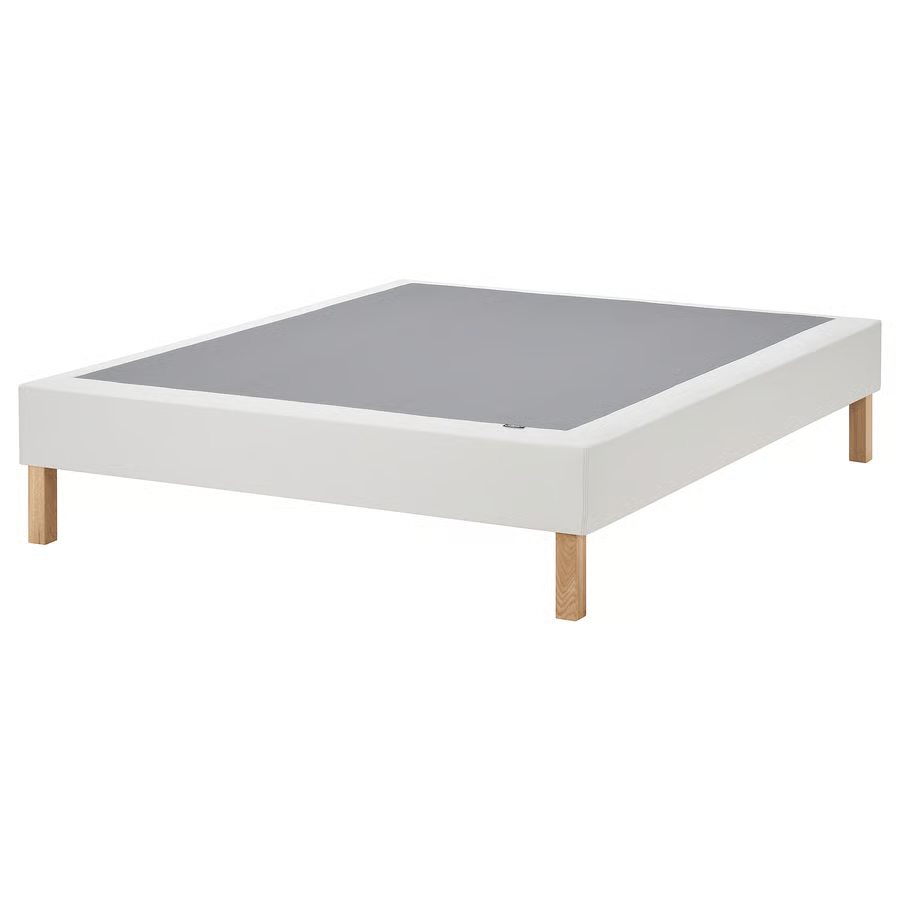
You ordered a 25 cm mattress, you have an 18 cm slatted base, and you are still unsure which legs to choose. Or perhaps your mother struggles to get up in the morning, and you are wondering if raising her bed would really make a difference. In both cases, the answer comes down to a simple calculation that no one bothers to explain clearly: mattress + base + legs = total bed height, and this total height is not trivial.
The basic rule: align the top of the mattress with the hollow of the knee
The ergonomic principle is simple. Sitting on the edge of the bed, with your feet flat on the floor, your knees should form an angle close to 90°. This position makes getting up and lying down easier without straining the lower back or hips.
For the vast majority of adults of standard height (between 1.60 m and 1.80 m), this corresponds to a mattress top height between 45 and 55 cm from the floor. Below this, you are too low, and getting up becomes laborious. Above 60-65 cm for a shorter person, the feet no longer touch the ground, and getting into bed becomes uncomfortable.
For seniors or people with reduced mobility, the recommendation is slightly higher: a total height between 55 and 65 cm reduces the strain on the knee and hip joints when getting up, which, in the long term, preserves true autonomy.
With these benchmarks established, let’s see how to achieve them by adjusting the three elements you control.
The three components of total height
The mattress: thickness varies more than you think
An entry-level mattress often measures between 15 and 18 cm. Intermediate models, suitable for the majority of sleepers up to about 85-90 kg, range from 18 to 22 cm. Premium mattresses, particularly hybrids with multiple layers of foam and pocket springs, easily exceed 25 to 30 cm.
This thickness is often the first surprise upon receipt: a mattress advertised as 25 cm looks impressive once placed on the base. This is a factor to note before any purchase, as it directly influences the choice of leg height.
The base: rarely more than 18 to 20 cm (excluding decorative box springs)
A classic slatted base, the most common in France, generally measures 15 to 18 cm in height (frame included, without the legs). It rests on the bed legs.
Decorative box springs, those whose frame is entirely covered in fabric or faux leather, can go further: some models display integrated heights of 25, 30, or even 38 cm — meaning they do not need legs, or only small pads, to reach a reasonable total height.
One often overlooked point: a slatted base placed directly on the floor (without legs) prevents any air circulation under the mattress. Moisture stagnates, promoting mold. Legs are therefore not just a matter of style or height: they also serve an essential hygienic role. A minimum of 10 cm of clearance under the base is generally recommended.
View on AmazonBed legs: the only truly adjustable parameter afterward
This is where you have control. Bed legs screw under the base frame and come in a variety of heights: 5, 10, 15, 17, 20, 25 cm, and sometimes more.
Legs of 15 to 17 cm are considered “standard”: when combined with an 18 cm base and a 20 cm mattress, you reach a total height of 53-55 cm, in the ideal zone for the majority of adults.
Legs of 20 cm and more allow for sufficient clearance to slide storage drawers under the bed — an interesting option in small spaces. They are also suitable for raising the bedding of an elderly person or someone recovering.
Very low legs (5-7 cm) give a “floor bed” look, contemporary and often associated with Scandinavian or Japanese style. Practical for aesthetics, less so for the knees upon waking.
Making the calculation: a concrete example
Let’s take a typical case: an 18 cm slatted base, a 20 cm foam mattress. Without legs, the total height is 38 cm — too low for most adults. With 15 cm legs, you reach 53 cm: excellent for someone of average height. With 20 cm legs, you reach 58 cm: very comfortable for a tall person, or recommended for a senior.
Another example: premium hybrid mattress of 28 cm on a 20 cm box spring with 10 cm legs. Total height: 58 cm. This is already at the high end of the standard range; for a shorter person, adding taller legs would make no sense.
The formula always remains the same: height of the legs + height of the base + thickness of the mattress = height of the mattress top from the floor. It is this final figure that should be compared to the height of your knee hollow, measurable with a simple measuring tape.
View on AmazonDepending on the profile, priorities change
Tall person (over 1.85 m). The top of the mattress can easily rise to 55-60 cm without inconvenience, and 20 cm legs become natural. The mistake would be to take a very thick mattress (28-30 cm) on 17 cm legs with an 18 cm base: you then approach 65 cm, which forces you to sit on the edge of the bed with your feet not really touching the ground.
Short person (under 1.60 m). The target is rather 44-50 cm. A mattress of 18-20 cm on a 15 cm base with 10-12 cm legs is often sufficient. The low bed, tatami style, can also be suitable if there are no knee problems.
Couple with different body types. We aim for the middle zone. A bed that is too low will be frustrating for the tall person, too high risky for the short one. The 50-55 cm range is generally a good compromise, to be adjusted according to any discomfort felt.
Seniors and people with reduced mobility. This is where height makes a measurable difference in daily life. Between 55 and 65 cm total height, getting up puts much less strain on the knees and hips. If the existing bed is too low, leg risers (accessories sold separately) can increase the height without changing all the furniture.
Height and bedroom style: what is often underestimated
The height of the bed also influences the perception of space. A low bed (40-45 cm mattress top) visually enlarges a small room, gives an impression of a higher ceiling, and integrates well into a clean contemporary interior. A raised bed (55-65 cm) adds volume and presence to the room and naturally creates storage space underneath.
In a studio or a room of less than 12 m², opting for 20 cm legs with a storage drawer is often a decision as practical as it is aesthetic. In a large master bedroom, a high bed with an imposing box spring frame can become the centerpiece of the decor.
View on AmazonWhat manufacturers do not always clearly indicate
When you buy a base, does the height indicated in the product sheet correspond to the height of the frame alone, or does it include the supplied legs? This is not always specified. Always check if the legs are included in the product and what their height is. Some brands deliver 10 cm legs by default and offer taller legs as a paid option.
On the mattress side, the thickness is generally announced without compression. However, a memory foam mattress can slightly compress under body weight and lose 1 to 2 cm “under load.” This is marginal, but worth keeping in mind if you are really at the limit of a height range.
To go further in choosing your base (type of slats, flexibility, compatibility with your mattress), consult our complete guide to choosing your base .
What is the ideal total bed height for a standard adult?
For the majority of adults whose height is between 1.60 m and 1.80 m, the height of the mattress top should be between 45 and 55 cm from the floor. This measurement allows you to sit on the edge of the bed with your feet flat and knees at about 90°, which facilitates both getting up and lying down without straining the lower back or hips. If you are rather tall (over 1.80 m), you can aim for 55-60 cm. If you are short, stay in the lower range, around 45-48 cm. In any case, the most reliable test remains to measure yourself standing and note the height of your knee hollow: this is the target to reach with your bedding.
How to calculate the total height of my bed?
Simply add: height of the bed legs + height of the base (frame without legs) + thickness of the mattress. For example: 15 cm legs + 18 cm base + 20 cm mattress = 53 cm total height. It is this final figure that you compare to the height of your knee hollow.
What bed height is recommended for seniors?
For an elderly person or someone with reduced mobility, the total bed height (legs + base + mattress) should be between 55 and 65 cm. At this height, getting up puts much less strain on the knee and hip joints, as the body does not have to “rise” from a position that is too low. Below 50 cm, the movement to get up is mechanically more costly: the leg muscles and hip tendons must exert more effort, which can be painful or risky in case of fragility. If the current bed is too low, leg risers, sold separately, can add 5 to 15 cm without replacing the entire structure. It is a simple, economical, and reversible solution.
What height of bed legs should I choose to store under the bed?
To create usable storage space under the bed (flat drawers, storage boxes), you need at least 20 cm of clearance between the floor and the underside of the base. Therefore, 20 cm legs are the minimum practical in this case, and some models go up to 25-30 cm for even more comfortable storage. However, be careful about the impact on total height: if you add 25 cm legs to an 18 cm base and a 22 cm mattress, you reach 65 cm of mattress top height, which may be too high for an average-sized person.
Can you change the height of an existing bed without replacing everything?
Yes, and this is often the simplest solution. Bed legs screw under the base frame and can be replaced at a low cost. If your current bed is too low, you can buy taller legs (be sure to check the threading or attachment system compatible with your base) or use universal risers that simply go under the existing legs. These risers are available in 5, 10, or 15 cm increments. Conversely, if your bed is too high, replacing the legs with shorter models is just as easy. However, if the problem comes from a mattress that is too thick, the only lever is to replace the mattress itself: there is no solution to permanently compress a 28 cm mattress to make it a 20 cm one.
Is a low bed (Scandinavian or Japanese style) less comfortable?
Not necessarily, as long as your mobility allows it. A bed with the mattress top at 35-40 cm from the floor can be perfectly comfortable for a young person without joint pain. The “floor bed” or “low platform” style is even appreciated for the sense of security it provides and the visual aspect it gives to the room. However, for someone with knee, hip, or back pain, or for anyone over 60, such a low bed gradually becomes a real constraint in daily life, and the consequences are felt over time. Aesthetic reasons are valid for choosing a low bed, but they should be weighed honestly against functional comfort.