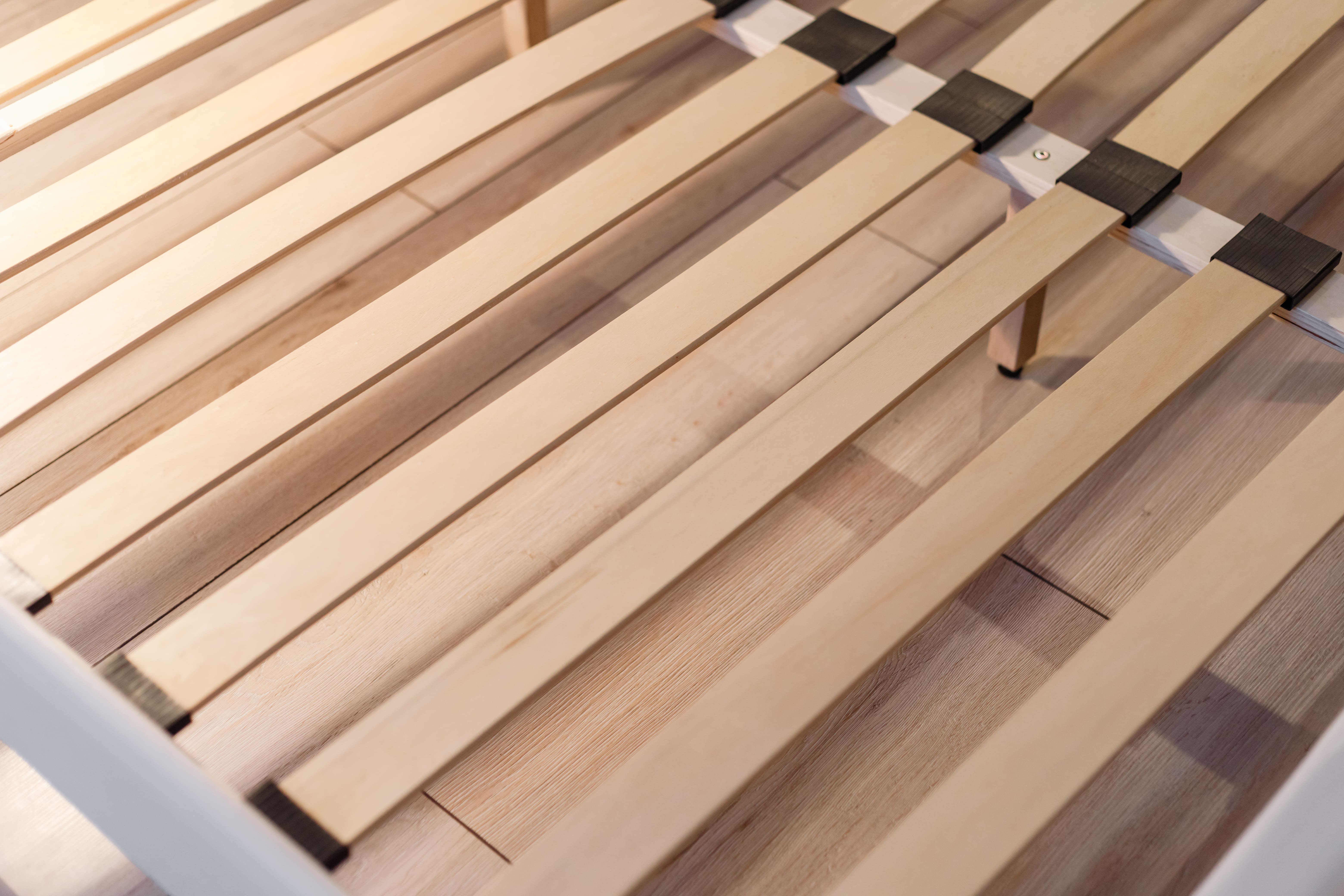
Kipli Upholstered Bed Base
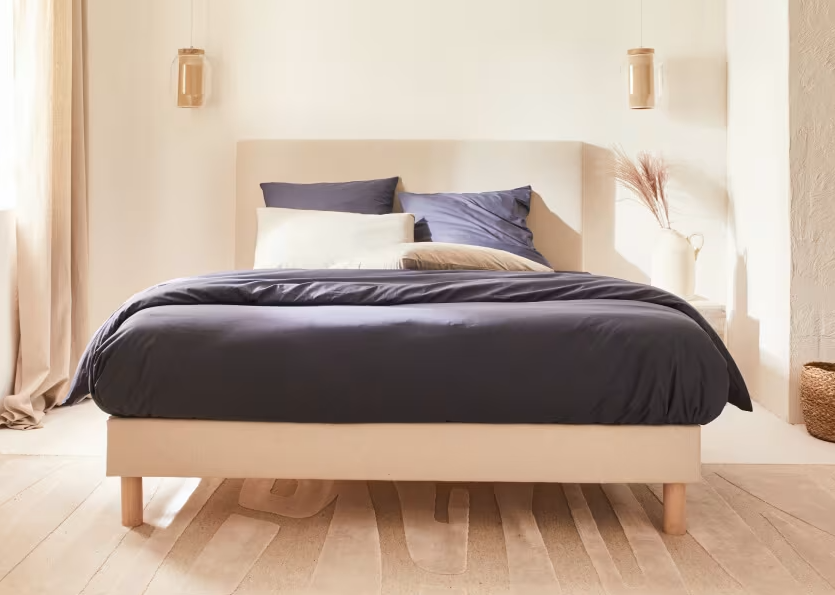
Entirely handcrafted from poplar wood in the Centre-Val de Loire (Sologne), the Kipli upholstered bed base is filled with flax fiber and dressed in a linen fabric woven in France — no foam or chemical glue. Its uncovered rigid slats ensure optimal breathability, complementing the needs of natural latex. The eco-responsible design and the sober, natural aesthetic make it a benchmark for committed bedding.
View on AmazonHossegor Bed in Landes Pine – Biosense
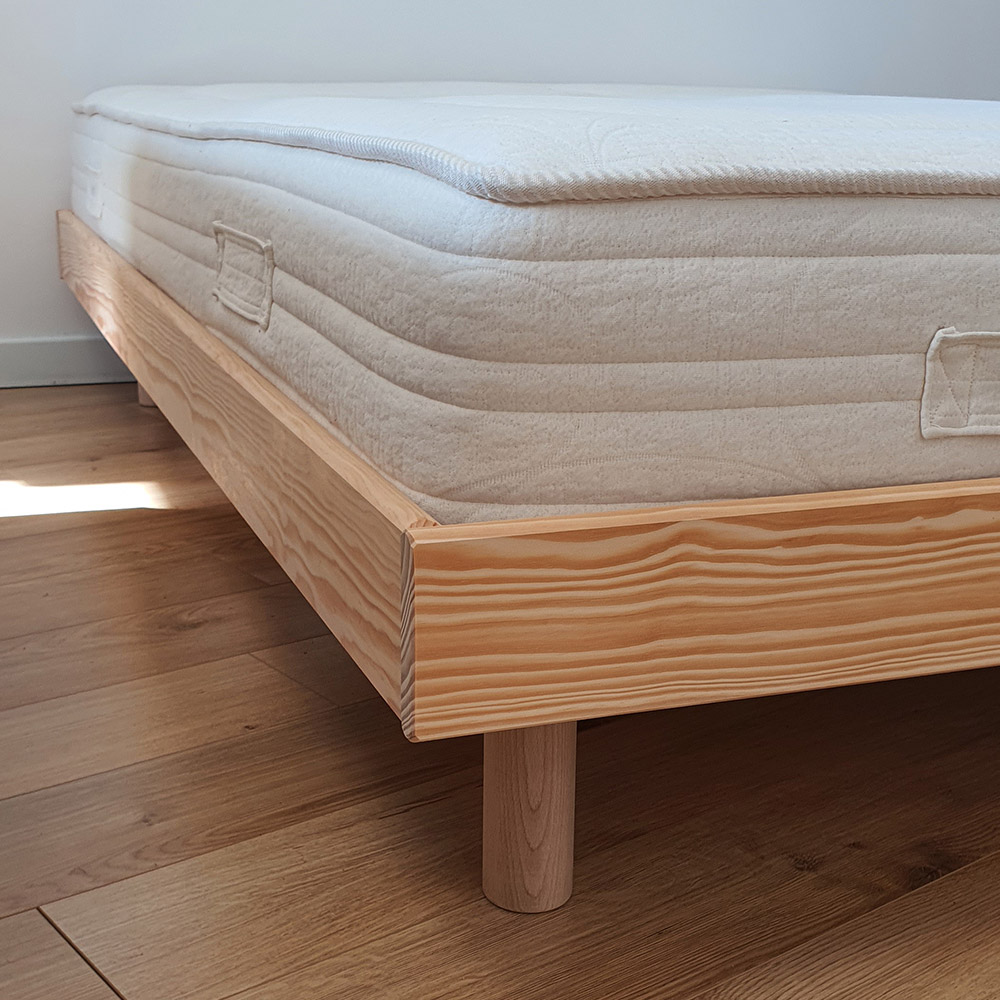
Biosense offers a complete bed with an integrated base, made from untreated local solid pine, compatible with natural latex mattresses. Local manufacturing, raw materials, and natural design make it a coherent choice for a bedroom committed to a healthy and sustainable approach. The integrated base respects the recommended spacing for latex.
Deco Slatted Base – No Stress Mattress
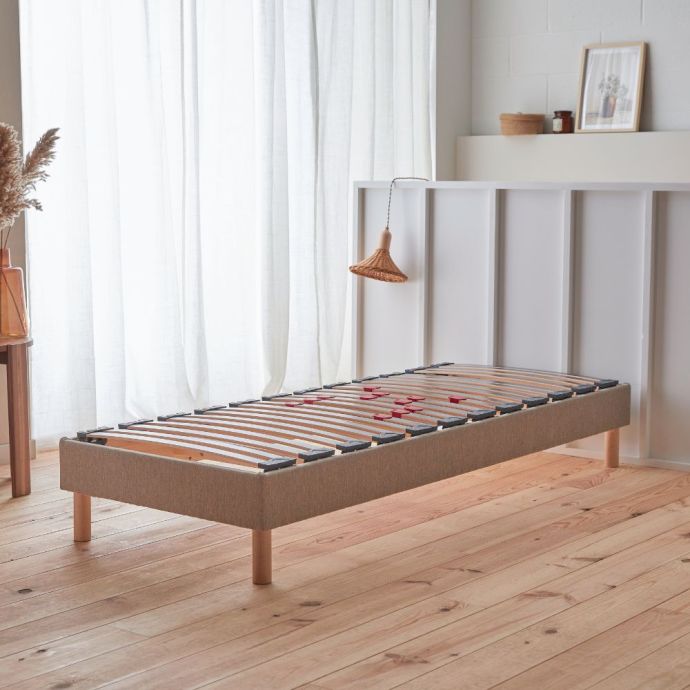
The fixed slatted bases range from No Stress Mattress offers excellent value for money, with a carefully designed decorative fabric covering and ventilation ensured by the regular arrangement of the slats. Compatible with natural latex mattresses, this type of base is perfectly suited for mid-range budgets without compromising on essential technical criteria.
View on Amazon View on AmazonPractical Tips for Preserving the Latex + Base Combination
A natural latex mattress placed on an unsuitable base can have its lifespan reduced by several years. A few good practices can help avoid this. Avoid spring bases, which are incompatible with the structure of natural latex: the contact points of the springs create localized wear areas that quickly alter the sleeping surface. Regularly check the condition of your slats — a cracked or sagging slat should be replaced without delay. Maintain the hygiene of the base by cleaning it twice a year and avoiding placing it against the wall, which would hinder air circulation. If you have a double-sided (reversible) mattress, turn it every 3 to 6 months to wear both sides evenly, and ensure that your base is easily accessible from both sides of the bedding to facilitate this handling.
To go further on the topic of bases and bed frames, check out our complete guide to choosing your base .
FAQ
Can I reuse my old base with a natural latex mattress?
Yes, provided you check three essential points. First, the spacing between the slats: it should not exceed 5 cm, otherwise the latex sinks into the gaps and wears out prematurely — if your slats are too far apart, additional slats can be added in some models. Next, the condition of the slats: cracked, sagging, or missing slats must be replaced before placing a new latex mattress on them, as a faulty slat creates an asymmetrical pressure point that will permanently deform the latex in that area. Finally, the type of base: a fully upholstered base (without visible slats) or a spring base is strongly discouraged, as they block the ventilation that latex needs to release moisture and regulate temperature. If your old base meets these three criteria, you can reuse it without issue and save several hundred euros.
Is a solid wood base always better?
For a natural latex mattress, solid wood is generally the best choice for several cumulative reasons. First, it is robust: latex is heavier than foam, often between 25 and 35 kg for a 160×200 cm mattress, which puts more strain on the base structure over time. It also offers natural ventilation due to the porosity of the wood fibers, and its lifespan often exceeds that of the mattress itself. Choose FSC or PEFC certified species — beech, oak, poplar, or pine — and check for the absence of aggressive chemical treatments: some glues, varnishes, or fire retardants can emit volatile organic compounds (VOCs) incompatible with healthy bedding. Composite wood (MDF, particleboard) is much less recommended: less durable over time and often assembled with formaldehyde-based glues, it constitutes a poor investment for a premium mattress.
Should I prefer a soft or firm base for my natural latex?
For a natural latex mattress, a slightly firm base is generally recommended, and the reason is simple: latex is already an elastic and adaptive material by nature — if the base is also very soft, the whole setup will lack support to keep the spine properly aligned throughout the night. In practice, choose a fixed or semi-rigid slatted base if your latex mattress is soft to medium, and active slats (flexible and articulated) if your latex mattress is firm, to create complementarity rather than redundancy. Special case: for individuals over 80 kg, a reinforced base with slats 8 cm wide spaced only 3 to 4 cm apart is highly recommended to avoid premature sagging and to ensure optimal lumbar support.
Is an electric base compatible with a natural latex mattress?
Yes, and it is even one of the most successful combinations in bedding. Natural latex is indeed one of the most flexible materials: it perfectly follows the joints of an electric base without creating resistance or permanently deforming, unlike spring mattresses that can bend with difficulty or high-density foam mattresses that may crack at repeated flex points. Just ensure that the electric base has flexible slats (and not a solid board) to maintain good ventilation, and that its dimensions match exactly those of your mattress to avoid slipping during position changes. Motorization is particularly interesting for people suffering from gastroesophageal reflux or circulation problems, as raising the head or legs is possible without effort.
Is a specific base required for a double-sided (reversible) latex mattress?
No, the criteria remain the same as for a classic latex mattress: closely spaced slats (≤ 5 cm), good ventilation under the mattress, perfectly adapted dimensions. The only practical difference lies in usage: you will regularly turn your mattress — every 3 to 6 months — to wear both sides evenly and preserve the longevity of the latex, which means your base should be easily accessible from both sides of the bed. If your bedding is fitted against a wall, a base on wheels or a lightweight bed frame greatly facilitates maneuvering. Also, consider using a reversible mattress protector (without a fixed top or bottom) to maintain the same hygiene and protection guarantees on both sides, and check that your mattress protector does not hinder the breathing of the latex.
Can the floor or a flat platform replace a base for a natural latex mattress?
Placing a natural latex mattress directly on the floor or on a completely flat platform is strongly discouraged, even if it may seem practical or aesthetically minimalist. The main reason is ventilation: latex is hygroscopic and naturally absorbs body moisture during sleep; without air circulation beneath the mattress, this moisture cannot escape and promotes the development of mold and dust mites in the latex foam, drastically reducing its lifespan and hypoallergenic properties. On a bed platform, it is possible to manage as long as the surface has regular ventilation holes or grooves and the room is well-ventilated — but a slatted base remains the optimal solution. If you opt for a platform, air out your mattress by propping it against the wall at least once a week.