You just chose your mattress and think that the bed base is the detail that remains? It’s often at this point that we find ourselves stuck facing two names that seem close but do not work the same way: the upholstered bed base and the slatted bed base. The wrong choice can harden a soft mattress, prevent latex from breathing, or accelerate the wear of memory foam. It’s worth taking five minutes to understand the difference.
What the term “upholstered bed base” hides
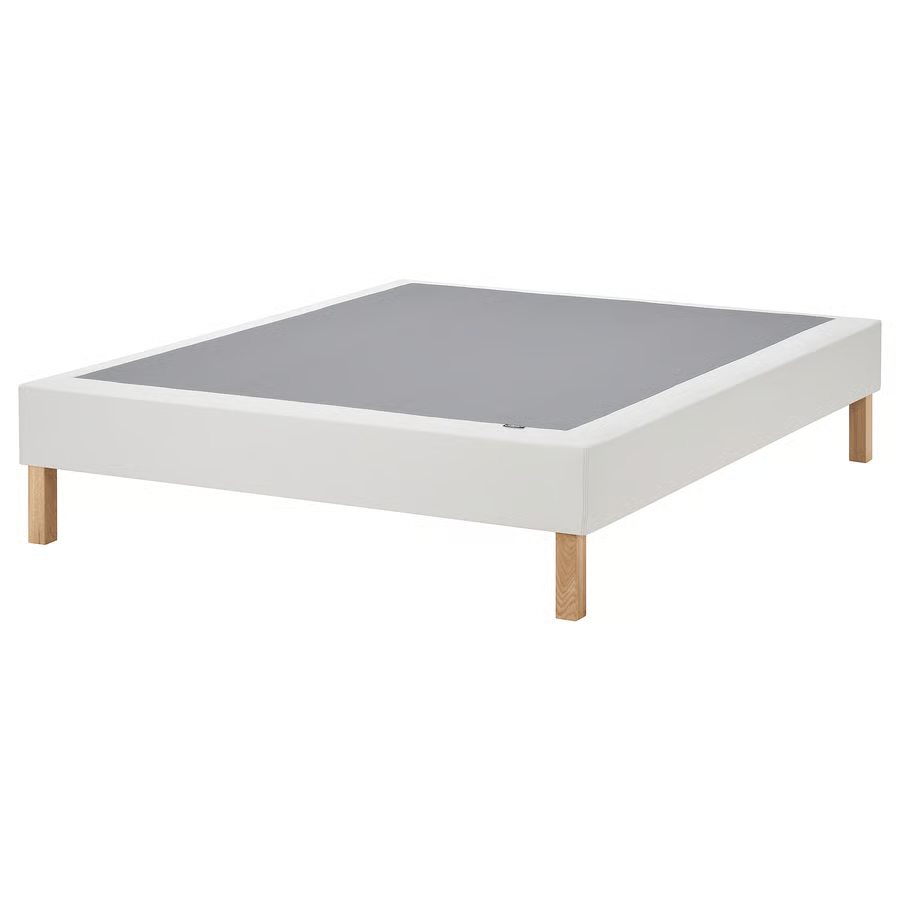
The term is confusing, and this is often where people get lost. An upholstered bed base is not a type of structure in itself: it is a bed base whose internal structure (slats, springs, or platform) is covered with fabric, usually a cotton or polyester ticking. The fabric hides everything, including the legs, hence the “box” appearance with a clean and uniform look.
Inside, depending on the model, you may find:
- Rigid slats (made of solid wood or plywood), tightly packed together, forming an almost continuous platform.
- Springs (bonnell or pocketed), rarer today in the mid-range, which provide a slight bounce.
- Flexible slats (made of bent beech or ash) with or without bilaminate, spaced further apart, allowing for some flexibility.
What brings them all together under the name “upholstered”: nothing of the mechanics is visible, and the profile is low, often between 13 and 20 cm. It is primarily an aesthetic choice as much as a technical one.
The support provided therefore entirely depends on what is under the fabric. An upholstered bed base with tightly packed rigid slats will provide very firm, homogeneous support, close to a wooden platform. An upholstered bed base with flexible slats will behave more like a classic slatted bed base, with a bit more flexibility and adaptation to body movements.
View on AmazonWhat a slatted bed base really is
Here, the slats are visible. The slatted bed base presents itself as a wooden or metal frame on which transverse slats rest, spaced a few centimeters apart. There are two main families:
Rigid slats are fixed, made of solid wood (pine, beech), and hardly bend. They are suitable for mattresses that need firm and stable support, particularly natural latex mattresses or firm foam mattresses. The spacing between the slats should remain less than 3 cm for foam mattresses; otherwise, the mattress will sag and wear prematurely.
Flexible slats (also called flexible slats or bilaminate slats) are curved and slightly arched upwards. They bend under weight and follow body movements, relieving pressure points. This configuration is best suited for memory foam mattresses, as it enhances the enveloping effect. Many models allow you to adjust the tension of the slats according to body zones (shoulders, lower back, hips).
Ventilation is the great strength of the open slatted bed base: air circulates freely between the slats, which dissipates heat and moisture from the mattress, prolonging its lifespan. For a natural latex mattress—a material that breathes and must breathe—this is often the basic recommendation from manufacturers.
The real differences, point by point
Support. The upholstered bed base with rigid slats offers the firmest and most uniform support. Ideal for sleepers who need good back support, heavier individuals, or firm mattresses that one does not wish to soften further. The bed base with flexible slats, on the other hand, adapts the support to the shapes of the body.
Ventilation. A clear advantage goes to the open slatted bed base. On an upholstered bed base, the fabric closes off the structure and reduces air exchange. On high-density latex or foam mattresses, this can accelerate heat retention over the long term.
Mattress compatibility. Manufacturers of latex mattresses often specify in their instructions that their product should rest on a slatted bed base with a spacing of less than 3 cm—the rigid upholstered bed base (continuous platform) also works very well in this case. In contrast, a memory foam mattress will perform better on flexible slats, which extend its action.
Bulk and aesthetics. The upholstered bed base is more discreet: low profile, no visible slats, neat look even without a bed frame. The slatted bed base generally fits into a bed frame or a complete bed; alone, it may appear raw.
Price. Both families cover entry-level to high-end. You can find upholstered bed bases with rigid slats starting at around €200 in 140×190 cm, and quality flexible slatted bed bases starting at around €150-180 in the same format. Models with adjustable tension zones or bilaminate slats go higher.
View on AmazonWhich type suits whom?
There is no universal answer, but a few cases are quite clear.
Choose an upholstered bed base with rigid slats if:
- You sleep on your stomach or back and prefer very firm support.
- Your mattress is already soft or plush, and you do not want to amplify that effect.
- You are looking for an integrated look, without a visible bed frame.
- You suffer from back pain, and your doctor or physiotherapist has advised you to have a firm surface.
Choose a slatted bed base with flexible slats if:
- You sleep on your side and need your shoulders and hips to sink in a bit.
- Your mattress is made of memory foam, and you want it to fully express its comfort.
- You share your bed, and your weights are different: some models allow you to adjust the tension zones side by side.
- You have a natural latex mattress and want to preserve its ventilation.
Choose an upholstered bed base with flexible slats if: you want the best of both worlds aesthetically, the flexibility of curved slats with the clean visual appearance of the upholstered base. This is a common compromise in the mid-range and often a very good choice for couples with different sensitivities.
An honest remark about spring mattresses: a bonnell or pocketed spring mattress works properly on most types of bed bases, including rigid slatted bed bases. This is not where the choice is most critical. It is with technical foams and latex that compatibility becomes truly critical.
View on AmazonWhat to look at beyond the type
The type of bed base does not summarize everything. A few other elements deserve attention before buying:
The number of slats. The more there are and the closer they are together, the better the support and the less likely the mattress is to sag. For a 140 cm bed, at least twenty slats are recommended.
The spacing. Never more than 3 cm between two slats for a foam or latex mattress, at the risk of seeing the mattress sag and age prematurely between the slats.
The strength of the structure. A central frame and additional legs in the middle are essential from 140 cm. Without this, the bed base may bend along its length, which distorts the support and fatigues the slats.
The height. Between 13 and 25 cm depending on the models. Beyond 25 cm, the interest becomes marginal for most configurations; however, a greater height can facilitate getting up for people with reduced mobility.
If you are choosing both the mattress and the bed base, our complete guide to choosing your bed base will help you ask the right questions in the right order.
FAQ
Can you place a latex mattress on an upholstered bed base?
Yes, provided that the upholstered bed base has sufficiently tight slats (spacing less than 3 cm) or a continuous platform. Natural latex is a breathable material, and manufacturers ideally recommend an open slatted bed base to promote air circulation under the mattress. That said, a good quality upholstered bed base with closely spaced slats remains compatible. What would really pose a problem is an old spring upholstered bed base with large voids: the latex might work unevenly and wear out faster. When in doubt, consult the manufacturer’s instructions for the mattress: they almost always indicate the recommended types of bed bases, and this is contractual information that can condition the warranty.
Is an upholstered bed base suitable for a memory foam mattress?
This is the most frequently asked question, and the answer is nuanced. An upholstered bed base with flexible slats is very suitable for a memory foam mattress: the slats bend slightly, which accompanies the gradual sinking of the foam and preserves its viscoelastic properties. In contrast, an upholstered bed base with very tightly packed rigid slats (like a platform) can limit the responsiveness of the foam and give the impression of a mattress that is less enveloping than expected. If your memory foam mattress is your main purchase and you chose this type to relieve shoulder or hip pain, opt instead for a bed base with flexible slats or an upholstered base with flexible slats. The result will be significantly better.
Which lasts longer: an upholstered bed base or a slatted bed base?
Durability depends less on the type than on the quality of manufacturing and the materials used. An upholstered bed base made of thick plywood with multilayer slats can last fifteen years without any problem. A cheap slatted bed base made of soft pine, with slats that are too thin, will deform in three or four years. What to watch for: the thickness of the slats (at least 8 mm for rigid slats), the material of the frame, the presence of a central support for large formats, and the quality of the slat fixings. On an upholstered bed base, the covering fabric may wear or tear, but this does not affect the support. In general, expect 10 to 15 years for a mid-range model properly maintained, regardless of the type.
Can you use an upholstered bed base without a bed frame?
Yes, this is even one of the advantages of the upholstered bed base. Thanks to its woven covering and integrated legs, it can be placed directly on the floor without a frame. This is a solution often chosen for small spaces or rooms with a minimalist aesthetic. Just make sure that the legs are well distributed (at least four corners, plus one or two in the center for formats 140 cm and larger) to avoid any buckling of the structure.
What is the difference between flexible and rigid slats on a slatted bed base?
Rigid slats are straight strips made of solid wood (pine, beech) or plywood. They hardly bend, provide firm and constant support, and are suitable for firm or latex mattresses. Flexible slats are curved, made of steam-bent beech or ash. Their arched shape allows them to lower slightly under body weight and rise when the pressure decreases. This micro-movement accompanies position changes and adapts the support according to body zones. On some models, bilaminate slats (small secondary slats fixed under the slats) further enhance flexibility. The choice between the two depends on the mattress and your sensitivity: for a firm mattress and a sleeper who likes support, rigid slats; for a plush or memory foam mattress and a side sleeper, flexible slats.